Comparison and chart pageNo. 0015
Halos, Sundogs and Coronas: Only the Halo Stays Put at 22°
Published Updated
Parts of this entry7 parts
Main images
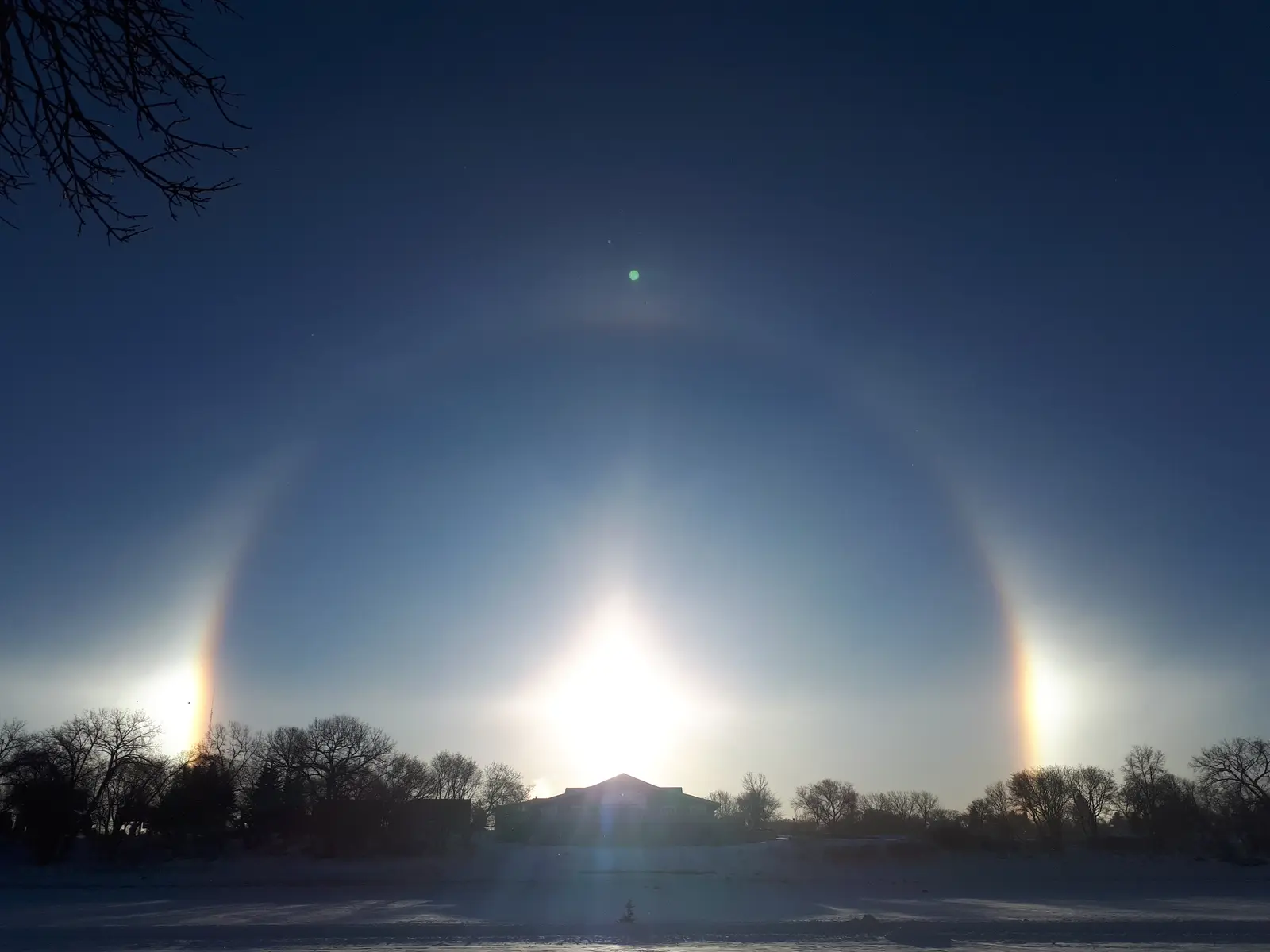
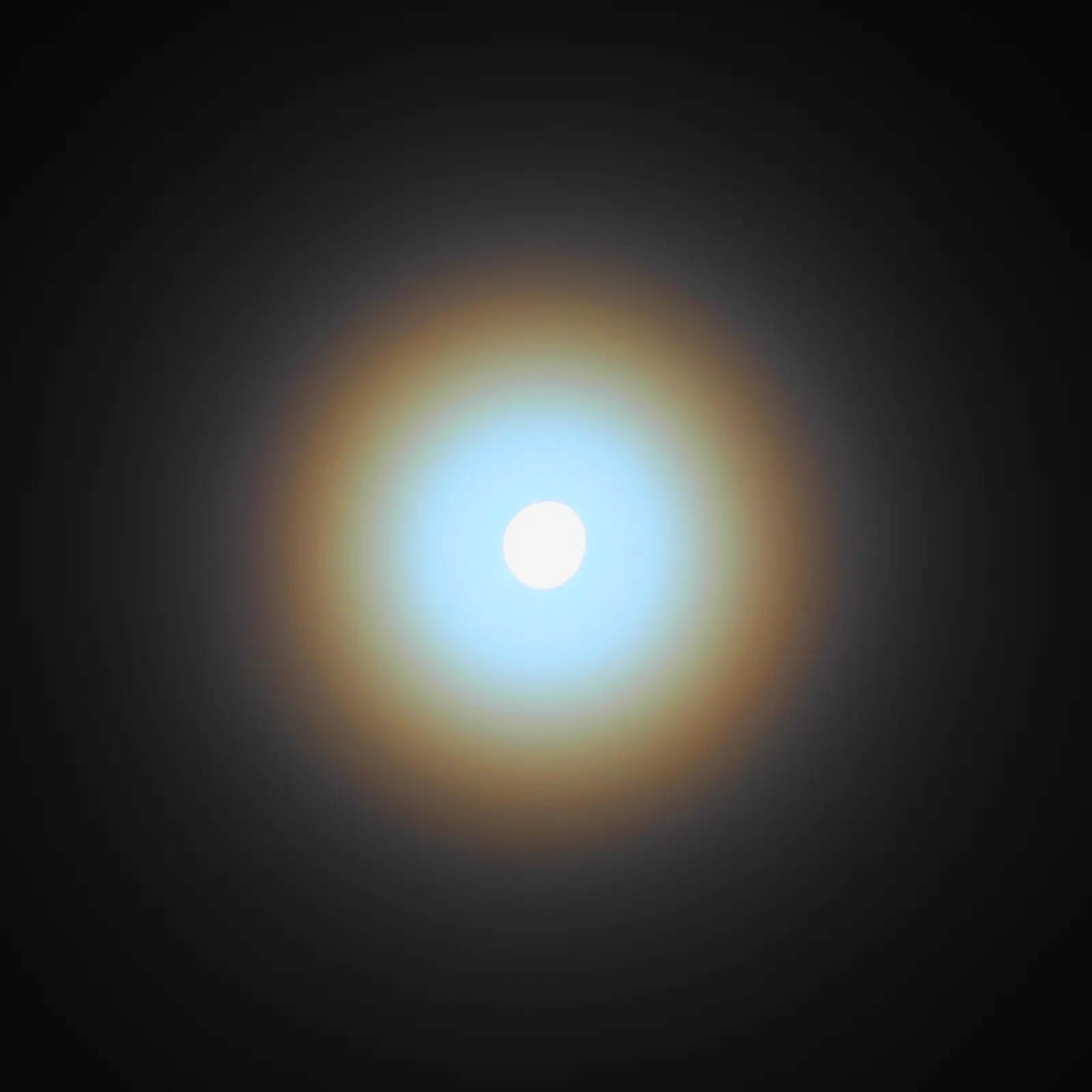
First photo: Winnipeg, Canada, February 1, 2018, labeled by the photographer as a sun dog and 22° halo; a bright spot shows on each side of the Sun. Second: a lunar corona, in a frame the photographer gives as about 8° tall.
The short answer
Near the Sun, sundogs drift and coronas swell, but the 22° halo always sits 22° away.
- 22° halo: the most often seen sun halo (the Moon gets one too), a mostly white ring of 22° radius with a red inner edge and darker sky inside. Ice crystals bend the light.
- Sundogs: bright, often colored spots level with the Sun, most commonly a little outside the halo, red on the side facing the Sun. The higher the Sun, the farther out they sit.
- Corona: small colored rings hugging the Sun or Moon, blue or violet inside and red outside. Very small water or ice particles spread the light, and smaller particles make bigger rings.
How do you tell which one you are seeing?
Hide the Sun first. Stand so a building or utility pole blocks it, or cover it with your outstretched hand. Never look straight at the Sun. Never point binoculars, a telescope or a camera viewfinder toward it. The European Space Agency warns that even a brief glimpse of the Sun can cause serious eye damage, and that it should never be viewed through any unfiltered optical device, such as binoculars or a telescope.
Then measure. Hold your arm out and spread your fingers: thumb tip to little-finger tip spans about 20°, the WMO International Cloud Atlas says, so with your thumb over the Sun, the 22° halo lies near your little fingertip.
A corona sits much closer, inside the glare. Philip Laven, who models these rings, notes that the Sun's brightness generally hides solar coronas. Never stare at or near the Sun to find one: the Atmospheric Optics site warns that this can permanently damage eyesight, and suggests looking around a nearly full Moon on a dark night instead.
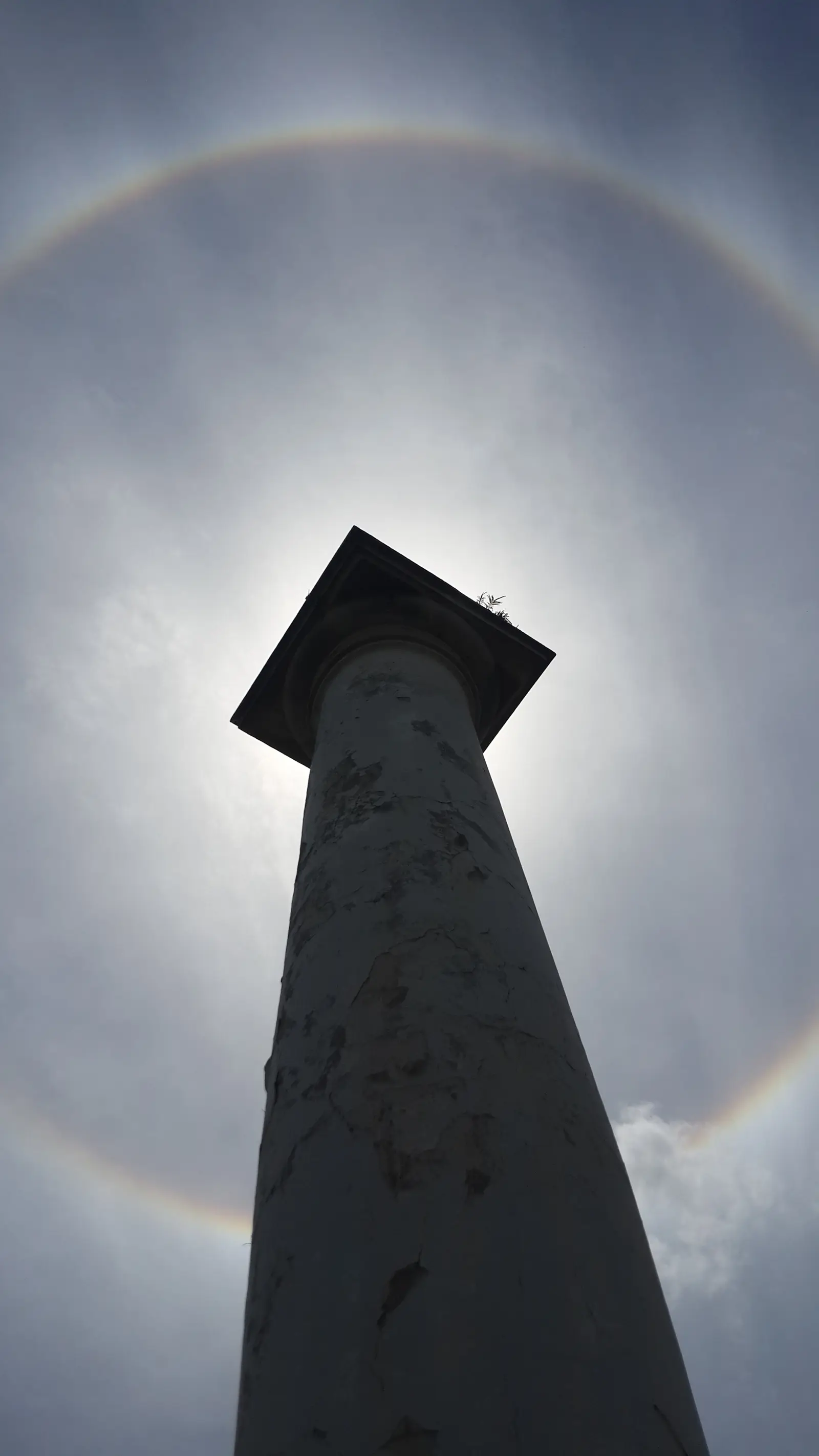
A sun halo over the column marking the founding of Corrientes, Argentina, February 1, 2016, as the photographer labels it. The column's top hides the Sun itself; the ring's inner edge is reddish.
Halo, sundog or corona: side by side
| Feature | 22° halo | Sundog (parhelion) | Corona |
|---|---|---|---|
| Where | 22° from the Sun or Moon; sometimes only partly visible | Level with the Sun, usually just outside the halo; often seen without it | Close in; innermost set generally ≤5° across, whole corona up to 15° |
| Made by | Ice crystals (refraction) | Flat plate crystals (refraction); other paths proposed for a high Sun | Tiny water or ice particles, or pollen (diffraction) |
| Colors | Red inner edge; mostly white around the Moon | Red toward the Sun | Blue or violet inside, red outside |
| Size | Fixed | Moves out as the Sun climbs | Bigger for smaller particles |
| Clouds | Thin cirrostratus, diamond dust | Ice clouds; sometimes altocumulus | Thin altocumulus, mist, fog |
Sources for each cell: halos-sundogs-coronas-comparison.csv (CSV · JSON label).
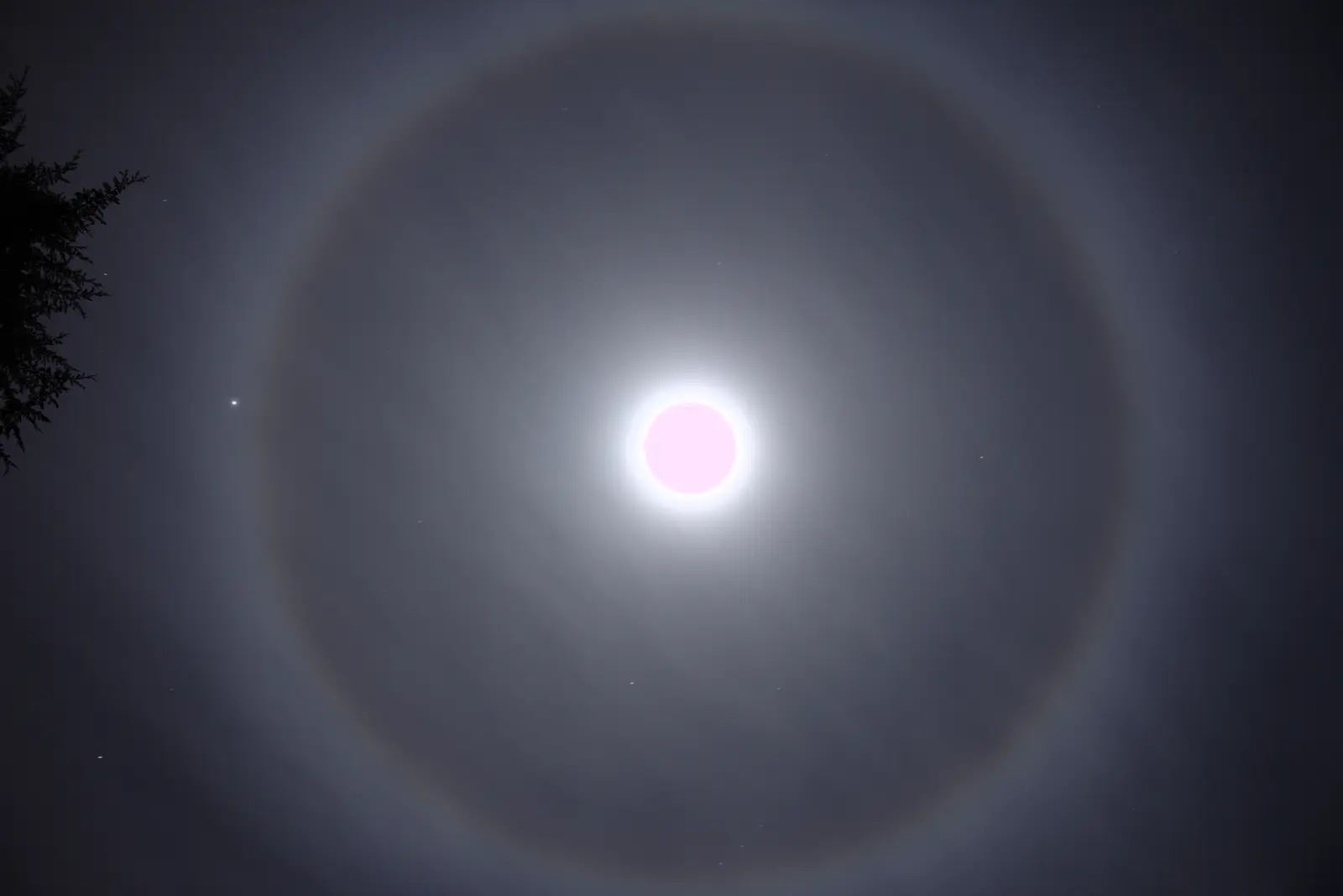
A complete 22° halo around the Moon in Atherton, California, December 17, 2013, as labeled by the photographer. The ring is mostly white, and the sky just inside it is darker.
Why is the 22° halo always the same size?
Six-sided ice crystals make the halo. Two side faces with one face between them, extended until they meet, form a 60° prism. Georgia State University's HyperPhysics site calculates that light through that prism bends by at least 21.84°, taking 1.31 as ice's refractive index, a measure of how strongly ice bends light.
No light takes that path bent by less. That is why the sky inside the ring looks darker. Red light bends a little less than blue (1.306 against 1.317), so the inner edge turns red at about 21.5°. Blue, near 22.4°, mixes with other colors and looks paler.
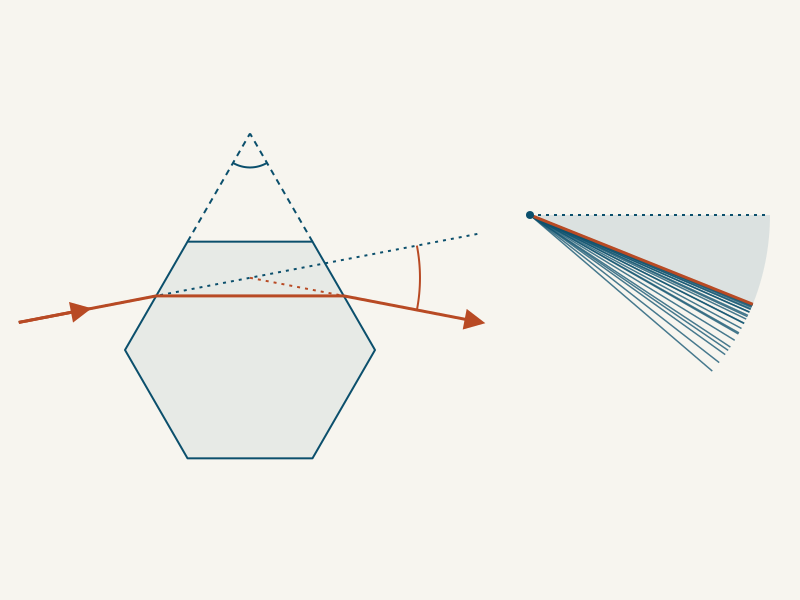
Left: computed with ice's refractive index of 1.31, light crossing two side faces with one between bends at least 21.84°. Right: other entry angles bend it more, leaving the shaded wedge empty.
Form is frozen physics, in this site's working view. In a halo, what is frozen is an angle: 60° of ice, read back from the sky as a 22° ring.
Wherever the halo sits in the sky, its radius stays 22°, the atlas says. Thin cirrostratus, a transparent veil of small ice crystals, often shows one, sometimes as the only sign the cloud is there. Altostratus, a sheet that always blurs the Sun's outline, never shows halos to observers on the ground.
Does a halo mean rain is coming?
A halo is not a reliable sign of rain, though rain sometimes follows one. The National Weather Service answers the saying "Ring around the moon means rain soon" with "sometimes": the ice clouds that make halos often form ahead of rain or snow, but halos do not predict the weather. The Atmospheric Optics site explains why: the same cirrostratus can lead a warm front, and if increasingly thick cloud follows the halo, rain is likely within a few hours. Very many halos, it adds, come with no front.
Why do sundogs move away from the Sun?
Sundogs come from the same 60° prisms. Here the prisms are part of thin plate crystals that tend to fall with their flat faces level, and light crossing their upright side faces makes spots level with the Sun. With the Sun on the horizon, the spots sit on the halo.
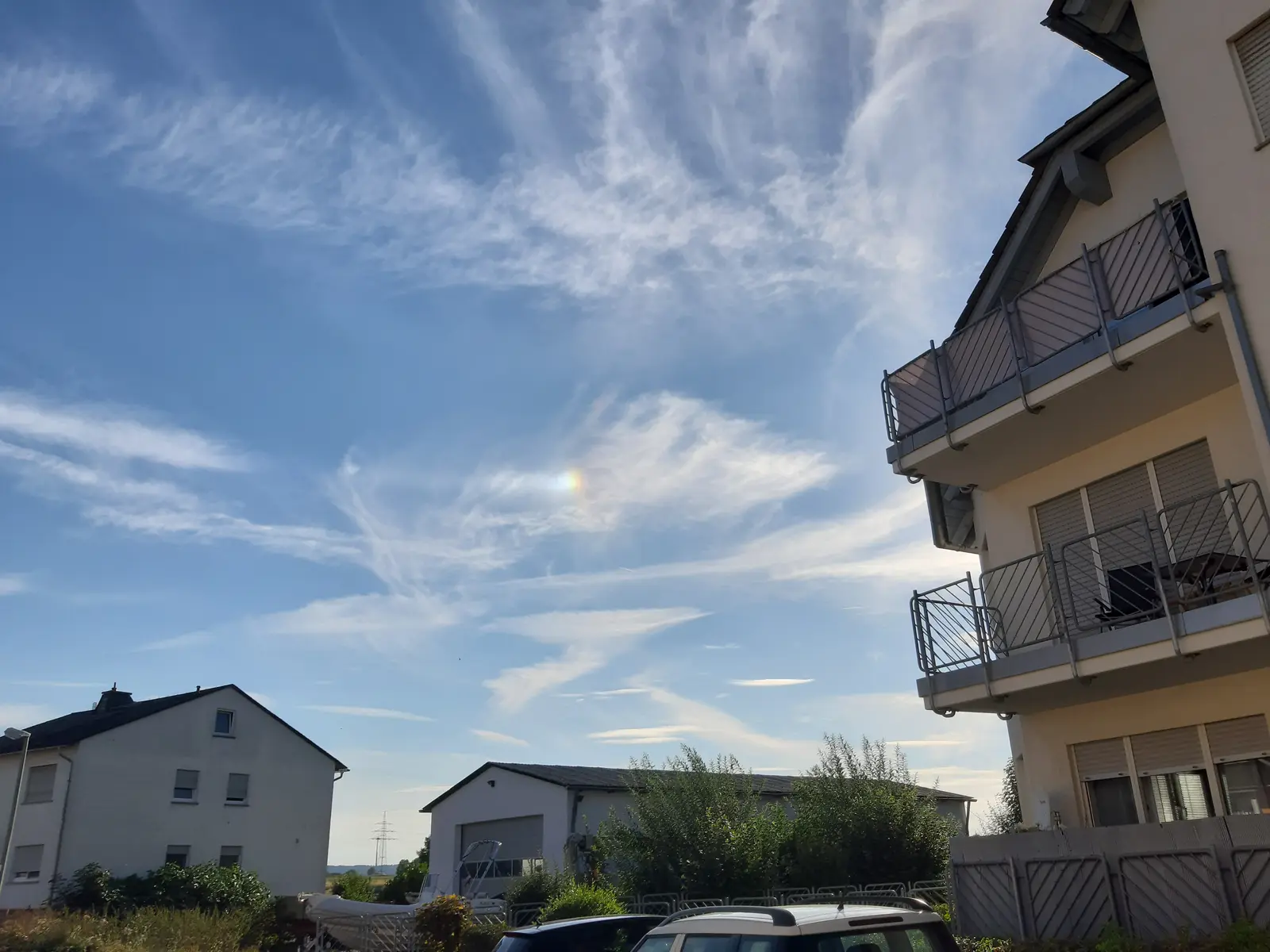
A left sundog in fibrous cirrus over Hesse, Germany, July 30, 2022, as labeled by the photographer. Its red edge faces the unseen Sun to the right; a white tail trails away.
As the Sun climbs, light crosses those faces on a slant. A 2014 paper handles the slant with an index it traces to Auguste Bravais in 1847: the steeper the light, the higher the index, so the ice bends it more. By this page's calculation, a sundog sits about 23.1° from the Sun when the Sun is 20° up, 27.6° at 40° and 44.6° at 60°.
Above about 61°, no light gets through both faces in this calculation. So the simple model gives no sundogs. A 1974 paper notes that simple refraction in level plates cannot make sundogs at higher Sun elevations, yet Dutch observations it analyzed showed sundogs growing no rarer with Sun elevation than other factors predict. The paper weighs three other proposed light paths.
Why does a corona change size?
A corona is made by diffraction, light spreading as it passes very small water or ice particles in mist, fog or thin cloud, the atlas says. Thin parts of altocumulus, a cloud of water droplets, often show one. Large amounts of pollen can make one too.
The radii of the aureole, the bright center, and of the red rings are greater for smaller particles. In the diffraction model Laven uses for droplets more than about 5 µm in radius, the first red ring falls about 16/r degrees out, with r in micrometers. Droplets 10 µm in radius put it about 1.6° out, roughly a twelfth of a spread hand. Droplets of 5 µm double that.
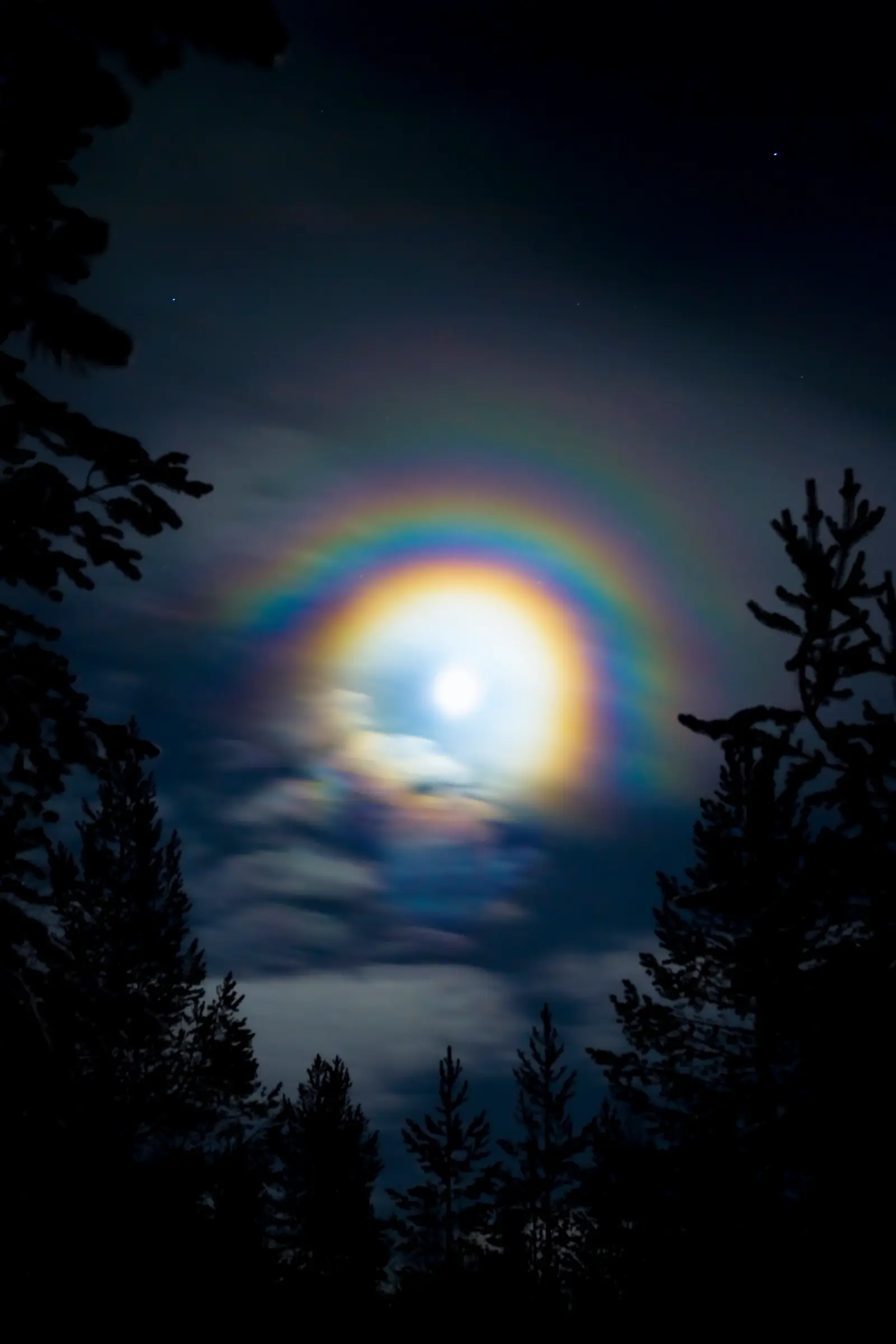
A lunar corona over Kuusamo, Finland, October 30, 2009, as labeled by the photographer. A bright center edged in red is followed outward by more rings, each running blue to red.
Below about 5 µm, Laven finds that the full scattering theory is needed. The atlas says a corona may shrink or swell as different clouds pass across the Sun or Moon.
What else could a ring in the sky be?
- Rainbow: opposite the Sun or Moon, violet inside (40° radius) and red outside (42°).
- Glory: colored rings around your own shadow on cloud or fog below you, in a corona's color order.
- 46° halo: much less common and always fainter than the 22° halo, and easily confused with the supralateral arc, the atlas says.
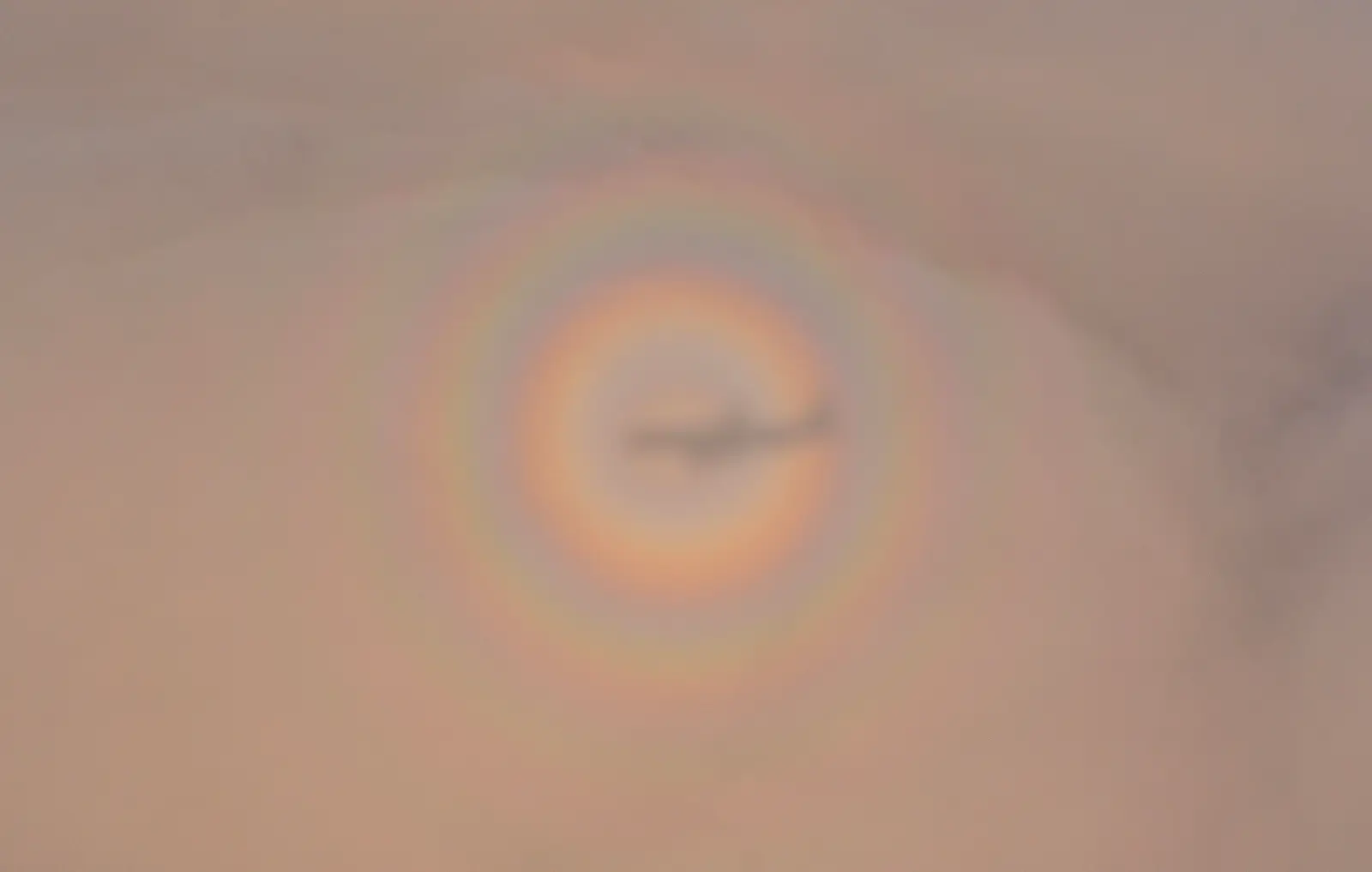
A glory seen from an aircraft, with the plane's shadow at its center, as labeled by the photographer. Its rings run bluish inside to red outside, the order a corona shows.
Next, see ice clouds that stand out well past summer sunset because they float in the mesosphere: Noctilucent Clouds: The Sky's Highest Ice, Made Only in Summer.
Figure: Where each ring sits
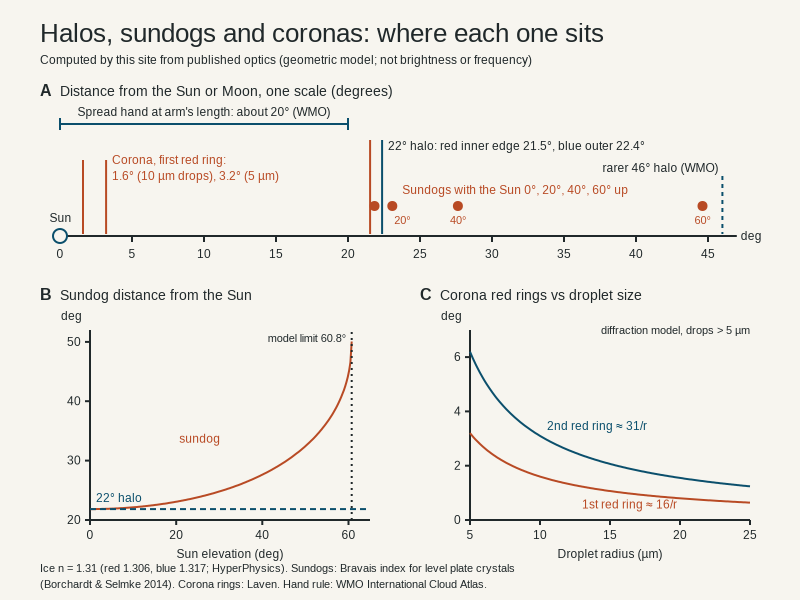
Computed, not measured, from HyperPhysics, Borchardt & Selmke 2014 (ideal level plates; the 0° sundog dot sits on the halo), Laven and the WMO hand span. It shows where light can go, not how bright or common a display is.
Data: halos-sundogs-coronas-ring-sizes.csv (CSV · JSON label)
Source card
- Images: seven Wikimedia Commons photographs (four CC BY-SA 4.0, two CC0 and one CC BY 2.0 that reached Commons from Flickr) and two charts drawn by this site, with photo licenses checked against the Commons records on 2026-10-10 for the first two photographs and on 2026-10-13 for the other five; labels follow the photographers.
- Classification: WMO International Cloud Atlas, 2017 edition. Halos, sundogs (parhelia) and coronas are photometeors, optical effects of light from the Sun or Moon, not cloud types (sections 1.2.3, 3.2.3.1, 3.2.3.2).
- Data: angles computed by this site; the CSV gives each value's method and source.
Corrections: 2026-10-14: Added the section "Does a halo mean rain is coming?", drawn from the National Weather Service and the Atmospheric Optics site (the entry did not answer this question before).
Sources
- World Meteorological Organization. "22° halo" (section 3.2.3.1.1), International Cloud Atlas, 2017 edition cloudatlas.wmo.int/en/22-halo.htmlpage text read
- World Meteorological Organization. "Parhelic circle" (section 3.2.3.1.7), International Cloud Atlas, 2017 edition cloudatlas.wmo.int/en/parhelic-circle.htmlpage text read
- Atmospheric Optics (atoptics.co.uk). "Sundogs, Sun Dogs, Parhelia, Mock Suns." Last updated December 16, 2024 atoptics.co.uk/blog/sundogs-sun-dogs-parhelia-mock-suns/page text read
- World Meteorological Organization. "Corona" (section 3.2.3.2), International Cloud Atlas, 2017 edition cloudatlas.wmo.int/en/corona.htmlpage text read
- Atmospheric Optics (atoptics.co.uk). "22 Degree Halo, 22º Halo, 22º Circular Halo." Last updated December 16, 2024 atoptics.co.uk/blog/22-degree-halo-22-halo-22-circular-halo/page text read
- European Space Agency. "Safety tips for observing the Sun" www.esa.int/Science_Exploration/Space_Science/Safety_tips_for_observing_the_Sunpage text read
- Laven P. "Analysing the corona (using the Debye series)." philiplaven.com, page updated November 10, 2002 www.philiplaven.com/p2-2.htmlpage text read
- Atmospheric Optics (atoptics.co.uk). "Coronae." Last updated December 16, 2024 atoptics.co.uk/blog/coronae/page text read
- World Meteorological Organization. "Halo phenomena" (section 3.2.3.1), International Cloud Atlas, 2017 edition cloudatlas.wmo.int/en/halo-phenomena.htmlpage text read
- McDowell RS. "The Formation of Parhelia at Higher Solar Elevations." Journal of the Atmospheric Sciences 31(7):1876–1884 (1974) journals.ametsoc.org/view/journals/atsc/31/7/1520-0469_1974_031_1876_tfopah_2_0_co_2.xmlabstract read (AMS article page)
- World Meteorological Organization. "Altocumulus: Physical constitution" (section 2.3.4.7), International Cloud Atlas, 2017 edition cloudatlas.wmo.int/en/physical-constitution-altocumulus.htmlpage text read
- Nave R. "The 22° Halo," "Details of 22° Halo" and "Sun Dogs (Parhelia)." HyperPhysics, Department of Physics and Astronomy, Georgia State University hyperphysics.phy-astr.gsu.edu/hbase/atmos/halo22.htmlpage text read
- Borchardt S, Selmke M. "Intensity distribution of the parhelic circle and embedded parhelia at low solar elevations: theory and experiments." arXiv:1412.8033 [physics.ao-ph] (2014) arxiv.org/abs/1412.8033full text (arXiv PDF)
- World Meteorological Organization. "Cirrostratus: Physical constitution" (section 2.3.3.7), International Cloud Atlas, 2017 edition cloudatlas.wmo.int/en/physical-constitution-cirrostratus.htmlpage text read
- World Meteorological Organization. "Altostratus: Physical constitution" (section 2.3.5.7), International Cloud Atlas, 2017 edition cloudatlas.wmo.int/en/physical-constitution-altostratus.htmlpage text read
- Laven P. "Modelling the Corona (Diffraction or Mie theory)." philiplaven.com, page updated November 28, 2021 www.philiplaven.com/p8d.htmlpage text read
- World Meteorological Organization. "Primary rainbow" (section 3.2.3.5.1), International Cloud Atlas, 2017 edition cloudatlas.wmo.int/en/primary-rainbow.htmlpage text read
- World Meteorological Organization. "Glory" (section 3.2.3.4), International Cloud Atlas, 2017 edition cloudatlas.wmo.int/en/glory.htmlpage text read
- World Meteorological Organization. "46° halo" (section 3.2.3.1.2), International Cloud Atlas, 2017 edition cloudatlas.wmo.int/en/46-halo.htmlpage text read
- World Meteorological Organization. "Noctilucent clouds (polar mesospheric clouds)" (sections 2.6.3.1–2.6.3.2), International Cloud Atlas, 2017 edition cloudatlas.wmo.int/en/noctilucent-clouds.htmlpage text read
- World Meteorological Organization. "Photometeors" (section 1.2.3), International Cloud Atlas, 2017 edition cloudatlas.wmo.int/en/general-classification-of-meteors-photometeors.htmlpage text read
- World Meteorological Organization. "Photometeors: Table 17, Classification of photometeors" (section 3.1.3), International Cloud Atlas, 2017 edition cloudatlas.wmo.int/en/photometeors.htmlpage text read
- NOAA National Weather Service. "Owlie's Weird Weather!" (entry "22° Halo"), Weather.gov www.weather.gov/owlie/weird-weatherpage text, "22° Halo" entry
Cite this page
Plankton to Plumage. “Halos, Sundogs and Coronas: Only the Halo Stays Put at 22°.” October 12, 2026, updated October 14, 2026. https://planktontoplumage.com/clouds-sky-optics/halos-sundogs-coronas/
Add the date you read the page after the address if your style guide asks for it.