Deep explainerNo. 0004
Blue Without Blue Pigment: How a Blue Jay Feather Makes Its Color
Published
Parts of this entry11 parts
Spec card
Size analogy (length)≈ a 12-inch ruler, or up to a fifth shorterScale: Cornell Lab, All About Birds: length 9.8–11.8 in (25–30 cm)
- Common name
- Blue JaySource: eBird/Clements taxonomy v2025 (species code blujay)
- Scientific name
- Cyanocitta cristataSource: eBird/Clements taxonomy v2025; GBIF Backbone Taxonomy, usageKey 2482593 (accepted)
- Group
- Songbird in the crow, jay and magpie family (Corvidae)Source: eBird/Clements taxonomy v2025 (Passeriformes, Corvidae)
- Size band
- 25–30 cm (9.8–11.8 in) long; 70–100 g; wingspan 34–43 cmSource: Cornell Lab of Ornithology, All About Birds: Blue Jay Identification (archived 2026-07-29); Audubon Field Guide: Blue Jay
- Distribution / habitat
- Mostly eastern North America, with the range expanding toward the northwest; oak and pine woods, forest edges, wooded suburbs, towns and city parksSource: Audubon Field Guide: Blue Jay (eastern back yards and woodlots; range expanding toward northwest; habitat); Cornell Lab, All About Birds: Blue Jay Identification and Life History (forest edges, near oaks, urban and suburban areas)
- Three ID features
- Blue crest
- Black necklace, a black bridle across the face, nape and throat
- Bright blue wings and tail with white wing bars and white tail corners, over white or light gray underparts
- The misidentification twin
- Can be confused with Steller's Jay and with Florida, California and Woodhouse's scrub-jays; other blue-colored jays lack the white pattern in the wings and tailSource: Cornell Lab, All About Birds: Blue Jay Overview, similar species list (archived 2026-09-13); Audubon Field Guide: Blue Jay
Download this card as CSV blue-feathers-spec-card.csv · CC BY 4.0File label (JSON): name, license, publisher
Main images
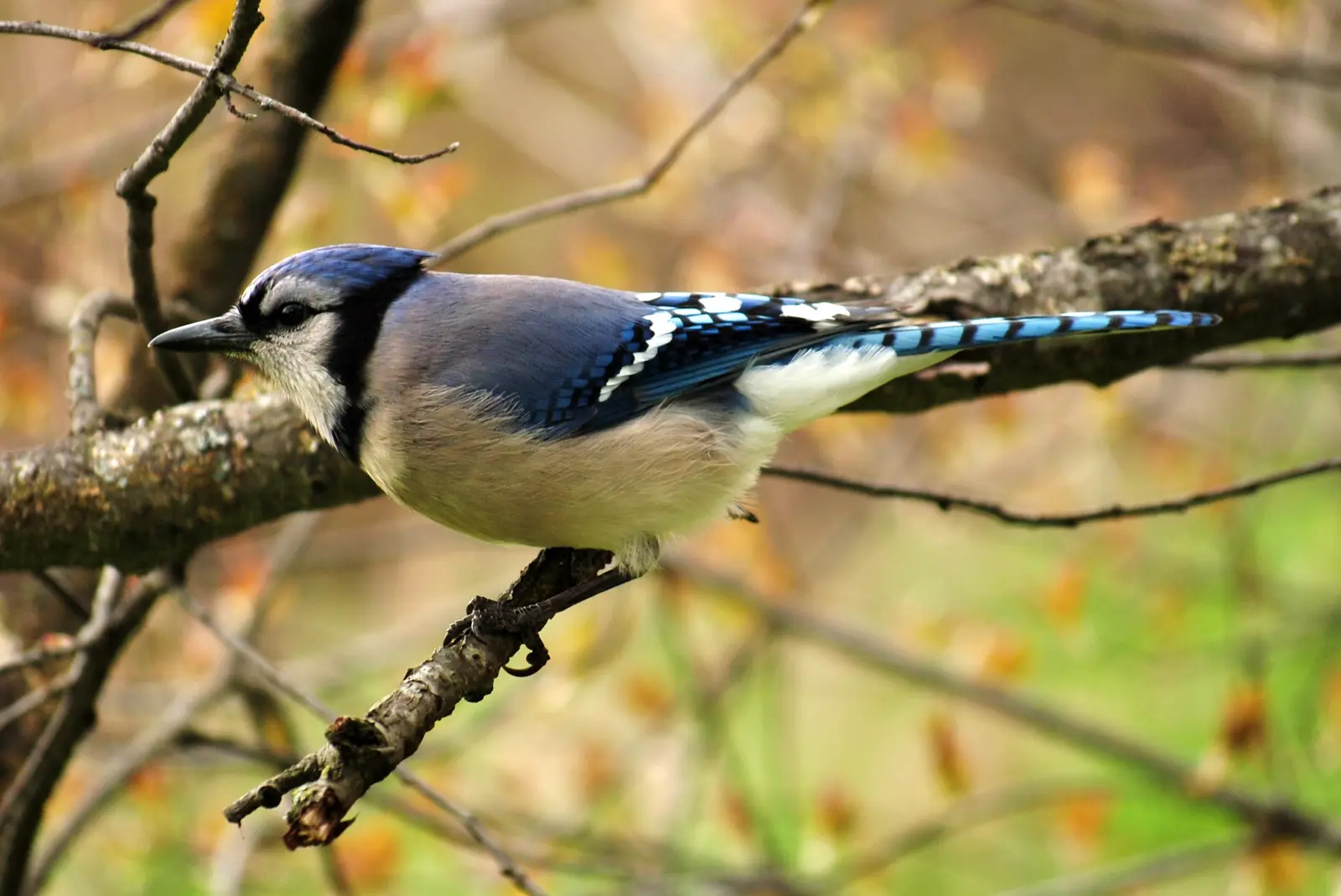
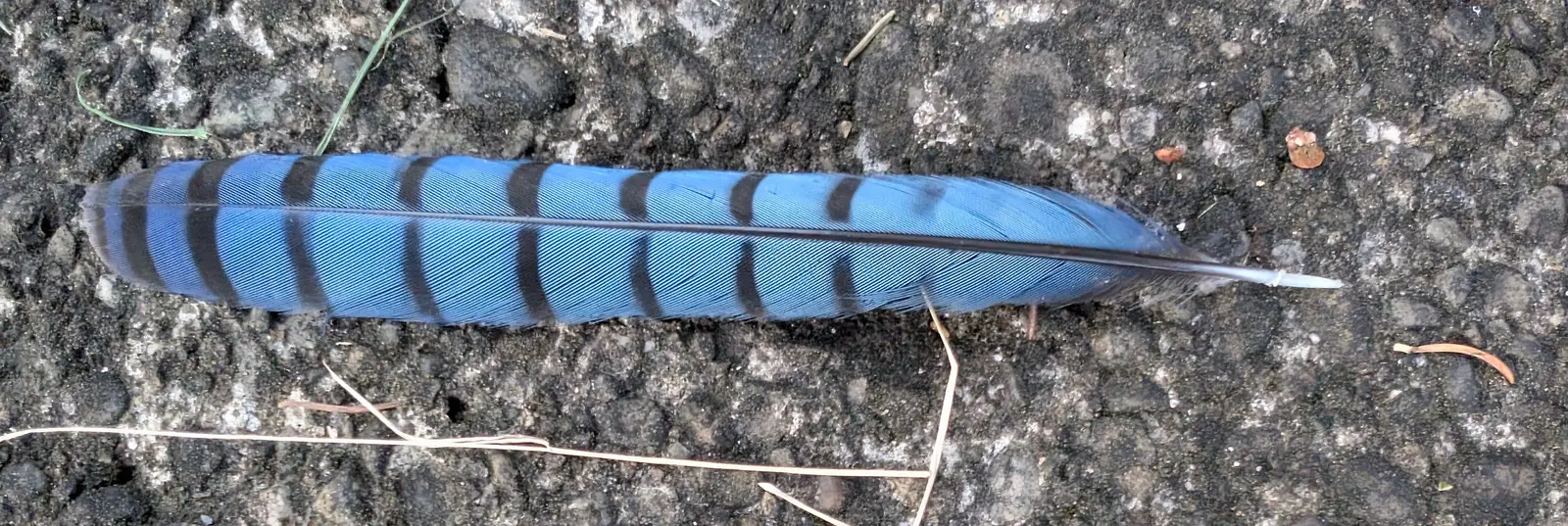
A Blue Jay, and a Blue Jay feather photographed where it lay.
The short answer
The pigment in a Blue Jay's feathers is melanin, and melanin is brown. The blue comes from structure. Inside each barb, a sponge of keratin and air sends blue light back in step, and a dark melanin core beneath it absorbs much of the light the sponge does not return.
For most of the 20th century, the accepted explanation for blue feathers was the one used for the sky: light scattered by tiny particles. Studies in 1998 and 1999 showed that the feather works differently. Its sponge, they found, has one main spacing that sets which color is reinforced.
This page follows the Blue Jay (Cyanocitta cristata) and the only other species in its genus, the Steller's Jay (Cyanocitta stelleri), through a century of experiments.
Where is the blue in a Blue Jay feather?
A feather has a central shaft with a row of barbs on each side. Each barb carries smaller barbules. In a Blue Jay, the blue sits in the barbs.
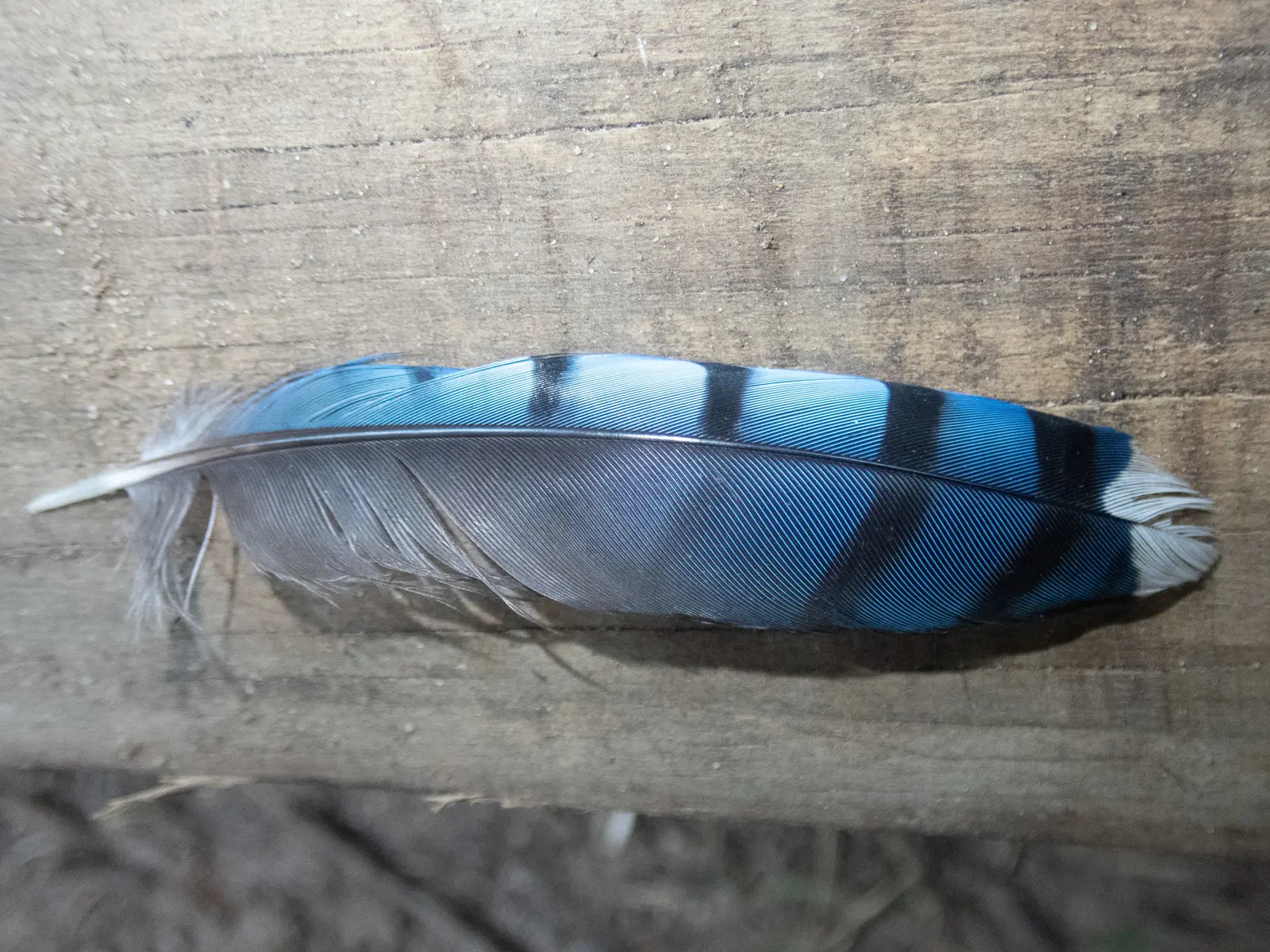
A Blue Jay feather on a wooden board. The fine parallel lines across the vane are barbs, and the blue runs along them.
In 1936, Carl Gower cut Blue Jay barbs into thin slices. A clear keratin sheath, 7.2 to 21.6 μm thick, wraps each barb. Under it, on the upper side only, lies a layer of blue-producing cells about 15 μm across, a little smaller than the cells that fill the core.
Those core cells measure 19 to 20 μm and are packed with melanin granules, brown in thin sections and black where dense. The blue cells stop partway down the sides. That leaves the underside of each barb black.
Modern studies call the blue layer the medullary layer and trace the color to a spongy matrix of keratin and air inside it, but those studies describe that sponge in other species. So the nanoscale details below come from other blue birds.
A blue feather on a sidewalk holds this whole layered structure. Seeing one up close is not the same as being allowed to take it home.
Naming the bird does not mean you may pick up, collect or keep the feather; check the official rules where you are. In the United States, feathers and other parts of native North American birds protected under the Migratory Bird Treaty Act may not be possessed without a permit, and a feather that was shed naturally or came from a bird killed on a road or at a window is not exempt. The official exceptions, including feathers of legally hunted waterfowl and other migratory game birds and the rules on Native American use, are on the U.S. Fish and Wildlife Service page Feathers and the Law.
Why isn't a blue feather blue the way the sky is?
The sky is blue because the gases and particles in the air scatter sunlight in all directions, and they scatter blue light more than other colors because its waves are shorter. Lord Rayleigh worked this out in 1871 for particles much smaller than a wavelength, and in 1899 he argued that the molecules of the air would make the sky blue on their own. That kind of scattering simply grows stronger as the waves get shorter.
Feathers once got the same explanation. In the early 1900s, Valentin Häcker and Georg Meyer traced the blue to minute pores, small compared with a wavelength of light. In 1923, Clyde Mason reported no blue pigment in such feathers and called their color "the blue described by Tyndall," the blue of turbid, cloudy media. This page relies on Gower's 1936 summary for both.
Gower saw small solid bodies rather than pores. He also argued that the dark pigment cells acted as a background that let only the blue show, an idea that a 2006 study put to the test 70 years later.
In 1998, Richard Prum and colleagues ran a two-dimensional Fourier analysis, a method that finds repeating spacings in an image, on blue barbs of the Plum-throated Cotinga (Cotinga maynana). The color, they reported, comes from constructive interference of light scattered coherently by the keratin and air matrix. A 1999 study of three more species found ring-shaped Fourier patterns, ruling out the Rayleigh and Mie models, which treat each scatterer as independent.
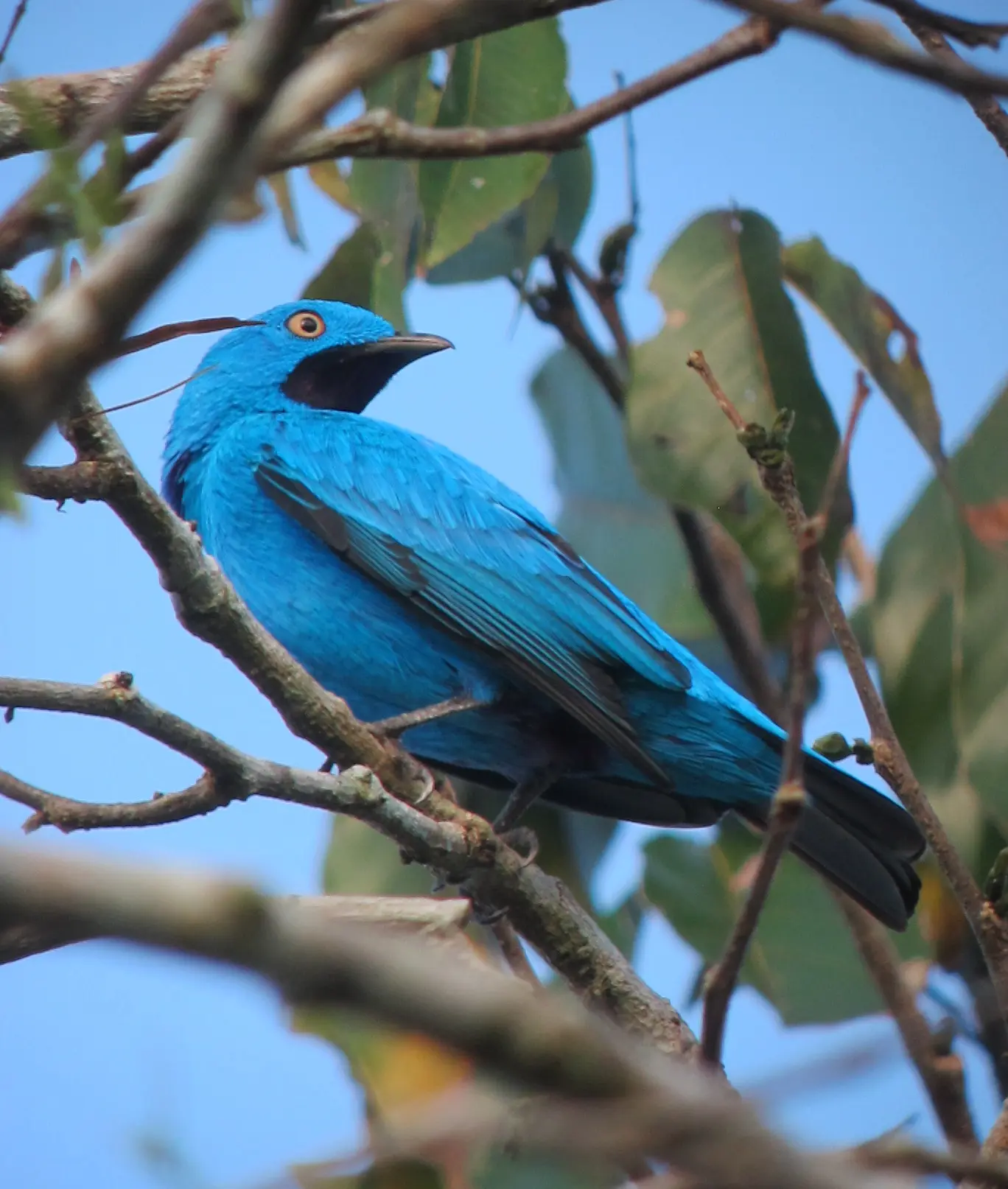
A Plum-throated Cotinga, the species in the 1998 study, against a blue sky. Its blue and the sky's come from different kinds of scattering.
A 2015 paper notes that this agreed with a conclusion C. V. Raman had reached in the 1930s. In 2012, an X-ray scattering survey of 297 feathers from 230 species found one main length scale, the same in every direction, reinforcing a narrow band of wavelengths.
One blue, explained four ways
| Year | Researchers | Birds studied | Proposed cause of the blue | Where it stands in later work |
|---|---|---|---|---|
| 1923 | Clyde Mason | Blue Jay among others | Tyndall scattering by fine pores in barb cells | Independent-scatterer models were ruled out by the Fourier analyses of 1998 and 1999 |
| 1936 | Carl Gower | Blue Jay, Eastern Bluebird | Scattering by small solid bodies, with melanin cells as a dark background | The dark-background role is supported by one Steller's Jay study (2006) |
| 1998, 1999 | Richard Prum and colleagues | Plum-throated Cotinga, then three more species | Coherent scattering: waves add in step at a wavelength set by the sponge's spacing | Supported across 230 species by X-ray scattering (2012) |
| 2012 | Vinodkumar Saranathan and colleagues | 230 species | Two sponge types whose measured spacing predicts the hue | How the sponge forms is still a hypothesis (see below) |
How does a sponge of keratin and air make blue?
Keratin, the protein feathers are made of, bends light more strongly than air. Published values for its refractive index run from about 1.54 to 1.58, against 1.00 for air, so every boundary between keratin and air scatters a little light.
Spacing turns that scattering into color. In a feather sponge, keratin and air alternate at one main distance in every direction. Light scattered from many boundaries adds in step at the wavelength that distance favors, so the feather reflects a peak of color instead of the sky's kind of scattering, which keeps growing as waves get shorter.
The 2012 survey used a simple rule: the reinforced wavelength is about twice the sponge's average refractive index times its spacing. From 255 feathers, it estimated that average index at 1.201 for channel-type sponges and 1.265 for sphere-type sponges. A peak at 450 nm sits toward the short end of human vision. With those indices, it needs a spacing of about 187 nm or 178 nm.
By that rule, the spacing works out to about four-tenths of the wavelength it reinforces, 0.42 for channel-type and 0.40 for sphere-type sponges, rather than the full wavelength. The chart in the figures below plots the rule for both types.
Channel-type sponges are a twisting network of air channels and keratin bars of similar widths, as in the back feathers of the Eastern Bluebird (Sialia sialis). Sphere-type sponges are packed air pockets with keratin walls, as in the Plum-throated Cotinga. A 2017 review adds that sphere-type sponges tend to make more saturated blues.
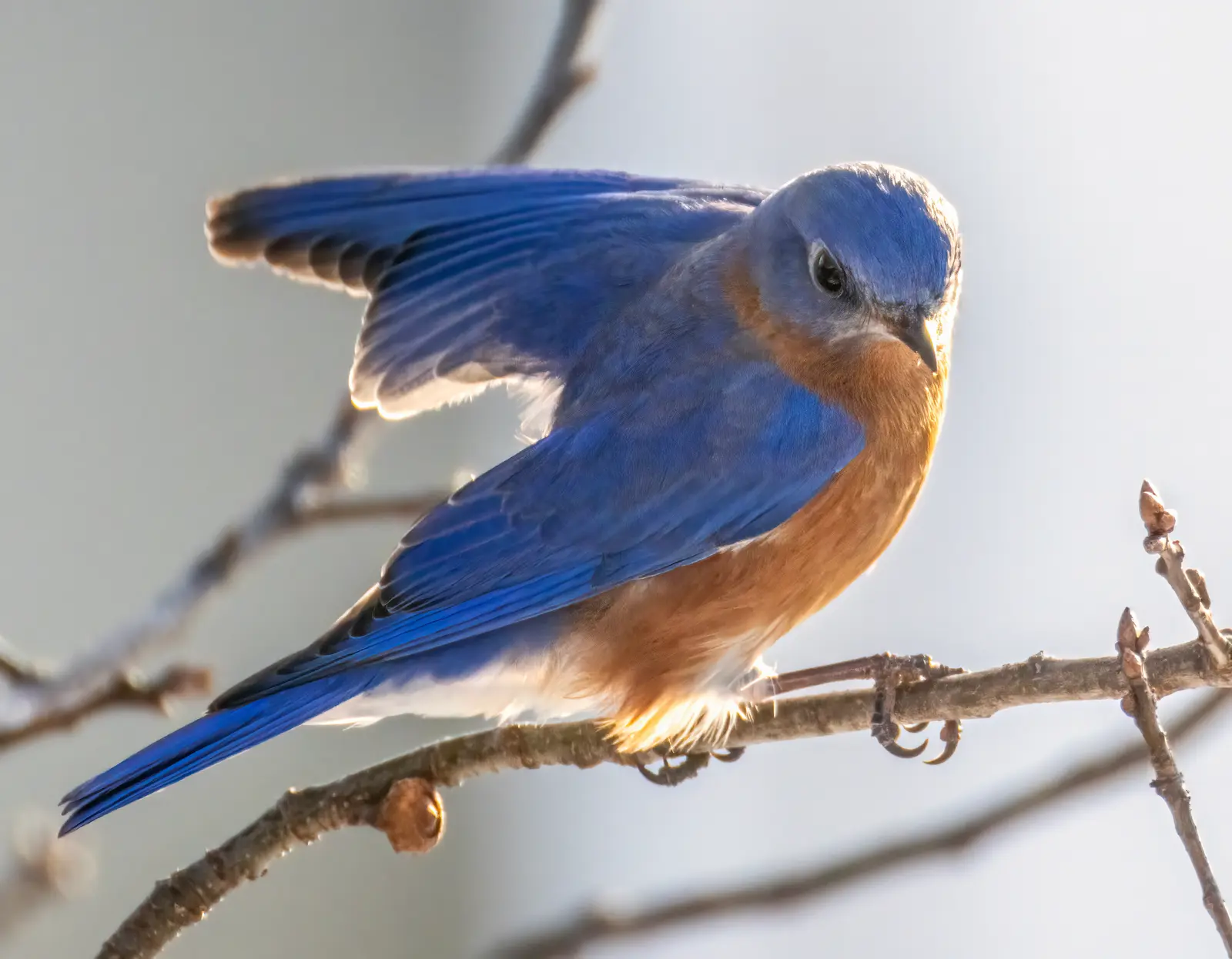
An Eastern Bluebird with its wings raised. Its blue back feathers carry a channel-type sponge.
In natural light, the hue of these feathers barely changes with the viewing angle, because backscattered light dominates, the 2012 survey reports.
What does the black layer under the blue do?
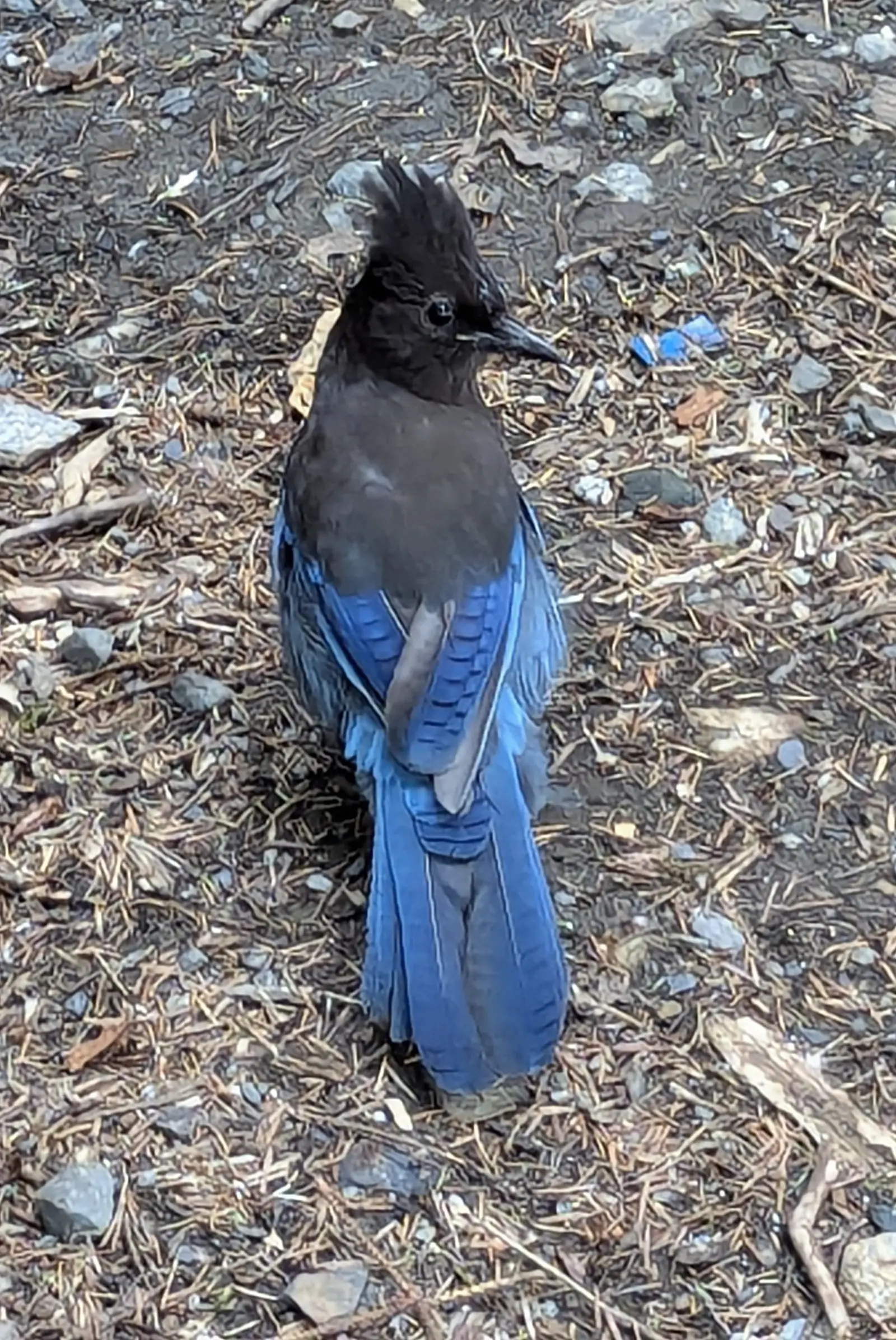
A Steller's Jay, the Blue Jay's western relative.
The Steller's Jay of western evergreen forests has a charcoal-black head and a blue body, lightest on the wings. A 2006 study used one of these jays as a natural experiment. The bird was amelanotic, meaning it lacked melanin.
Matthew Shawkey and Geoffrey Hill compared one of its feathers with one normal blue feather. Under the electron microscope, both barbs held well-formed spongy layers of the right size and arrangement to produce their measured color peaks, so the sponge did not explain the difference.
The normal feather reflected a distinct, bell-shaped blue curve peaking in the ultraviolet to violet. The pale feather's curve was broad, with a blue-green peak. The authors describe that color as washed out.
The missing melanin most probably caused the washed-out color, the authors concluded. Shawkey and Hill suggest that melanin absorbs white light the barb scatters out of step, which raises the purity of the blue. The comparison rests on one feather of each kind. The result fits the dark background Gower described in 1936.
Does soaking a feather make its blue vanish?
Mason's 1923 case rested on a soak test, as Gower describes it. A feather soaked in a liquid with a refractive index of about 1.54, close to keratin's, lost its blue and turned brownish black from the pigment beneath. When the liquid evaporated, the blue came back.
A 2015 summary of Mason's Blue Jay work names the liquid as Canada balsam (index 1.54). Liquids above or below keratin's index left some color. Carbon disulfide (1.627) gave a pale blue, and water (1.33) a sea green.
Gower could not repeat the result. Blue Jay and bluebird barbs left for up to six weeks in methyl salicylate (1.534), xylene (1.49) or cedar oil (1.51) showed no noticeable change. None of the sources here explains the conflict.
The spacing rule predicts the direction Mason reported for water. Take a channel-type sponge with 34% keratin at index 1.58: a simple volume-weighted average index rises from about 1.20 with air to about 1.42 with water. That moves the reinforced wavelength about 18% longer. For a sphere-type sponge with 46% keratin, the shift is about 14%.
These are model estimates, not measurements. The simple average lands within 0.004 of the 2012 survey's air-filled values, though the survey used a more careful mixing formula. In the model, a liquid that matches keratin removes the contrast, leaving nothing to reinforce and only the melanin to see.
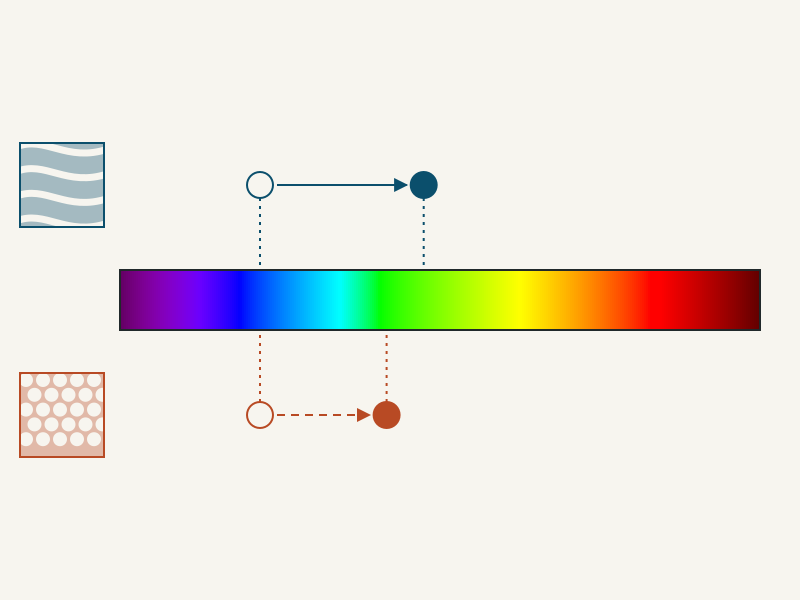
Model estimate, not a measurement: water in the air spaces moves a 450 nm peak about 18% longer in a channel-type sponge (teal, above) and 14% in a sphere-type (coral, below).
Why are green feathers usually blue plus yellow?
Mason also described green feathers as blue ones with a transparent yellow layer over the blue cells, Gower reported. Parnell and colleagues wrote in 2015 that non-iridescent green feathers nearly always pair a pigment with a structural blue; the exception they name is the turacos, which make a green pigment called turacoverdin.
The 2012 survey likens such pigment to a band-pass filter: it lets some wavelengths through, and the sponge reinforces part of what passes. A 2017 review cites the Budgerigar (Melopsittacus undulatus) as one example of green made this way.
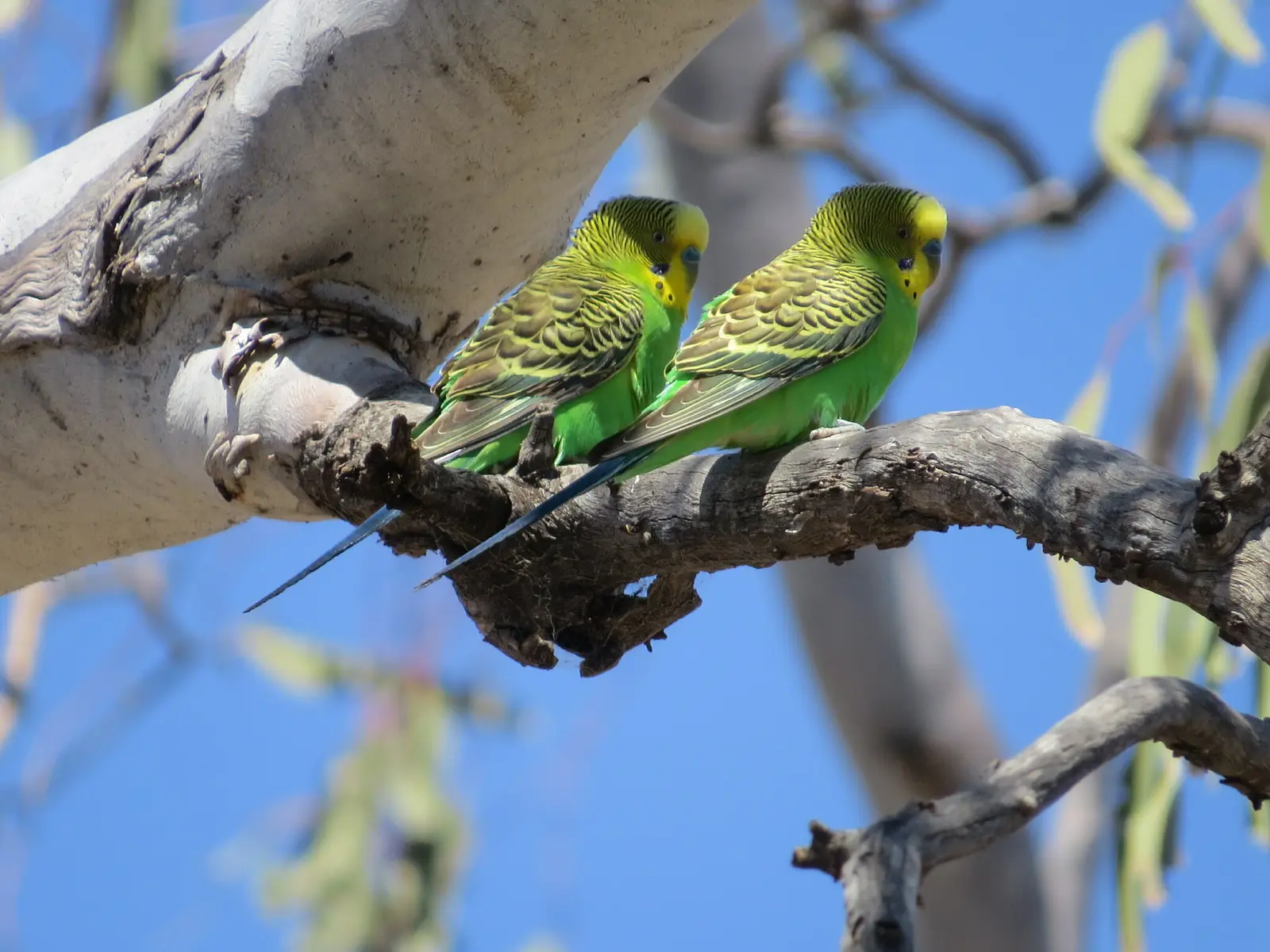
Two Budgerigars in green plumage. A 2017 review cites this species as one example of green made by combining a pigment with a keratin sponge.
The limits of pigment and structure run in opposite directions. Melanins make blacks, browns and grays. Carotenoids, which absorb most strongly around blue wavelengths, are limited to colors such as yellows, oranges and reds. No spongy barb has been shown to produce a color with a longer wavelength than green, the 2017 review notes, and one theoretical paper argues it is not possible.
What do birds see in a blue feather that you don't?
Birds can see near-ultraviolet light that people cannot, the 2012 survey notes. In Eurasian Jay (Garrulus glandarius) feathers, reflectance rises sharply at 290 nm, well into the ultraviolet, and continues into the blue.
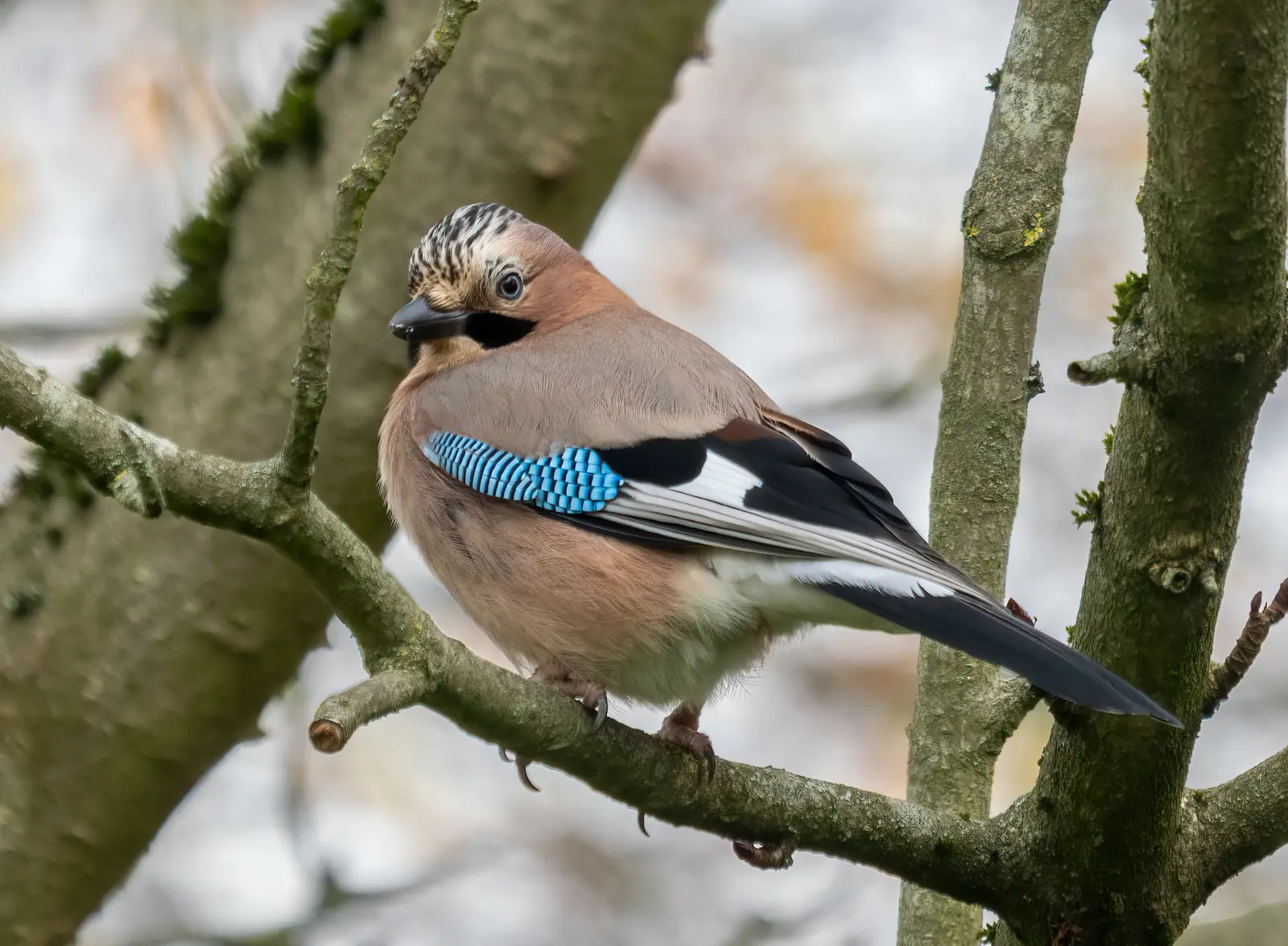
A Eurasian Jay with its blue wing patch showing. In this species' barred blue wing feathers, reflectance rises sharply at 290 nm, well into the ultraviolet.
Sponge reflectance peaks have a similar width whatever hue they make, the 2017 review says, so in blue feathers part of the reflected light spills into the ultraviolet. The review calls such feathers blue to the human eye but ultraviolet to birds.
Fine details matter too. In a 2003 study of Eastern Bluebird feathers, the number of keratin rods in the sponge predicted ultraviolet to violet chroma, a measure of how rich the color is. The same study found that variation in rod diameter predicted saturation. The authors concluded that the precision of the nanostructure determines some of the color differences between individual bluebirds.
How does a feather grow its sponge?
The 2012 survey found that both sponge types give X-ray patterns like those of synthetic materials that self-assemble by phase separation, the un-mixing seen when oil and vinegar separate. The survey's authors propose that the sponges probably form as keratin polymerizes inside the medullary cells and separates from the cell fluid until the process is arrested.
A striped feather tests the idea. Along a single barb of a Eurasian Jay wing covert, the color shifts from white through light blue and dark blue to black. Parnell and colleagues found blue regions built on a structure about 150 nm in scale, and white regions on a coarser structure of roughly 200 nm that reflects a broad band of light.
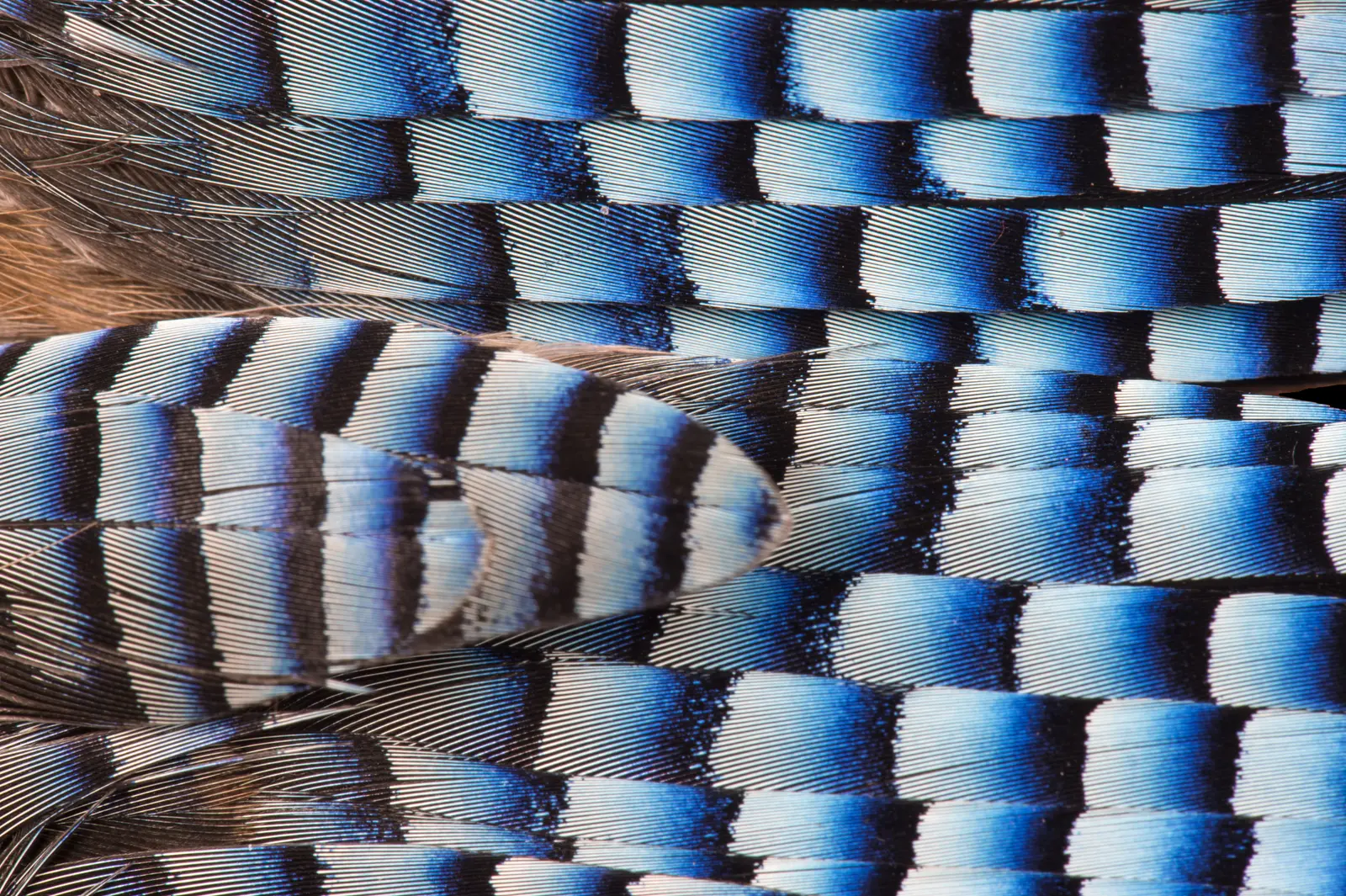
Eurasian Jay feathers up close. Along the barbs, bands run from white through light blue and dark blue to black.
They propose that how long the keratin network separates before it locks in sets that scale, so a coarsening structure passes through ultraviolet and blue scales first. It remains a proposed mechanism, consistent with the measurements.
Is a peacock feather blue the same way?
No. A 2003 study of the Green Peafowl (Pavo muticus), in the same genus as the familiar Indian Peafowl, found the eyespot colors in the barbules, the small branches off each barb.
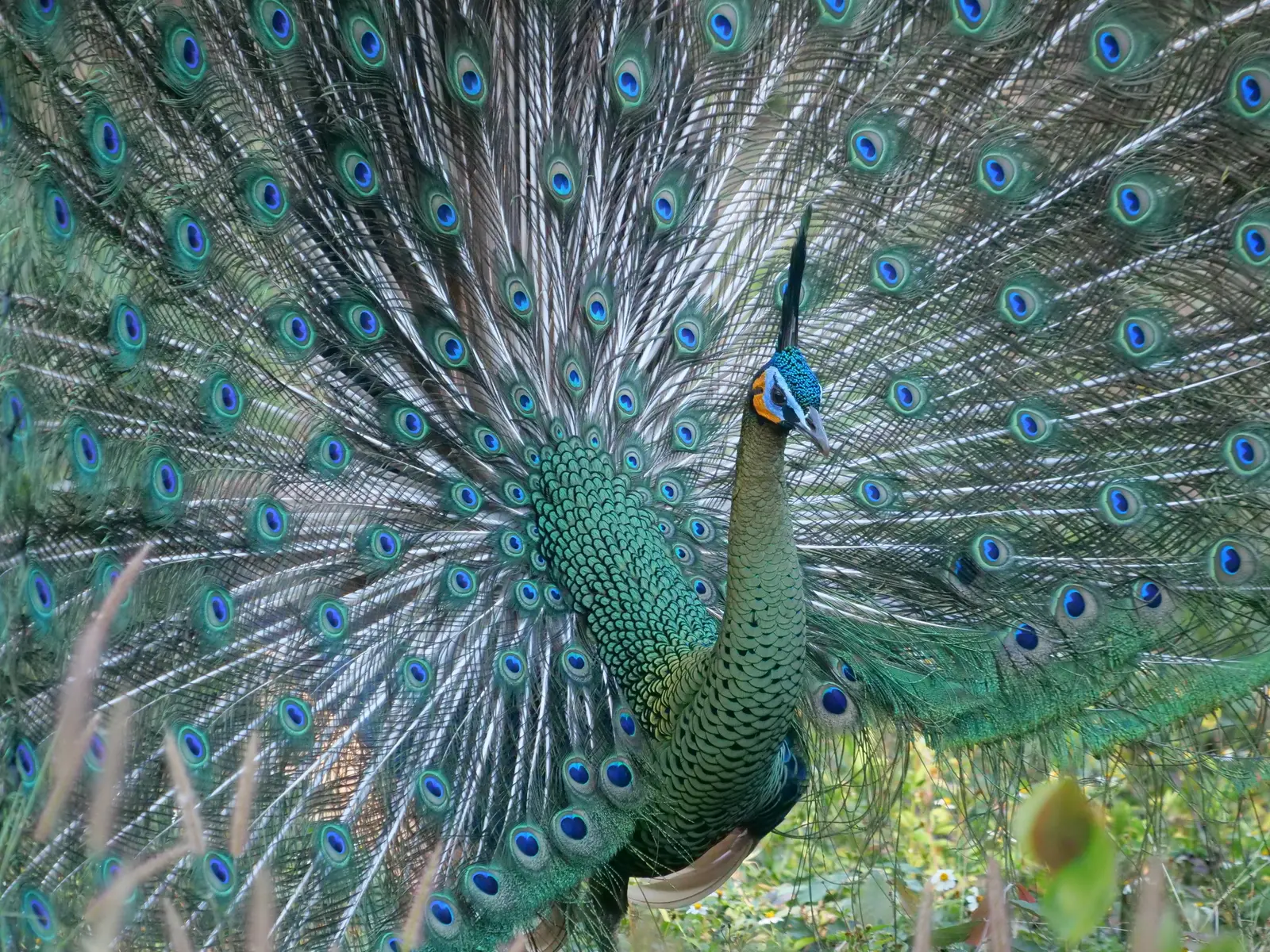
A Green Peafowl with its train fanned out. A 2003 study found its eyespot colors in the barbules, the small branches off each barb.
The outer layer of each colored barbule holds a two-dimensional photonic crystal: a regular grid of melanin rods joined by keratin, with air holes between. The grid spacing was about 140 nm in blue barbules, 150 nm in green and 165 nm in yellow. The colors are iridescent.
A barb sponge is only quasi-ordered. Its hue changes little with angle in natural light. In the jay, melanin sits behind the color; in the peafowl, melanin rods help build it.
Blue feather FAQ
Is a Blue Jay actually blue?
Its feathers reflect blue light, so the blue you see is real, but no blue pigment makes it. The Cornell Lab of Ornithology states that the pigment in Blue Jay feathers is melanin, which is brown, and that the blue comes from light scattered by modified cells in the barbs. Melanin beneath that layer absorbs much of the remaining light.
Why do parts of a Blue Jay feather look black?
In 1936, Carl Gower found the core of each Blue Jay barb packed with melanin, dense enough to look black wherever the blue-producing cells are absent. Those cells line only the upper side of each barb, so the underside is black. In Clyde Mason's 1923 soak test, a feather whose blue was canceled turned brownish black.
Does the blue in a feather fade?
The structure lasts. Researchers note that structurally colored feathers stay stable enough to study in detail after collection: pigmented layers degrade over time, but the nanostructure remains. Liquid in the air spaces is another matter. In 1923, Clyde Mason reported that it changed or canceled a Blue Jay's blue, though Carl Gower could not repeat the cancellation in 1936.
Does a blue feather change color when you tilt it?
When the blue comes from a barb sponge, the hue changes very little. In natural light, backscattered light dominates, so the hue barely shifts with the viewing angle, a 2012 survey of 230 species reports. Brightness can still change: Cornell's Blue Jay guide notes pale-blue wing patches that can glitter or look dull depending on the angle of light. Peacock barbules differ, because their regular grid of melanin rods makes iridescent colors.
Next, see what sets an owl's feather structure apart, and how it relates to quiet flight: Owl Feathers: Silent Flight Is Partly a Friction Problem.
Figure: Inside one blue barb
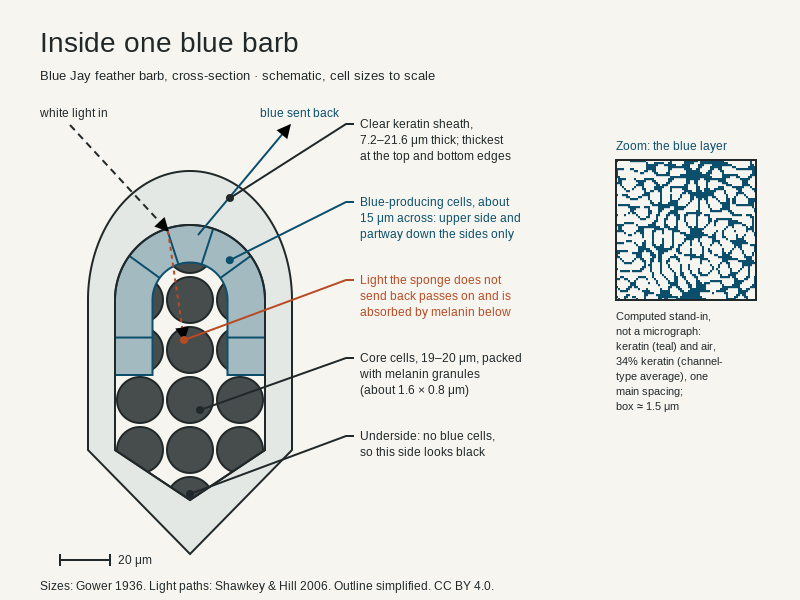
Drawn by this site from Gower's 1936 measurements; the outline and number of cells are simplified. Light paths follow Shawkey and Hill 2006. The zoom panel is a computed pattern with one spacing and 34% keratin, the channel-type average in Saranathan et al. 2012, not a micrograph; the sources used here do not say which sponge type the Blue Jay has.
Measurements behind the drawing, with sources: blue-feathers-barb-diagram.csv (CSV · JSON label).
Figure: Spacing sets the color
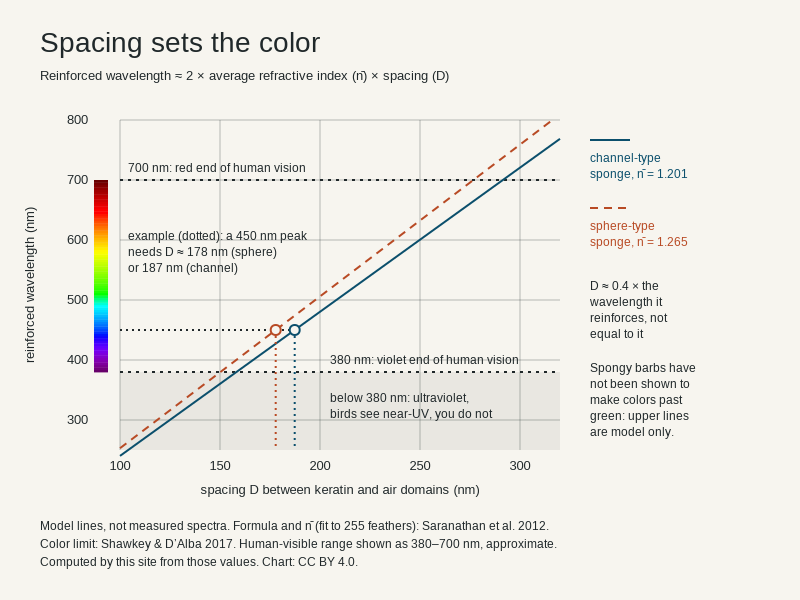
Model lines computed by this site from the rule and indices in Saranathan et al. 2012, not measured spectra. Human-visible range shown as 380–700 nm, approximate. Spongy barbs have not been shown to make colors past green (Shawkey and D'Alba 2017).
Spacing for every 10 nm from 380 to 700 nm, both sponge types: blue-feathers-spacing-chart.csv (CSV · JSON label).
Source card
- Images: ten photographs, seven from Wikimedia Commons and three from iNaturalist, under CC BY 4.0 (four), CC BY-SA 4.0 (three), and CC BY 3.0, CC BY-SA 2.0 and CC0 (one each), each license checked photo by photo against the Commons or iNaturalist records on 2026-10-10 (three) or 2026-10-13 (seven), with species names following the photographers' labels or iNaturalist research-grade identifications; three figures are drawn by this site.
- Classification: the eBird/Clements taxonomy (2025) and the GBIF Backbone Taxonomy list Cyanocitta cristata and C. stelleri as the two species of Cyanocitta, family Corvidae.
- Data: barb sizes from Gower 1936; the spacing rule and average indices from Saranathan et al. 2012. The water estimate is this page's own calculation, with its inputs given above.
- Look-alikes: the misidentification twin field uses Cornell's similar-species list and Audubon's field marks.
Corrections: none yet.
Sources
- Cornell Lab of Ornithology, All About Birds. "Blue Jay Overview." www.allaboutbirds.org/guide/Blue_Jay/overviewread via the Internet Archive copy of 2026-09-13 (snapshot 20260913123542)
- Gower C. "Cause of Blue Color as Found in the Bluebird (Sialia sialis) and the Blue Jay (Cyanocitta cristata)." The Auk 53:178–185 (1936) archive.org/details/sim_auk_1936-04_53_2full text read in the Internet Archive scan of The Auk 53(2), April 1936
- Saranathan V, Forster JD, Noh H, Liew SF, Mochrie SGJ, Cao H, Dufresne ER, Prum RO. "Structure and optical function of amorphous photonic nanostructures from avian feather barbs: a comparative small angle X-ray scattering (SAXS) analysis of 230 bird species." Journal of the Royal Society Interface 9:2563–2580 (2012) doi.org/10.1098/rsif.2012.0191full text read via PubMed Central, PMC3427513
- Prum RO, Torres RH, Williamson S, Dyck J. "Coherent light scattering by blue feather barbs." Nature 396:28–29 (1998) doi.org/10.1038/23838abstract read on the Nature article page
- Prum RO, Torres R, Williamson S, Dyck J. "Two-dimensional Fourier analysis of the spongy medullary keratin of structurally coloured feather barbs." Proceedings of the Royal Society B 266:13–22 (1999) doi.org/10.1098/rspb.1999.0598abstract read via PubMed Central, PMC1689643
- Strutt JW (Lord Rayleigh). "On the light from the sky, its polarization and colour." Philosophical Magazine 41:107–120, 274–279 (1871); reprinted in Scientific Papers, vol. 1, art. 8 (Cambridge University Press, 1899) archive.org/details/cu31924073426870full text of the 1899 reprint (Internet Archive scan of the Cornell University Library copy), pp. 87–91
- Strutt JW (Lord Rayleigh). "On the transmission of light through an atmosphere containing small particles in suspension, and on the origin of the blue of the sky." Philosophical Magazine 47:375–384 (1899); reprinted in Scientific Papers, vol. 4, art. 247 (Cambridge University Press, 1903) archive.org/details/scientificpapers04raylialafull text of the 1903 reprint (Internet Archive scan), p. 397
- Parnell AJ, Washington AL, Mykhaylyk OO, Hill CJ, Bianco A, Burg SL, Dennison AJC, Snape M, Cadby AJ, Smith A, Prevost S, Whittaker DM, Jones RAL, Fairclough JPA, Parker AR. "Spatially modulated structural colour in bird feathers." Scientific Reports 5:18317 (2015) doi.org/10.1038/srep18317full text read via Europe PMC, PMC4685390 (CC BY 4.0); the 2025 author correction (Sci. Rep. 15:4070) changes only Figure 4
- Shawkey MD, Hill GE. "Significance of a basal melanin layer to production of non-iridescent structural plumage color: evidence from an amelanotic Steller's jay (Cyanocitta stelleri)." Journal of Experimental Biology 209:1245–1250 (2006) doi.org/10.1242/jeb.02115abstract read via Europe PMC, PMID 16547296
- Cornell Lab of Ornithology, All About Birds. "Steller's Jay Identification" and "Steller's Jay Overview." www.allaboutbirds.org/guide/Stellers_Jay/idread via Internet Archive copies of 2026-08-07 (identification, snapshot 20260807150808) and 2026-06-05 (overview, snapshot 20260605145607)
- Shawkey MD, D'Alba L. "Interactions between colour-producing mechanisms and their effects on the integumentary colour palette." Philosophical Transactions of the Royal Society B 372:20160536 (2017) doi.org/10.1098/rstb.2016.0536full text read via PubMed Central, PMC5444072
- Shawkey MD, Estes AM, Siefferman LM, Hill GE. "Nanostructure predicts intraspecific variation in ultraviolet–blue plumage colour." Proceedings of the Royal Society B 270:1455–1460 (2003) doi.org/10.1098/rspb.2003.2390abstract read via Europe PMC, PMID 12965009
- Zi J, Yu X, Li Y, Hu X, Xu C, Wang X, Liu X, Fu R. "Coloration strategies in peacock feathers." Proceedings of the National Academy of Sciences 100:12576–12578 (2003) doi.org/10.1073/pnas.2133313100full text read via PubMed Central, PMC240659
- Cornell Lab of Ornithology, All About Birds. "Blue Jay Identification." www.allaboutbirds.org/guide/Blue_Jay/idread via the Internet Archive copy of 2026-07-29 (snapshot 20260729051414)
- Cornell Lab of Ornithology, All About Birds. "Blue Jay Life History." www.allaboutbirds.org/guide/Blue_Jay/lifehistoryread via the Internet Archive copy of 2026-09-25 (snapshot 20260925215050)
- National Audubon Society, Audubon Field Guide. "Blue Jay." www.audubon.org/field-guide/bird/blue-jay
- eBird/Clements taxonomy, version 2025, via the eBird API 2.0 taxonomy endpoint (Cyanocitta cristata, C. stelleri, Cotinga maynana, Sialia sialis, Garrulus glandarius, Pavo muticus, P. cristatus, Melopsittacus undulatus) api.ebird.org/v2/ref/taxonomy/ebird?fmt=csv
- GBIF Backbone Taxonomy, species match and species search API for Cyanocitta cristata (usageKey 2482593), C. stelleri (2482598) and the genus Cyanocitta api.gbif.org/v1/species/match?name=Cyanocitta%20cristata
Cite this page
Plankton to Plumage. “Blue Without Blue Pigment: How a Blue Jay Feather Makes Its Color.” October 12, 2026. https://planktontoplumage.com/feathers/blue-feathers/
Add the date you read the page after the address if your style guide asks for it.