Deep explainerNo. 0010
Owl Feathers: Silent Flight Is Partly a Friction Problem
Published
Parts of this entry10 parts
Spec card
Size analogy (wingspan)≈ a yardstick plus 3 to 7 inchesScale: National Audubon Society Guide to North American Birds: Barred Owl (wingspan 3 ft 3 in–3 ft 7 in; a yardstick is 3 ft)
- Common name
- Barred OwlSource: eBird/Clements taxonomy v2025 (species code brdowl)
- Scientific name
- Strix variaSource: eBird/Clements taxonomy v2025; GBIF Backbone Taxonomy, usageKey 2497541 (Strix varia Barton, 1799, accepted)
- Group
- Owl in the family Strigidae, the larger of the two owl families (about 200 species)Source: eBird/Clements taxonomy v2025 (Strigiformes, Strigidae); Clark, LePiane & Liu 2020, Integrative Organismal Biology 2:obaa001 (Strigidae about 200 species, Tytonidae about 20)
- Size band
- 43–51 cm (17–20 in) long; wingspan 1.0–1.1 m (3 ft 3 in–3 ft 7 in); 470 g–1.05 kg; females largerSource: National Audubon Society Guide to North American Birds: Barred Owl (description)
- Distribution / habitat
- Woodlands, wooded river bottoms and wooded swamps across much of the United States and Canada; a permanent resident whose range has expanded into the Northwest in recent decadesSource: National Audubon Society Guide to North American Birds: Barred Owl (habitat, region list, range, conservation)
- Three ID features
- Round head with no ear tufts
- Dark eyes
- Horizontal bars across the chest and vertical stripes on the belly
- The misidentification twin
- Can be confused with Spotted Owl, which Audubon describes as much like Barred Owl but a bit smaller, with brown underparts spotted with white instead of bars and stripesSource: National Audubon Society Guide to North American Birds: Spotted Owl (description: much like Barred Owl but a bit smaller, different pattern below, brown with white spots) and Barred Owl (description)
Download this card as CSV owl-feathers-spec-card.csv · CC BY 4.0File label (JSON): name, license, publisher
Main images
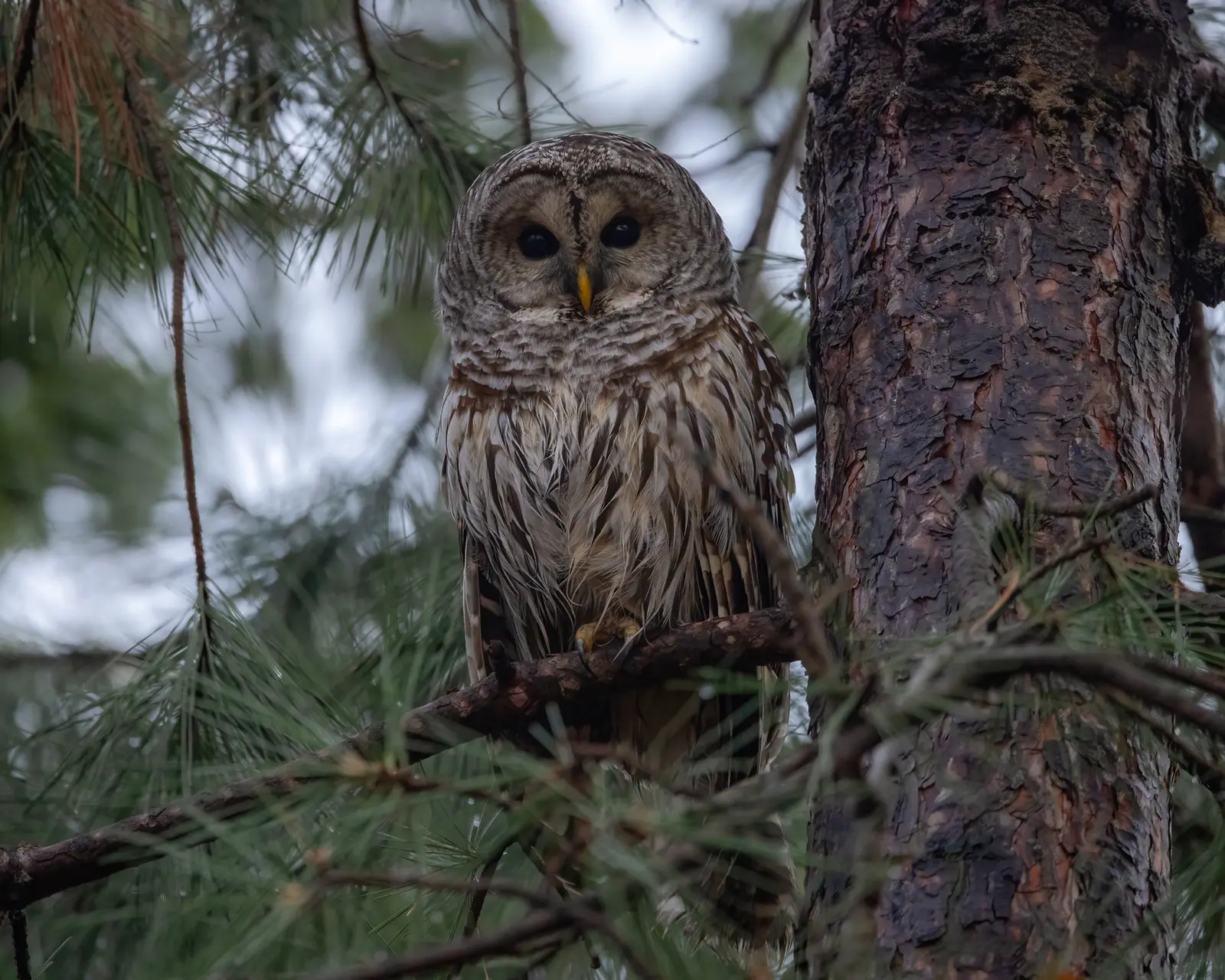
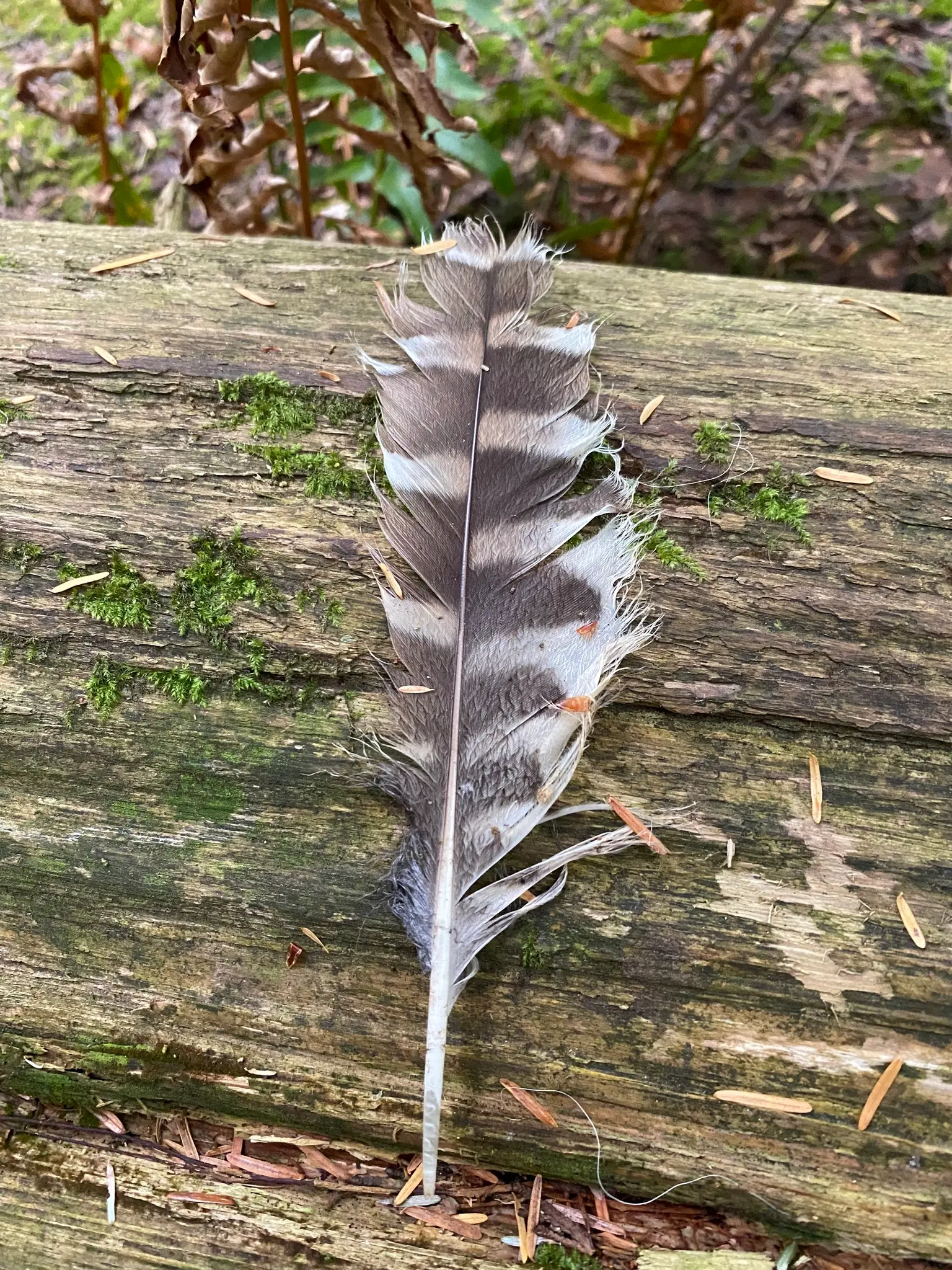
A Barred Owl in Ontario, and a single Barred Owl feather photographed on a log in British Columbia; the two photos come from separate observations.
The short answer
Rubbed together in a 2025 lab test, Barred Owl flight feathers averaged about 27 decibels; Rock Pigeon feathers, about 57. By this page's arithmetic, that 30 dB gap is roughly a thirtyfold difference in sound pressure, and it points to a side of silent flight that has little to do with air.
Owls are not silent, but many fly quietly enough that a person close by often does not hear them, a 2020 review notes. The usual explanation is three traits of owl feathers, named together in 1934. A comb of free barb tips sits on the leading edge of the outermost wing feather, fringes of loose barb ends run along feather edges, and a velvet of fine filaments lies on the upper surface. Large wings that allow slow flight help too.
Many studies of owl flight have treated all three as airflow devices. Experiments since 2020 suggest the velvet mainly quiets something else: the rasp of feathers sliding over feathers as the wing flaps. The comb still looks like an airflow device. It may matter most near landing.
This page follows the Barred Owl (Strix varia) and the barn owls behind many of the measurements, which most studies call Tyto alba; the 2025 eBird/Clements taxonomy lists North American barn owls as Tyto furcata.
Are owls really silent when they fly?
No, but they are hard to hear. In 1971, researchers recording a gliding Barred Owl measured sound levels that people could not hear from 3 m or farther away, a 2017 review reports.
In outdoor flyovers reported in the same review, a barn owl's flight noise above about 1.6 kHz ran about 4 dB below that of a Eurasian Kestrel and a Harris's Hawk. A flapping Eurasian Eagle-Owl made about 5 to 10 dB less noise than a Common Buzzard above 400 Hz.
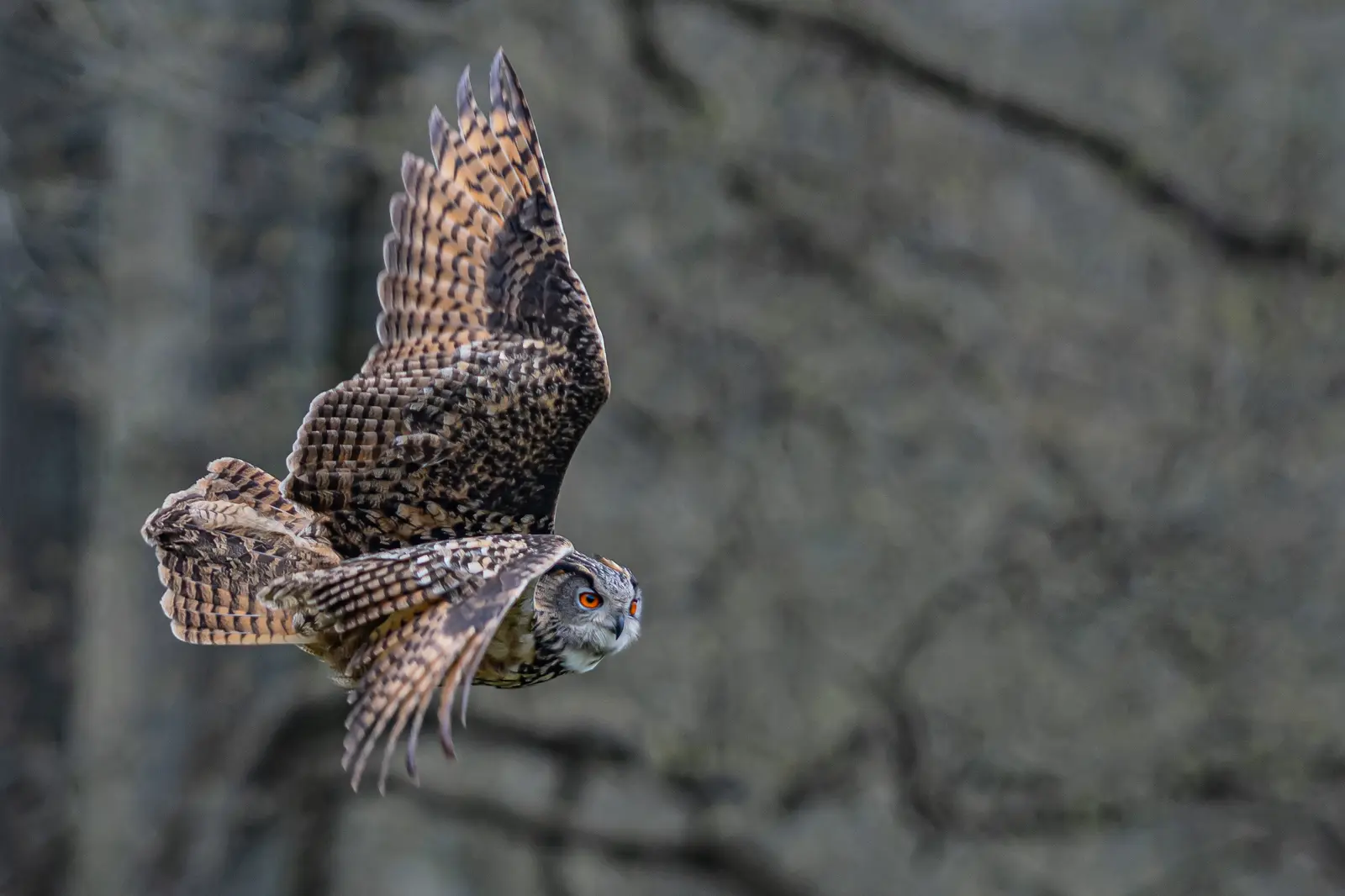
A Eurasian Eagle-Owl in flapping flight. In recordings described in the 2017 review, a flapping eagle-owl made about 5 to 10 dB less noise than a Common Buzzard above 400 Hz.
Ultrasound, sound too high for people to hear, sharpens the contrast. In 1962, researchers using a bat detector, which makes ultrasound audible, picked up none from five owl species in flight, the 2020 review reports. Pigeons, doves, a kestrel and a hawk produced it. So did two fishing owls that lack the usual silencing features.
The 2020 review even turns the question around. Because feathers rub, it proposes, bird flight in general may be noisy, rather than owl flight unusually quiet.
What makes an owl's flight feather different?
A flight feather is a central shaft, the rachis, with a vane on each side. The vane is built from barbs. Each barb carries tiny side branches called barbules. Hooklets on the barbules catch neighboring barbules and lock the vane into a flat sheet.
R. R. Graham's 1934 paper "The silent flight of owls" named three ways owl feathers differ from that pattern, the 2020 review explains. A 2007 study of North American barn owls measured each:
- The comb. On the leading edge of the outermost primary, called P10, the barb tips stand free as a row of stiff, curved teeth, each about 1.8 mm long and about 18 per centimeter, on a feather about 24.5 cm long.
- The fringes. Along many feather edges, barb ends lack hooklets and float free: 3.45 mm long on the inner vane of P10, 1.68 mm on the innermost primary, P1, and up to 6.1 mm on the coverts, the smaller feathers overlapping the bases of the flight feathers.
- The velvet. Barbules end in thin filaments called pennula. On the inner vane of P10 they averaged 1.27 mm, more than nine times the 0.14 mm of a pigeon of about the same body weight. They reached across up to four neighboring barbs.
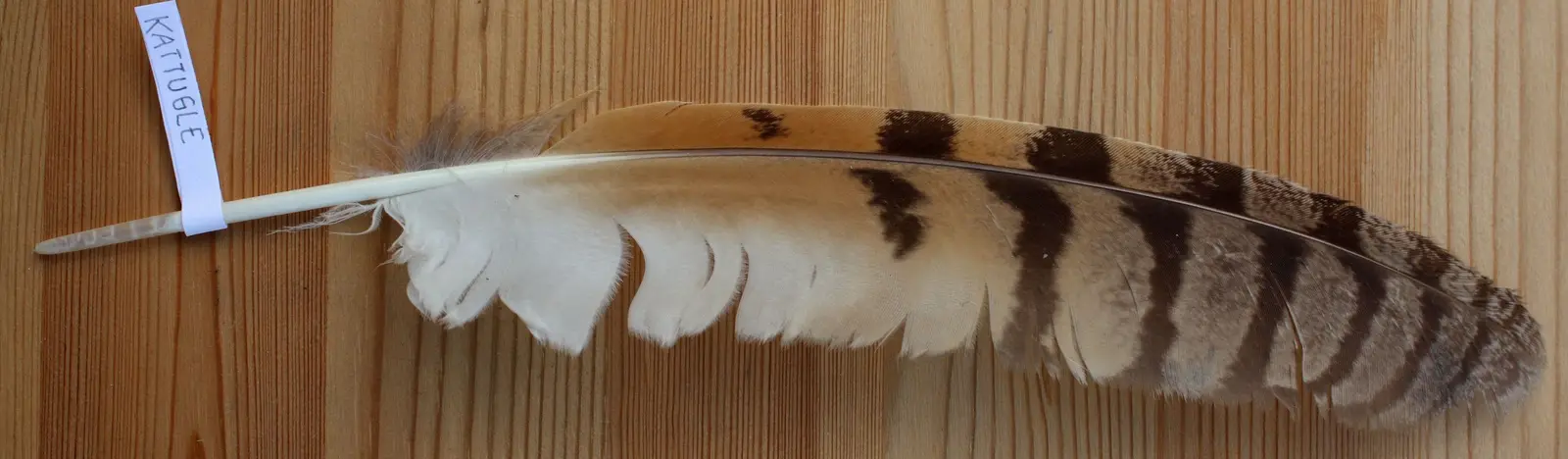
A Tawny Owl's right primary, tagged with its Norwegian name. A narrow vane runs along one side of the rachis; the broad inner vane ends in a loose, scalloped edge.
The 2020 review calls this three-trait list artificial, since owl flight feathers also seem to let more air through and bend more easily than those of similar-sized birds. In barn and Barred Owls, velvet and fringes run across the wing feathers. Barred Owls have them on the tail too. A shed owl feather can carry all of this; the rules on picking one up are a separate matter.
Naming the bird does not mean you may pick up, collect or keep the feather; check the official rules where you are. In the United States, feathers and other parts of native North American birds protected under the Migratory Bird Treaty Act may not be possessed without a permit, and a feather that was shed naturally or came from a bird killed on a road or at a window is not exempt. The official exceptions, including feathers of legally hunted waterfowl and other migratory game birds and the rules on Native American use, are on the U.S. Fish and Wildlife Service page Feathers and the Law.
What does the comb on an owl's wing do?
The comb's teeth face into the oncoming air and, in most species, tilt upward. They change the flow over the wing's upper surface. The 2020 review knew of no data disputing that role.
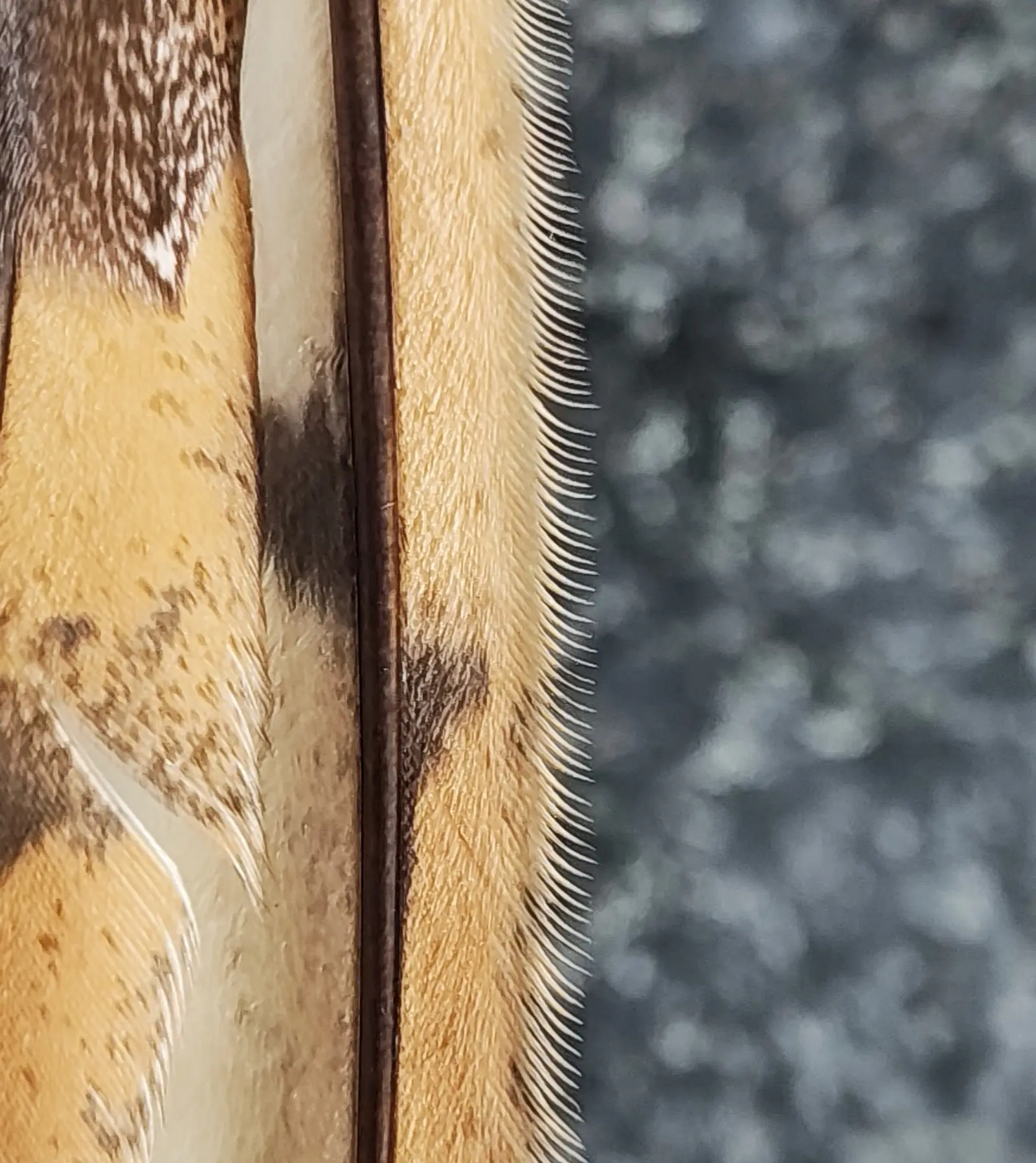
The comb on a captive owl's primary; the photographer calls it a barn owl, and the file is classified only to the genus Tyto.
Yet in some experiments, removing the comb changed little in steady flight. In 1973, as the 2017 review describes, cutting the comb off a Tawny Owl (Strix aluco) left the sound of its flapping flight unchanged, but noise rose clearly just before landing.
The comb may work mainly at steep angles to the airflow, near a stall, when air breaks away from the wing and lift drops. The 2020 review suggests such angles may occur in the final strike.
In a 2016 wind-tunnel test described in the 2017 review, one of the two dried barn owl wings tested made about 5 dB less gliding noise at 24 degrees with the comb than without it. Models and measurements suggest most of the comb's effect lies above 1 kHz.
Comb shape also tracks lifestyle. Across seven owl species compared in 2016, combs were longer and set at wider angles in species active at night than in species more active by day. The Little Owl (Athene noctua), a more daytime species, had the shortest, about 1 mm. The authors read this as support for a role in noise reduction.
Why does an owl feather feel like velvet?
The velvet, a mat of pennula on the upper surface, makes owl flight feathers feel soft to human fingers. A 1972 feather anatomy text, cited in the 2020 review, proposed that the velvet is a modified form of the small projections that, in other birds, help overlapping flight feathers hold together when the wing is loaded. According to the 2025 study's summary of later work, those projections in pigeon feathers interlock more like Velcro than rub like sandpaper, and owl feathers lack them.
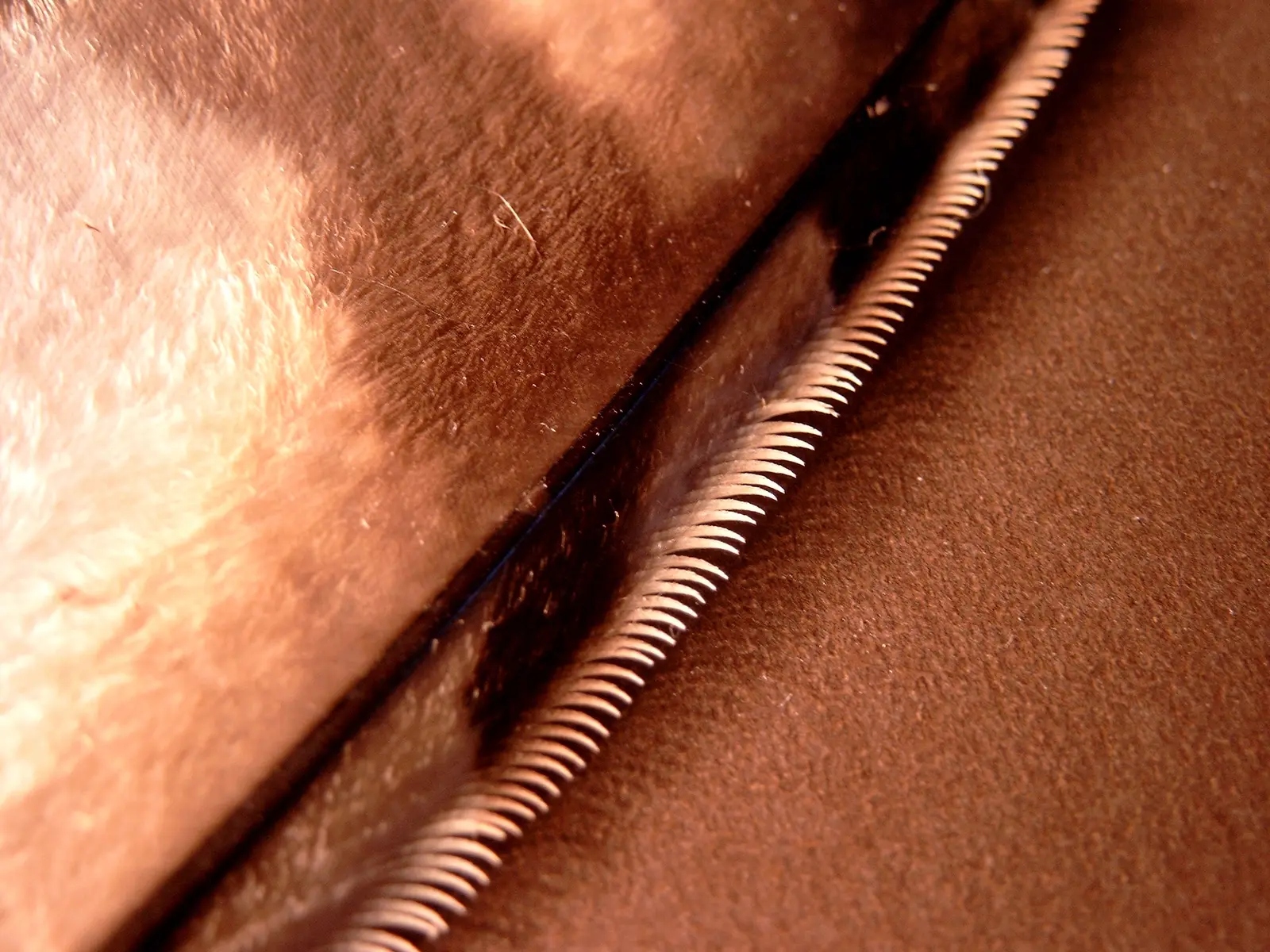
An owl feather up close, its file classified as Long-eared Owl. The photographer points out comb-like projections along its edge and a fur-like down on its surface, the velvet.
If the velvet mainly tuned airflow, it should be longest where air flows over the wing. In the owls measured, it is longest where feathers overlap. In the 2007 barn owl study, pennula grew longer in areas covered by another feather. In three Barred Owls measured for the 2025 study, filaments in covered zones averaged 1.76 mm against 1.17 mm in zones exposed to airflow, about half again as long.
Barn owl feathers even show the boundary in color, the 2017 review notes: whitish where a neighboring feather lies on top, brownish and patterned where air flows over it.
Do owl feathers rub quietly? The hairspray tests
In a 2020 experiment, researchers coated the velvet on the inner wing feathers of 13 live barn owls with hairspray. Then they recorded the owls flapping. Sound rose across the whole recorded range, 0.1 to 16 kHz, and rose more on the upstroke, when feathers rub against each other most, than on the downstroke, when air forces peak.
That is the pattern the friction idea predicted. The airflow idea predicted a rise mostly at low frequencies and on the downstroke.
A 2025 follow-up rubbed 96 pairs of flight feathers from 17 species together by hand at a steady speed, 10 cm from a calibrated microphone, before and after hairspray. In the species averages published with the study, untreated Barred Owl pairs came to about 27 dB and barn owl pairs about 25 dB. Rock Pigeon pairs came to about 57 dB and Andean Condor pairs about 64 dB.
Spraying erased much of the owls' advantage. Barred Owl and barn owl pairs got about 18 dB louder, while Rock Pigeon pairs changed by about 1 dB. The paper's statistical model, which pools all 17 species, gives smaller figures: hairspray added 7.4 dB to velvet-covered feathers and 1.7 dB to the rest, and species with velvet rubbed 20.9 dB more quietly than species without it.
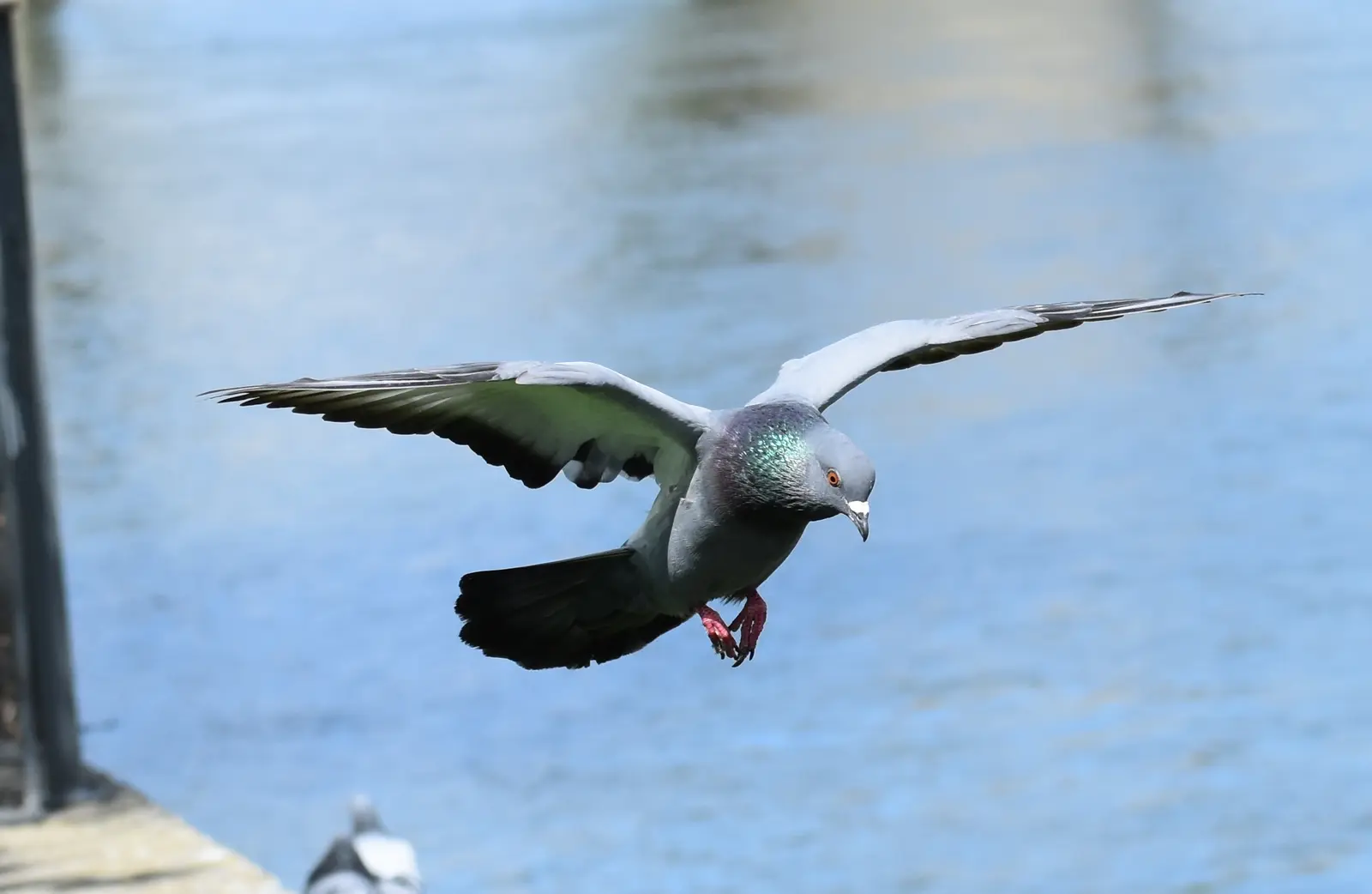
A feral Rock Pigeon in flight in Carcassonne, France. In the 2025 test, hairspray changed Rock Pigeon feather pairs by about 1 dB; Barred Owl pairs got about 18 dB louder.
Every pair made broadband sound, like sandpaper or Velcro rather than the low whoosh of a feather swung through the air. The authors note the limits: hand-rubbed feathers are not a flying wing, and hairspray explained only part of the gap, so feathers with velvet may differ in other ways too, such as being less stiff.
Five experiments that altered owl feathers
| Year | Birds | What was changed | What happened |
|---|---|---|---|
| 1971–72 | Barred Owl, live | Wing's trailing edge cut | No rise in flight noise |
| 1973 | Tawny Owl, live | Comb removed | Flapping unchanged; louder just before landing |
| 2016 | Barn owl, dried wings | Comb removed | About 5 dB louder gliding at 24 degrees, in one of two wings |
| 2020 | 13 live barn owls | Velvet coated with hairspray | Louder at all recorded frequencies, more on the upstroke |
| 2025 | Feathers of 17 species, rubbed by hand | Hairspray on all pairs, stiffening any velvet | Velvet-covered feathers much louder; others changed little |
What do the fringes on owl feathers do?
Graham called them the "trailing-edge fringe." The 2020 review argues that the name misleads: fringes also line leading edges, the coverts and the tail, and they are longer where feathers overlap than on free trailing edges.
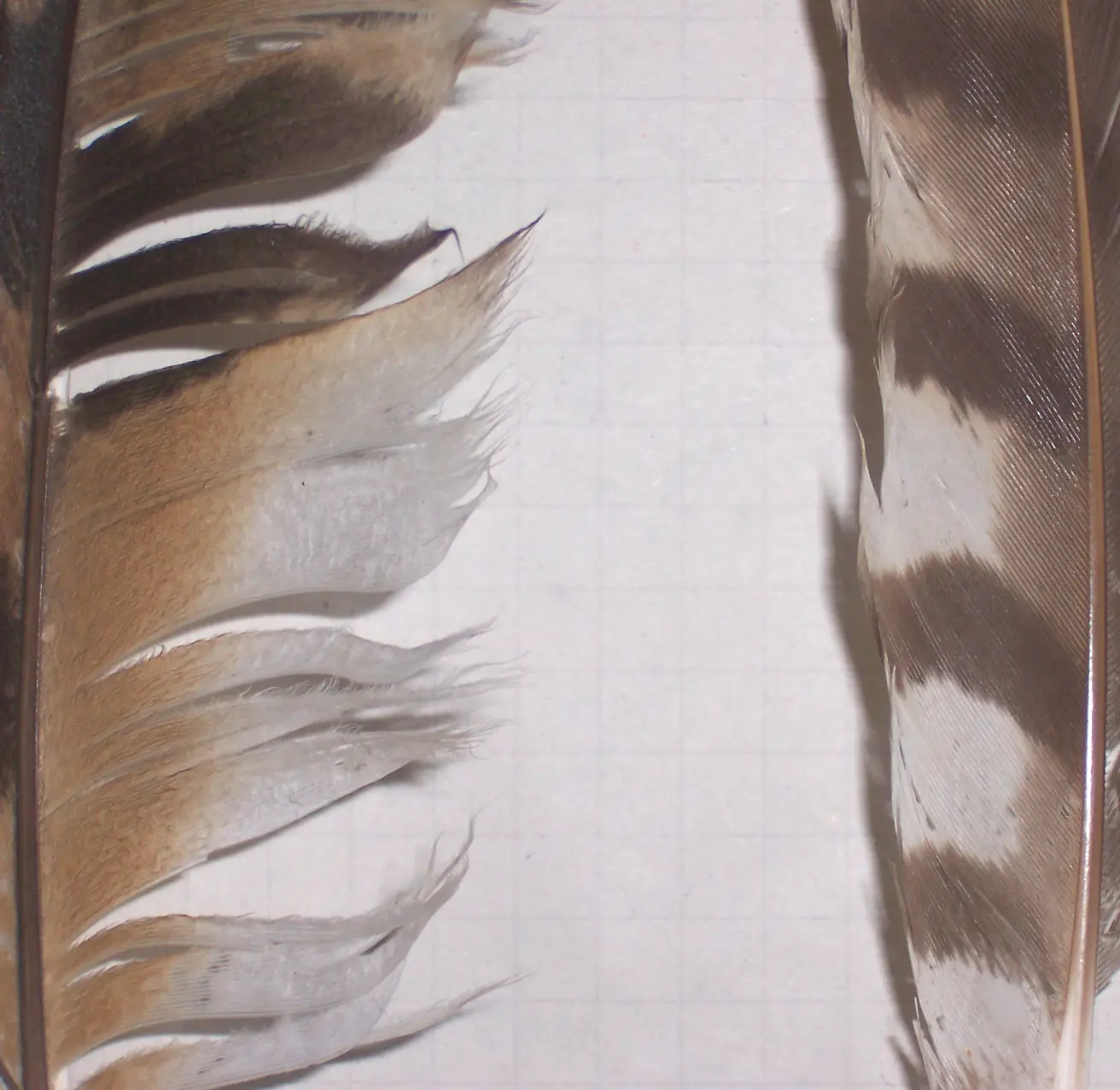
An owl's flight feather (left) beside a hawk's on a 5 mm grid; the photographer suggests Tawny Owl and Common Buzzard. The owl's vane has a fluffy margin; its gaps are damage.
Two ideas compete. In the airflow version, a soft, porous edge sheds less noise. A 2013 mathematical model found limiting cases in which noise power from a porous edge scales with the sixth power of airspeed, against the fifth for a rigid edge, so it would fall off faster as a bird slows. In the friction version, argued in the 2020 review, the fringes soften feather edges that slide past each other or brush against twigs and grass.
In a 2012 study described in the 2017 review, the fringes of one secondary feather settled into the grooves between the barbs of its neighbor when air flowed, holding the two together as one trailing edge. The 2017 review reads this as fewer noise-making edges. The 2020 review, following the 2012 authors, reads it as less friction.
The only live-owl test, the 2020 review says, came in the early 1970s: cutting the trailing edge off a Barred Owl's wing did not raise flight noise, as the airflow version predicts it should. The 2017 review reads the result as no change, the 2020 review as a reduction. The sample was small.
Why do big wings make an owl quieter?
Owl wings are large for the bird: North American barn owls weigh about 465 g and carry about 706 cm² on each wing, the 2017 review reports. Each square centimeter of wing therefore carries about a third of a gram of owl (this page's arithmetic). The review credits that light load with allowing slow flight, estimated at 2.5 to 7 m/s, about 6 to 16 mph, and counts the big wing as a quieting feature in its own right.
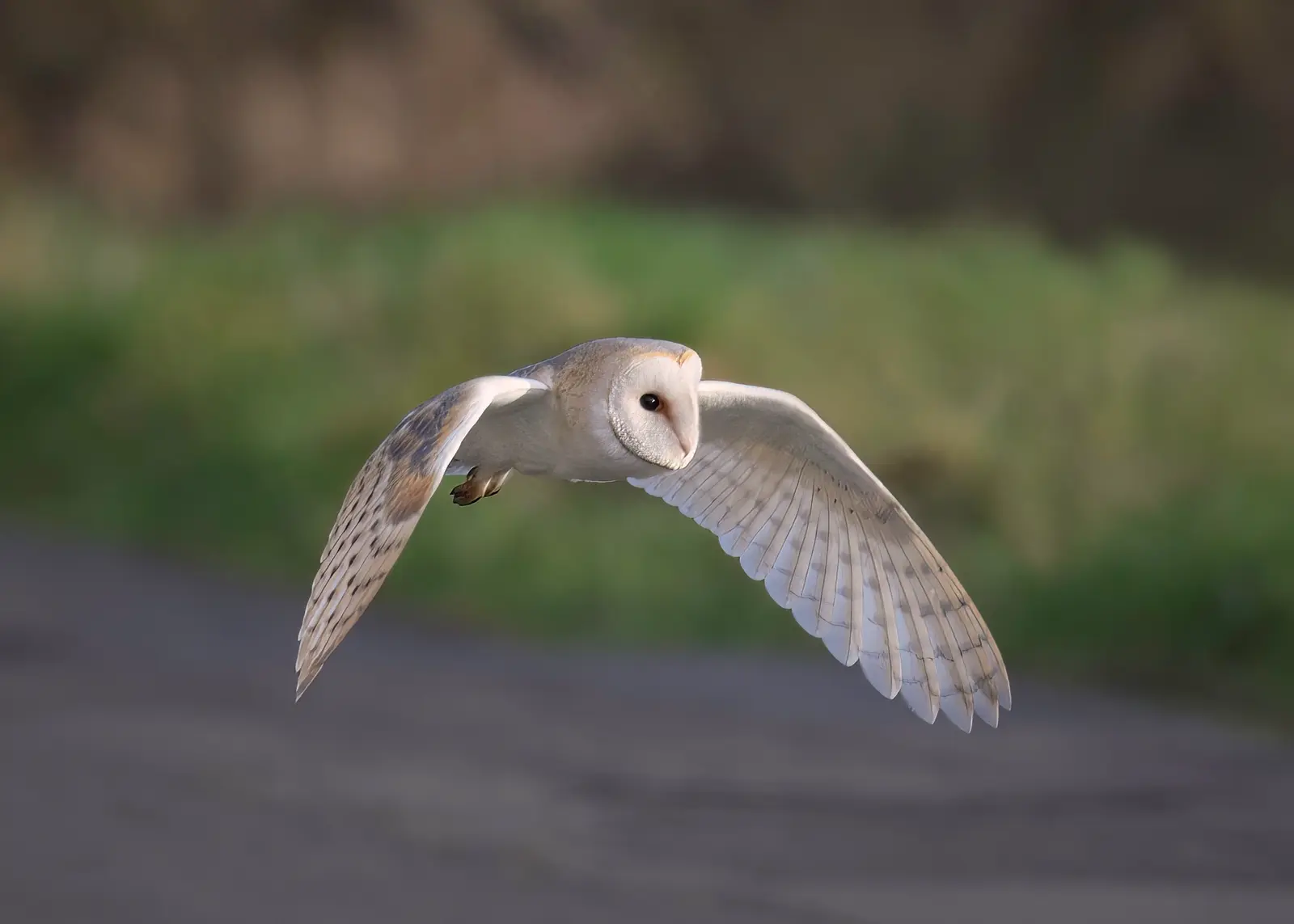
A barn owl in flight in Scotland, wings spread. North American barn owls carry about 706 cm² on each wing for about 465 g of body weight, the 2017 review reports.
Airflow noise climbs steeply with speed. The 2020 review cites exponents of four to six for aerodynamic sources. Under the fifth-power rule for a rigid trailing edge, halving airspeed cuts that sound's power to 1/32, about 15 dB less (this page's arithmetic). Here the site's working idea, that form is frozen physics, holds in a simple way: a big wing permits slow flight, and slow air makes less airflow noise.
Why would an owl need to fly quietly?
Two explanations compete, and both can be true. Under the self-masking idea, a quiet wing keeps the owl's own flight noise from drowning out its prey. Under the stealth idea, quiet keeps prey from hearing the owl coming. The 2020 review judged that current evidence slightly favors self-masking, but called the question unsettled.
Owl hearing makes the first idea plausible. As the review describes, barn owls caught prey in complete darkness by sound alone in a 1971 study.
Prey hearing supports the second. In a 1962 experiment, deafened kangaroo rats were less likely than hearing ones to escape owl strikes in the dark, the review reports. Fishing owls fit both ideas. Fish do not hear an owl through the water's surface, and the owl does not hear the fish.
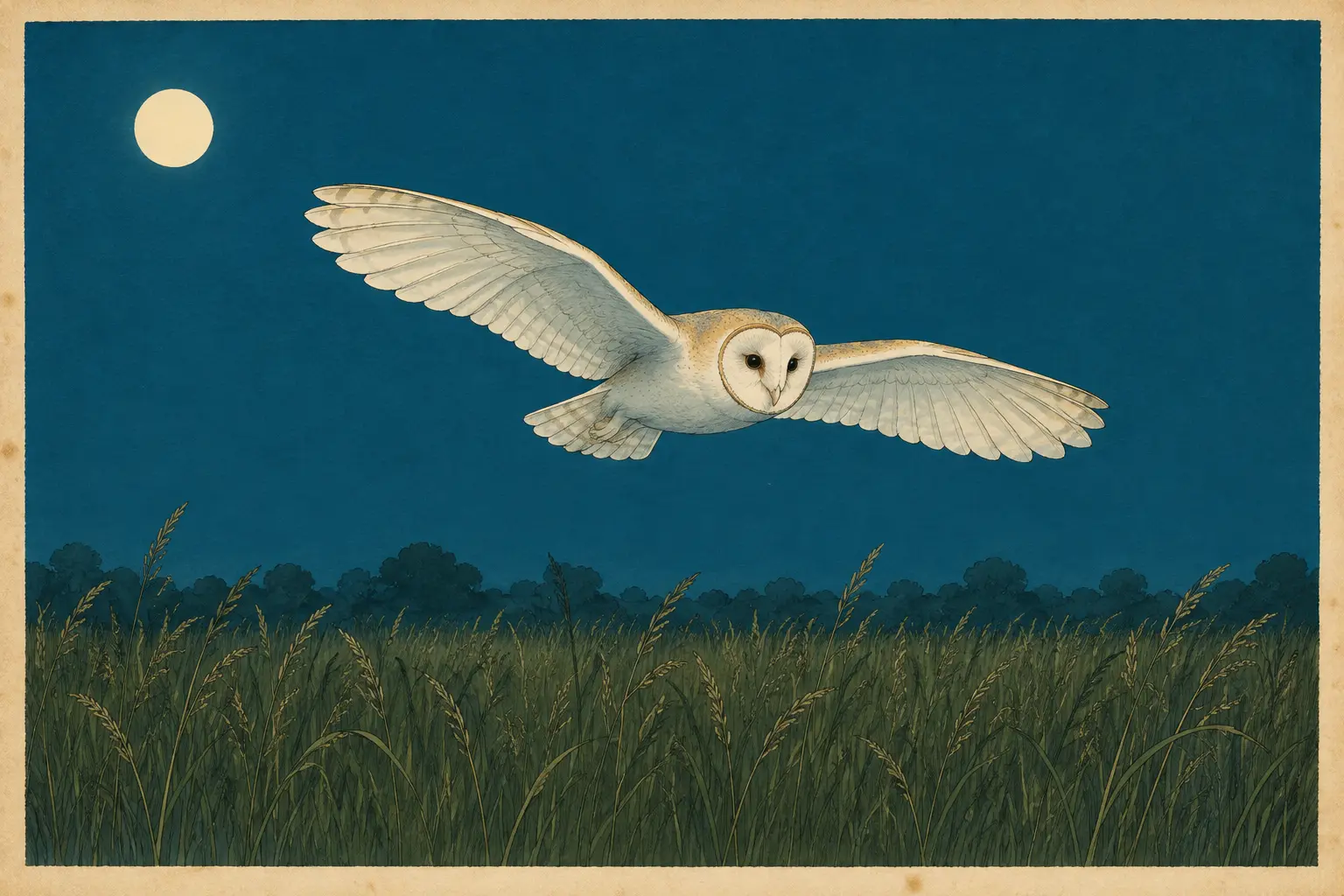
An illustrated scene: a barn owl flying low over grass at night. A 2020 review called it unsettled whether quiet flight helps the owl hear prey or keeps prey from hearing the owl.
Barn owls also soften their landings, in what a 2024 study calls a new form of sound camouflage. In Switzerland, GPS loggers and accelerometers on 163 wild barn owls recorded tens of thousands of landings, and landings on poles grew markedly softer in the last 30 minutes before a strike. When owls attacked straight from a perch, a median of 6.5 m from the prey, the odds of success fell about 15% for each extra newton in the landing before it. The study's model put perch landings at about 8 to 9 newtons, roughly three times the owls' weight (this page's arithmetic).
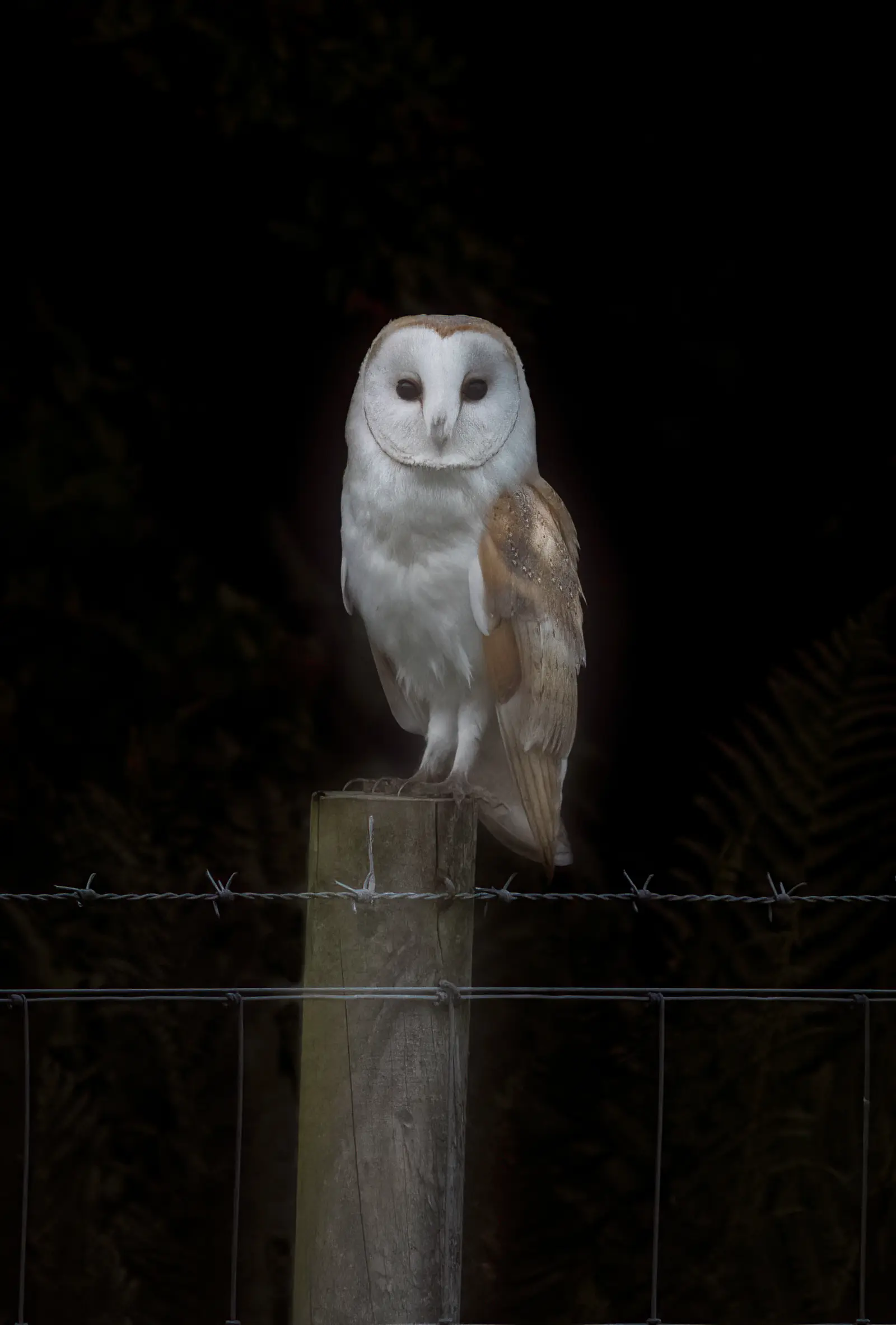
A barn owl on a fence post. In the 2024 Swiss study, barn owls landed more softly on poles in the last 30 minutes before a strike.
Owl feather FAQ
Are owls completely silent when they fly?
No. Owls make flight noise, but it is generally agreed that they are quieter than other birds, a 2017 review notes. A gliding Barred Owl recorded in 1971 measured too faint for people to hear from 3 m away.
Which owl feather has the comb?
The comb sits on the leading edge of the outermost primary, P10, which meets the oncoming air first. It often also appears on the alula, the small thumb feathers at the wrist, and in some species on P9 or, rarely, P7 and P8. Barn owls in a 2007 study had it only on P10 and its covert.
Do all owls fly quietly?
No. Fishing owls, which catch fish through the water's surface, lack the usual silencing features, and two produced ultrasound in flight in a 1962 test. In a 2016 comparison of seven species, owls more active by day had less developed combs than nocturnal owls.
Next, see how a feather's inner structure, not a blue pigment, makes a Blue Jay blue: Blue Without Blue Pigment: How a Blue Jay Feather Makes Its Color.
Figure: One outer primary, three quiet features
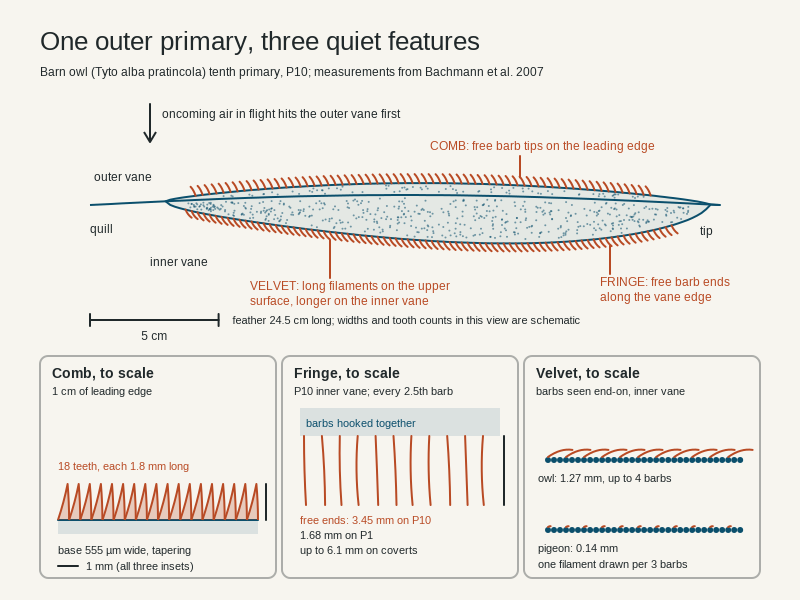
Drawn by this site from the measurements in Bachmann et al. 2007, not traced from any figure; the study's Tyto alba pratincola is now placed in Tyto furcata by eBird/Clements. Widths and tooth counts in the main view are schematic; the insets share one scale.
Measurements behind the drawing, with sources: owl-feathers-p10-diagram.csv (CSV · JSON label).
Figure: Rub two flight feathers together
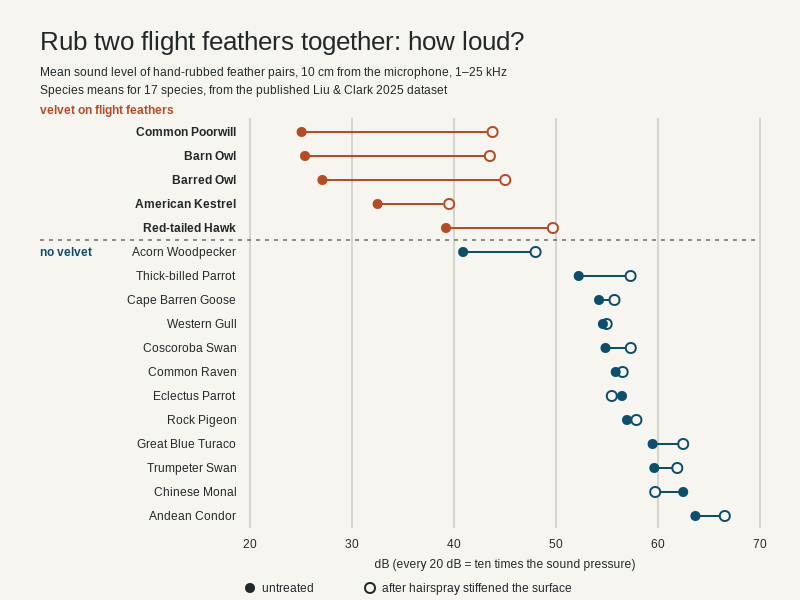
Species averages published with Liu and Clark 2025 (Dataset 1, CC BY 4.0), replotted by this site: filled dots untreated, open dots after hairspray. The paper's model estimates (20.9 and 7.4 dB) are not plotted.
Species averages with recording counts: owl-feathers-rubbing-chart.csv (CSV · JSON label).
Source card
- Images: ten photographs, two from iNaturalist (one CC BY 4.0, one CC0) and eight from Wikimedia Commons (one CC BY 4.0, two CC BY-SA 4.0, two CC BY-SA 3.0, one CC BY 2.5, two CC BY 2.0), no public-domain plates and two figures drawn by this site, with photo licenses checked per photo against the iNaturalist, GBIF and Commons records on 2026-10-10 for the two iNaturalist photos and the comb photo and on 2026-10-13 for the other seven, and species names as each source labels them.
- Classification: eBird/Clements (2025) and the GBIF Backbone Taxonomy list Strix varia as an accepted species in the family Strigidae. eBird/Clements separates the American Barn Owl, Tyto furcata, from the Western Barn Owl, Tyto alba; this page keeps each study's name.
- Data: measurements from Bachmann et al. 2007 and Liu and Clark 2025. Older studies named but not listed below were read through the listed reviews and papers. The pressure ratios, length ratios, wing load per square centimeter, fifth-power arithmetic and landing-force comparison are this page's own calculations.
- Look-alikes: the misidentification twin field uses Audubon's Spotted Owl description.
Corrections: none yet.
Sources
- Liu LG, Clark CJ. "Acoustics of rubbing feathers: the velvet of owl feathers reduces frictional noise." Journal of Experimental Biology 228(2):jeb246234 (2025) doi.org/10.1242/jeb.246234full text read via Europe PMC, PMC11832125 (CC BY 4.0); Dataset 1 (xlsx) and supplementary Tables S1–S3 read from the Europe PMC supplementary files
- Clark CJ, LePiane K, Liu L. "Evolution and Ecology of Silent Flight in Owls and Other Flying Vertebrates." Integrative Organismal Biology 2(1):obaa001 (2020) doi.org/10.1093/iob/obaa001full text read via Europe PMC, PMC7671161 (CC BY 4.0)
- Wagner H, Weger M, Klaas M, Schröder W. "Features of owl wings that promote silent flight." Interface Focus 7(1):20160078 (2017) doi.org/10.1098/rsfs.2016.0078full text read via PubMed Central, PMC5206597
- Bachmann T, Klän S, Baumgartner W, Klaas M, Schröder W, Wagner H. "Morphometric characterisation of wing feathers of the barn owl Tyto alba pratincola and the pigeon Columba livia." Frontiers in Zoology 4:23 (2007) doi.org/10.1186/1742-9994-4-23full text read via Europe PMC, PMC2211483 (CC BY 2.0)
- Weger M, Wagner H. "Morphological Variations of Leading-Edge Serrations in Owls (Strigiformes)." PLoS ONE 11(3):e0149236 (2016) doi.org/10.1371/journal.pone.0149236full text read via Europe PMC, PMC4774958 (CC BY 4.0)
- LePiane K, Clark CJ. "Evidence that the Dorsal Velvet of Barn Owl Wing Feathers Decreases Rubbing Sounds during Flapping Flight." Integrative and Comparative Biology 60(5):1068–1079 (2020) doi.org/10.1093/icb/icaa045abstract read via Europe PMC, PMID 32525524
- Jaworski JW, Peake N. "Aerodynamic noise from a poroelastic edge with implications for the silent flight of owls." Journal of Fluid Mechanics 723:456–479 (2013) doi.org/10.1017/jfm.2013.139abstract
- Schalcher K, Milliet E, Séchaud R, Bühler R, Almasi B, Potier S, Becciu P, Roulin A, Shepard ELC. "Landing force reveals new form of motion-induced sound camouflage in a wild predator." eLife 12:RP87775 (2024) doi.org/10.7554/eLife.87775full text read via Europe PMC, PMC11268889 (CC BY)
- National Audubon Society. "Barred Owl." Guide to North American Birds (text adapted from Kenn Kaufman, Lives of North American Birds) www.audubon.org/field-guide/bird/barred-owl
- National Audubon Society. "Spotted Owl." Guide to North American Birds (text adapted from Kenn Kaufman, Lives of North American Birds) www.audubon.org/field-guide/bird/spotted-owl
- eBird / Clements Checklist of Birds of the World, taxonomy v2025 (eBird API 2.0, ref/taxonomy/ebird) api.ebird.org/v2/ref/taxonomy/ebird?species=brdowl,spoowl,brnowl,webowl1&fmt=jsontaxonomy entries (version 2025, the latest)
- GBIF Backbone Taxonomy, species match API api.gbif.org/v1/species/match?name=Strix%20varia&strict=truespecies match results
Cite this page
Plankton to Plumage. “Owl Feathers: Silent Flight Is Partly a Friction Problem.” October 12, 2026. https://planktontoplumage.com/feathers/owl-feathers/
Add the date you read the page after the address if your style guide asks for it.