Comparison and chart pageNo. 0016
Bird Feather Identification: Ask Where It Grew Before Whose It Is
Published Updated
Parts of this entry7 parts
Main images
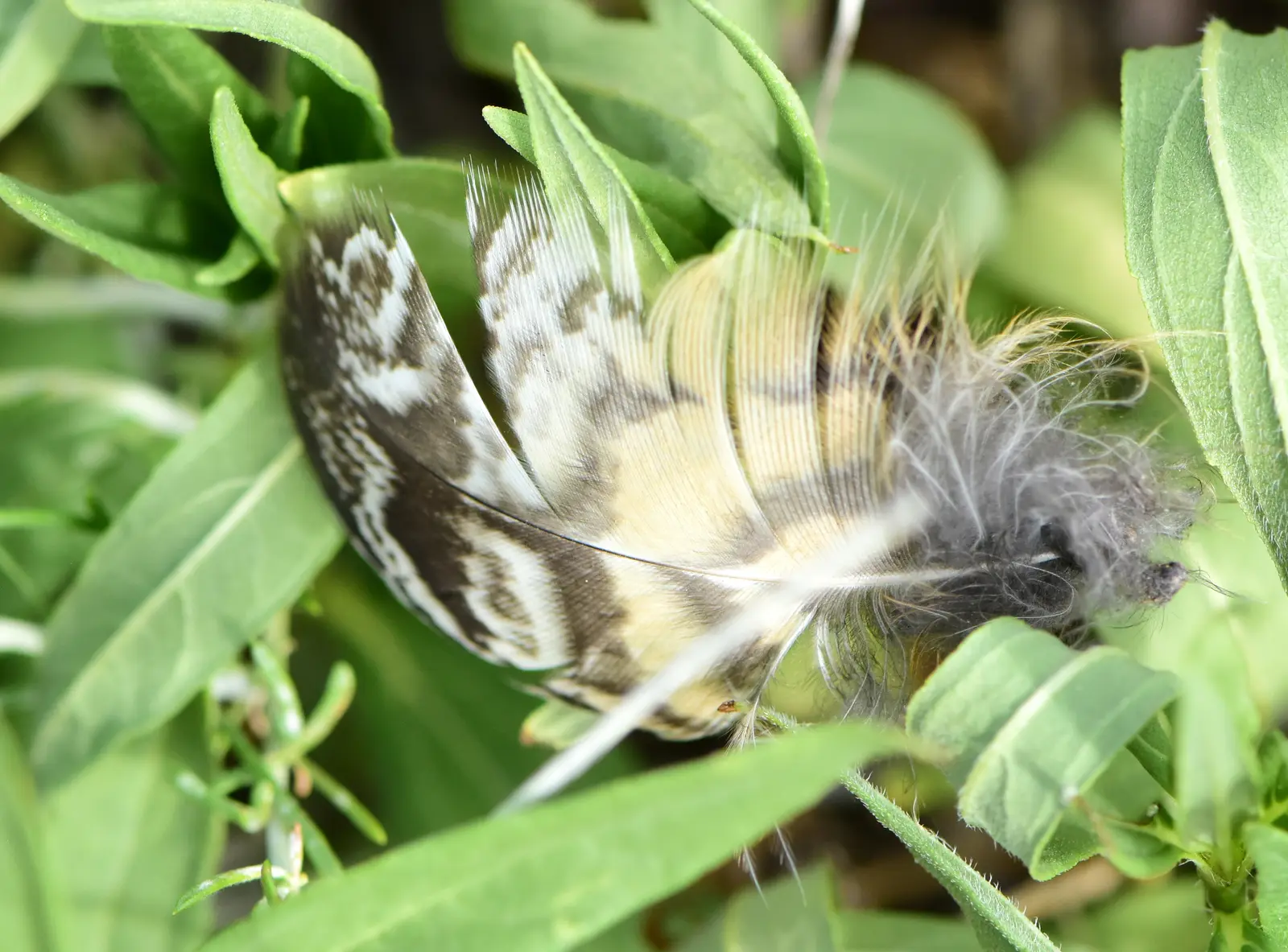
Among leaves at Seedskadee National Wildlife Refuge, July 2022; the U.S. Fish and Wildlife Service's title names it a Great Horned Owl feather.
The short answer
The two central feathers of a bird's tail are usually exactly symmetrical, while the outermost ones are highly lopsided. A lopsided feather, then, does not have to come from a wing.
Three steps, in order:
- Work out where on the bird the feather grew: on the outer wing (a primary), the inner wing (a secondary), the tail or the body. Knowing that position can significantly narrow a search, the Feather Atlas notes.
- Record the feather's pattern, its most noticeable color and its total length.
- Search by those traits in the Feather Atlas, a database of feather scans from the U.S. Fish and Wildlife Service's forensics laboratory. It shows mostly the large flight feathers of the wings and tail, from 438 species as of September 2026, about half of North America's breeding species by its FAQ's count.
A photo with a ruler laid beside the feather records its pattern, color and length without moving it.
Naming the bird does not mean you may pick up, collect or keep the feather; check the official rules where you are. In the United States, feathers and other parts of native North American birds protected under the Migratory Bird Treaty Act may not be possessed without a permit, and a feather that was shed naturally or came from a bird killed on a road or at a window is not exempt. The official exceptions, including feathers of legally hunted waterfowl and other migratory game birds and the rules on Native American use, are on the U.S. Fish and Wildlife Service page Feathers and the Law.
Primary, secondary, tail or body feather? Side by side
| Clue | Primary | Secondary | Tail feather | Body feather or covert |
|---|---|---|---|---|
| Grows on | Outer wing, on the "hand" | Inner wing, on the "forearm" | Tail, in mirror-image pairs | Body; coverts overlap flight-feather bases |
| How many | 9–10 in most species | 9–25, by species | 10–12 in most species; 12 is most common | — |
| Tip | Usually pointed; outer ones finger-like in soaring birds | Typically rounded or squared | No finger-like tips; stiff and sharply pointed in woodpeckers | — |
| Vanes | In soaring birds, a notch in the trailing vane forms each finger | Usually slightly lopsided, the outer vane a bit narrower | Outermost very lopsided; the central pair usually exactly symmetrical | — |
| Shaft and quill | Very long quill | Shaft often curved | Central shaft usually perfectly straight | — |
Each cell's source is listed in the CSV: bird-feather-identification-comparison.csv (CSV · JSON label).
Full credit and license
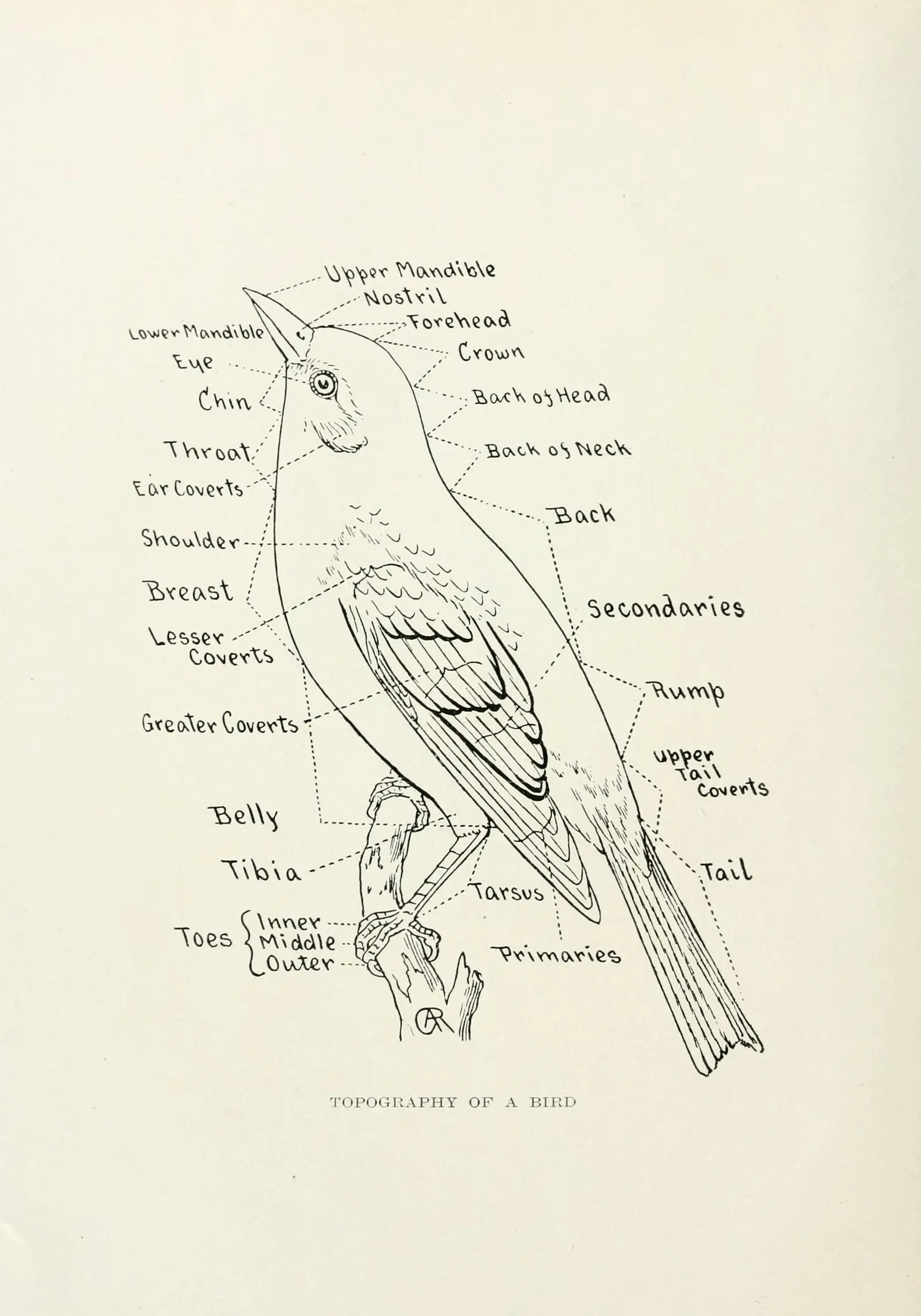
"Topography of a Bird" by Chester A. Reed — https://commons.wikimedia.org/wiki/File:The_Canadian_bird_book_-_illustrating_in_natural_colors_more_than_seven_hundred_north_American_birds,_also_several_hundred_photographs_of_their_nests_and_eggs_(1914)_(14562285008).jpg — Public domain (drawn and signed (monogram CAR) by Chester A. Reed, 1876–1912; published 1914, before 1931 (U.S.); author died more than 70 years ago (EU))Chester A. Reed's "Topography of a Bird," printed in 1914, labels the primaries, secondaries, tail, and the greater, lesser and upper tail coverts on a perched bird.
How do you tell a primary from a secondary?
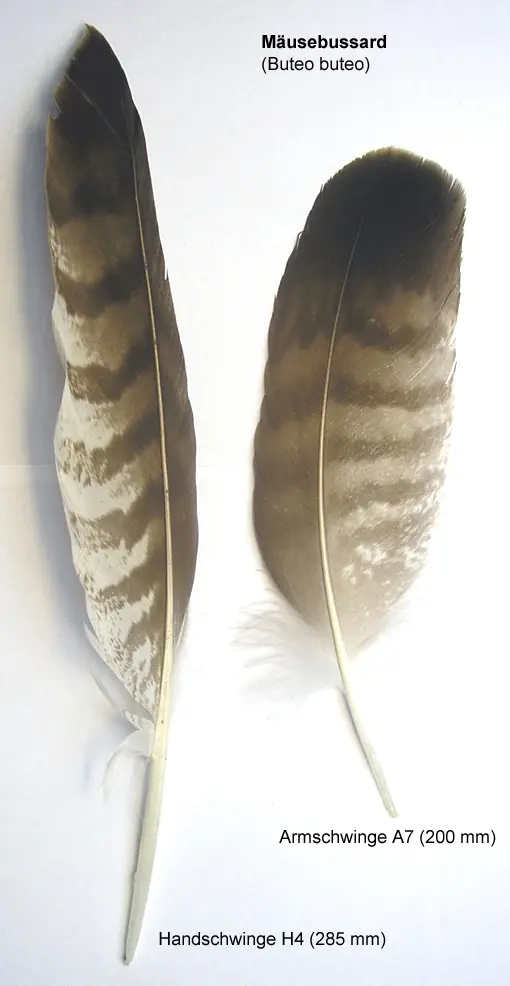
A Common Buzzard primary (left) and secondary, photographed by S. Seyfert and labeled in German: Handschwinge H4 (285 mm) is the primary, Armschwinge A7 (200 mm) the secondary.
Look at the tip and the quill. Primaries usually end in a point, and because they provide most of the power in flight, long quills anchor them firmly to the wing, the Feather Atlas explains. Secondaries usually end in a rounded or squared tip, often on a curved shaft.
In soaring birds, such as many birds of prey, the outer primaries end in finger-like tips. A distinct notch in the trailing vane makes each finger, sometimes helped by an emargination, a narrowing of the leading vane.
The line blurs in mid-wing. The inner primaries often closely resemble the outer secondaries.
How do you tell a tail feather from a wing feather?
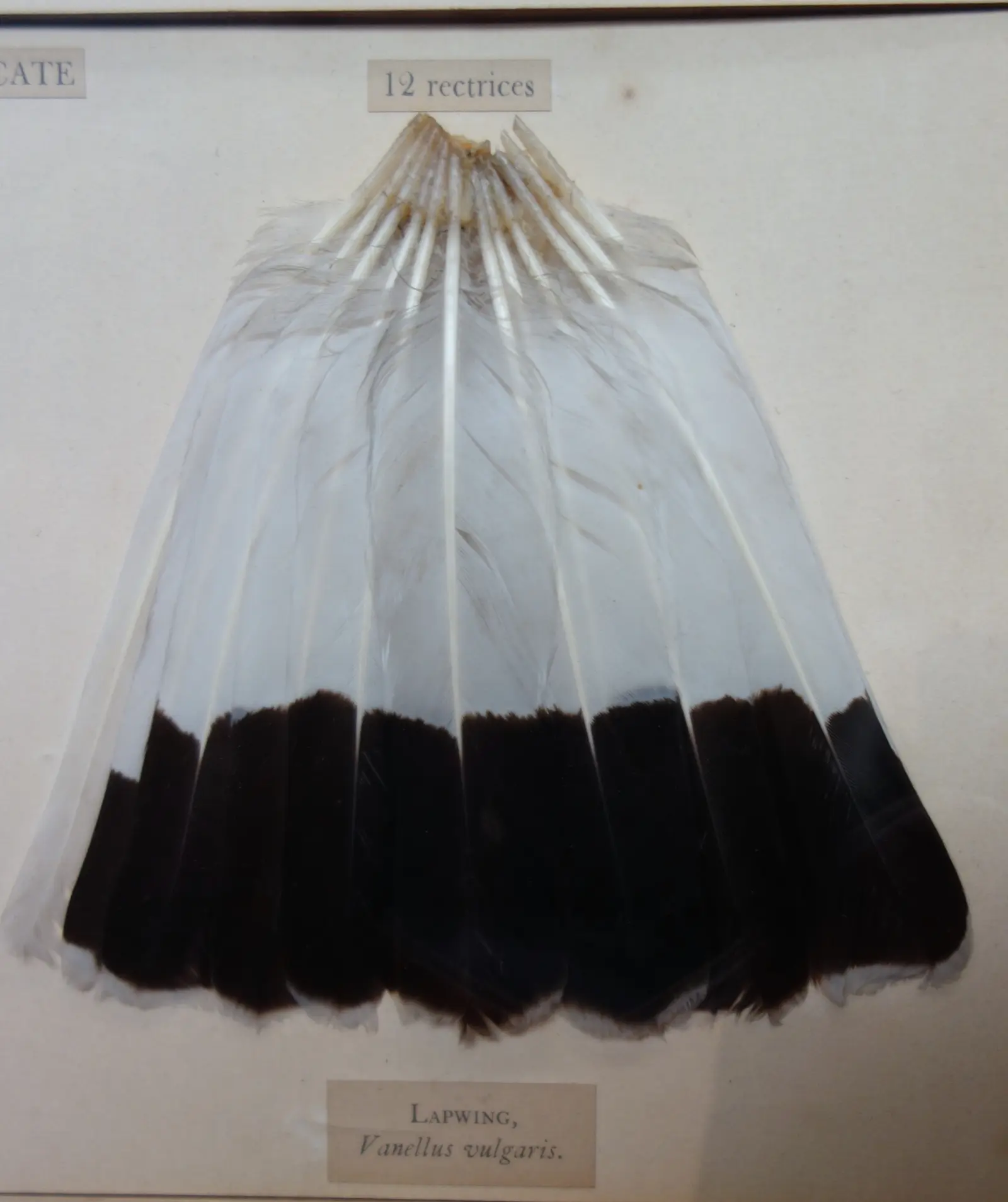
A lapwing's 12 tail feathers, as labeled, on display at the Natural History Museum, London. GBIF lists the label's Vanellus vulgaris as a synonym of Vanellus vanellus.
Tail feathers come in mirror-image pairs, and 12 is the most common number, the Feather Atlas says, though it varies among bird groups. Toward the middle of the tail, the vanes even out: the outermost feather has a narrow outer vane and a broad inner one, and the two central feathers usually have vanes of exactly equal width on a perfectly straight shaft.
Some tail feathers are easy to place. Woodpecker tail feathers have stiff, pointed tips that brace the bird against tree trunks, and many gamebird tail feathers are boldly patterned or long because they are used in display.
Others are not. In birds of prey, tail feathers and secondaries can be hard to tell apart, and the atlas suggests searching both positions when in doubt.
What if it is a body feather or down?
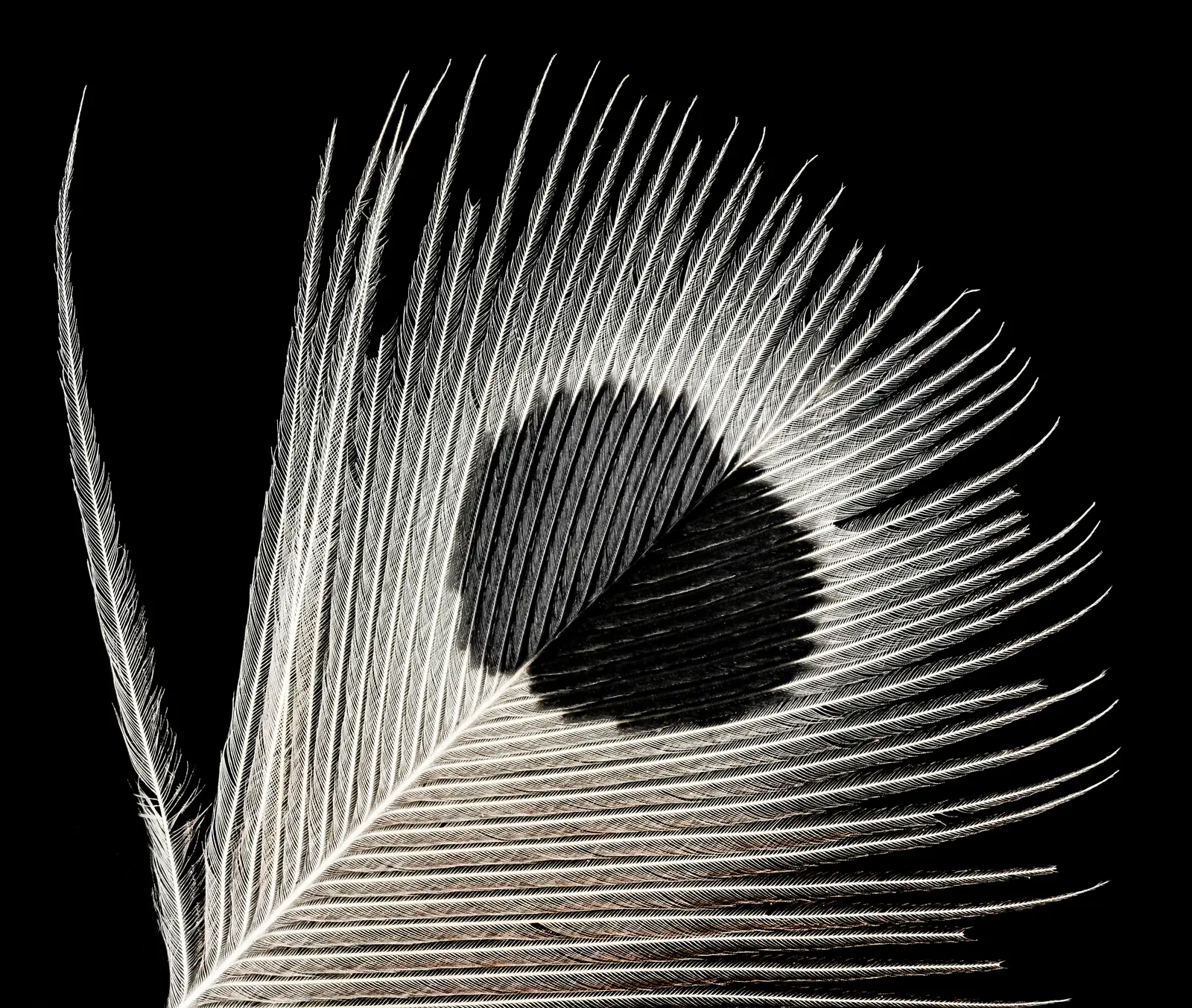
Full credit and license
"Yellow-shafted Flicker 1, U, Breast feather, Washington DC 2013-07-25-13.25.28 ZS PMax" by Sam Droege — https://commons.wikimedia.org/wiki/File:Yellow-shafted_Flicker_1,_U,_Breast_feather,_Washington_DC_2013-07-25-13.25.28_ZS_PMax_(9365352739).jpg — Public domain (U.S. Geological Survey work, 17 U.S.C. §105; marked Public Domain Mark 1.0 by the USGS Bee Inventory and Monitoring Lab)A Northern Flicker breast feather (labeled Yellow-shafted Flicker), focus-stacked by a U.S. Geological Survey lab, from a bird found in Washington, D.C., in 2012 after it struck a building.
Contour feathers include the flight feathers and the overlapping body feathers that give a bird its smooth outline. A contour feather can have a loose, fluffy layer at the base, where the barbs' side branches, called barbules, do not interlock as they do in the rest of the vane.
A down feather is built entirely of those loose barbs.
Small body feathers often have striking patterns, but the Feather Atlas FAQ calls illustrating them beyond the project's capabilities. The atlas skips them and the smaller coverts, except for a few especially large or boldly patterned body feathers, such as the Bald Eagle's and the turkey's.
Which clues point to a kind of bird?
Some traits point to a group of birds:
- Barred, with a soft, fuzzy texture: probably an owl, the atlas suggests. Long filaments give owl wing feathers a velvety nap (what that velvet does). A 2020 review reports similar velvet in harriers, the White-tailed Kite and some nightjars, while some fishing owls lack the usual silencing wing features.
- A shiny or waxy-looking patch along the shaft underneath: called tegmen, it marks a primary, probably from a duck, goose or swan, though some gamebirds, gulls and owls have it too.
- A bright patch in the middle of a secondary: dabbling ducks often have one, and on the spread wing these patches form the speculum.
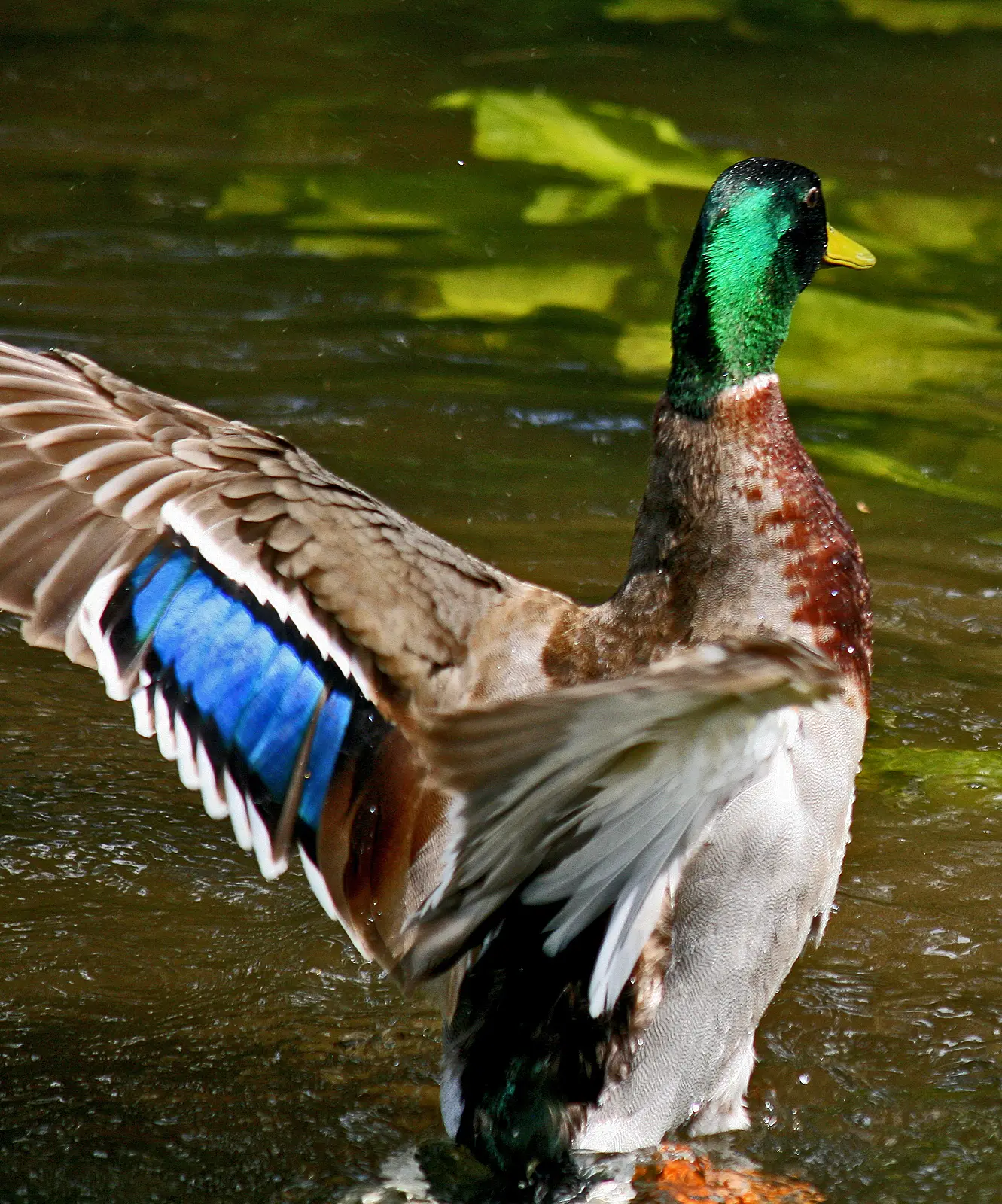
Speculum feathers of a male Mallard, as the photographer labels them: on the raised wing, blue patches form one band edged in black and white.
Color comes with caveats. A Blue Jay's blue is made by the feather's structure, not a blue pigment (Blue Without Blue Pigment: How a Blue Jay Feather Makes Its Color), and Cornell's Blue Jay guide describes pale-blue wing patches that can glitter or look dull depending on the angle of light. In many birds, plumage also differs with sex, age or geography, the atlas notes, so a scan of the right species may still not match.
What if the feather is not from a North American bird?
For birds outside North America, Featherbase is a wider reference: an online collection from German feather scientists and other collectors, with 2,108 species and a filter by country as of October 2026. The Feather Atlas FAQ notes that the Migratory Bird Treaty Act does not cover non-North American birds, though other laws and treaties may, such as CITES, which protects all birds of prey and almost all parrots. Knowing the species does not make a feather legal to keep; that depends on local law.
How long is a small, medium, large or huge feather?
The atlas sorts feathers into four classes by total length. For scale, a U.S. dollar bill is 6.14 inches (15.6 cm) long, a size the U.S. Currency Education Program dates to 1929.
- Small: 8 cm (about 3 inches) or shorter, about half a bill
- Medium: 8 to 16 cm, up to about one bill
- Large: 16 to 24 cm, up to about one and a half bills
- Huge: longer than 24 cm (about 10 inches)
The buzzard primary pictured above, labeled 285 mm, falls in the huge class, and its 200 mm secondary in the large class.
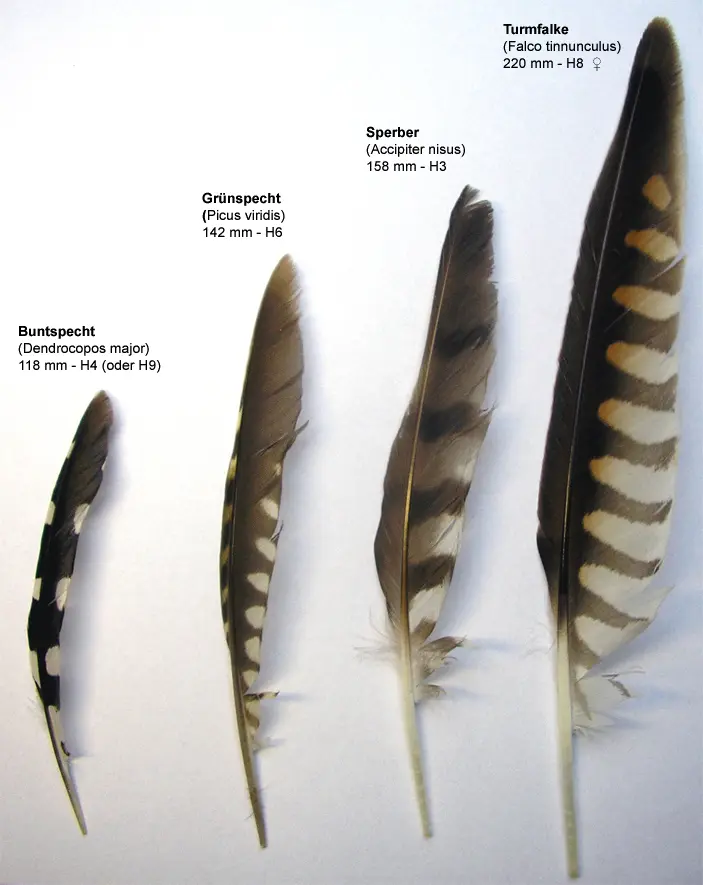
The photographer's German labels give these primaries' lengths: Great Spotted Woodpecker 118 mm, Eurasian Green Woodpecker 142 mm and Eurasian Sparrowhawk 158 mm, all medium; female Eurasian Kestrel 220 mm, large.
Next, see what the velvet on an owl's flight feathers does in flight: Owl Feathers: Silent Flight Is Partly a Friction Problem.
Figure: Where did it grow?
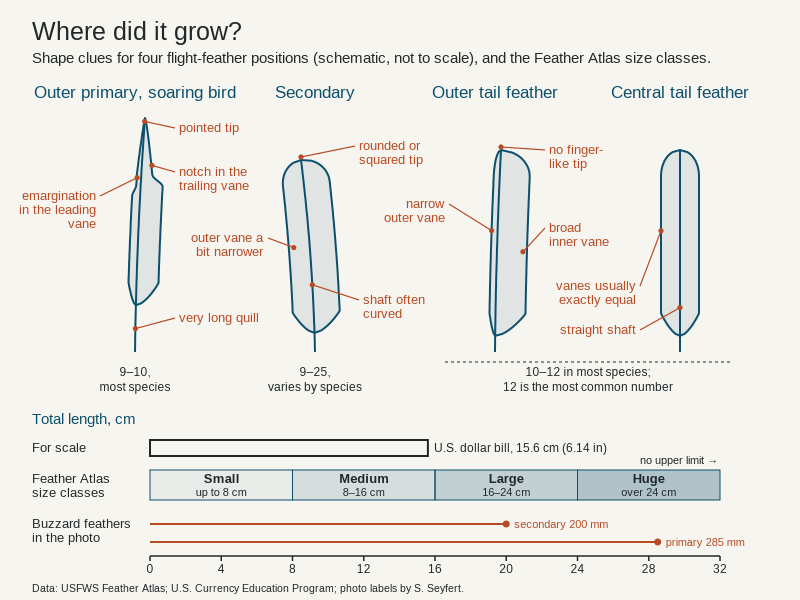
Drawn by this site from the Feather Atlas descriptions; schematic, not to scale and not traced from any scan. Every value, with its source: bird-feather-identification-position-chart.csv (CSV · JSON label).
Source card
- Images: six Wikimedia Commons photographs (two U.S. government works in the public domain, one CC0, two CC BY 2.5, one CC BY-SA 3.0), one public-domain plate from a 1914 book by Chester A. Reed, also via Commons, and one chart drawn by this site; licenses checked against the Commons records on 2026-10-10, and on 2026-10-13 for the plate, the Mallard and the primaries. Species names and feather positions follow the source labels.
- Web pages: the Feather Atlas and Cornell pages were read through Internet Archive copies (December 2025 to September 2026).
- Classification: bird names follow eBird/Clements (2025) and the GBIF Backbone Taxonomy.
- Look-alikes: this comparison page has no spec card and lists no misidentification twin.
Corrections: 2026-10-14: Added the section "What if the feather is not from a North American bird?", drawn from Featherbase and the Feather Atlas FAQ (the entry did not answer this question before).
Sources
- U.S. Fish and Wildlife Service, National Fish and Wildlife Forensics Laboratory. "Identify Feather: Determining Feather Position." The Feather Atlas. www.fws.gov/lab/featheratlas/id-position.htmlfull text via the Internet Archive copy of 2026-09-09 (snapshot 20260909111908)
- U.S. Fish and Wildlife Service, National Fish and Wildlife Forensics Laboratory. "Glossary." The Feather Atlas. www.fws.gov/lab/featheratlas/glossary.htmlfull text via the Internet Archive copy of 2026-09-08 (snapshot 20260908070138)
- U.S. Fish and Wildlife Service, National Fish and Wildlife Forensics Laboratory. "Identify Feather Tool." The Feather Atlas. www.fws.gov/lab/featheratlas/identify.htmlpage text via the Internet Archive copy of 2026-09-08 (snapshot 20260908093509)
- U.S. Fish and Wildlife Service, National Fish and Wildlife Forensics Laboratory. "The Feather Atlas: Feather Identification and Scans." Home page. www.fws.gov/lab/featheratlas/page text via the Internet Archive copy of 2026-09-08 (snapshot 20260908093522)
- U.S. Fish and Wildlife Service, National Fish and Wildlife Forensics Laboratory. "Frequently Asked Questions." The Feather Atlas. www.fws.gov/lab/featheratlas/faq.htmlfull text via the Internet Archive copy of 2025-12-14 (snapshot 20251214112737)
- Clark CJ, LePiane K, Liu L. "Evolution and Ecology of Silent Flight in Owls and Other Flying Vertebrates." Integrative Organismal Biology 2(1):obaa001 (2020) doi.org/10.1093/iob/obaa001full text read via Europe PMC, PMC7671161 (CC BY 4.0)
- Cornell Lab of Ornithology, All About Birds. "Blue Jay Overview." www.allaboutbirds.org/guide/Blue_Jay/overviewread via the Internet Archive copy of 2026-09-13 (snapshot 20260913123542)
- Cornell Lab of Ornithology, All About Birds. "Blue Jay Identification." www.allaboutbirds.org/guide/Blue_Jay/idread via the Internet Archive copy of 2026-07-29 (snapshot 20260729051414)
- U.S. Currency Education Program (Federal Reserve Board). "$1 Note." www.uscurrency.gov/denominations/1history timeline entry for 1929
- eBird/Clements taxonomy, version 2025, via the eBird API 2.0 taxonomy endpoint (Great Horned Owl, Common Buzzard, Northern Lapwing, Northern Flicker and its Yellow-shafted group, Blue Jay, Bald Eagle, Wild Turkey, White-tailed Kite) api.ebird.org/v2/ref/taxonomy/ebird?fmt=json&species=grhowl,combuz1,norlap,norfli,yesfli,blujay,baleag,wiltur,whtkit
- GBIF Backbone Taxonomy, species match API for Bubo virginianus (usageKey 5959118), Buteo buteo (2480537), Vanellus vanellus (2480242), Vanellus vulgaris (11290735, SYNONYM of 2480242) and Colaptes auratus (2478259) api.gbif.org/v1/species/match?kingdom=Animalia&name=Vanellus%20vulgaris
- eBird/Clements taxonomy, version 2025, via the eBird API 2.0 taxonomy endpoint (Mallard, Great Spotted Woodpecker, Eurasian Green Woodpecker, Eurasian Sparrowhawk, Eurasian Kestrel) api.ebird.org/v2/ref/taxonomy/ebird?fmt=json&species=mallar3,grswoo,eugwoo2,eurspa1,eurkestaxonomy entries (version 2025, the latest release)
- GBIF Backbone Taxonomy, species match API for Anas platyrhynchos (usageKey 9761484), Dendrocopos major (2477968), Picus viridis (2478523), Accipiter nisus (2480637) and Falco tinnunculus (9616058) api.gbif.org/v1/species/match?kingdom=Animalia&name=Anas%20platyrhynchosmatch results for all five names (status ACCEPTED, match type EXACT)
- Featherbase working group. Featherbase, scientific feather collection (featherbase.info), English home page www.featherbase.info/en/homehome page text: project description, collection totals and country filter
Cite this page
Plankton to Plumage. “Bird Feather Identification: Ask Where It Grew Before Whose It Is.” October 12, 2026, updated October 14, 2026. https://planktontoplumage.com/feathers/bird-feather-identification/
Add the date you read the page after the address if your style guide asks for it.