Comparison and chart pageNo. 0018
Seashell Identification: A Clam's Two Halves Are Its Left and Right Sides
Published Updated
Parts of this entry7 parts
Main images
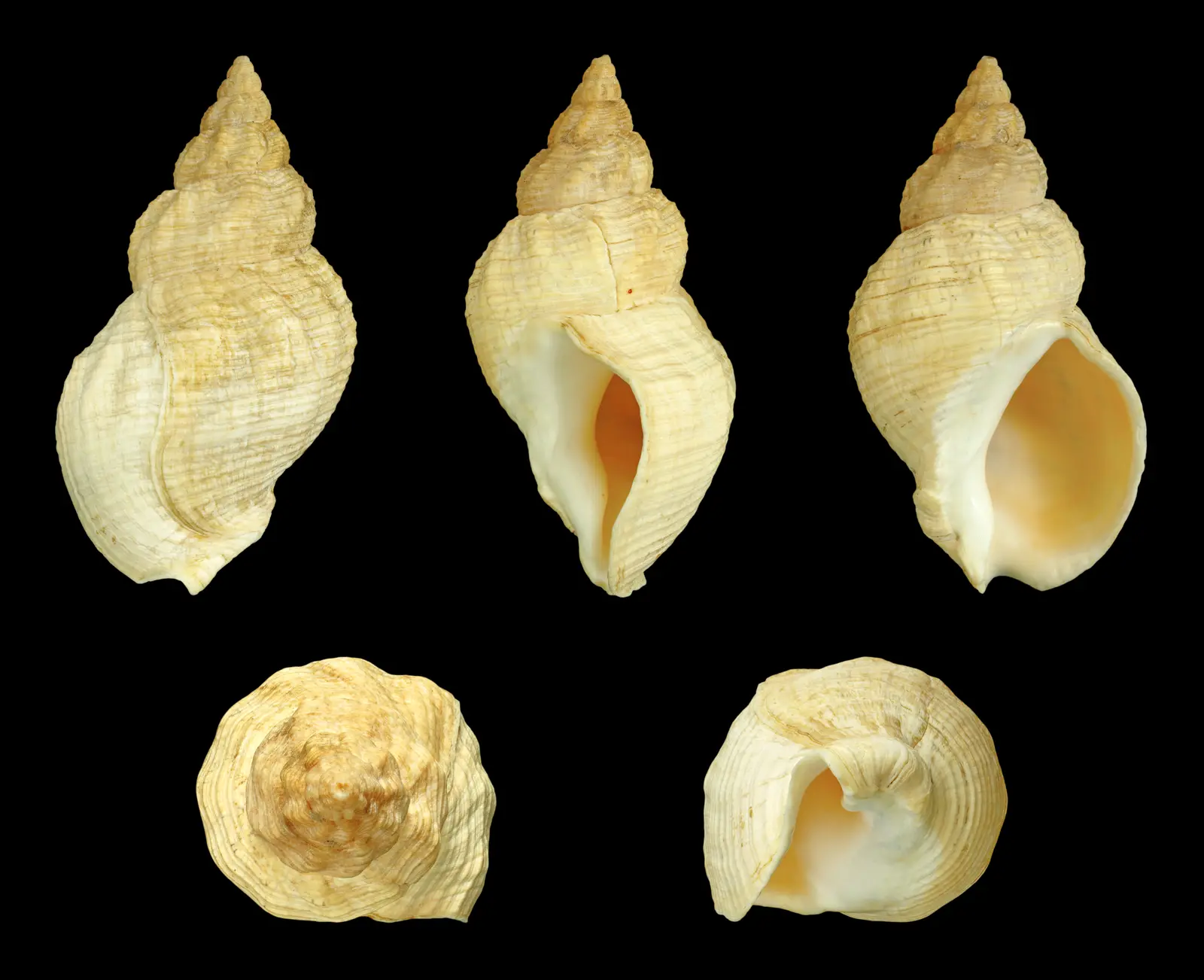
One common whelk shell from five sides. In the top-right view, held tip up, the opening sits on the right.
The short answer
Half a clam shell is one side of the animal, its left or its right, not its top or bottom. That fact also separates clams from lamp shells. Lamp shells look like clams, but they are not mollusks at all.
For seashell identification, count the pieces first:
- One piece, coiled: a snail, or gastropod. An uncoiled cap may be a limpet, also a snail; a lone clam valve has a hinge edge instead.
- Two valves: a clam or other bivalve, or a lamp shell (brachiopod) if each valve is symmetrical down its own midline.
- Eight plates in a row: a chiton, a mollusk mostly of rocky shores.
- A tube open at both ends: a tusk shell, another mollusk.
- A wall of plates fixed to rock: an acorn barnacle, which is a crustacean.
- A rigid disk with a petal pattern: a sand dollar, in the sea urchin class.
How do you identify a snail shell?
A gastropod has a single shell, often coiled, though some slugs have lost it. Most coil to the right. Hold the shell with its tip up. In a right-handed, or dextral, shell the opening is then on the right-hand side, and in a left-handed, or sinistral, shell it is on the left.
In some snails the opening is elongated to go with a siphon, a tube of tissue that draws in water. Many snails can close the opening with a lid called an operculum. The pulmonate snails, which include most land snails, almost all lack one.
Not every one-piece shell coils. True limpets wear a cap-shaped shell and cling tightly to rocks, and keyhole limpets have a hole just above the tip that lets water out. For why most snails coil right, see the left-handed snail page; for how one model describes coiled shapes, see the shell coiling model.
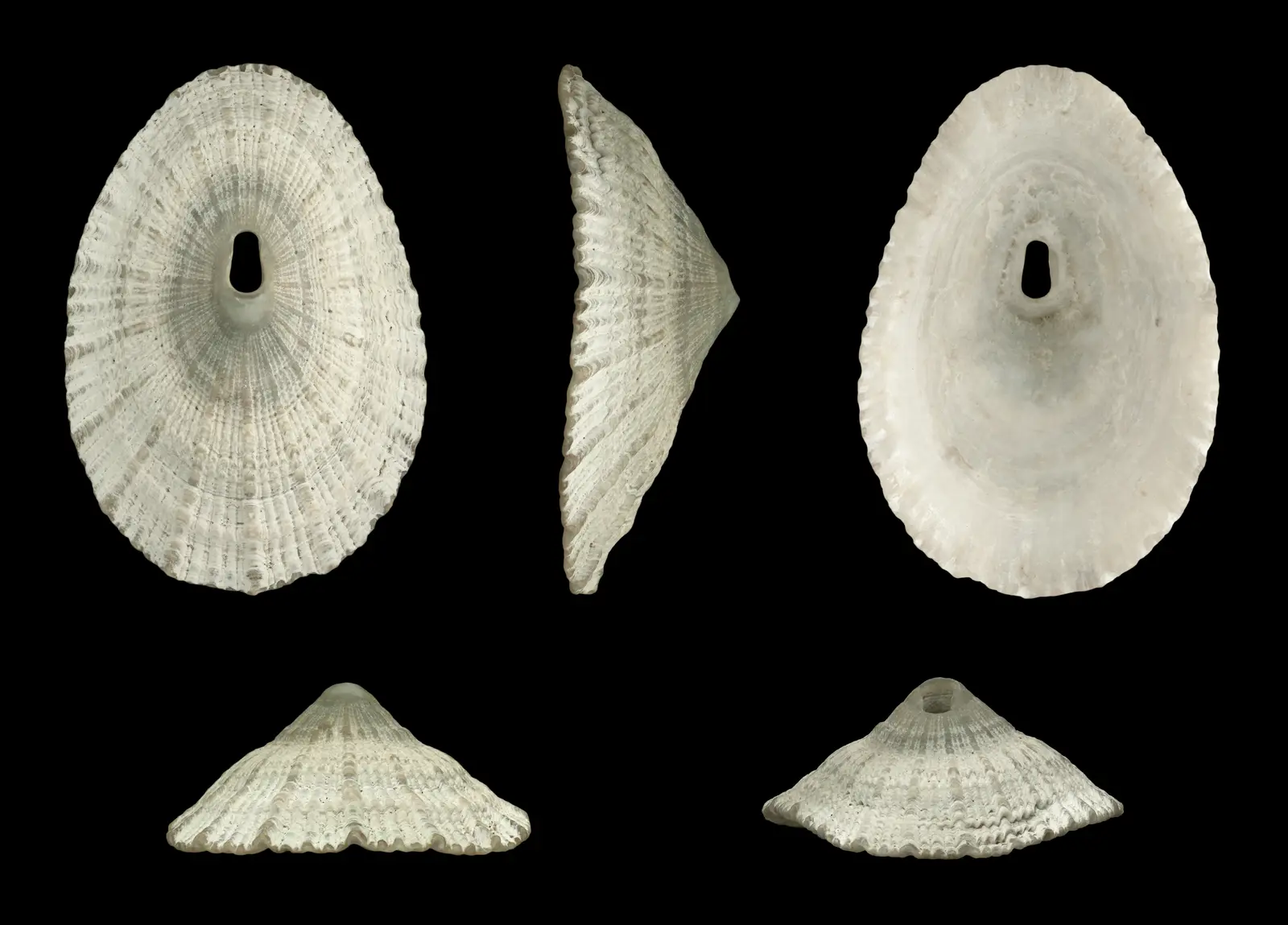
One Italian keyhole limpet shell from five sides: a single cap with no coil, with the hole that lets water out near its tip.
How do you identify a clam shell?
A bivalve's two valves are joined along one edge by a hinge, usually with interlocking teeth, and always by a horny ligament that pushes them apart. In most bivalves the valves lie on the animal's left and right sides, so its plane of symmetry runs between them. Each valve has a beak, or umbo, the earliest-formed part of the shell.
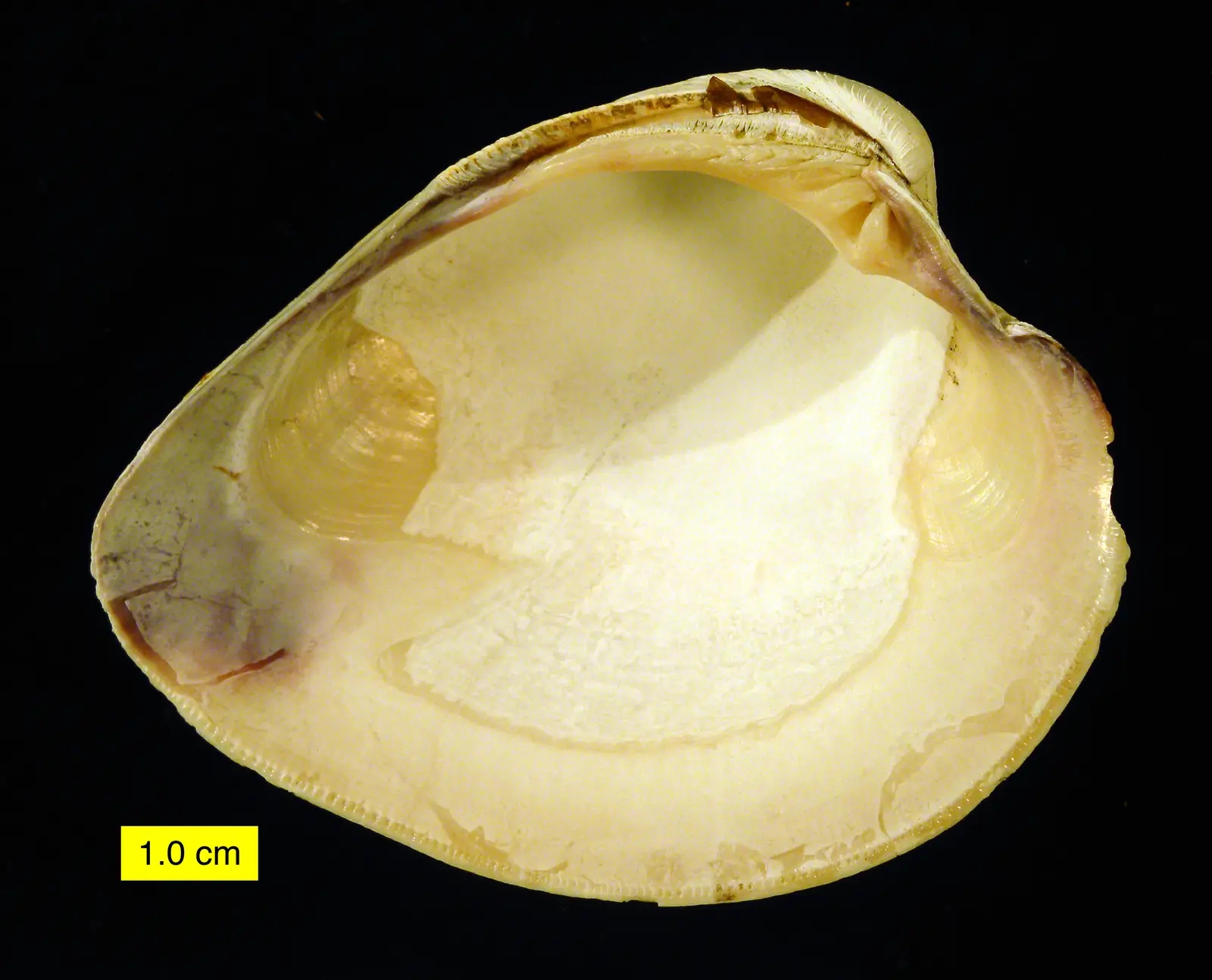
The inside of a hard clam valve, labeled a left valve at the source.
Inside a valve, three marks help. Muscle scars show where the muscles that close the shell were attached; there are usually two, sometimes one. The pallial line marks where soft tissue was attached to the shell, and a notch in it, the pallial sinus, shows up in bivalves with large siphons. Hinge teeth vary too: a row of many small, similar teeth in nut shells, a few large teeth in the family Veneridae, which includes the hard clam, and weak teeth near the beak in mussels.
A hole through a valve may be a predator's work: some carnivorous snails drill into shelled prey.
Is it a clam or a lamp shell?
Brachiopods, also called lamp shells, look like clams at first glance. Many early naturalists counted both as mollusks, but brachiopods belong to a separate phylum, Brachiopoda, related to the bryozoans, the animals that own the name "moss animals."
The quick test is symmetry. In most brachiopods the plane of symmetry cuts across both valves, so each valve is symmetrical about its own midline, while most clam valves are slightly twisted and lopsided across theirs. The two brachiopod valves are often unequal in size, and the larger one often has an opening for a fleshy stalk, the pedicle. Most living brachiopods live in cold or deep water, where few people go.
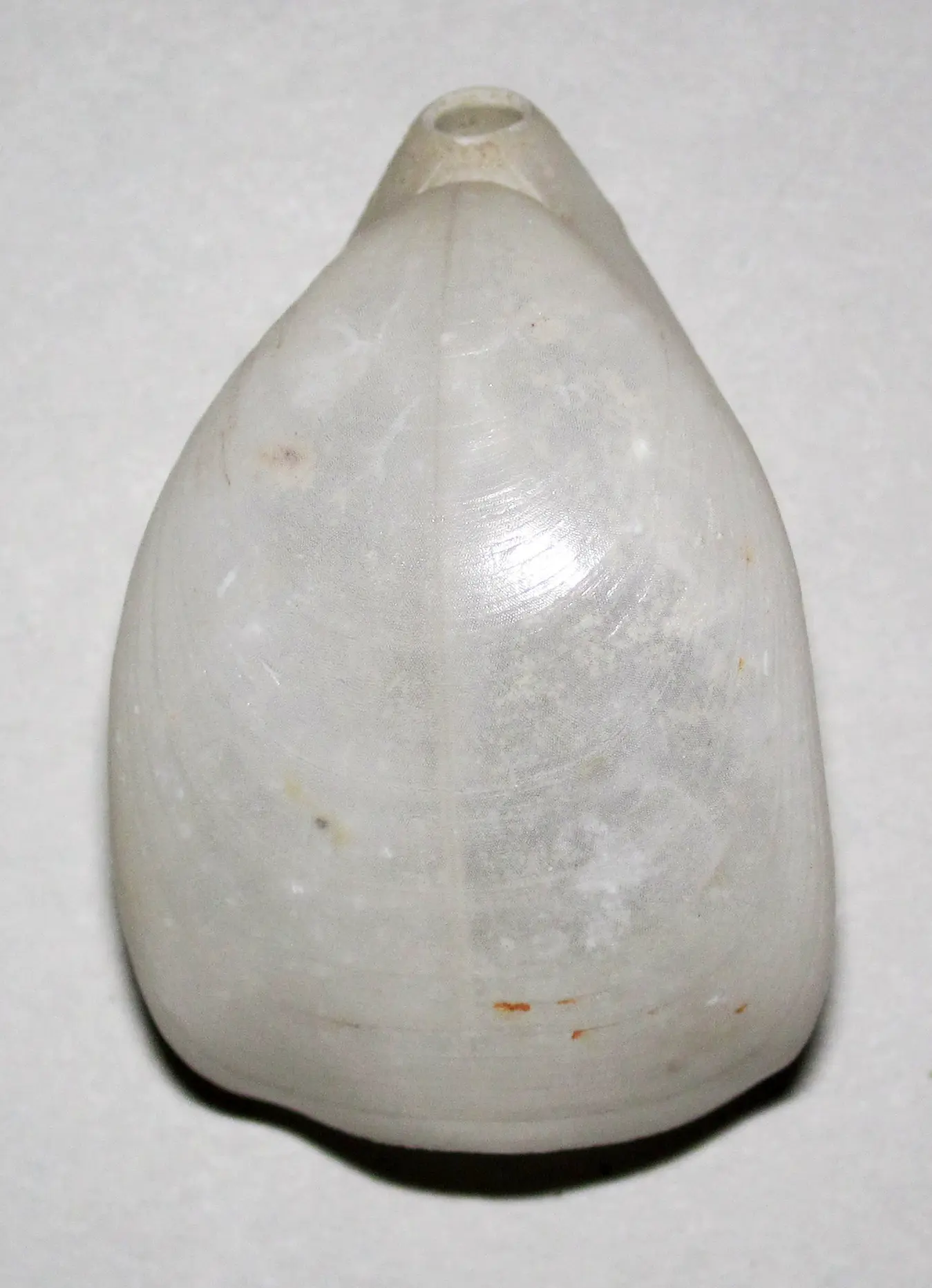
A lamp shell, Campages asthenia, seen from one valve, which is symmetrical down its midline. The round hole at the top is in the other valve.
What about finds that are not snails or clams?
Chitons carry eight overlapping plates in a row, bordered by a thick girdle that may bear spines, scales or hairs. Most live on rocky shores, between the tides or just below.
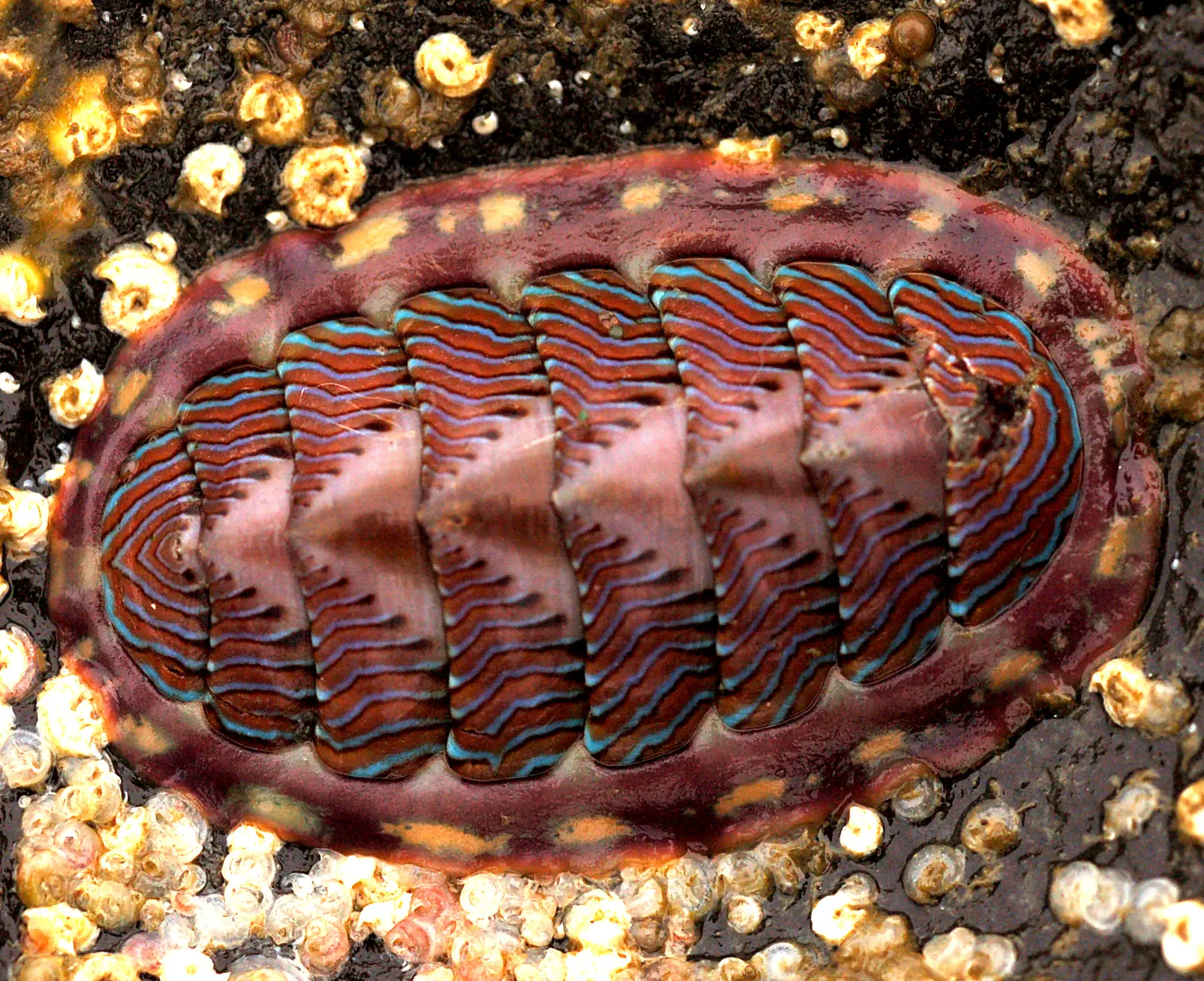
A tusk shell is a tapering, slightly curved tube. Unlike most mollusk shells, it is open at both ends.
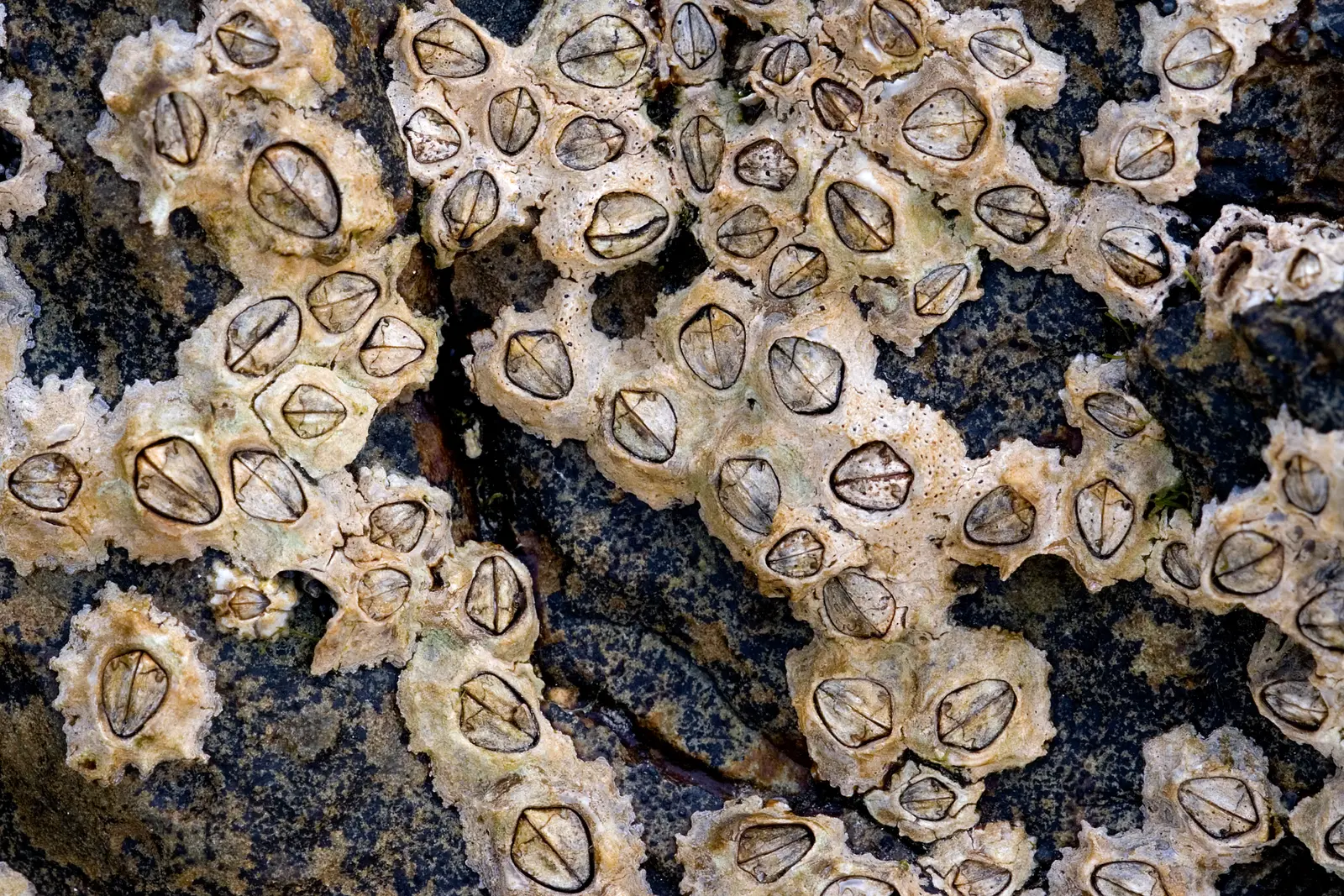
Acorn barnacles are crustaceans, in the same subphylum as crabs. They are the rough white barnacles seen on intertidal rocks worldwide. A barnacle larva swims, then attaches to a hard surface, where the animal, in effect, sits on its head and builds the hard plates that surround it.
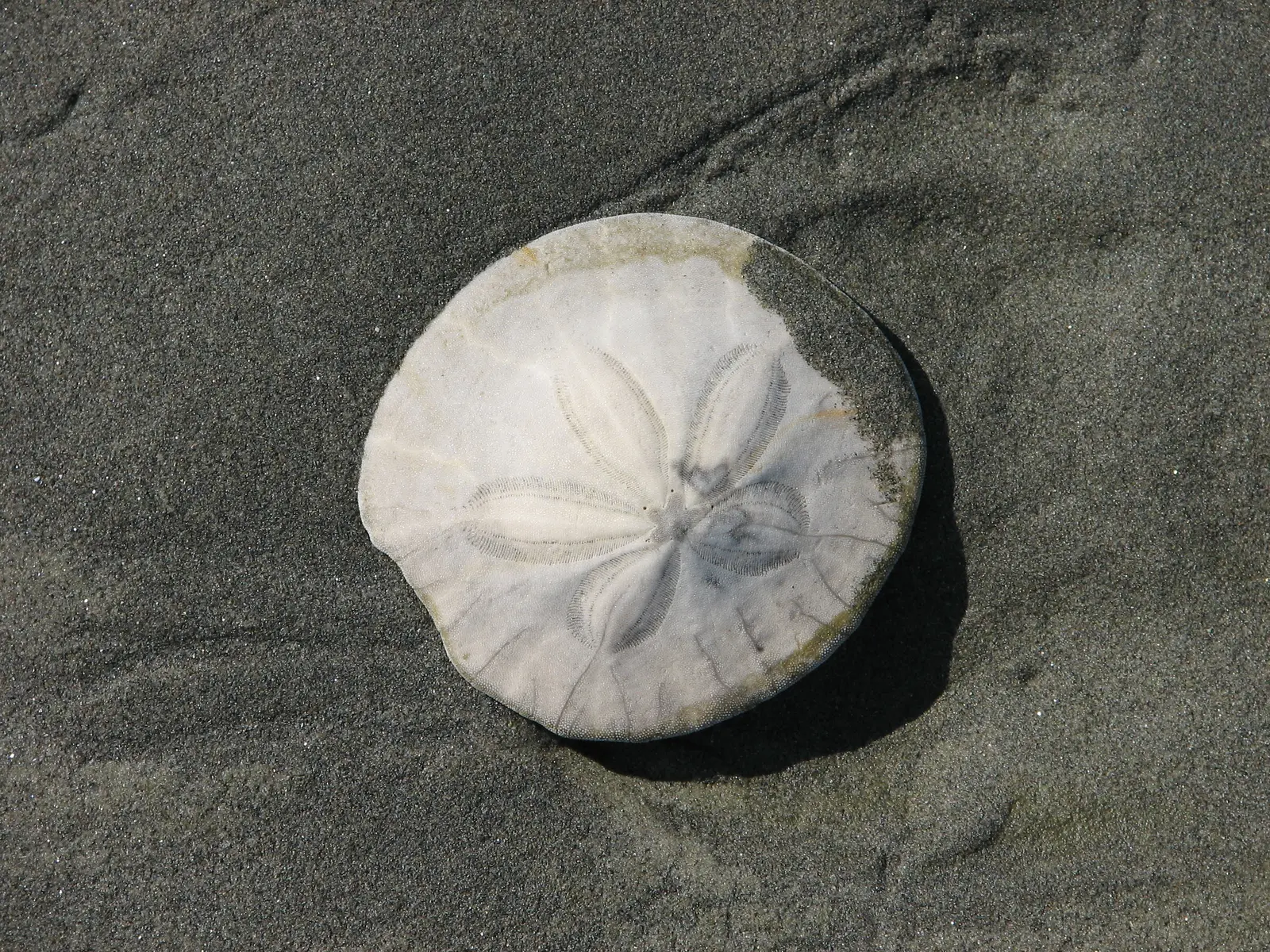
Sand dollars belong to the class Echinoidea, with sea urchins. The bare disk is the test, a skeleton of tightly interlocking plates, and the petal pattern is made of rows of pores used for breathing. A living sand dollar, like a heart urchin, is covered in very short spines that form an almost felt-like coat.
What should you check before you pick up a shell?
Before you look for shells along the shore, check the tide table and never turn your back to the ocean; the National Park Service reports that tidepoolers have died after being struck by sneaker waves. Do not wade in, and do not climb wet rocks or walk on seaweed, which is especially slippery. Leave any shell with an animal inside, whether the snail that built it or a hermit crab that moved in, and do not pull off anything clinging to a rock. Naming a shell is not permission to take it, and even empty shells can be off-limits: some national parks prohibit collecting any shell, so check the rules where you are.
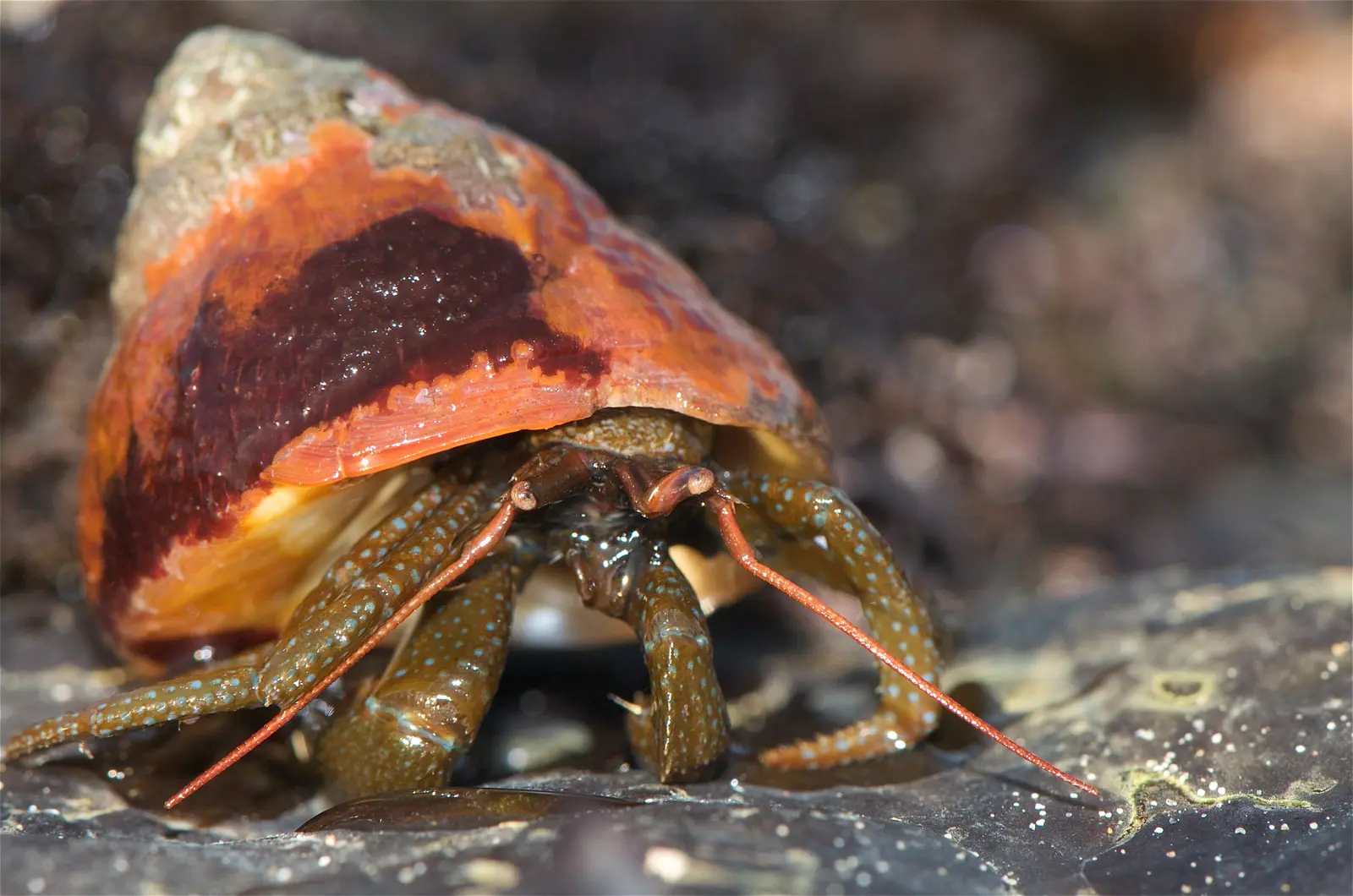
A hermit crab, Pagurus samuelis, living in the shell of a brown turban snail. A shell with any animal inside stays where you found it.
Seashell identification, side by side
| Find | Pieces | Group | Mollusk? | What to check |
|---|---|---|---|---|
| Snail | 1, usually coiled | Gastropoda | Yes | Tip up: in most, the opening is on the right |
| Limpet | 1, cap-shaped | Gastropoda | Yes | No coil and no hinge edge, unlike a lone clam valve |
| Clam | 2 valves | Bivalvia | Yes | In most, the symmetry plane runs between the valves; scallops and oysters depart from it |
| Lamp shell | 2 valves | Brachiopoda | No | In most, each valve is symmetrical down its midline |
| Chiton | 8 plates | Polyplacophora | Yes | Girdle around the plates; a few species have reduced or internal plates |
| Tusk shell | 1 tube | Scaphopoda | Yes | Open at both ends |
| Acorn barnacle | A wall of plates | Cirripedia | No | Fixed to rock; some barnacles attach to floating objects or whales |
| Sand dollar | 1 rigid test | Echinoidea | No | Petal pattern; felt-like spines when alive, as on heart urchins |
Every clue, with its sources, is in the CSV: seashell-identification-key.csv (CSV · JSON label).
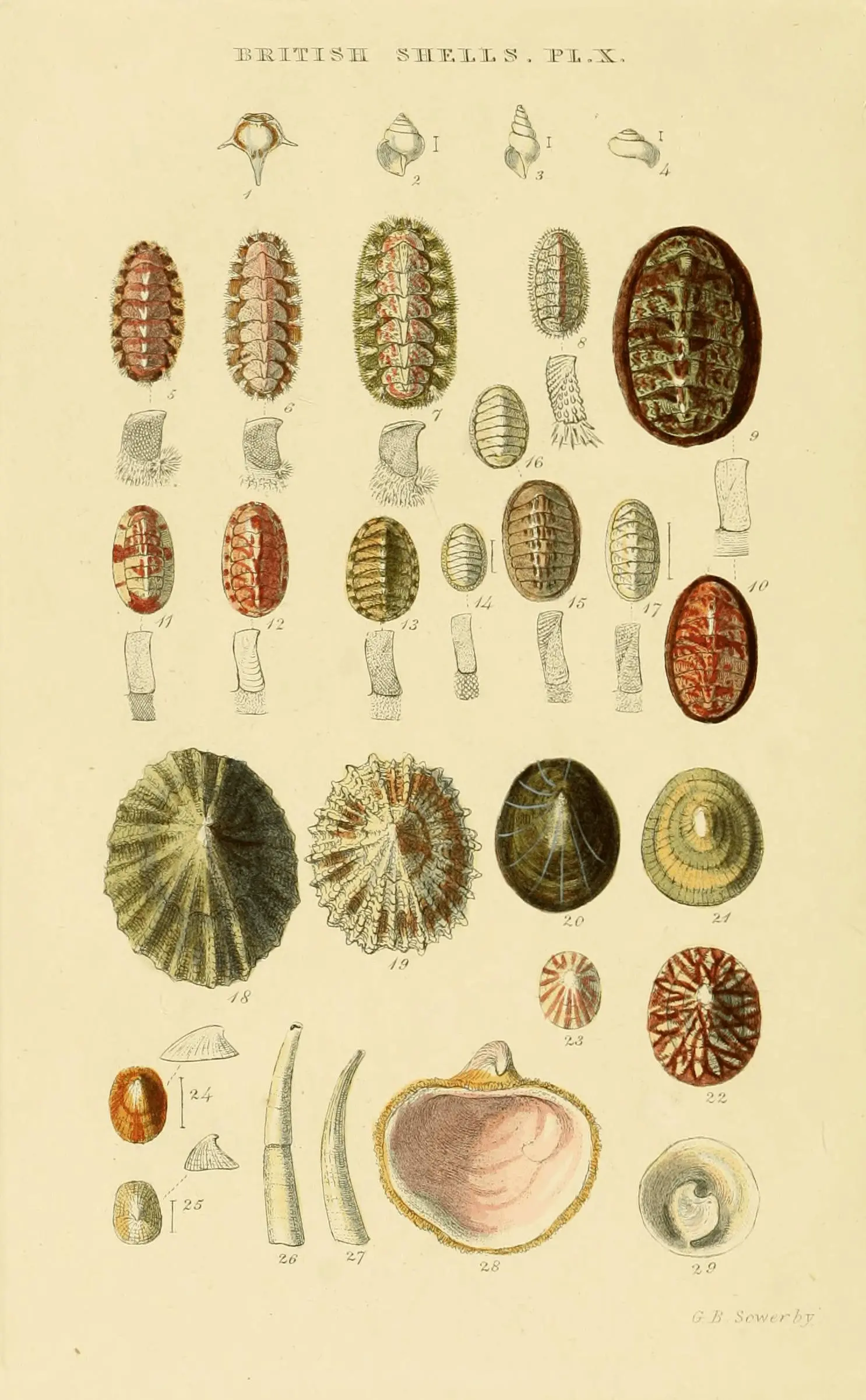
Chitons, limpets and two tusk shells side by side on one 1859 plate of British shells.
How do you go from the group to the species?
Getting from the group to a species can take more than the shell's shape, and where it was found matters. A 2025 review of Korean Siphonaria, the false limpets, notes that many mollusk shells vary in shape, sculpture, size and color with their surroundings, so shell-only identifications often go wrong; its authors also checked feeding teeth and DNA. They doubted four earlier Korean records partly because those species' known ranges did not fit. The World Register of Marine Species then shows whether a proposed name is currently accepted.
Next, see how one model describes both kinds of shell: A Seashell Is an Equation: Four Numbers Draw Both a Snail and a Clam.
Figure: Count the pieces
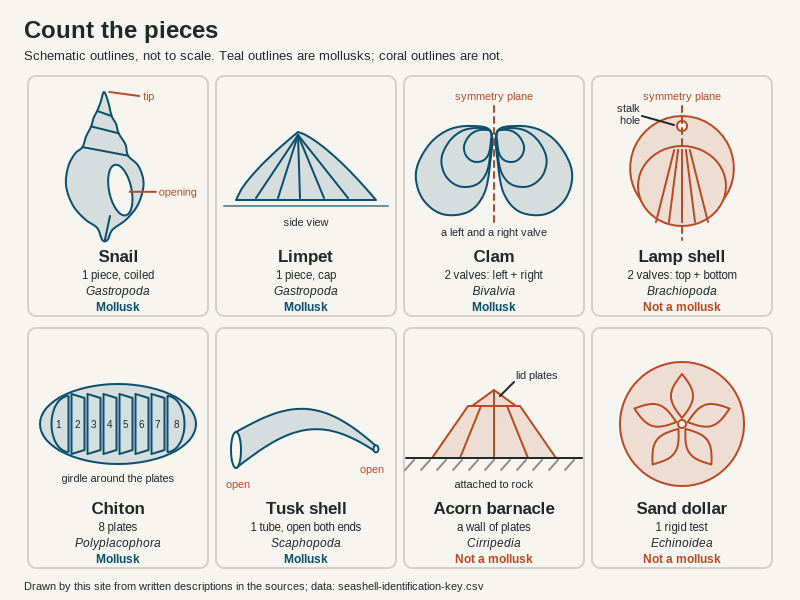
Drawn by this site from the sources' written descriptions, not traced from any published figure; not to scale.
Source card
- Images: eight Wikimedia Commons photographs (four CC BY-SA 3.0, four CC BY 2.0), one public-domain 1859 plate from Wikimedia Commons and one chart drawn by this site; licenses and file hashes checked against the Commons records on 2026-10-10 for five photographs and on 2026-10-13 for three photographs and the plate; species names follow the source labels.
- Classification: WoRMS lists every species shown as accepted (checked 2026-10-10, and 2026-10-13 for the three species added that day) and puts barnacles in the subphylum Crustacea with crabs. Lamp shells can be confused with clams, the closest thing here to a misidentification twin (sources 1 and 6).
- Data: each clue traces to a numbered source and the CSV.
Corrections: 2026-10-14: Added the section "How do you go from the group to the species?", drawn from a 2025 review of Korean false limpets and the World Register of Marine Species (the entry did not answer this question before).
Sources
- Pier JQ. "Brachiopods vs Bivalves." In: Pier JQ (2019), Brachiopoda, The Digital Encyclopedia of Ancient Life, Paleontological Research Institution www.digitalatlasofancientlife.org/learn/brachiopoda-vs-bivalvia/full page text
- Bunje P. "The Gastropoda: Snails and slugs, limpets, and sea hares." University of California Museum of Paleontology (UCMP), Berkeley ucmp.berkeley.edu/taxa/inverts/mollusca/gastropoda.phpfull page text
- Schilthuizen M, Haase M. "Disentangling true shape differences and experimenter bias: are dextral and sinistral snail shells exact mirror images?" Journal of Zoology 282:191–200 (2010) doi.org/10.1111/j.1469-7998.2010.00729.xfull text read via Europe PMC, PMC3020325 (Introduction)
- Bunje P. "The Bivalvia: Scallops, clams, mussels, and more." University of California Museum of Paleontology (UCMP), Berkeley ucmp.berkeley.edu/taxa/inverts/mollusca/bivalvia.phpfull page text
- Allmon WD, Mikkelsen PM. "Bivalvia." The Digital Encyclopedia of Ancient Life, Paleontological Research Institution (2020) www.digitalatlasofancientlife.org/learn/mollusca/bivalvia/full page text (Introduction and Morphology)
- "Introduction to the Brachiopoda: Of lamp shells and lophophores." University of California Museum of Paleontology (UCMP), Berkeley ucmp.berkeley.edu/brachiopoda/brachiopoda.htmlfull page text
- "Brachiopoda: More on Morphology." University of California Museum of Paleontology (UCMP), Berkeley ucmp.berkeley.edu/brachiopoda/brachiopodamm.htmlfull page text
- Pier JQ. "Brachiopoda." The Digital Encyclopedia of Ancient Life, Paleontological Research Institution (2019) www.digitalatlasofancientlife.org/learn/brachiopoda/full page text
- Bunje P. "The Polyplacophora: Chitons, the eight-shelled molluscs." University of California Museum of Paleontology (UCMP), Berkeley (2003) ucmp.berkeley.edu/taxa/inverts/mollusca/polyplacophora.phpfull page text
- Speer B. "The Scaphopoda: Tusk shells." University of California Museum of Paleontology (UCMP), Berkeley (2000) ucmp.berkeley.edu/taxa/inverts/mollusca/scaphopoda.phpfull page text
- "Cirripedia: Life History." University of California Museum of Paleontology (UCMP), Berkeley ucmp.berkeley.edu/arthropoda/crustacea/maxillopoda/cirripedialh.htmlfull page text
- "Cirripedia: Systematics. Barnacles and their Relatives." University of California Museum of Paleontology (UCMP), Berkeley ucmp.berkeley.edu/arthropoda/crustacea/maxillopoda/cirripediasy.htmlfull page text
- "Introduction to the Echinoidea." University of California Museum of Paleontology (UCMP), Berkeley ucmp.berkeley.edu/echinodermata/echinoidea.htmlfull page text
- National Park Service. "Tidepooling at Point Reyes National Seashore." www.nps.gov/pore/planyourvisit/tidepooling.htmfull page text
- National Park Service. "Tidepooling – Acadia National Park." www.nps.gov/acad/planyourvisit/tidepooling.htmfull page text
- National Park Service. "The Rocky Intertidal Zone – Cabrillo National Monument." www.nps.gov/cabr/learn/nature/tidepools.htmfull page text
- WoRMS Editorial Board. World Register of Marine Species (WoRMS), REST API records for Buccinum undatum (AphiaID 138878), Mercenaria mercenaria (141919), Tonicella lineata (386441), Chthamalus stellatus (106231), Dendraster excentricus (513215), Brachyura (106673) and the classes and phylum named on the page www.marinespecies.org/rest/taxon records, classification chains and English vernacular names
- "Introduction to the Bryozoa: 'Moss animals'." University of California Museum of Paleontology (UCMP), Berkeley ucmp.berkeley.edu/bryozoa/bryozoa.htmlfull page text
- Kim Y, Park J, Hwang UW, Park J-K. "Taxonomic review of Korean Siphonaria species (Mollusca, Gastropoda, Siphonariidae)." Biodiversity Data Journal 13:e139388 (2025) doi.org/10.3897/BDJ.13.e139388full text (CC BY 4.0)
- WoRMS Editorial Board. "What is WoRMS?" World Register of Marine Species www.marinespecies.org/about.phppage text
Cite this page
Plankton to Plumage. “Seashell Identification: A Clam's Two Halves Are Its Left and Right Sides.” October 12, 2026, updated October 14, 2026. https://planktontoplumage.com/shells/seashell-identification/
Add the date you read the page after the address if your style guide asks for it.