Comparison and chart pageNo. 0013
Moss Animals: Tardigrade, Rotifer or Nematode? Look for Legs, Wheels or Waves
Published
Parts of this entry8 parts
Main images
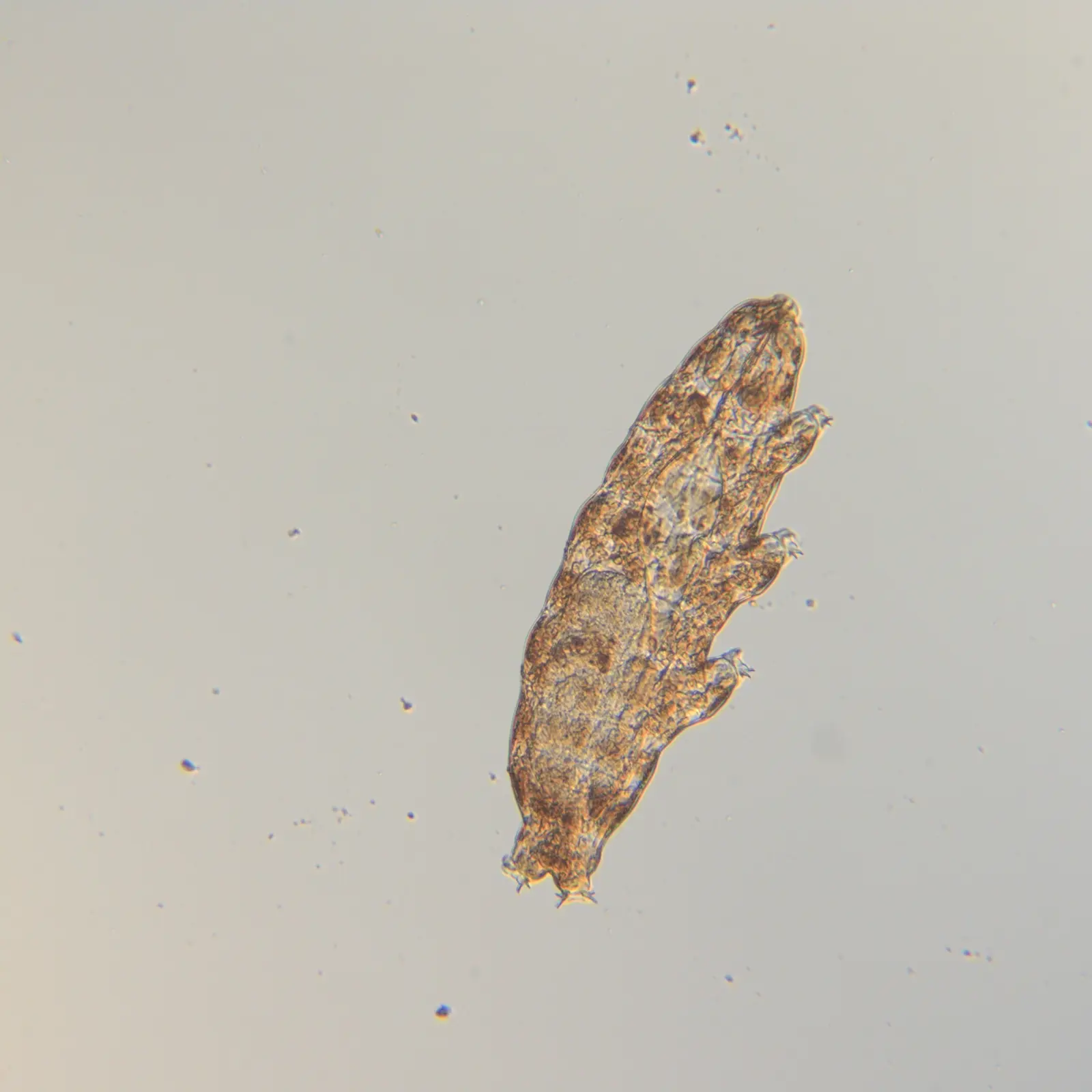
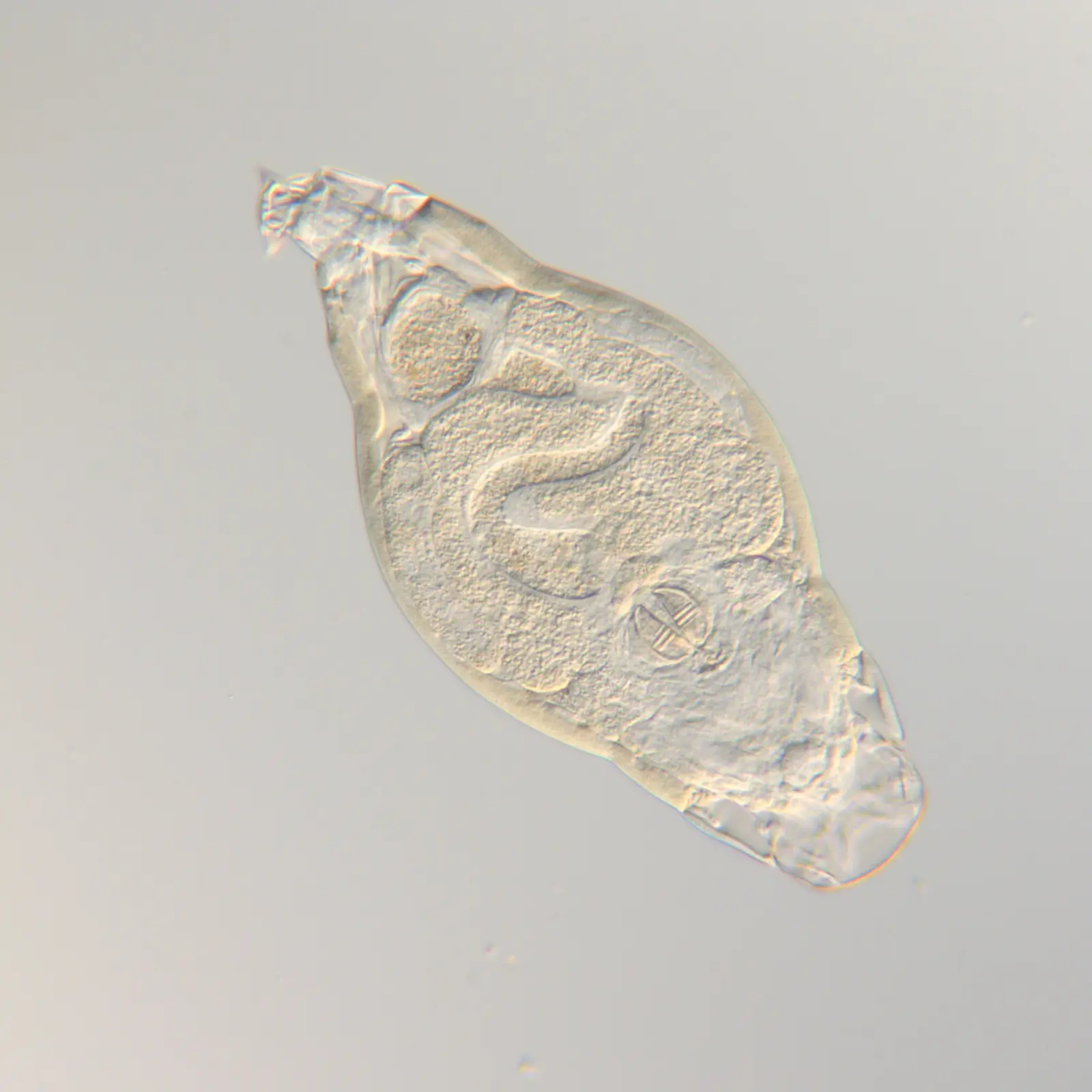
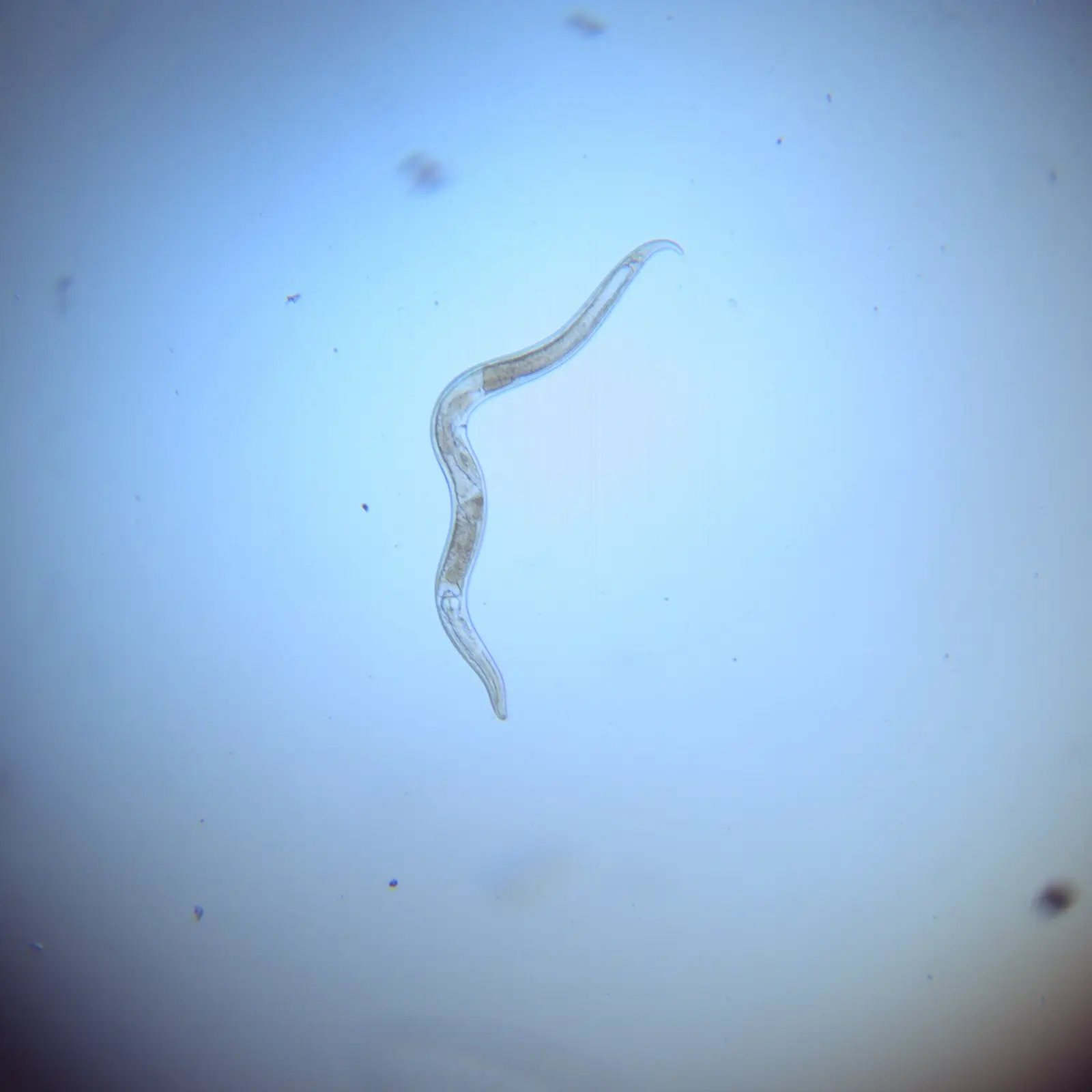
Photographed by Lukas Schärer from mosses collected in Basel, Switzerland (records dated 14 November 2024). No record is research grade on iNaturalist, so this page names each animal only to phylum, or to Bdelloidea for the rotifer. No scale bars.
The short answer
The name "moss animals" already belongs to bryozoans, and every bryozoan lives in water. Animals in wet moss under a microscope include members of three other phyla. One feature goes a long way toward sorting them:
- Legs: eight stubby legs, most often tipped with claws, mean a tardigrade. Legs that bend at joints mean an arthropod, such as a mite.
- Wheels: no legs, a crown of beating cilia on the head and a body that telescopes in and out mean a rotifer. The genus Adineta has no crown, and a disturbed rotifer may contract into a ball.
- Waves: no legs, no crown and a thread-like body that bends in S-shaped waves mean a nematode. Not every nematode is thread-like, and a drying one may coil up.
Which animals are the real "moss animals"?
Bryozoans, or "moss animals," are aquatic animals that live mostly in colonies of linked individuals. About 5,000 living species are known, most of them marine. An individual is rarely larger than a millimeter.
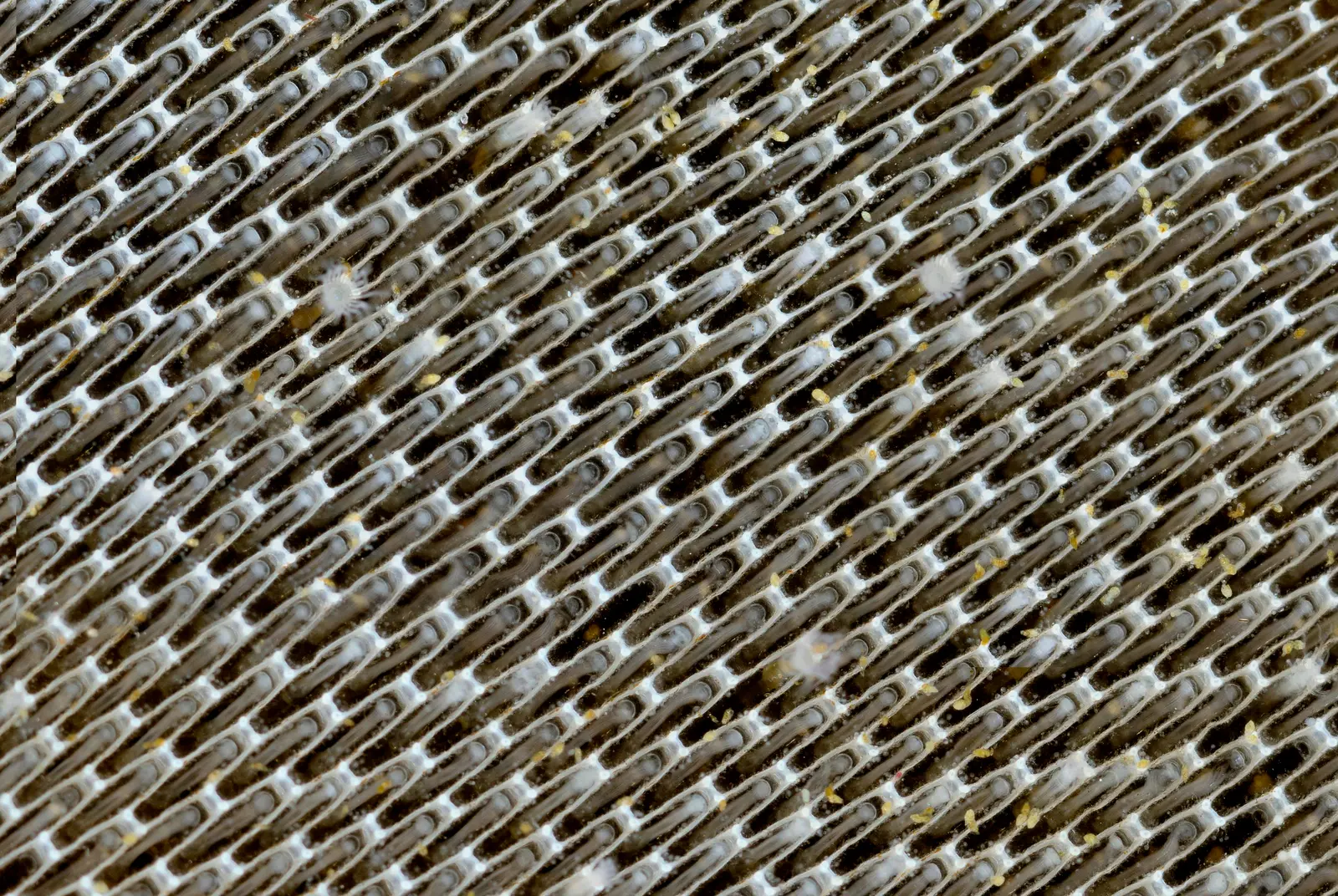
A colony of the marine bryozoan Membranipora membranacea on kelp. Each rectangular box is one individual.
Tardigrades have nicknames of their own, water bears and moss piglets, and the scientific names keep all four apart: Tardigrada, Rotifera, Nematoda and Bryozoa are separate phyla. A 2025 survey of tree microhabitats in a Pyrenees beech forest, mosses among them, counted nematodes, tardigrades, rotifers and mites.
Tardigrade, rotifer or nematode: side by side
| Feature | Tardigrade | Bdelloid rotifer | Nematode |
|---|---|---|---|
| Phylum | Tardigrada | Rotifera | Nematoda |
| Legs | 4 pairs, unsegmented, most often clawed | None | None |
| Body | Head plus 4 trunk segments | Telescopes in and out; ends in a foot | Generally long, narrow and threadlike; unsegmented |
| Crown of cilia | — | In many species; none in Adineta | None |
| Movement | Slow; the name means "slow-stepper" | Crown pulls in water; foot holds on | S-shaped waves; cannot crawl or lift itself |
| Usual length | 0.25–0.5 mm | 0.2–0.5 mm (most rotifers) | Mostly under 1 mm in one wind-trap study |
| When dried | A shriveled tun | A flat, oval tun | Some coil or clump |
Each cell's source is listed in the CSV: moss-animals-comparison.csv (CSV · JSON label).
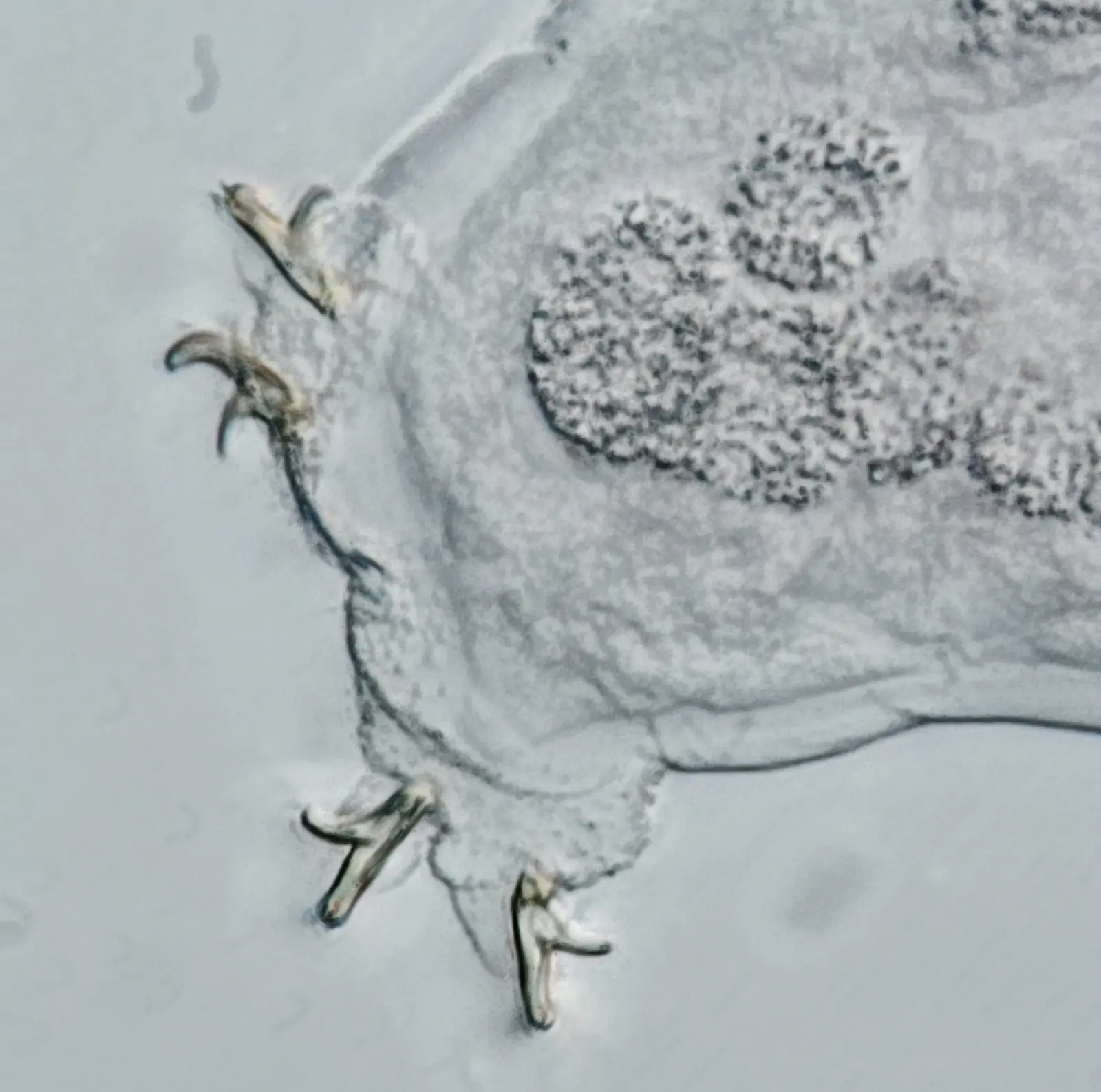
Close-up of a tardigrade from moss beside a trail in Ontario, Canada. Each stubby leg ends in hooked claws.
How do you tell a tardigrade from a rotifer?
Count legs first. A tardigrade has a head and four trunk segments. Each trunk segment carries one pair of unsegmented legs that most often end in claws.
A rotifer has no legs. Its body ends in a foot with a "toe" holding a cement gland it uses to attach itself.
Then look at the head. In most rotifers, a crown of cilia (beating, hair-like strands) pulls a current of water into the mouth, and in some species the cilia seem to whirl like wheels. The name "rotifer," Latin for "wheel-bearer," refers to this crown. Not every rotifer has a crown: Adineta has none.
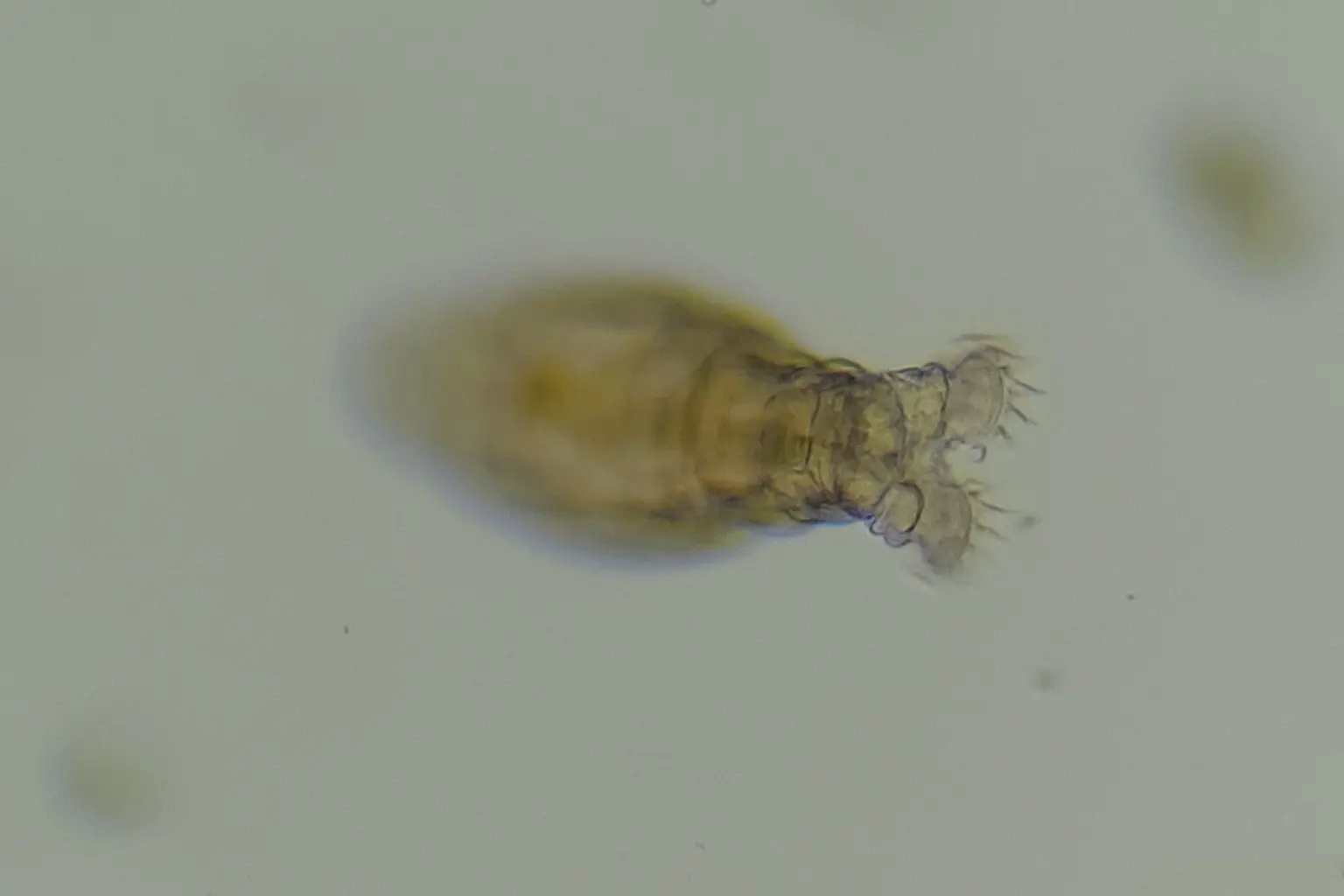
A bdelloid with its crown out, from wet moss in California (identified on iNaturalist only to the family Philodinidae, not research grade).
A disturbed rotifer may contract into a ball. Then look for the jaws, called trophi. They grind food and are found in almost all rotifers. In the contracted bdelloid at the top of this page, the round structure with ridged plates looks like these jaws, though the record does not label it.
How do you tell a rotifer from a nematode?
Both lack legs, so watch the shape and the motion. A nematode is generally long, narrow and threadlike, and not segmented. Its name comes from the Greek nema, "thread." It has no crown of cilia.
Its muscles all run lengthwise, so it can only bend from side to side, not crawl or lift itself, and in water it seems to thrash about. A 2013 primer describes the motion as sinusoidal waves made while the worm lies on one side.
A rotifer changes its length instead. It telescopes in and out under a semi-flexible, see-through cuticle.
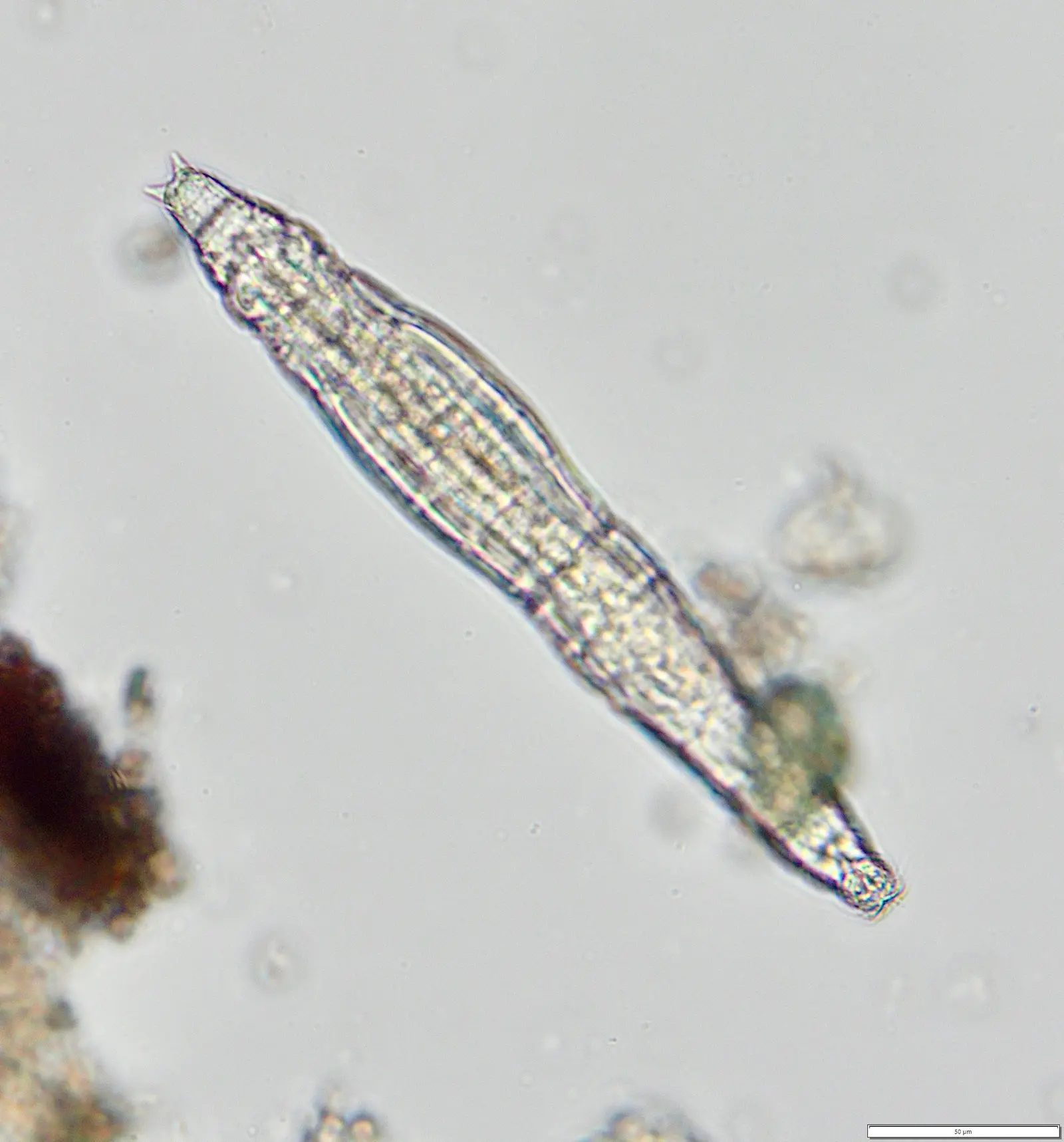
A bdelloid rotifer from moss in New Zealand, stretched out long, with a 50 µm scale bar; the contracted bdelloid at the top of the page is a different animal.
What about mites?
Mites also live in moss; the 2025 survey counted them too. A mite is an arthropod, and arthropods are named for their jointed limbs. Tardigrade legs are unsegmented. Counting legs alone can mislead, because some mites have reduced or lost one, two or three pairs.
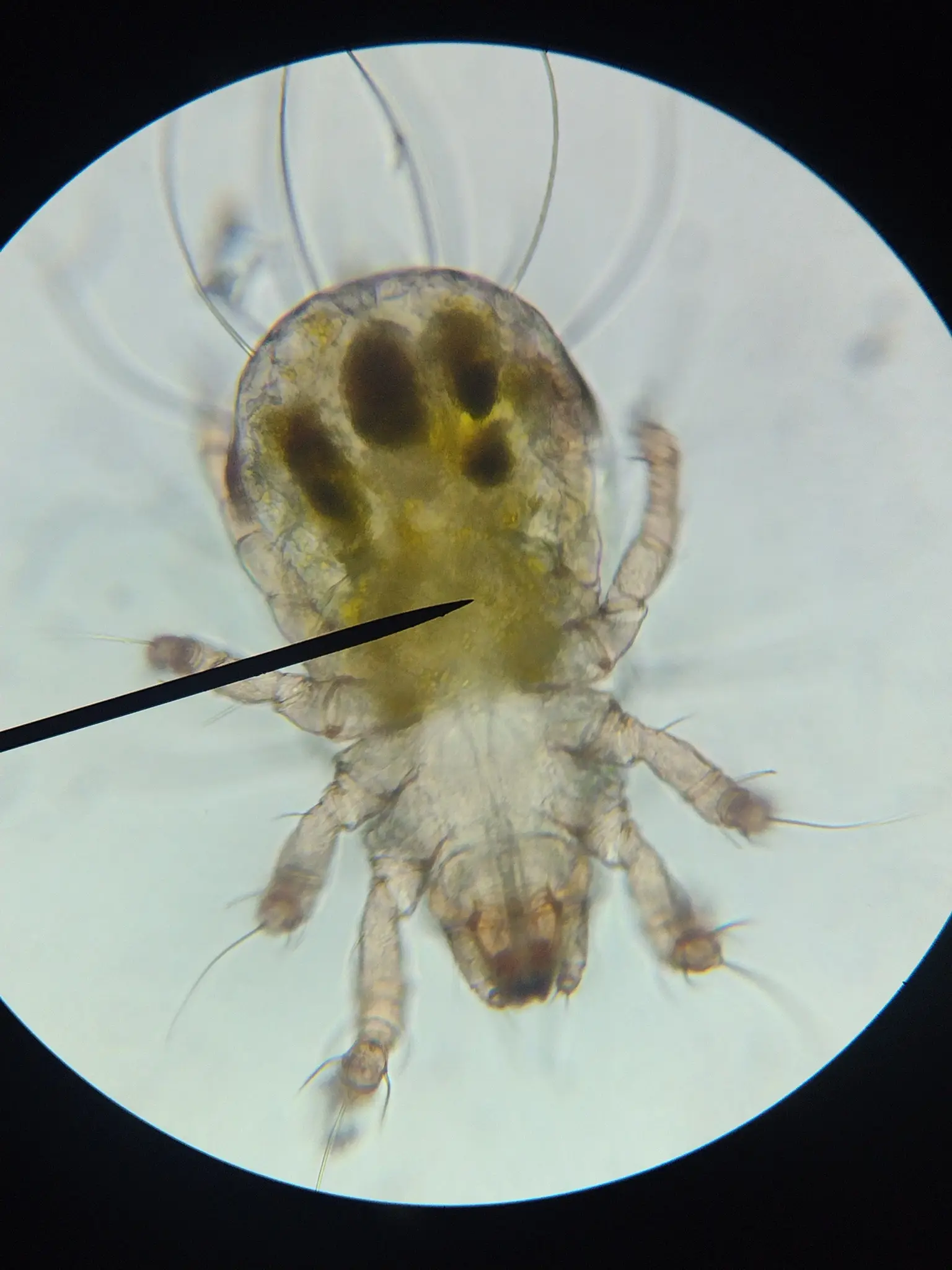
A mite found inside a moss capsule in Poland, seen from below. Its legs are built of jointed segments; the black needle is not part of the mite.
Are tardigrades, rotifers and nematodes related?
Not the way their shapes suggest. Tardigrades and nematodes both belong to Ecdysozoa, a branch of animals that shed their cuticle as they grow, while rotifers sit in a separate branch, Spiralia. So the legless nematode is a closer relative of the eight-legged tardigrade than the legless rotifer is.
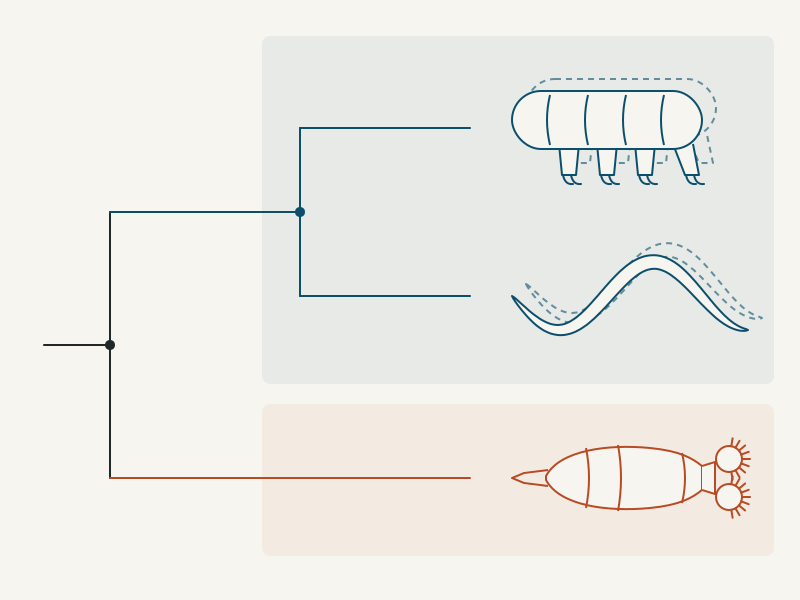
Tardigrades and nematodes share one branch, Ecdysozoa (teal), whose members shed their cuticle as they grow (dashed outlines); rotifers sit on another, Spiralia (coral). Schematic: branch lengths are not to scale.
Members of all three groups can survive drying. Not every species can. Tolerant tardigrades manage it at all life stages, with uneven success across species and stages, and so do many Panagrolaimus nematodes. Most bdelloid species can dry out at any life stage, but a few that live permanently in water, such as Rotaria macrura, cannot.
Dried, a tardigrade shrivels into a "tun," a bdelloid contracts into a flat, oval tun, and some nematodes coil or clump, which a 2017 paper suggests might help control water loss.
How big are moss animals?
A 2024 review gives tardigrades a usual length of 0.25 to 0.5 mm. On the Wentworth grain-size scale used by the U.S. Geological Survey, that matches a grain of medium sand. The same review gives the known range as 0.05 to 2.1 mm. Most rotifer species are about 0.2 to 0.5 mm, fine to medium sand, though a few, such as Rotaria neptunia, may be longer than 1 mm.
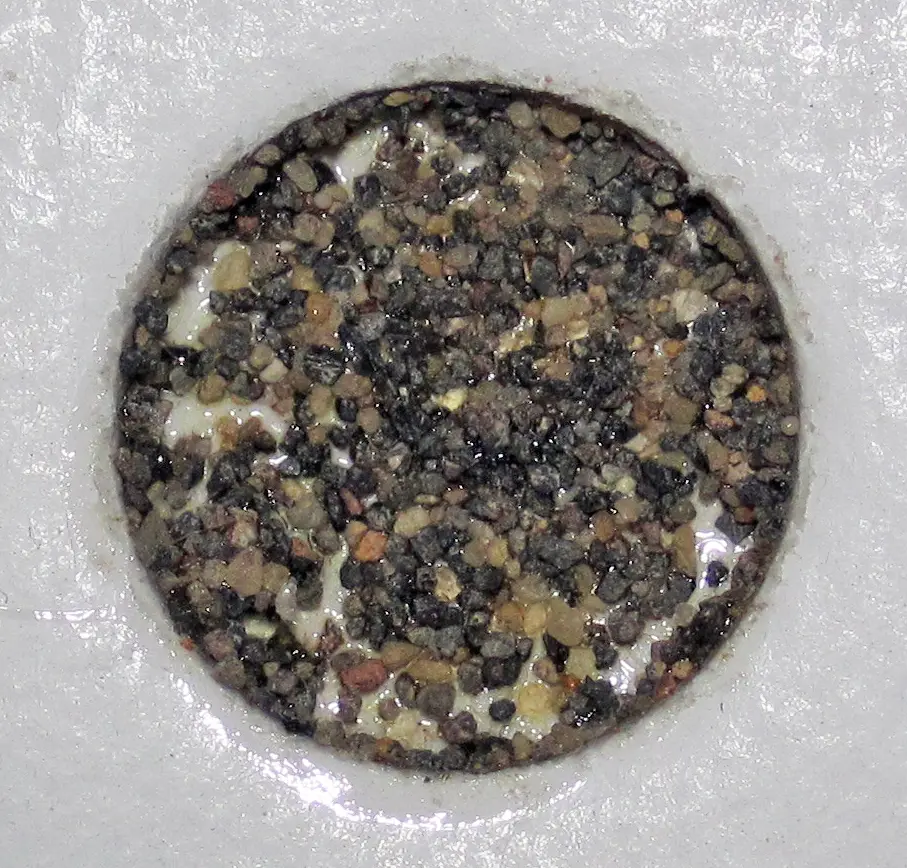
Medium sand, grains 0.25 to 0.5 mm across, in a holder 1 cm wide; a tardigrade of usual length is about as long as one grain.
The nematode lengths here come from one 2018 study of animals the wind blew into funnels on a meadow at Bielefeld University in Germany, not from moss. The study's table puts 96.5% of the nematodes in the ground traps filled with formaldehyde under 1 mm, though its text gives 63.6% for the ground site. The longest was 1.5 mm, a grain of very coarse sand. More than half were juveniles.
Next, see where the dried tardigrade's survival records hold and break in the tardigrade survival ledger, or meet the bdelloids, in which no male has been reported, in the bdelloid rotifer explainer.
Figure: What to look for, and how long they are
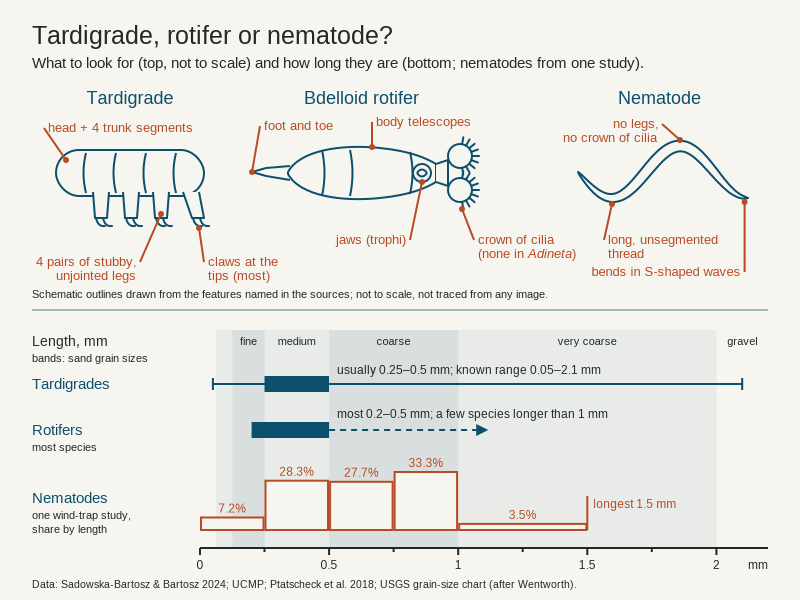
Top: outlines drawn by this site, not to scale; the side view shows one leg of each tardigrade pair. Bottom: Sadowska-Bartosz & Bartosz 2024, UCMP and Ptatscheck et al. 2018 (Table 2, ground traps with formaldehyde; the paper's text gives a lower share under 1 mm), over USGS sand classes. Data: moss-animals-id-chart.csv (CSV · JSON label).
Source card
- Images: nine photos, seven from iNaturalist (five CC BY 4.0; two CC0, both cropped) and two from Wikimedia Commons (one CC BY 4.0, one CC BY 2.0), no public-domain plates and two figures drawn by this site; each photo's own license was checked against the iNaturalist or Commons records, on 2026-10-10 for the three main images and the crown close-up and on 2026-10-13 for the other five.
- Classification: GBIF Backbone Taxonomy lists Tardigrada, Rotifera, Nematoda and Bryozoa as accepted phyla and Bdelloidea as an accepted order. No source here records how often these animals are mistaken for one another, so none is listed as another's misidentification twin.
- Data: each number traces to a numbered source below; both CSV files cite one per value.
Corrections: none yet.
Sources
- University of California Museum of Paleontology. "Introduction to the Bryozoa" and "Bryozoa: Life History and Ecology" ucmp.berkeley.edu/bryozoa/bryozoa.htmlfull pages read (also https://ucmp.berkeley.edu/bryozoa/bryozoalh.html)
- Majdi N, Traunspurger W, Garrigue J, Larrieu L. "Tree-related microhabitats harbor distinct micro-invertebrate communities and support complex food webs." Oecologia 207:148 (2025) doi.org/10.1007/s00442-025-05774-5full text via Europe PMC, PMC12370837 (CC BY 4.0): abstract, introduction, methods and the results and discussion passages on mosses
- Sadowska-Bartosz I, Bartosz G. "Antioxidant Defense in the Toughest Animals on the Earth: Its Contribution to the Extreme Resistance of Tardigrades." International Journal of Molecular Sciences 25:8393 (2024) doi.org/10.3390/ijms25158393full text via Europe PMC, PMC11313143 (CC BY): introduction and the section on tun formation
- University of California Museum of Paleontology. "Introduction to the Rotifera" ucmp.berkeley.edu/phyla/rotifera/rotifera.htmlfull page read
- Nowell RW, Almeida P, Wilson CG, Smith TP, Fontaneto D, Crisp A, Micklem G, Tunnacliffe A, Boschetti C, Barraclough TG. "Comparative genomics of bdelloid rotifers: Insights from desiccating and nondesiccating species." PLoS Biology 16:e2004830 (2018) doi.org/10.1371/journal.pbio.2004830full text via Europe PMC, PMC5916493 (CC BY 4.0): introduction and Fig. 1 caption
- Kiontke K, Fitch DHA. "Nematodes." Current Biology 23:R862–R864 (2013) doi.org/10.1016/j.cub.2013.08.009full text of the author manuscript via PMC, PMC6827559
- University of California Museum of Paleontology. "Introduction to the Nematoda" ucmp.berkeley.edu/phyla/ecdysozoa/nematoda.htmlfull page read
- Ptatscheck C, Gansfort B, Traunspurger W. "The extent of wind-mediated dispersal of small metazoans, focusing nematodes." Scientific Reports 8:6814 (2018) doi.org/10.1038/s41598-018-24747-8full text via Europe PMC, PMC5931521 (CC BY 4.0): methods, results, Table 2 and discussion
- University of California Museum of Paleontology. "Introduction to the Arthropoda" ucmp.berkeley.edu/arthropoda/arthropoda.htmlfull page read
- University of California Museum of Paleontology. "Introduction to the Acari: Mites and Ticks" ucmp.berkeley.edu/arthropoda/arachnida/acari.htmlfull page read
- Laumer CE, Fernández R, Lemer S, Combosch D, Kocot KM, Riesgo A, Andrade SCS, Sterrer W, Sørensen MV, Giribet G. "Revisiting metazoan phylogeny with genomic sampling of all phyla." Proceedings of the Royal Society B 286:20190831 (2019) doi.org/10.1098/rspb.2019.0831full text via Europe PMC, PMC6650721 (CC BY): results and discussion on Ecdysozoa and Spiralia
- Nagwani AK, Melosik I, Kaczmarek Ł, Kmita H. "Recovery from anhydrobiosis in the tardigrade Paramacrobiotus experimentalis: Better to be young than old and in a group than alone." Heliyon 10:e26807 (2024) doi.org/10.1016/j.heliyon.2024.e26807full text via Europe PMC, PMC10907786: introduction
- Hespeels B, Fontaneto D, Cornet V, Penninckx S, Berthe J, Bruneau L, Larrick JW, Rapport E, Bailly J, Debortoli N, Iakovenko N, Janko K, Heuskin AC, Lucas S, Hallet B, Van Doninck K. "Back to the roots, desiccation and radiation resistances are ancestral characters in bdelloid rotifers." BMC Biology 21:72 (2023) doi.org/10.1186/s12915-023-01554-wfull text via Europe PMC, PMC10080820 (CC BY 4.0): background
- Schiffer PH, Danchin EGJ, Burnell AM, Creevey CJ, Wong S, Dix I, O'Mahony G, Culleton BA, Rancurel C, Stier G, Martínez-Salazar EA, Marconi A, Trivedi U, Kroiher M, Thorne MAS, Schierenberg E, Wiehe T, Blaxter M. "Signatures of the Evolution of Parthenogenesis and Cryptobiosis in the Genomes of Panagrolaimid Nematodes." iScience 21:587–602 (2019) doi.org/10.1016/j.isci.2019.10.039full text via Europe PMC, PMC6889759 (CC BY): introduction
- Evangelista CCS, Guidelli GV, Borges G, Araujo TF, Souza TAJ, Neves UPDC, Tunnacliffe A, Pereira TC. "Multiple genes contribute to anhydrobiosis (tolerance to extreme desiccation) in the nematode Panagrolaimus superbus." Genetics and Molecular Biology 40:790–802 (2017) doi.org/10.1590/1678-4685-gmb-2017-0030full text via Europe PMC, PMC5738622 (CC BY): introduction and discussion
- U.S. Geological Survey. Open-File Report 2006-1195, "Nomenclature," grain-size chart (modified from Wentworth 1922) pubs.usgs.gov/of/2006/1195/htmldocs/nomenclature.htmpage read; chart PDF https://pubs.usgs.gov/of/2006/1195/htmldocs/images/chart.pdf read (very fine 0.0625–0.125, fine 0.125–0.25, medium 0.25–0.5, coarse 0.5–1, very coarse 1–2 mm)
- GBIF Secretariat. GBIF Backbone Taxonomy, species match API api.gbif.org/v1/species/match?name=Tardigradaspecies match results: Tardigrada 14, Rotifera 91, Nematoda 5967481 and Bryozoa 53 accepted phyla; Bdelloidea 1234 accepted order; Philodinidae 8058 accepted family; Macrobiotus 2253538 and Plectus Bastian, 1865 (2283075) accepted genera
- Bock P, Figuerola B. World List of Bryozoa: Membranipora membranacea (Linnaeus, 1767). Accessed through World Register of Marine Species (WoRMS), AphiaID 111411 www.marinespecies.org/aphia.php?p=taxdetails&id=111411taxon record: status accepted, rank Species, phylum Bryozoa, family Membraniporidae, marine
Cite this page
Plankton to Plumage. “Moss Animals: Tardigrade, Rotifer or Nematode? Look for Legs, Wheels or Waves.” October 12, 2026. https://planktontoplumage.com/microscopic/moss-animals/
Add the date you read the page after the address if your style guide asks for it.