Deep explainerNo. 0007
Bdelloid Rotifers: Hundreds of Species, Not One Known Male
Published Updated
Parts of this entry8 parts
Spec card
Size analogy (length)≈ 1 grain of medium sandScale: Wentworth "medium sand" class, 0.25–0.5 mm (USGS Open-File Report 2006-1195 grain-size chart), compared with the 0.43 mm mean adult Philodina roseola (Moreira et al. 2016)
- Common name
- Bdelloid rotifer, bdelloid (the "b" is silent)Source: Gross 2007 (PLoS Biology 5:e99)
- Scientific name
- BdelloideaSource: GBIF Backbone Taxonomy, usageKey 1234 (rank: order, in class Eurotatoria); most studies cited on this page call it a class
- Group
- Rotifers (phylum Rotifera); closest relatives are the monogonont rotifers, which can reproduce sexuallySource: GBIF Backbone Taxonomy (phylum); Gladyshev & Meselson 2008 (Monogononta as sister class; facultatively sexual)
- Described species
- About 460; published counts range from about 400 to over 500Source: Hespeels et al. 2023 (460); Hespeels et al. 2015 (400 morphospecies); Nowell et al. 2018 (over 500)
- Size band
- Most species under 0.5 mm long; adult Philodina roseola average about 0.43 mm; Rotaria neptunia can exceed 1 mmSource: Hespeels et al. 2023 (most species); Moreira et al. 2016 (P. roseola mean adult size 429.96 µm); UCMP Introduction to the Rotifera (R. neptunia)
- Distribution / habitat
- Worldwide, including Antarctica and the Atacama Desert; more than 95% of species live in moss, lichen, soil or short-lived waterSource: Hespeels et al. 2023
- Adult life span
- Weeks: in one lab study Philodina roseola matured at about 3.5 days and lived at most 23 days; time spent dried does not count toward ageSource: Moreira et al. 2016 (age at maturity 3.5 days; maximum lifespan 23 days); Ricci & Caprioli 2005 ('Sleeping Beauty' model)
- Three ID features
- Wheel-like organs of cilia on the head in many genera, absent in Adineta
- a telescoping, shape-changing body ending in a foot with a cement gland for anchoring
- hard jaws (trophi) just behind the mouth
- The misidentification twin
- Not yet verified
Download this card as CSV bdelloid-rotifers-spec-card.csv · CC BY 4.0File label (JSON): name, license, publisher
Main images
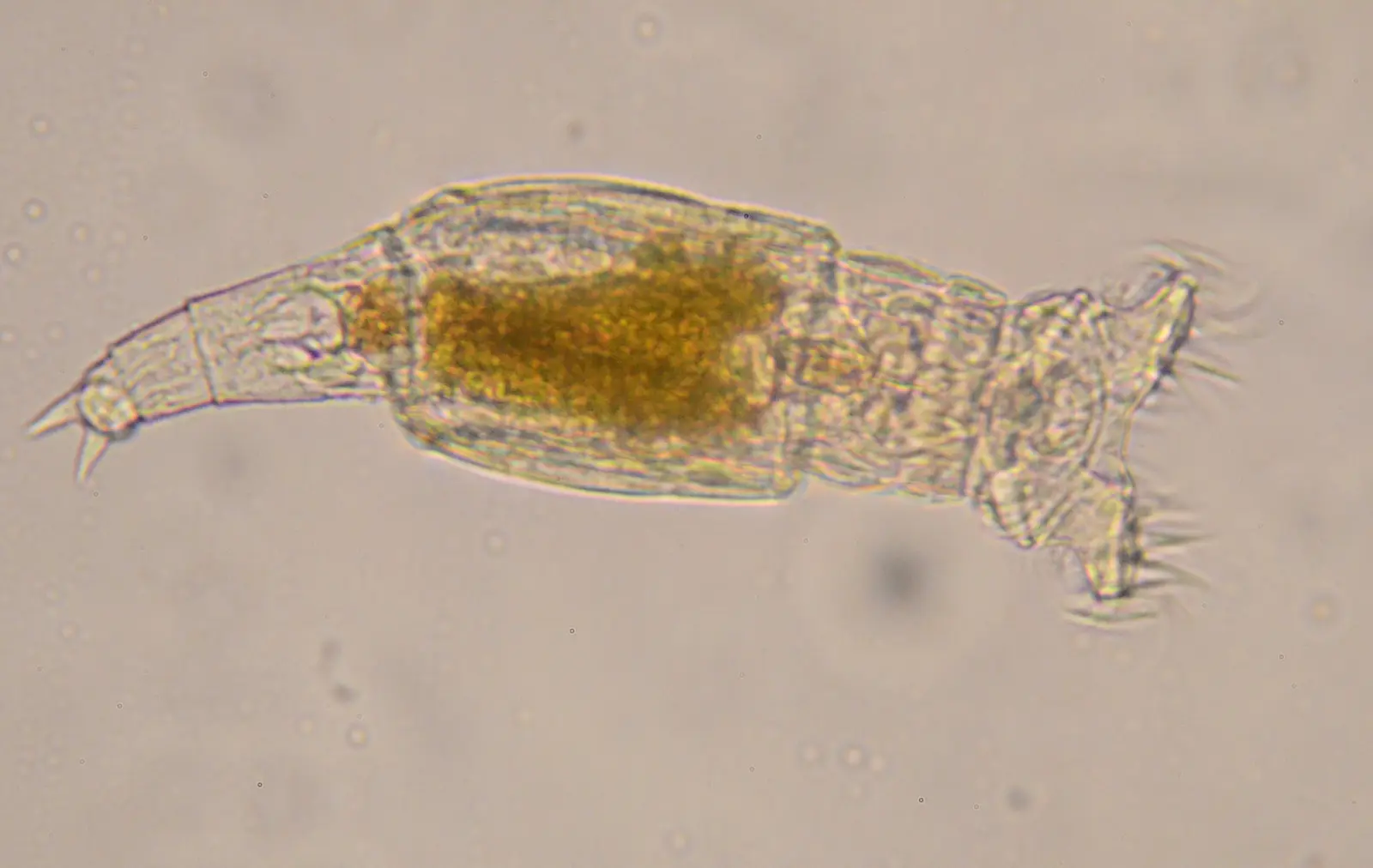
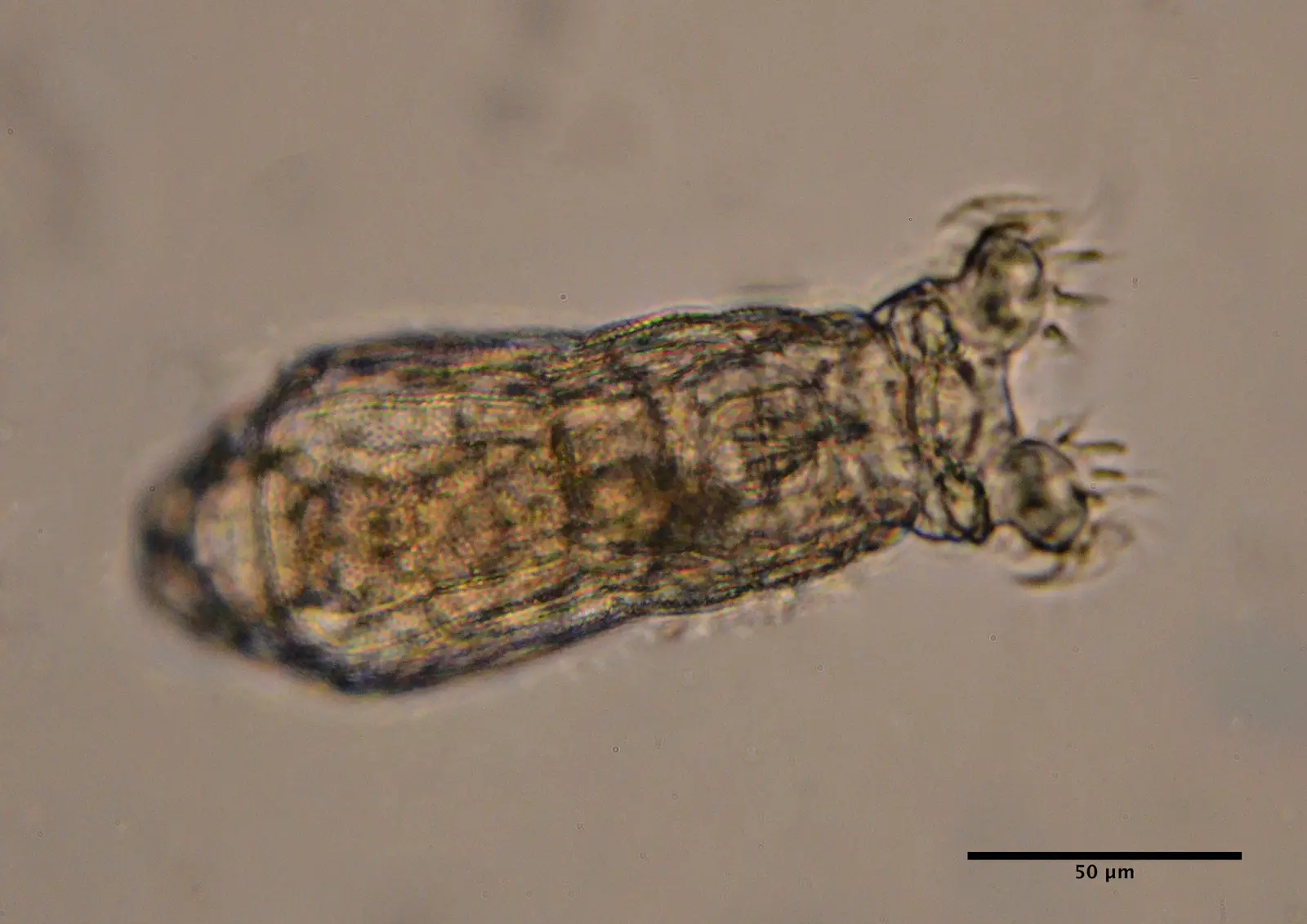
Two Philodina species photographed in California, identified to species by the iNaturalist community. The second photo shows the wheel-like organs that give rotifers their name.
The short answer
Despite centuries of study under microscopes, no one has reported a male bdelloid rotifer. Every bdelloid known reproduces from eggs that were never fertilized, so each one is a female that makes daughters. Most species are less than half a millimeter long, about the size of a grain of medium sand, and they live worldwide in moss, lichen, soil and puddles.
Two more traits set them apart. Most bdelloids can dry out at any age, not just as eggs. When water returns, they become active again. Some species that live permanently in water, such as Rotaria macrura, cannot survive drying. About a tenth of their genes appear to come from bacteria, fungi and plants rather than from animal ancestors.
Whether bdelloids have really gone without sex for millions of years is now an open question, because recent genomes show signs of DNA shuffling that no one can yet tie to a male.
What is a bdelloid rotifer?
Bdelloids belong to the rotifers, a phylum of animals so small that they live at the scale of single-celled protists. The name rotifer means "wheel-bearer," after the crown of cilia (beating, hair-like strands) that pulls a current of water into the mouth.
In many bdelloids, such as Philodina and Rotaria, the crown forms wheel-like organs used for feeding and moving. The genus Adineta, which includes the lab model Adineta vaga, has none, so the "wheel" in the name does not fit every member of the group.
The word bdelloid means "leech-like," and the "b" is silent. In the lab, A. vaga crawls over surfaces the way a leech does. Behind the head, the body telescopes in and out under a flexible, see-through cuticle and ends in a foot, where a cement gland lets the animal anchor itself while it feeds.
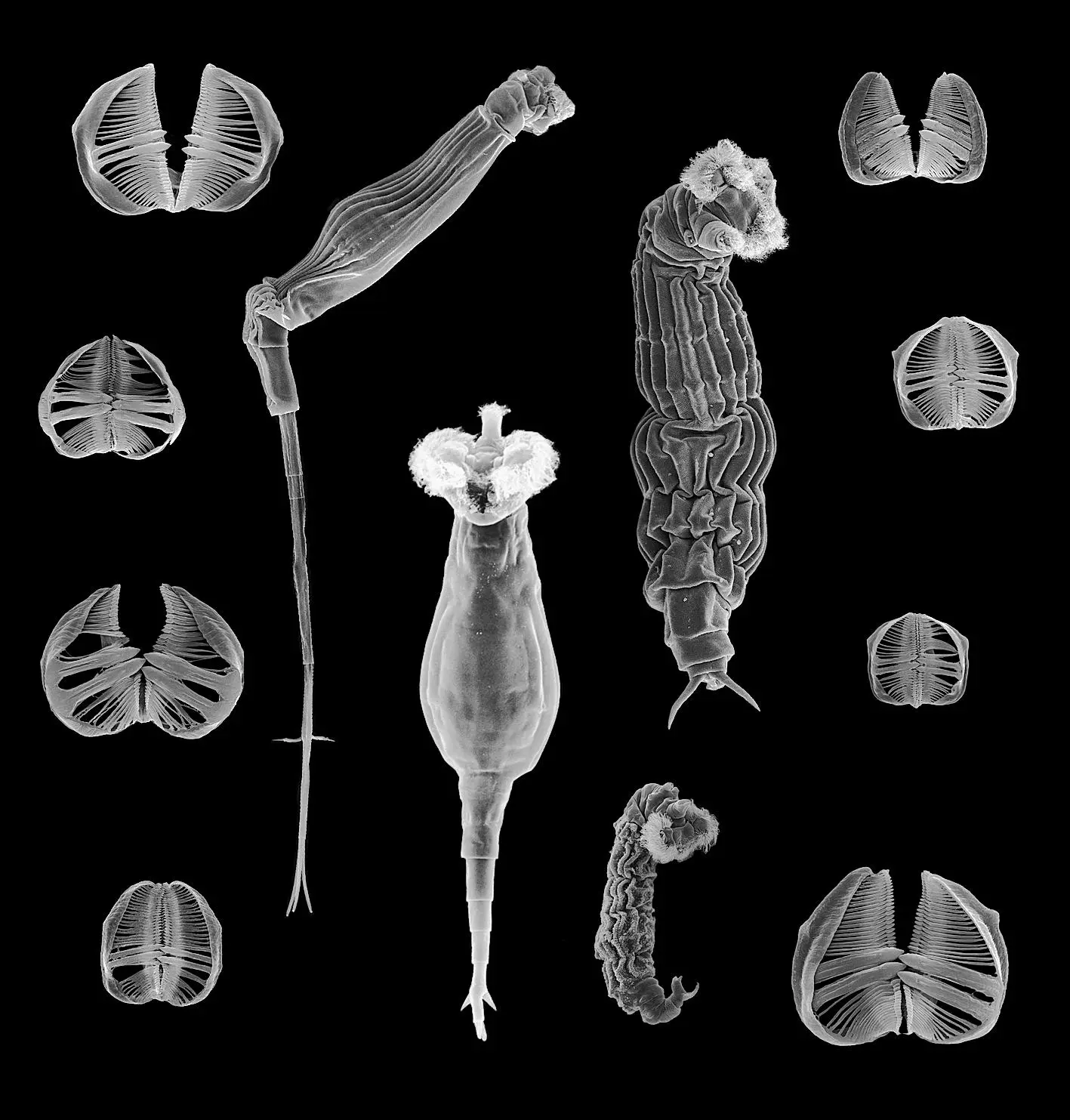
Bdelloid bodies stretch and fold, which is why one 2007 study compared species by their hard jaws instead. The source does not name the species shown.
Inside, hard jaws called trophi sit just behind the mouth and grind food. The soft body keeps changing shape. So when a 2007 study compared species, the jaws were the one trait it could measure reliably.
An adult of most species is built from about 1,000 cells. Once the animal matures, that number stays fixed. In one lab study of Philodina roseola, newborns averaged about 0.20 mm and adults about 0.43 mm. But Rotaria neptunia can grow longer than 1 mm.
Bdelloids live from temperate regions to Antarctica and the Atacama Desert, and more than 95% of species live where water comes and goes, such as soil, moss, lichen and short-lived pools. Their closest relatives, the monogonont rotifers, are different on both counts: they can reproduce sexually, and only their resting eggs survive drying.
How does a bdelloid survive drying out?
As water evaporates, a bdelloid contracts into a flat oval called a tun and enters anhydrobiosis, or "life without water." Its metabolism stops until water returns, and it can do this at any stage of life, adults included. Most stays last days or weeks, but some last several years. A 2015 study credits Van Leeuwenhoek with discovering this revival in bdelloids, in work published in 1702.
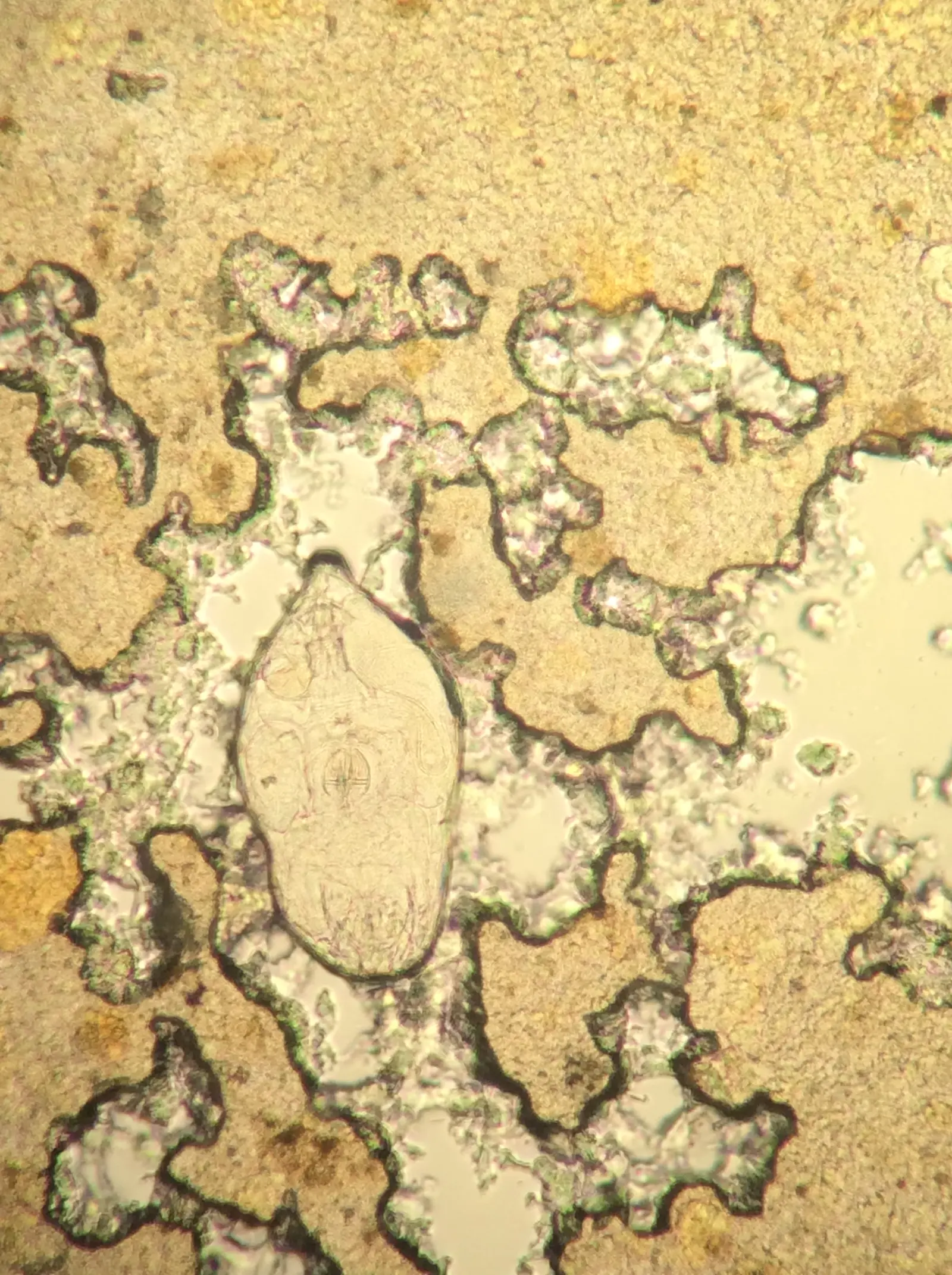
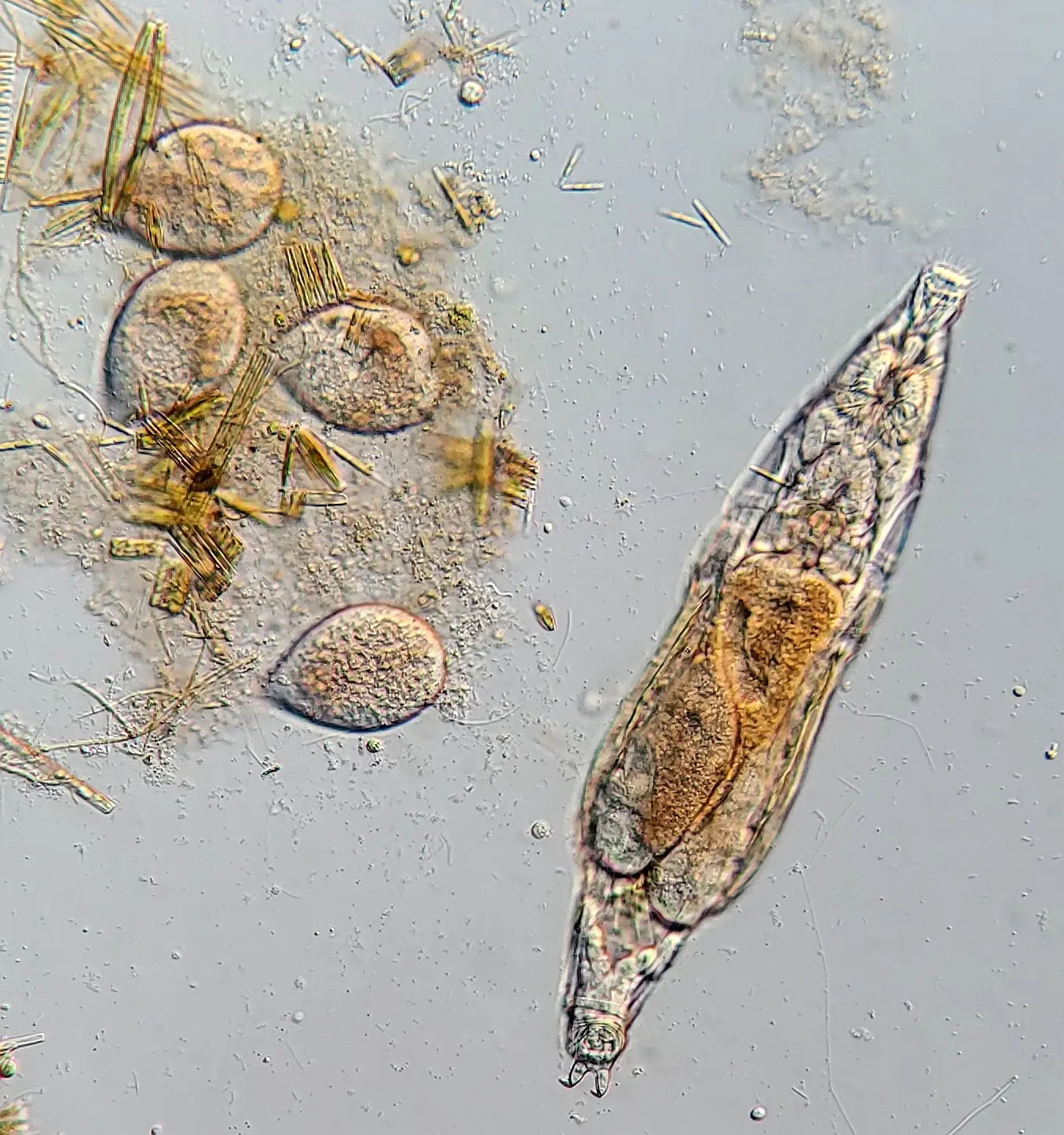
A bdelloid rotifer contracted into a closed oval among debris. Its photographer describes it as encysted because of adverse conditions.
Drying seems to cost the animal little. A 2005 review reports that time spent dry does not count toward a bdelloid's age: an animal picks up its life where it left off, a pattern researchers call the "Sleeping Beauty" model. Average egg production after drying was never found to drop. Fitness declined in populations kept wet for several generations, but not in ones dried and rewetted in cycles.
Do bdelloids use trehalose?
Many animals that survive drying build up a sugar called trehalose. The sugar is thought to stand in for water and protect cell parts. In 2003, researchers found no trehalose in dried Philodina roseola or Adineta vaga.
A 2015 study then found trehalose-making genes in A. vaga, apparently acquired from other organisms, and they switched on strongly as the animals dried. The authors suggest the sugar had escaped detection because genes for an enzyme that breaks it down are far more active.
Proteins share the work. In one bdelloid, two gene copies probably began as two versions of the same gene. Now they do different jobs during drying: one keeps drying-sensitive enzymes from clumping, while the other can attach to cell membranes and may help keep them intact. In A. vaga, genes for antioxidants and chaperones, proteins that help other proteins hold their shape, run at high levels all the time, and rehydration switches on a separate set.
Drying also breaks DNA. In A. vaga, breaks across both strands of the DNA built up the longer animals stayed dry, then were gradually repaired after rehydration. Ultraviolet light also broke DNA in dried animals. The authors suggest the genome is not shielded while dry and that the animals rely instead on efficient repair.
Where does drying fail?
Not every bdelloid can do it. Rotaria macrura lives only in permanent ponds, and in a 2023 test no R. macrura or R. rotatoria survived a single day of drying. Six other species dried in the same test, and on average about 82 to 99% of each were alive two days after rewetting. The study's family-tree analysis suggests the common ancestor of these species could already survive drying, and that a group of Rotaria lost the trait after moving into permanent water.
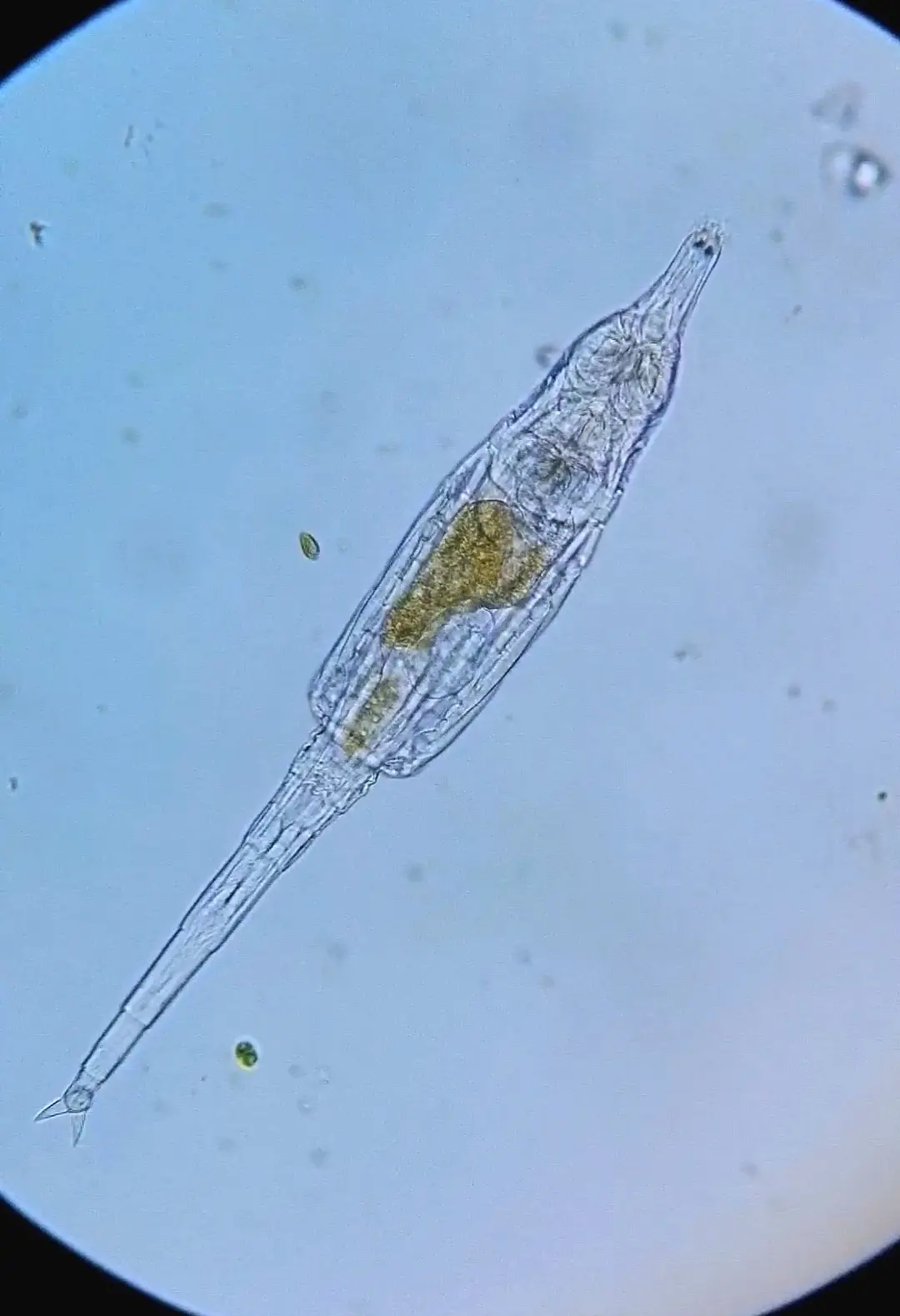
This Rotaria macrura was identified to species on iNaturalist. In a 2023 test, no animals of this species survived a single day of drying.
The same study also X-rayed the animals. All of them survived doses of up to 1,000 grays. Even the two Rotaria repaired broken DNA in their body cells.
Fertility told them apart: the estimated dose that sterilized half was 31 grays for R. macrura and 137 for R. rotatoria, against about 1,100 to 1,200 grays for the most resistant species. Others fell in between. Among them were two Antarctic species, near 400. Within the drying-tolerant group, these doses did not track drying survival or how often the home habitat dries.
An older study found a similar gap between rotifers that can and cannot dry out as adults. In 2008, a gamma-ray dose of about 200 grays cut the daughters produced by the monogonont Euchlanis dilatata by about 90%, while two bdelloids needed five times that dose for the same cut. A dose of 560 grays, which breaks the DNA of A. vaga in an estimated 500 places per genome, cut its output of daughters by only about 20%. For comparison, two species of tardigrades tested in other studies produced only sterile eggs after their lowest test doses, 500 and 1,000 grays.
Time is the other limit. Rotifers, tardigrades and nematodes in dry museum lichens lost survival at similar rates. A model predicted survival for up to about 10 years.
The longest records come from cold instead. An Adineta rotifer was recovered from Siberian permafrost radiocarbon-dated to about 24,000 years ago. It revived and kept reproducing without fertilization in the lab. Antarctic bdelloids stored at −25 °C for 24 years revived in under an hour.
Are bdelloid rotifers really asexual?
The case began with what is missing. In 2000, Bdelloidea was called the largest animal group in which males, hermaphrodites and meiosis, the cell division that makes eggs and sperm, are all unknown.
Asexual animal lineages usually die out early. Yet bdelloids have diversified into hundreds of species. A 2018 genome paper notes that the group was once labeled "an evolutionary scandal," citing a 1986 commentary by John Maynard Smith.
The genetic evidence has turned over several times:
- 2000: Gene copies inside single animals were very different from each other, as expected after millions of years without sex. Later work showed bdelloids are ancient tetraploids: genes generally have up to four copies, arranged as two pairs. The most different copies sit in separate pairs, probably left by an old hybridization or genome doubling.
- 2013: A draft genome of A. vaga looked incompatible with ordinary meiosis, with matching regions rearranged and sometimes on the same chromosome. A 2018 comparison found those features largely absent in A. ricciae, a close relative.
- 2018: A 2016 claim that DNA passes between individual bdelloids was traced to cross-contaminated samples.
- 2020 to 2022: Wild A. vaga genomes showed patterns that do not fit strict cloning, and allele sharing in Macrotrachela quadricornifera led its authors to argue for occasional sex.
- 2021 to 2026: A chromosome-level A. vaga genome showed six matched pairs of chromosomes. In this species, eggs turned out to form through a modified meiosis. Matching chromosomes pair up, swap or copy stretches of DNA and repair breaks, but do not separate, so each egg keeps the full double set.
The observation still stands: no male has been reported. What has changed is the genetics, since at least A. vaga shuffles its DNA while it makes eggs. A 2024 review lists, among the questions that remain open, how to reconcile apparent genomic signs of sex with the continued absence of reported males.
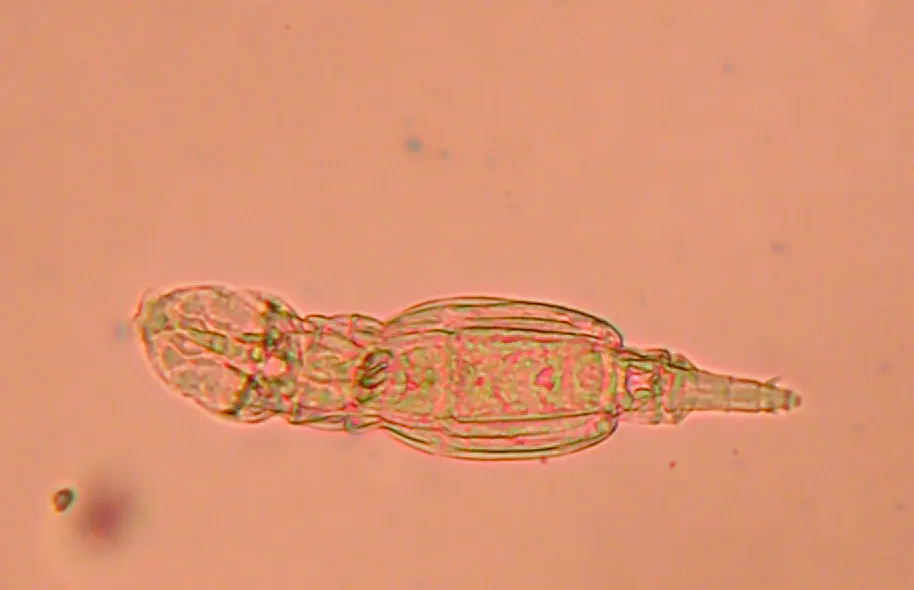
A Philodina citrina with eggs, identified to species on iNaturalist. As far as anyone has observed, bdelloid eggs develop into daughters without fertilization.
Why do bdelloids carry genes from bacteria and fungi?
In 2008, researchers found many bdelloid genes that appear to come from bacteria, fungi and plants, clustered toward the ends of chromosomes. Some were broken. Others were intact and read by the cell. Expressed in bacteria, one bacterial-type gene made a working enzyme.
The 2013 A. vaga genome put the share of such genes at about 8%, and a 2024 study put it at roughly 10%, about ten times the level in other animals.
This Adineta vaga major was identified to subspecies on iNaturalist. The 2013 genome that put the share of borrowed genes at about 8% came from its species, A. vaga.
| Genome | Survives drying? | Flagged as foreign, first screen | Still foreign after tree test |
|---|---|---|---|
| Adineta ricciae | Yes | 12.5% | 9.1% |
| Adineta vaga | Yes | 14.5% | 7.6% |
| Rotaria macrura | No | 12.6% | 6.2% |
| Rotaria magnacalcarata | No | 11.7% | 6.5% |
| 13 other invertebrate genomes, same method | Mixed | 3.6% at most | Under 1% |
Share of genes judged to come from outside the animal kingdom, from one 2018 genome comparison (Nowell et al., CC BY 4.0). The tree test keeps only genes that group with non-animal relatives in family-tree analysis. Download the table: bdelloid-rotifers-borrowed-genes.csv (CSV · JSON label).
Does drying explain the borrowed genes?
One idea was that drying lets foreign DNA in: when broken chromosomes are repaired after rehydration, stray DNA from the environment might be stitched in. The evidence is split.
A 2015 study of four species from one genus found more foreign genes in species from habitats that dry out, though permanently aquatic species still had hundreds.
The 2018 genomes found high shares in drying and non-drying species alike, while the tardigrade Ramazzottius varieornatus, which also survives drying, showed about 1%. Those authors raise another possibility: a long lack of sex may let borrowed genes persist, rather than drying letting more of them in.
Some borrowed genes now do jobs. When bdelloids were attacked by a fungus, foreign genes were more than twice as likely as other genes to be switched on, led by clusters resembling bacterial antibiotic-making enzymes. Those clusters were switched on nearly ten times more strongly in a resistant species than in a susceptible one. In one study of Antarctic bdelloids, ice-binding protein genes of apparent bacterial origin were judged to explain part of their freezing tolerance.
How do bdelloids live with parasites without sex?
The Red Queen hypothesis says asexual lineages die out fast because parasites keep evolving, and sex helps hosts keep up by producing new combinations of defenses. Bdelloids face more than 60 species of fungal and fungus-like pathogens. Some can wipe out a lab culture within weeks.
One way out is to leave. In a 2010 experiment, cultured bdelloids rid themselves of a deadly fungus by drying out completely, then drifted on the wind to found new populations without it.
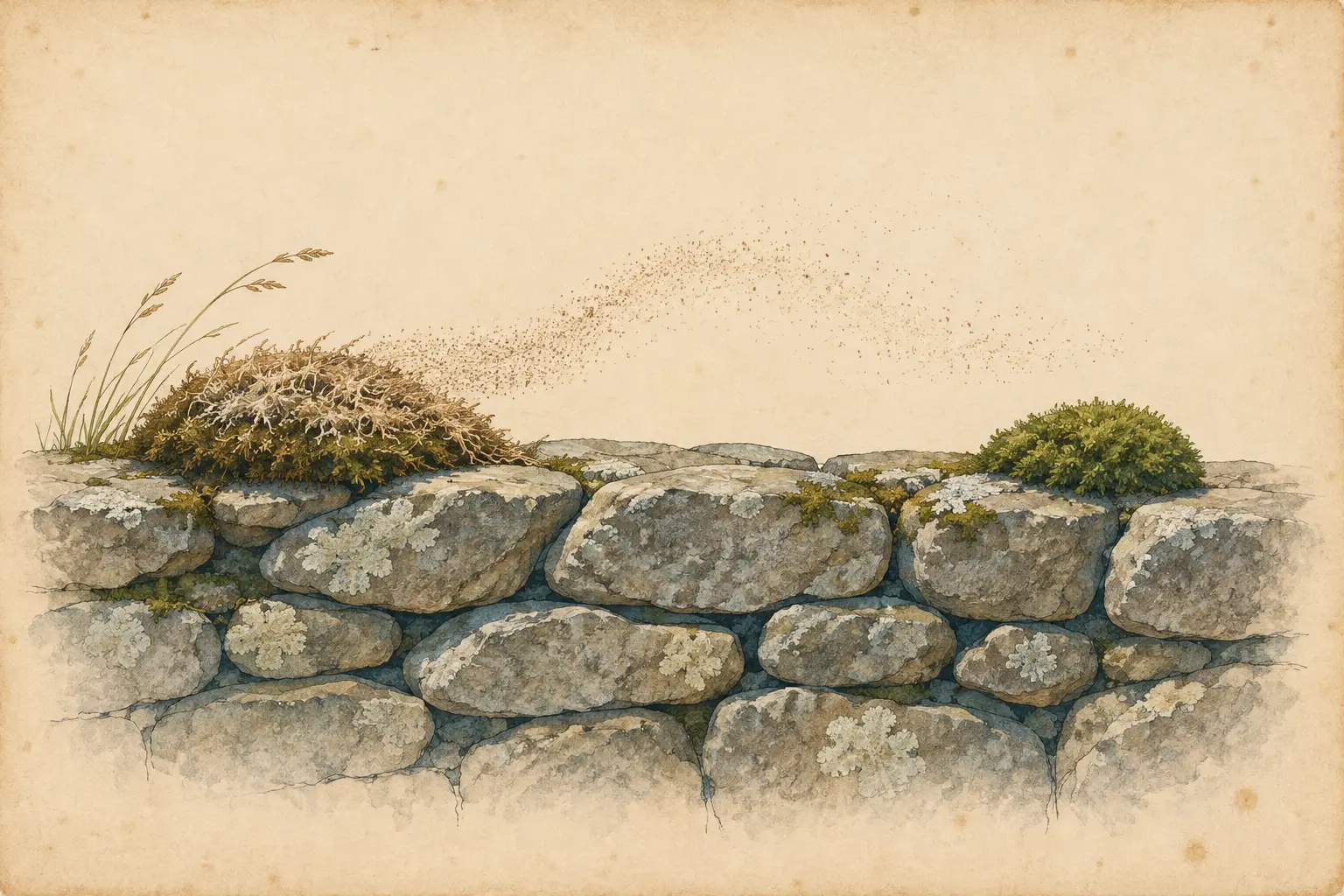
An illustrated scene, not the 2010 experiment: wind lifting dust off a drying moss cushion. In that experiment, dried bdelloids drifted on the wind to found new populations without the fungus.
A 2024 study notes that bdelloids can escape outbreaks of such fungi by dispersing in a dried state that the fungus does not tolerate. The 2010 authors present this escape in space and time as something that may help explain how bdelloids have persisted. It is one proposed piece of the answer, alongside borrowed defense genes, not a settled explanation.
Bdelloid rotifer FAQ
Are bdelloid rotifers all female?
Every bdelloid ever reported has been female. Neither males nor sperm have turned up in centuries of microscope work across hundreds of species. Females make eggs that develop into daughters without fertilization. Some recent genome studies find signs of genetic mixing, and a few authors argue for rare sex, but no one has yet found a male to go with that evidence.
How long can a bdelloid rotifer stay dried out?
Most dry spells last days or weeks, and some last several years. A study of museum lichens stored dry predicted survival for up to about 10 years. Frozen bdelloids have lasted much longer: one Adineta revived from permafrost dated to about 24,000 years ago, and lab-frozen Antarctic bdelloids revived after 24 years.
How is a bdelloid different from other rotifers?
As far as anyone has observed, bdelloids reproduce only by unfertilized eggs, and most species can dry out and revive as adults, though some that live permanently in water, such as Rotaria macrura, cannot. Their closest relatives, the monogonont rotifers, can reproduce sexually, and only their resting eggs survive drying. Many bdelloids also carry wheel-like ciliated organs on the head, though the genus Adineta lacks them.
Next, learn to tell a bdelloid apart from the other two animal groups with members that can dry out at any stage of life: tardigrade, rotifer or nematode?
Figure: The X-ray dose that sterilizes half
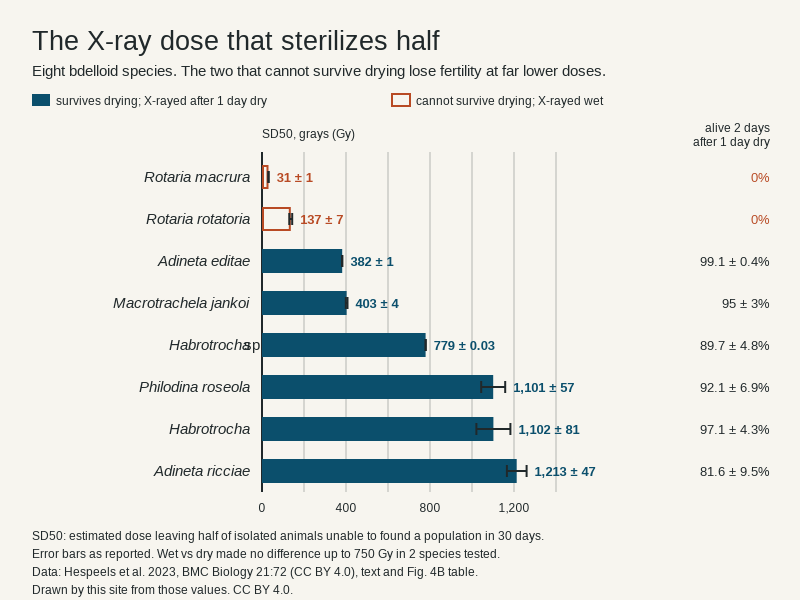
SD50 is the estimated X-ray dose at which half of the isolated animals could no longer found a population within 30 days; bars are drawn by this site from Hespeels et al. 2023 (CC BY 4.0). The six drying-tolerant species were X-rayed after one day dry, and the two Rotaria were X-rayed wet because they cannot survive drying. The study X-rayed A. editae and A. vaga both ways and found no difference in survival or fertility up to 750 grays, though an earlier study put the SD50 of wet A. vaga at 889 grays, against about 1,125 for dried animals. Data: bdelloid-rotifers-sd50.csv (CSV · JSON label).
Source card
- Images: seven photos, one chart and one generated schematic illustration: four photos via Wikimedia Commons (two light micrographs by Don Loarie from iNaturalist, CC BY 4.0; a scanning electron micrograph composite by Diego Fontaneto from PLoS Biology (2007), CC BY 2.5; a light micrograph by Blablabla0235, CC BY-SA 4.0) and three light micrographs from iNaturalist (two CC0, one CC BY 4.0), all five iNaturalist photos named to species or subspecies by research-grade community identification; no public-domain plates; one chart drawn by this site from published data; each license checked against the Commons records, the iNaturalist photo record or the journal page, on 2026-10-10 for the Loarie and Fontaneto images and on 2026-10-13 for the other four.
- Classification: GBIF Backbone Taxonomy lists Bdelloidea as an accepted order (usageKey 1234) in the class Eurotatoria; most studies cited here call it a class. Every species named on this page is accepted in GBIF.
- Data: every number traces to a numbered source below. The SD50 chart and the foreign-gene table are recompiled from two open-access papers, and both CSV files list the source for each row.
Corrections: 2026-10-23: Corrected the short answer, the page summary and an FAQ answer to say that most bdelloids, not all, can dry out at any age, and that some species living permanently in water, such as Rotaria macrura, cannot (the original said "Bdelloids can dry out at any age, not just as eggs").
Sources
- Wilson CG, Pieszko T, Nowell RW, Barraclough TG. "Recombination in bdelloid rotifer genomes: asexuality, transfer and stress." Trends in Genetics 40:422–436 (2024) doi.org/10.1016/j.tig.2024.02.001abstract read via Europe PMC, PMID 38458877
- Nowell RW, Rodriguez F, Hecox-Lea BJ, Mark Welch DB, Arkhipova IR, Barraclough TG, Wilson CG. "Bdelloid rotifers deploy horizontally acquired biosynthetic genes against a fungal pathogen." Nature Communications 15:5787 (2024) doi.org/10.1038/s41467-024-49919-1full text read via Europe PMC, PMC11258130 (introduction, results, discussion)
- Hespeels B, Fontaneto D, Cornet V, Penninckx S, Berthe J, Bruneau L, Larrick JW, Rapport E, Bailly J, Debortoli N, Iakovenko N, Janko K, Heuskin AC, Lucas S, Hallet B, Van Doninck K. "Back to the roots, desiccation and radiation resistances are ancestral characters in bdelloid rotifers." BMC Biology 21:72 (2023) doi.org/10.1186/s12915-023-01554-wfull text read via Europe PMC, PMC10080820 (CC BY 4.0)
- Nowell RW, Almeida P, Wilson CG, Smith TP, Fontaneto D, Crisp A, Micklem G, Tunnacliffe A, Boschetti C, Barraclough TG. "Comparative genomics of bdelloid rotifers: Insights from desiccating and nondesiccating species." PLoS Biology 16:e2004830 (2018) doi.org/10.1371/journal.pbio.2004830full text read via Europe PMC, PMC5916493 (CC BY 4.0)
- University of California Museum of Paleontology. "Introduction to the Rotifera" ucmp.berkeley.edu/phyla/rotifera/rotifera.htmlfull page read
- Raymond JA. "A horizontally transferred bacterial gene aids the freezing tolerance of Antarctic bdelloid rotifers." Proceedings of the National Academy of Sciences of the USA 122:e2421910122 (2025) doi.org/10.1073/pnas.2421910122abstract and introduction read via Europe PMC, PMC11912409
- Gladyshev E, Meselson M. "Extreme resistance of bdelloid rotifers to ionizing radiation." Proceedings of the National Academy of Sciences of the USA 105:5139–5144 (2008) doi.org/10.1073/pnas.0800966105full text read via PMC2278216 (pmc.ncbi.nlm.nih.gov article page)
- Gross L. "Who Needs Sex (or Males) Anyway?" PLoS Biology 5:e99 (2007) doi.org/10.1371/journal.pbio.0050099full text read on journals.plos.org (synopsis)
- Fontaneto D, Herniou EA, Boschetti C, Caprioli M, Melone G, Ricci C, Barraclough TG. "Independently evolving species in asexual bdelloid rotifers." PLoS Biology 5:e87 (2007) doi.org/10.1371/journal.pbio.0050087full text read via Europe PMC, PMC1828144
- Moreira RA, Mansano AS, Rocha O. "Life cycle traits of Philodina roseola Ehrenberg, 1830 (Rotifera, Bdelloidea), a model organism for bioassays." Anais da Academia Brasileira de Ciências 88 (Suppl. 1):579–588 (2016) doi.org/10.1590/0001-3765201620140729abstract read via Europe PMC, PMID 27168371
- Hespeels B, Li X, Flot JF, Pigneur LM, Malaisse J, Da Silva C, Van Doninck K. "Against All Odds: Trehalose-6-Phosphate Synthase and Trehalase Genes in the Bdelloid Rotifer Adineta vaga Were Acquired by Horizontal Gene Transfer and Are Upregulated during Desiccation." PLoS ONE 10:e0131313 (2015) doi.org/10.1371/journal.pone.0131313full text read via Europe PMC, PMC4498783 (introduction and abstract)
- Ricci C, Caprioli M. "Anhydrobiosis in bdelloid species, populations and individuals." Integrative and Comparative Biology 45:759–763 (2005) doi.org/10.1093/icb/45.5.759abstract read via Europe PMC, PMID 21676827
- Lapinski J, Tunnacliffe A. "Anhydrobiosis without trehalose in bdelloid rotifers." FEBS Letters 553:387–390 (2003) doi.org/10.1016/s0014-5793(03)01062-7abstract read via Europe PMC, PMID 14572656
- Pouchkina-Stantcheva NN, McGee BM, Boschetti C, Tolleter D, Chakrabortee S, Popova AV, Meersman F, Macherel D, Hincha DK, Tunnacliffe A. "Functional divergence of former alleles in an ancient asexual invertebrate." Science 318:268–271 (2007) doi.org/10.1126/science.1144363abstract read via Europe PMC, PMID 17932297
- Moris VC, Bruneau L, Berthe J, Heuskin AC, Penninckx S, Ritter S, Weber U, Durante M, Danchin EGJ, Hespeels B, Van Doninck K. "Ionizing radiation responses appear incidental to desiccation responses in the bdelloid rotifer Adineta vaga." BMC Biology 22:11 (2024) doi.org/10.1186/s12915-023-01807-8abstract and introduction read via Europe PMC, PMC10809525
- Hespeels B, Knapen M, Hanot-Mambres D, Heuskin AC, Pineux F, Lucas S, Koszul R, Van Doninck K. "Gateway to genetic exchange? DNA double-strand breaks in the bdelloid rotifer Adineta vaga submitted to desiccation." Journal of Evolutionary Biology 27:1334–1345 (2014) doi.org/10.1111/jeb.12326abstract read via Europe PMC, PMID 25105197
- Fontaneto D, Bunnefeld N, Westberg M. "Long-term survival of microscopic animals under desiccation is not so long." Astrobiology 12:863–869 (2012) doi.org/10.1089/ast.2012.0828abstract read via Europe PMC, PMID 22924877
- Shmakova L, Malavin S, Iakovenko N, Vishnivetskaya T, Shain D, Plewka M, Rivkina E. "A living bdelloid rotifer from 24,000-year-old Arctic permafrost." Current Biology 31:R712–R713 (2021) doi.org/10.1016/j.cub.2021.04.077abstract read via Europe PMC, PMID 34102116
- Mark Welch D, Meselson M. "Evidence for the evolution of bdelloid rotifers without sexual reproduction or genetic exchange." Science 288:1211–1215 (2000) doi.org/10.1126/science.288.5469.1211abstract read via Europe PMC, PMID 10817991
- Flot JF, Hespeels B, Li X, Noel B, Arkhipova I, Danchin EG, et al. "Genomic evidence for ameiotic evolution in the bdelloid rotifer Adineta vaga." Nature 500:453–457 (2013) doi.org/10.1038/nature12326abstract read via Europe PMC, PMID 23873043
- Simion P, Narayan J, Houtain A, Derzelle A, Baudry L, Nicolas E, et al. "Chromosome-level genome assembly reveals homologous chromosomes and recombination in asexual rotifer Adineta vaga." Science Advances 7:eabg4216 (2021) doi.org/10.1126/sciadv.abg4216abstract read via Europe PMC, PMID 34613768
- Wilson CG, Nowell RW, Barraclough TG. "Cross-Contamination Explains 'Inter and Intraspecific Horizontal Genetic Transfers' between Asexual Bdelloid Rotifers." Current Biology 28:2436–2444.e14 (2018) doi.org/10.1016/j.cub.2018.05.070abstract read via Europe PMC, PMID 30017483
- Laine VN, Sackton TB, Meselson M. "Genomic signature of sexual reproduction in the bdelloid rotifer Macrotrachella quadricornifera." Genetics 220:iyab221 (2022) doi.org/10.1093/genetics/iyab221abstract read via Europe PMC, PMID 34888647
- Vakhrusheva OA, Mnatsakanova EA, Galimov YR, Neretina TV, Gerasimov ES, Naumenko SA, et al. "Genomic signatures of recombination in a natural population of the bdelloid rotifer Adineta vaga." Nature Communications 11:6421 (2020) doi.org/10.1038/s41467-020-19614-yabstract read via Europe PMC, PMID 33339818
- Terwagne M, Nicolas E, Hespeels B, Herter L, Virgo J, Demazy C, Heuskin AC, Hallet B, Van Doninck K. "DNA repair during nonreductional meiosis in the asexual rotifer Adineta vaga." Science Advances 8:eadc8829 (2022) doi.org/10.1126/sciadv.adc8829abstract read via Europe PMC, PMID 36449626
- Houtain A, Dupré ML, Hespeels B, Nicolas É, Simion P, Virgo J, Heuskin AC, Lenormand T, Hallet B, Van Doninck K. "Transgenerational chromosome repair in the asexual bdelloid rotifer Adineta vaga." Science Advances 12:eaee0891 (2026) doi.org/10.1126/sciadv.aee0891full text read via Europe PMC, PMC13564844 (introduction, first results section, discussion)
- Gladyshev EA, Meselson M, Arkhipova IR. "Massive horizontal gene transfer in bdelloid rotifers." Science 320:1210–1213 (2008) doi.org/10.1126/science.1156407abstract read via Europe PMC, PMID 18511688
- Eyres I, Boschetti C, Crisp A, Smith TP, Fontaneto D, Tunnacliffe A, Barraclough TG. "Horizontal gene transfer in bdelloid rotifers is ancient, ongoing and more frequent in species from desiccating habitats." BMC Biology 13:90 (2015) doi.org/10.1186/s12915-015-0202-9abstract read via Europe PMC, PMID 26537913
- Wilson CG, Sherman PW. "Anciently asexual bdelloid rotifers escape lethal fungal parasites by drying up and blowing away." Science 327:574–576 (2010) doi.org/10.1126/science.1179252abstract read via Europe PMC, PMID 20110504
- GBIF Backbone Taxonomy, species match API (Bdelloidea, usageKey 1234; species named on the page) api.gbif.org/v1/species/match?name=Bdelloideaspecies match records for Bdelloidea, Rotifera and each species named
- U.S. Geological Survey. Open-File Report 2006-1195, "Nomenclature," grain-size chart (modified from Wentworth 1922) pubs.usgs.gov/of/2006/1195/htmldocs/nomenclature.htmalso https://pubs.usgs.gov/of/2006/1195/htmldocs/images/chart.pdf (medium sand 0.25–0.50 mm)
- Hespeels B, Penninckx S, Cornet V, Bruneau L, Bopp C, Baumlé V, Redivo B, Heuskin AC, Moeller R, Fujimori A, Lucas S, Van Doninck K. "Iron Ladies – How Desiccated Asexual Rotifer Adineta vaga Deal With X-Rays and Heavy Ions?" Frontiers in Microbiology 11:1792 (2020) doi.org/10.3389/fmicb.2020.01792full text read via Europe PMC, PMC7412981 (CC BY; methods and results)
Cite this page
Plankton to Plumage. “Bdelloid Rotifers: Hundreds of Species, Not One Known Male.” October 12, 2026, updated October 23, 2026. https://planktontoplumage.com/microscopic/bdelloid-rotifers/
Add the date you read the page after the address if your style guide asks for it.