Deep explainerNo. 0002
The Anglerfish, Explained Part by Part: Its Lure's Light Is Borrowed
Published Updated
Parts of this entry8 parts
Spec card
Size analogy (length)Female can be longer than 60 males end to end (Ceratias holboelli)Scale: Pietsch & Kenaley 2007: females may be more than 60 times the length of males
- Common name
- Anglerfish; the deep-sea species are also called seadevilsSource: Pietsch & Kenaley 2007, Tree of Life Web Project: Ceratioidei
- Scientific name
- Ceratioidei (deep-sea anglerfishes), a suborder of the order LophiiformesSource: WoRMS, AphiaID 154158 and 10316, checked 2026-10-10
- Group
- Ray-finned fishes; the same order holds the monkfishes, frogfishes, coffinfishes and batfishesSource: Miya et al. 2010
- Described species
- 180 accepted species in 11 families; 408 in the whole orderSource: WoRMS species count, 2026-10-10
- Size band
- Females: largest known 11 to 47 cm in most families, at least 77 cm in the warty seadevils (Ceratiidae). Males: adults from about 6 mm; largest known 1 to 4 cm, except attached warty seadevil males, to about 12 to 14 cm, depending on the account (standard length; records from 2005 to 2007)Source: Pietsch & Kenaley 2007 and Pietsch 2005–2007 family accounts, Tree of Life Web Project; see anglerfish-family-ledger.csv
- Distribution / habitat
- Open water in all major oceans, from high Arctic latitudes to the Southern Ocean; one genus, Thaumatichthys, lives on the bottomSource: Pietsch & Kenaley 2007 (Ceratioidei); Pietsch 2005 (Lophiiformes), Tree of Life Web Project
- Depth band
- Mostly below 300 m, concentrated at about 800 to 2,500 m; deepest record 5,866 m (reported 2024)Source: Pietsch & Kenaley 2007; Pietsch 2005 (Lophiiformes); Stewart et al. 2024
- Three ID features
- Most females: first dorsal-fin spine turned into a rod (illicium) with a lure (esca) at the tip
- no pelvic fins and no swim bladder
- dwarf males with no lure, large nostrils in most species and hooked denticles for gripping
- The misidentification twin
- Not yet verified
Download this card as CSV anglerfish-spec-card.csv · CC BY 4.0File label (JSON): name, license, publisher
Main images
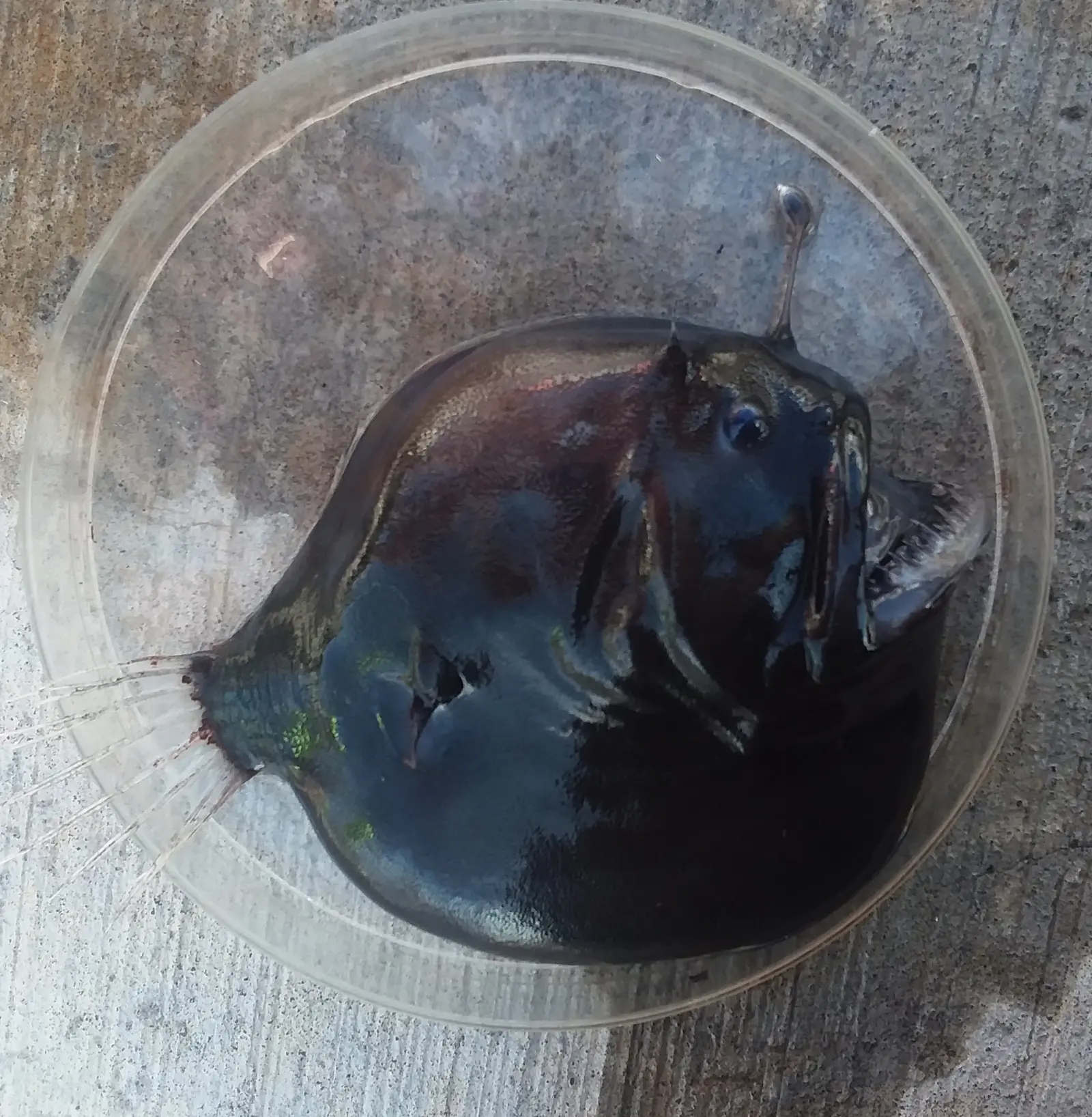
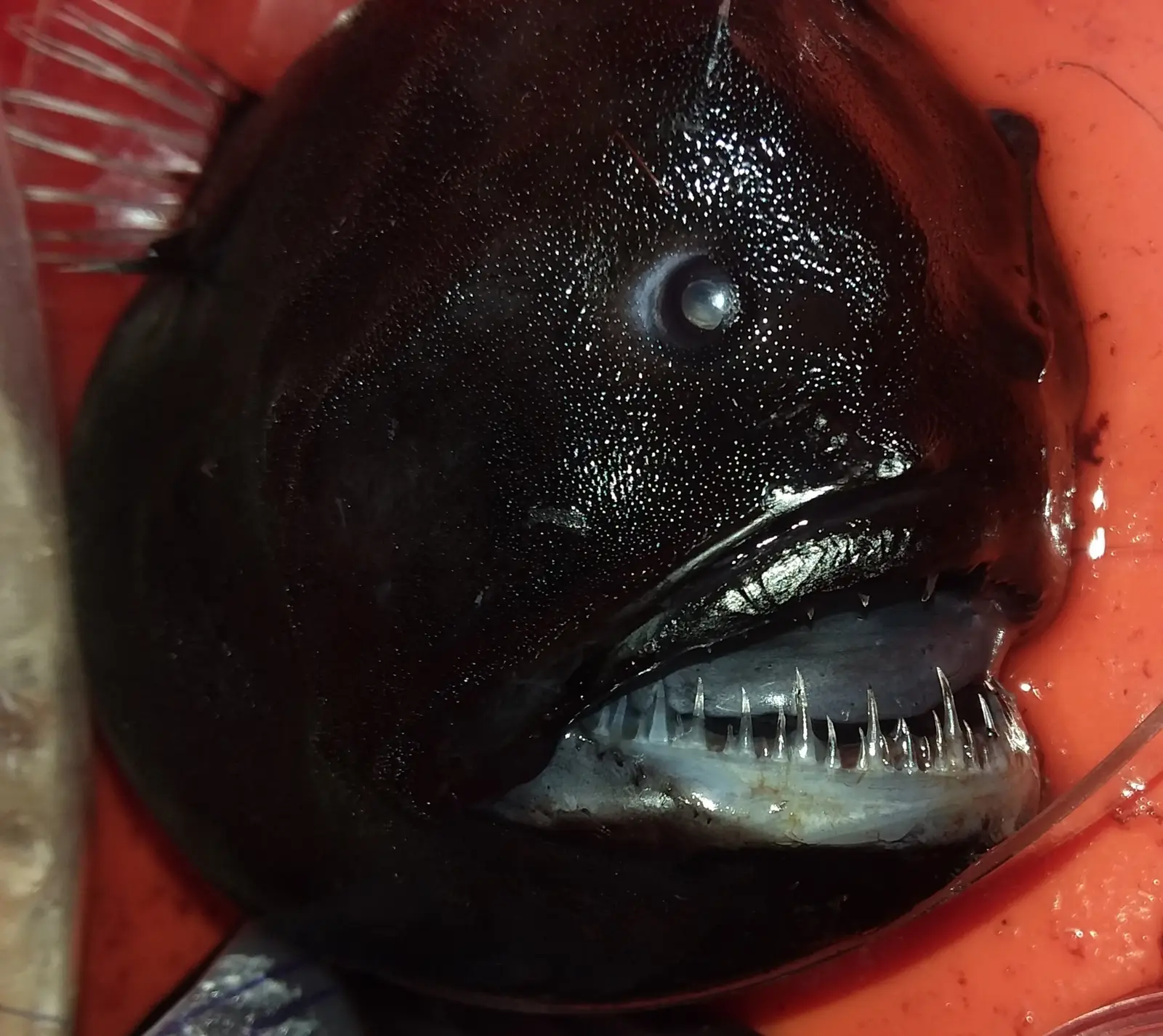
One deep-sea anglerfish, collected from a deep-seawater pipe in Hawaii in 2021, according to its observer; its lure marks it as a female. iNaturalist rates it research grade as Diceratias pileatus, but four identifiers place it in Oneirodidae, so this page labels it only to suborder.
The short answer
In most deep-sea anglerfishes, the glowing bead on the head holds bacteria the fish probably did not inherit. A young female's lure starts as a small bud. No glowing bacteria have been found in developing lures. A 2019 genetic study of six genera concluded that the fish pick up their light-making bacteria from the surrounding seawater, not from their parents.
Anglerfish is the common name for the order Lophiiformes, 408 accepted species in the World Register of Marine Species as of October 2026. What unites them is the first spine of the dorsal fin. It has moved forward onto the head and turned into a fishing rod. About 180 of those species, in 11 families, are the deep-sea anglerfishes or seadevils of the suborder Ceratioidei, the ones with glowing lures and dwarf males.
Both famous traits vary across the group. Some deep-sea groups carry lures with no light. Permanently fused males are on record in only four families and two genera.
What is an anglerfish?
A 2010 study follows the usual split of the order into five suborders: the flattened goosefishes or monkfishes, the frogfishes and their relatives, the coffinfishes, the batfishes, and the deep-sea anglerfishes. Most species outside the deep-sea group live on the bottom. They are found from shallow coasts to the continental shelf and slope.
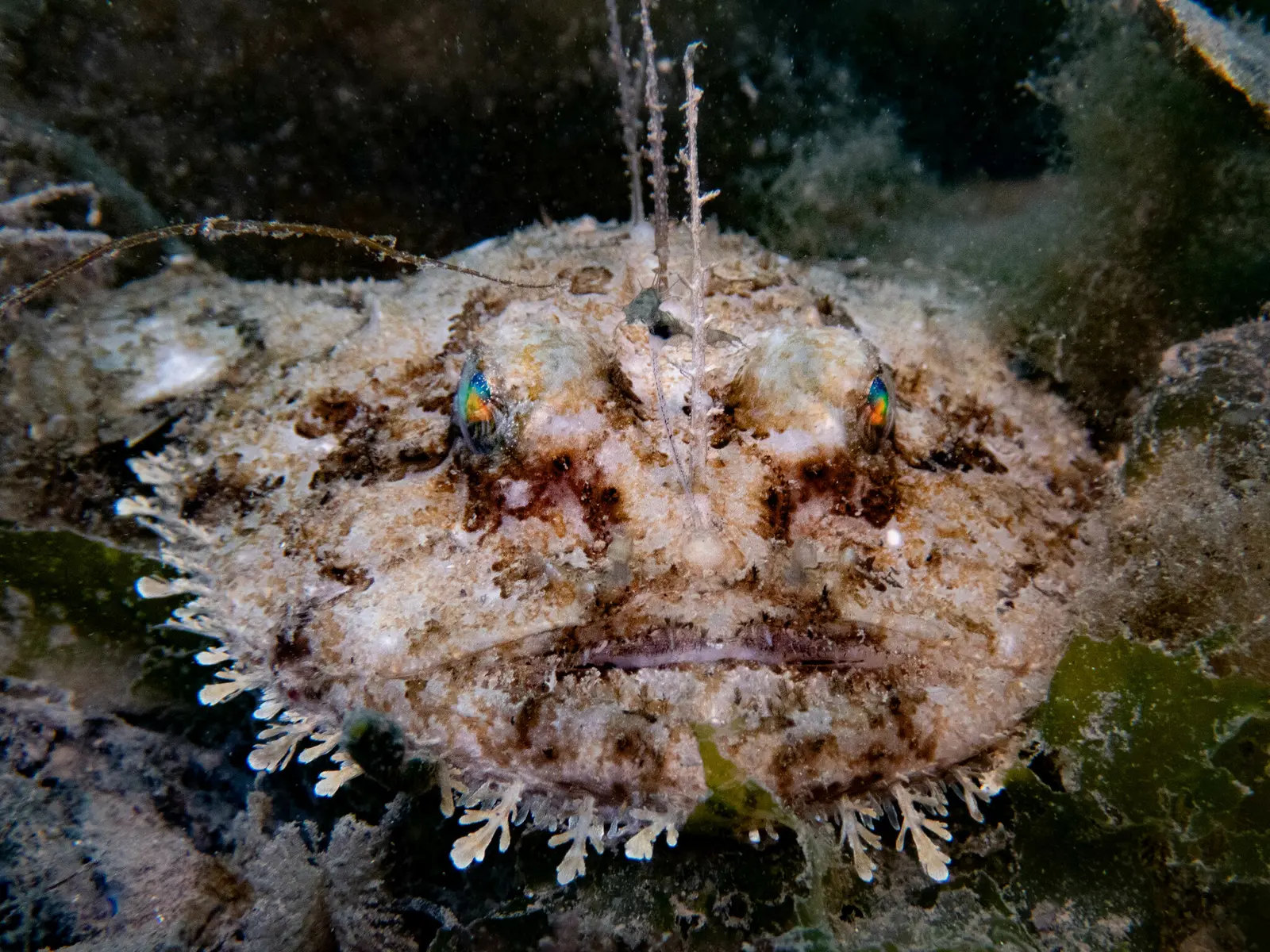
A monkfish (Lophius piscatorius) resting on the seabed in UK waters, its wide, flat head facing the camera. Monkfishes are among the bottom-living anglerfishes outside the deep-sea group.
Deep-sea anglerfishes drift in open water instead, mostly between about 800 and 2,500 m, a band that sits above the ocean's average depth, which NOAA gives as 3,682 m. The genus Thaumatichthys is the exception. It lives on the bottom at 1,000 to 3,600 m. The depth record for the group, reported in 2024, is 5,866 m, a little over half the depth of the Challenger Deep at about 10,935 m.
They live in all the major oceans, from high Arctic latitudes to the Southern Ocean. Below about 200 m there is little sunlight. Glowing animals become another source of light. A 2019 study, citing a count of 167 species, called the deep-sea anglerfishes the most species-rich fish suborder of the midwater below 1,000 m.
Part 1: The rod (illicium)
The rod is a modified fin spine. Biologists call it the illicium and the bait at its tip the esca. In the deep-sea anglerfishes the rod is a female feature. Males do not have one.
Its length and position change from family to family. In whipnose anglerfishes (Gigantactinidae), the rod reaches one to four times the length of the body, while in the wolftrap anglerfish Thaumatichthys the lure sits on the roof of the mouth. The needlebeard seadevil (Neoceratias spinifer) has no rod at all, in either sex. The female carries many long, hinged teeth on the outer edges of her jaws instead.
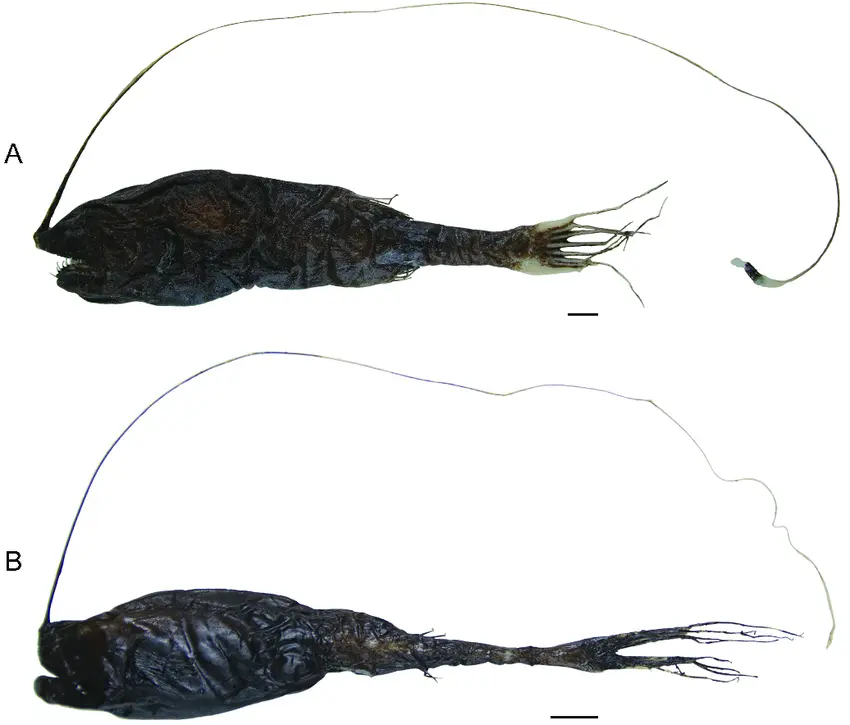
Two whipnose anglerfishes from off northeastern Brazil, labeled in the source paper as Gigantactis watermani (A, 170 mm standard length) and Rhynchactis sp. (B, 113 mm). Each rod is longer than its fish.
A long rod may be used upside down. A 2024 report gathered eight sightings of whipnose anglerfishes (Gigantactis) swimming inverted, from the Caribbean to the southwest Pacific. Its authors suggest this is the normal posture for the genus. An earlier idea, cited in the family's 2005 Tree of Life account, is that the fish drifts upside down while its lure tempts prey off the sea floor.
The whole order shares the rod. The glow is a deep-sea addition: shallow-water anglerfishes fish without light. In 1978, researchers described a frogfish (Antennarius) whose lure mimics a small fish.
Part 2: The lure (esca) and its light
Inside, the esca is far more complex than a bulb. The 2007 Tree of Life account of the deep-sea anglerfishes by Theodore Pietsch and Christopher Kenaley lists bacteria-filled chambers, layers of light-absorbing pigment, reflecting tissue, tubes that guide light, nerves, blood vessels and smooth muscle. The bacteria live outside the fish's cells. They are thought to leave through a small opening in the lure.
The 2019 study sequenced lure bacteria from six genera in four of the 11 families and found only two species, both in the genus Enterovibrio. "Candidatus Enterovibrio luxaltus" turned up only in Cryptopsaras couesii. "Ca. Enterovibrio escacola" lit the lures of Ceratias, Chaenophryne, Linophryne, Melanocetus and Oneirodes. The label Candidatus marks bacteria that have not been grown in a lab; as of 2019, attempts to culture these had failed.
The genetic evidence pulls two ways. The bacteria's genomes are about half the size of those of free-living relatives, a pattern more often seen in bacteria that live only inside hosts and pass from parent to offspring. Yet the bacterial family tree did not match the fish family tree, and DNA from each bacterium turned up in 8% of seawater samples taken near the fish. The authors concluded that anglerfishes acquire their bacteria from the environment.
The life cycle points the same way. According to the study, eggs float toward the surface in a raft, and the lure develops fully only as a young fish nears maturity and descends. That likely leaves parents and young kilometers apart. So bacteria are unlikely to pass between them.
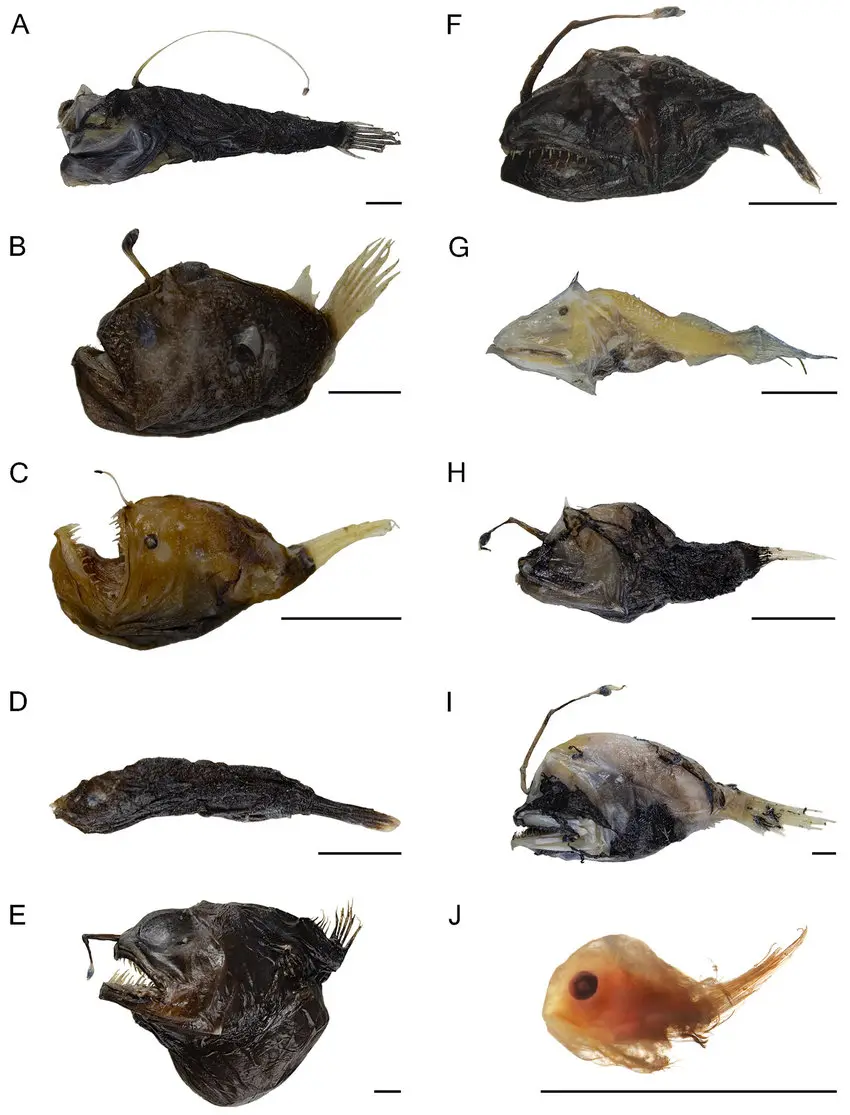
Specimens as labeled in the source paper (scale bars 10 mm): (A) Ceratias uranoscopus; (B) Himantolophus sp.; (C) Melanocetus johnsonii; (D) Thaumatichthys sp.; (E) Chaenophryne draco; (F) Chaenophryne ramifera; (G) Dolopichthys sp.; (H) Oneirodes anisacanthus; (I) Oneirodes carlsbergi; (J) Caulophryne sp.
Does every lure glow, and are there extra lights?
Not every deep-sea lure glows. The fanfin seadevils (Caulophrynidae) and the three Rhynchactis species of whipnose have lures with no bacterial light organ. Neoceratias has no lure.
Ceratias and Cryptopsaras also have two or three bacteria-filled bumps on the back, called caruncles, though the 2019 study notes they do not glow on the outside. Doublespine seadevils (Diceratiidae) have a second head spine tipped with a light gland, hidden under the skin in larger fish. Every Linophryne species in the 2007 account also has an elaborate chin barbel that glows with light made by the fish's own cells, not by bacteria. The same account calls this two-system arrangement unique among animals.
What is the light for?
The exact function of the light has not been observed, though the lure has been proposed to attract prey, to confuse predators, or to signal mates. There is some evidence that the esca also holds glands that may release a scent for males. What those glands do is unknown.
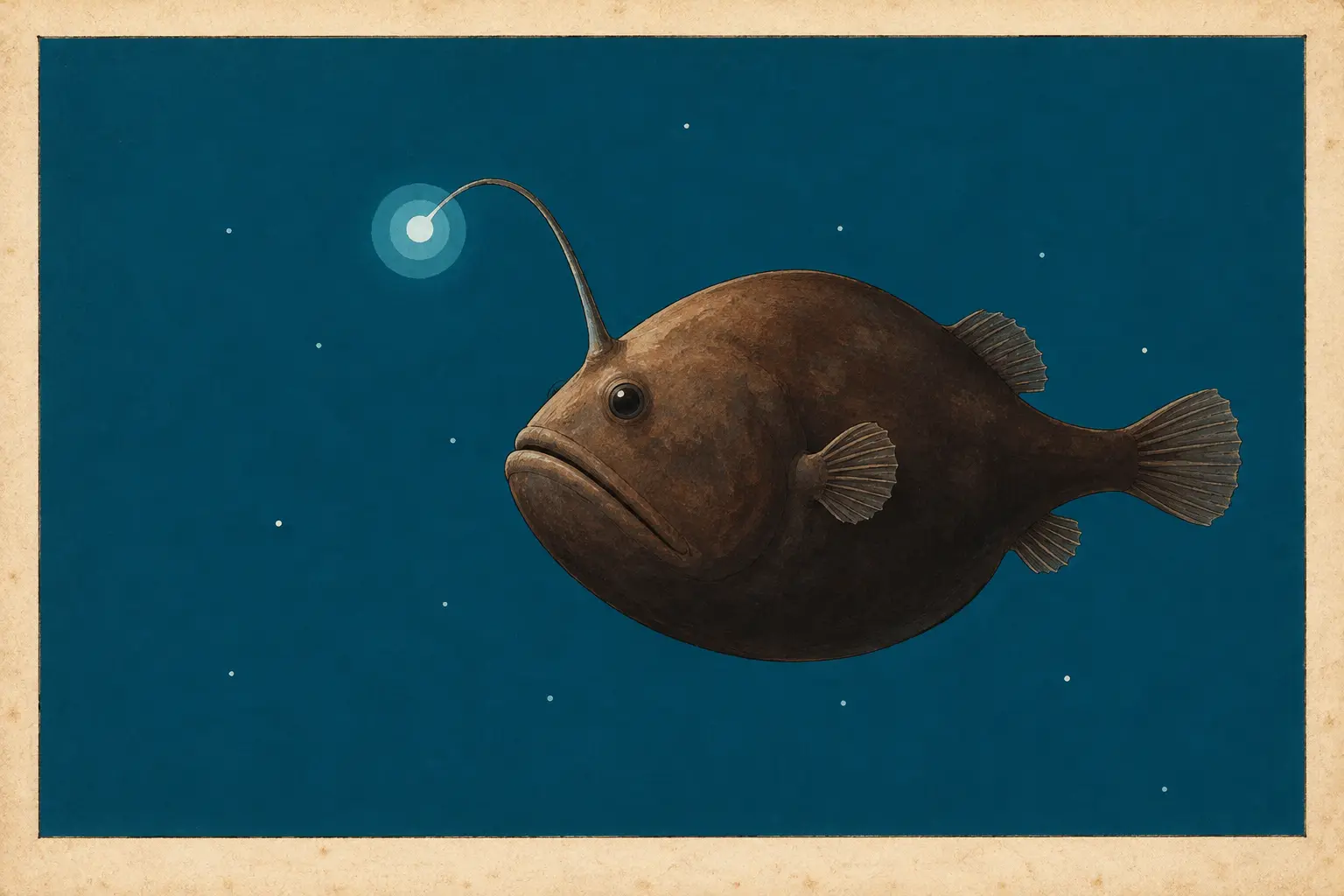
An illustrated scene, not a recorded sighting: a deep-sea anglerfish with its lure glowing in dark water. The exact function of the light has not been observed.
Part 3: Mouth, teeth and body
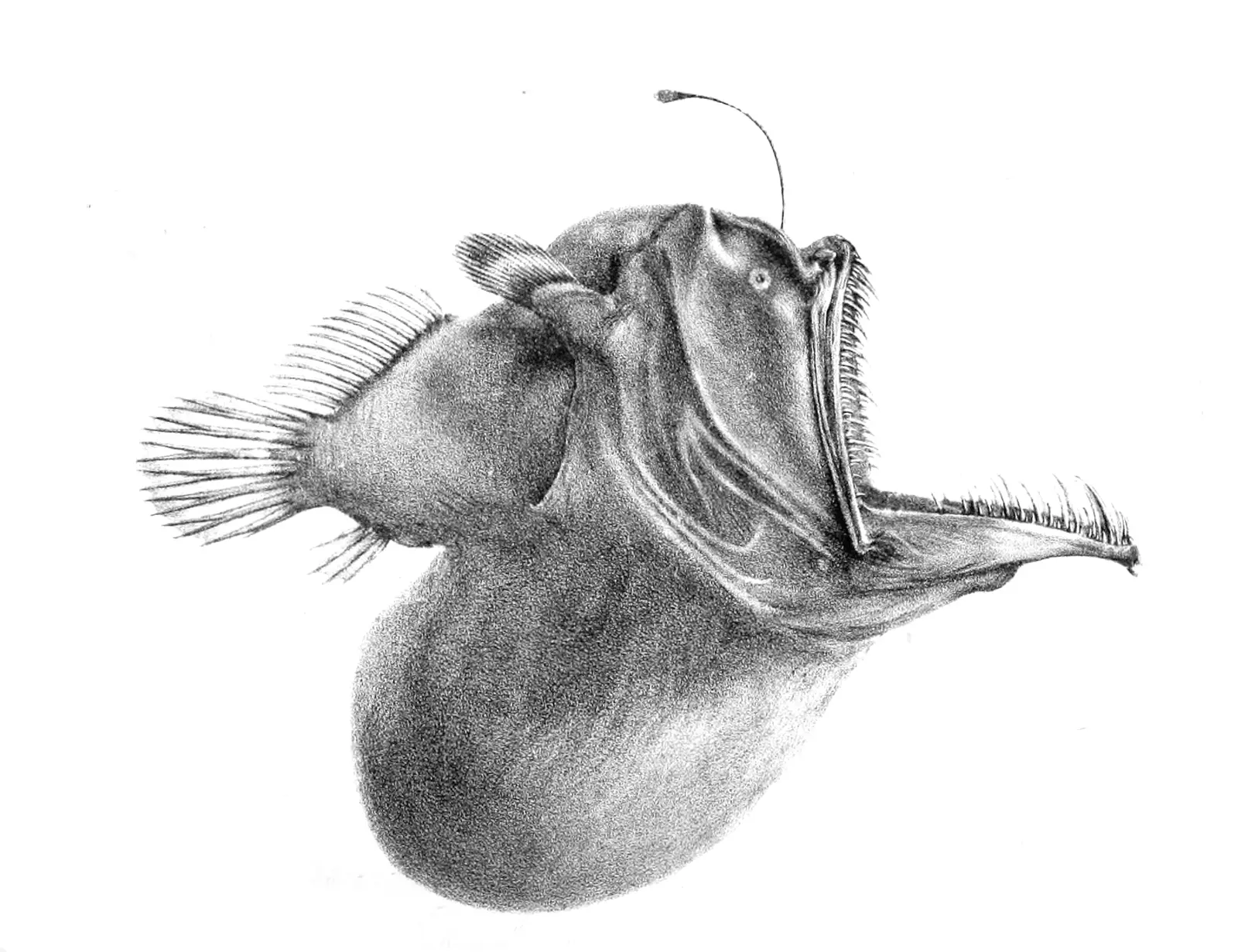
A female deep-sea anglerfish is built around a big head and mouth. In most families her body is short and deep, almost spherical. The head is usually more than 40% of the body length, and compared with other anglerfishes, mouths range from moderate to, in the account's words, extremely large.
Full credit and license
"Melanocetus johnsonii (Plate XXV, Proceedings of the Zoological Society of London 1864)" by George Henry Ford — https://commons.wikimedia.org/wiki/File:MelanocetusJohnsoniiFord.jpg — Public domain (drawn by G. H. Ford (died 1876) and published in London in 1864 or 1865; term expired in the US and the EU)George Henry Ford's plate of the black seadevil Melanocetus johnsonii for Albert Günther's 1864 description, based on one fish from Madeira: a rounded belly, a small eye and long, slender teeth.
Teeth differ by family: in the warty seadevils (Ceratiidae), the jaw teeth are slender, curved backward and depressible, meaning they can fold down. Pietsch's 2007 account of the Linophrynidae says they have the largest mouths and the longest dagger-like teeth of any fish, and perhaps of any vertebrate. In the wolftrap anglerfishes (Thaumatichthyidae), the upper jaw reaches far past the lower one. The 2005 account says it can flip down over the lower jaw, its long hooked teeth forming a cage that holds prey before swallowing.
The rest of the body is stripped down. Adults have no swim bladder and no pelvic fins. Most adult females have small eyes; in Ceratias and Melanocetus the eye lies under the skin and shows through a clear patch. Most species are dark brown to black all over, but the skin of Haplophryne has no pigment.
What do deep-sea anglerfishes eat?
Deep-sea anglerfishes are considered dietary generalists, opportunistic feeders in a zone where food is scarce. A 2023 study of anglerfish jaws gives that reasoning and notes that almost nothing is known about the diets of fishes in the dark midwater below 1,000 m. Its authors found unexpected variety in the jaws themselves, from many stout teeth and a relatively slow but forceful bite to long, fang-like teeth and a fast but weak bite.
Part 4: The male, built for finding
A male deep-sea anglerfish is built for finding a female, not for fishing. In most species he has large eyes and very large nostrils, which are thought to follow a scent released by females of his own species. Whipnose males are an exception. Their eyes are tiny, but their smell organs are large.
When a young male changes into his adult form, he loses his ordinary jaw teeth and grows hooked denticles at the tips of the jaws. These grip the skin of a female. In some families the grip is only temporary; in others it is the first step of fusion.
The size gap is extreme. In most genera the largest known males reach only 6 to 8% of the length of the largest females. Adult males of some sinistral seadevils (Linophrynidae) measure 6 to 10 mm, which the 2007 Pietsch and Kenaley account says puts them in contention for the title of world's smallest vertebrate.
In Ceratias holboelli, females may be more than 60 times as long as males. The females may also be about half a million times as heavy.

A teal bar for one female of Ceratias holboelli above 60 coral segments for males, end to end, and one male alone. Females may be more than 60 times as long as males.
Part 5: Fusion, family by family
Where fusion happens, outgrowths from the male's snout and lower jaw fuse with the female's skin, and eventually their blood systems connect, so he depends on her blood for food. The fused male is then considered a parasite. But he does not vanish: he keeps growing.
In the warty seadevils (Ceratiidae), every free-living male on record by 2006 was under 12 mm. Attached males reached about 120 to 140 mm. The figure depends on which of Pietsch's accounts (2005 or 2006) you read.
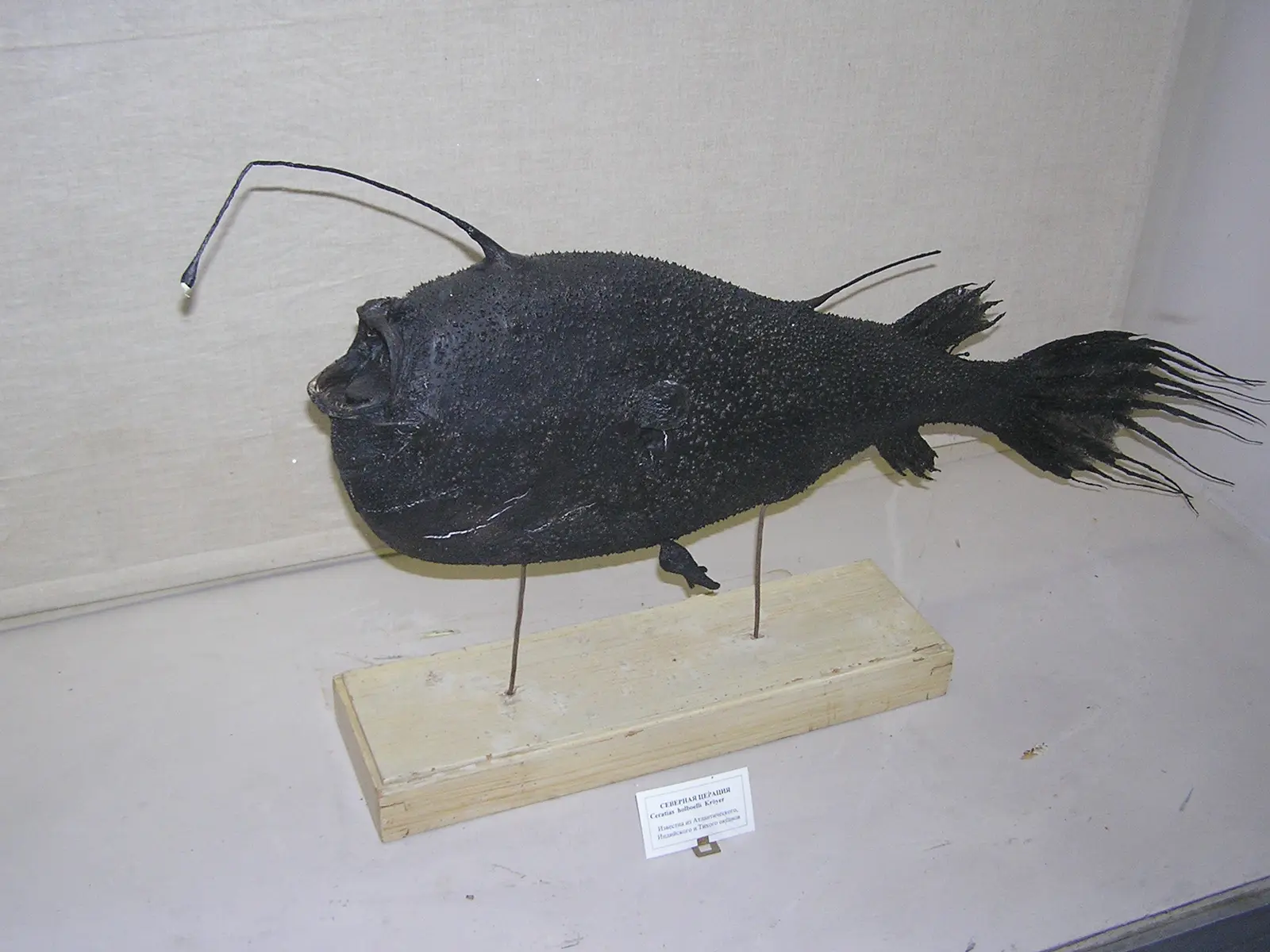
A female warty seadevil (Ceratias holboelli) on a stand at the Zoological Museum in Saint Petersburg. The small fish hanging from her belly is identified on Wikimedia Commons as an attached male.
Fused males apparently stay alive and fertile as long as the female lives, joining in repeated spawnings. Some groups seem to have one male per female. Others often carry several; a 2001 report found eight on one Cryptopsaras couesii female.
How the 11 families compare, from Pietsch's Tree of Life family accounts (2005 to 2007, so newer finds may be missing):
| Family | What the males do | Species (WoRMS, 2026-10-10) |
|---|---|---|
| Ceratiidae (warty seadevils) | Obligate parasites as adults | 4 |
| Linophrynidae (sinistral seadevils) | Obligate parasites | 27 |
| Neoceratiidae (needlebeard seadevil) | Apparently obligate; no free-living male known | 1 |
| Caulophrynidae (fanfin seadevils) | Parasitic, but probably not obligatory | 5 |
| Oneirodidae (dreamers) | Free-living; one attached pair each known for Leptacanthichthys and Bertella | 72 |
| Melanocetidae (black seadevils) | Never parasitic; two temporary couplings known | 6 |
| Himantolophidae (footballfishes) | Never parasitic | 23 |
| Diceratiidae (doublespine seadevils) | Apparently never parasitic | 7 |
| Centrophrynidae (prickly seadevil) | No evidence of parasitism | 1 |
| Gigantactinidae (whipnose seadevils) | None of more than 175 females carried a male | 25 |
| Thaumatichthyidae (wolftrap seadevils) | Not stated; males known only for Thaumatichthys | 9 |
By WoRMS species counts, the groups with fused males on record hold 39 of the 180 species, about one in five. That count assumes each family's pattern applies to all its species. Yet males of many species have never been found. The full ledger, with lure types, bacteria and record sizes for each family, is a download: anglerfish-family-ledger.csv (CSV · JSON label).
How does a fused pair avoid rejection?
Joining two genetically different vertebrates would normally trigger an immune attack against the foreign tissue. A 2022 review describes a 2020 genome study of 13 species. All ten whose males attach, even temporarily, lacked a working aicda gene, which antibodies need to improve their fit over time.
Permanent attachment came with further losses, ending in some species with broken rag genes. Immune cells use those genes to build new receptors. The review names Haplophryne mollis and Photocorynus spiniceps as two such species. How these fish fight infection is still unknown, it notes.
Why do only some families fuse?
Fusion seems to have arisen more than once: as a 2010 study summarizes, Pietsch and Orr argued that it was gained separately in different lineages rather than lost repeatedly. That study's analysis of mitochondrial genomes reconstructed temporary attachment as the forerunner in at least three of five family-level cases.
Why some lineages took this path is still a question for models. A 2026 mathematical model found that parasitic males are favored when males and females rarely meet and fusion costs little, while free-living males win when meetings are common or fusion is costly. That is a hypothesis about selection, not a measurement from the deep sea.
The claim vs. the record
- "Anglerfish make their own light." The lure's light comes from bacteria, and monkfish and frogfish lures do not glow at all. The known exception is the chin barbel of Linophryne, which makes its own light.
- "Male anglerfish always fuse with females." Fused males are on record in four families and two genera, holding 39 of 180 species.
- "The fused male dissolves." He apparently stays alive and fertile, and in the warty seadevils he keeps growing.
Anglerfish FAQ
How big do anglerfish get?
In Tree of Life records from 2005 to 2007, the largest known females of most deep-sea anglerfish families measure 11 to 47 cm in standard length (to the base of the tail fin). Warty seadevil (Ceratiidae) females reach at least 77 cm. Males reach at most 1 to 4 cm in most families, though attached warty seadevil males grow to about 12 to 14 cm. Some bottom-living monkfishes exceed 1 m and 27 kg.
How deep do anglerfish live?
Deep-sea anglerfishes live mostly below 300 m, concentrated between about 800 and 2,500 m in open water, above the ocean's average depth of 3,682 m. Their depth record, reported in 2024, is 5,866 m.
Do anglerfish make their own light?
In nearly all deep-sea anglerfish females, the lure's light comes from bacteria living inside it, not from the fish. A 2019 study found just two bacterial species in the lures it sampled and concluded that the fish pick them up from seawater. The exception is Linophryne, whose chin barbel glows with the fish's own light.
Next, compare two deep-sea giants: the giant squid and the colossal squid.
Figure: How much bigger the female gets
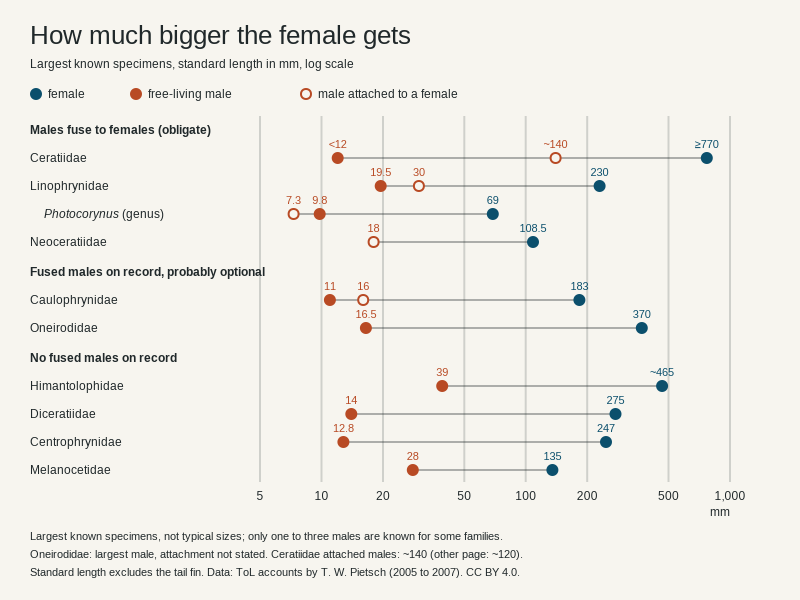
Largest known standard lengths of females and males in ten deep-sea anglerfish groups, grouped by whether males fuse, from Pietsch's Tree of Life family accounts (2005 to 2007). For attached warty seadevil males, another of his accounts gives nearly 120 mm instead of about 140 mm. These are record specimens, not typical sizes, and female and male values are not from paired animals.
Source card
- Images: six photographs, two of one fish from iNaturalist observation 70414155 (both CC0 at the photo level) and four from Wikimedia Commons, one of them first posted on iNaturalist and two of them figures from Mincarone et al. 2021 (three CC BY 4.0, one CC BY-SA 3.0), one public-domain 1864 plate by George Henry Ford, also via Commons, and two figures drawn by this site, with licenses checked against the iNaturalist and Commons records on 2026-10-10 for the two main images and Figure 1 of Mincarone et al. and on 2026-10-13 for the other three photographs and the plate; species names follow the source labels, and the two main images are labeled only to suborder because identifiers disagree.
- Classification: WoRMS lists Lophiiformes as an accepted order (AphiaID 10316) and Ceratioidei as an accepted suborder (AphiaID 154158). Species counts were run against the WoRMS records on 2026-10-10.
- Data: family facts follow Pietsch's Tree of Life accounts (2005 to 2007), which summarize his 2005 review of anglerfish reproduction; that review was not read directly, and records may have been updated since. The family ledger CSV gives the source for each row.
Corrections: 2026-10-14: Added the section "What do deep-sea anglerfishes eat?", drawn from a 2023 study of anglerfish jaws (the entry did not answer this question before).
Sources
- Baker LJ, Freed LL, Easson CG, Lopez JV, Fenolio D, Sutton TT, Nyholm SV, Hendry TA. "Diverse deep-sea anglerfishes share a genetically reduced luminous symbiont that is acquired from the environment." eLife 8:e47606 (2019) doi.org/10.7554/eLife.47606full text read via Europe PMC, PMC6773444
- WoRMS Editorial Board. World Register of Marine Species: Lophiiformes (AphiaID 10316) and Ceratioidei (AphiaID 154158), accepted species www.marinespecies.org/aphia.php?p=taxdetails&id=154158taxon records and lists of child taxa
- Miya M, Pietsch TW, Orr JW, Arnold RJ, Satoh TP, Shedlock AM, Ho H-C, Shimazaki M, Yabe M, Nishida M. "Evolutionary history of anglerfishes (Teleostei: Lophiiformes): a mitogenomic perspective." BMC Evolutionary Biology 10:58 (2010) doi.org/10.1186/1471-2148-10-58full text read via Europe PMC, PMC2836326
- Pietsch TW, Kenaley CP. "Ceratioidei. Seadevils, Devilfishes, Deep-sea Anglerfishes." Version 2 October 2007, Tree of Life Web Project tolweb.org/Ceratioidei/22000full page read
- Pietsch TW. "Lophiiformes. Anglerfishes." Version 18 October 2005, Tree of Life Web Project tolweb.org/Lophiiformes/21989full page read
- NOAA National Ocean Service. "How deep is the ocean?" oceanservice.noaa.gov/facts/oceandepth.htmlfull page read
- Stewart AL, Pietsch TW, Moore J, Peng X. "Upside-down swimming: in situ observations of inverted orientation in Gigantactis, with a new depth record for the Ceratioidei." Journal of Fish Biology 104:887–891 (2024) doi.org/10.1111/jfb.15609abstract read via Europe PMC, PMID 37933516
- Davis AL, Thomas KN, Goetz FE, Robison BH, Johnsen S, Osborn KJ. "Ultra-black camouflage in deep-sea fishes." Current Biology 30:3470–3476 (2020) doi.org/10.1016/j.cub.2020.06.044abstract read via Europe PMC, PMID 32679102
- Pietsch TW. "Gigantactinidae. Whipnose Seadevils." Version 6 November 2005, Tree of Life Web Project tolweb.org/Gigantactinidae/22011full page read
- Pietsch TW. "Thaumatichthyidae. Wolftrap Seadevils." Version 6 November 2005, Tree of Life Web Project tolweb.org/Thaumatichthyidae/22007full page read
- Pietsch TW, Grobecker DB. "The compleat angler: aggressive mimicry in an antennariid anglerfish." Science 201:369–370 (1978) doi.org/10.1126/science.201.4353.369abstract read via Europe PMC, PMID 17793734
- Pietsch TW. "Ceratiidae. Warty Seadevils." Version 17 April 2006, Tree of Life Web Project tolweb.org/Ceratiidae/22010full page read
- Pietsch TW. "Linophrynidae. Sinistral Seadevils." Version 2 October 2007, Tree of Life Web Project tolweb.org/Linophrynidae/22027full page read
- Mincarone MM, Afonso GVF, Di Dario F, Eduardo LN, Frédou T, Lucena-Frédou F, Bertrand A, Pietsch TW. "Deep-sea anglerfishes (Lophiiformes: Ceratioidei) from off northeastern Brazil, with remarks on the ceratioids reported from the Brazilian Exclusive Economic Zone." Neotropical Ichthyology 19(2):e200151 (2021) doi.org/10.1590/1982-0224-2020-0151full text read via SciELO
- Pietsch TW. "Melanocetidae. Melanocetus. Black Seadevils." Version 5 November 2005, Tree of Life Web Project tolweb.org/Melanocetus/22003full page read
- Pietsch TW. "Neoceratiidae. Neoceratias spinifer. Needlebeard Seadevils." Version 6 November 2005, Tree of Life Web Project tolweb.org/Neoceratias_spinifer/22002full page read
- Pietsch TW. "Caulophrynidae. Fanfin Seadevils." Version 3 November 2005, Tree of Life Web Project tolweb.org/Caulophrynidae/22025full page read
- Pietsch TW. "Oneirodidae. Dreamers." Version 5 November 2005, Tree of Life Web Project tolweb.org/Oneirodidae/22026full page read
- Pietsch TW. "Himantolophidae. Himantolophus. Footballfishes." Version 2 October 2007, Tree of Life Web Project tolweb.org/Himantolophus/22004full page read
- Pietsch TW. "Diceratiidae. Doublespine Seadevils." Version 5 November 2005, Tree of Life Web Project tolweb.org/Diceratiidae/22006full page read
- Pietsch TW. "Centrophrynidae. Centrophryne spinulosa. Prickly Seadevils." Version 3 November 2005, Tree of Life Web Project tolweb.org/Centrophryne_spinulosa/22009full page read
- Isakov N. "Histocompatibility and Reproduction: Lessons from the Anglerfish." Life 12:113 (2022) doi.org/10.3390/life12010113full text read via Europe PMC, PMC8780861
- Swann JB, Holland SJ, Petersen M, Pietsch TW, Boehm T. "The immunogenetics of sexual parasitism." Science 369:1608–1615 (2020) doi.org/10.1126/science.aaz9445abstract read via Europe PMC, PMID 32732279
- Satow T, Takimoto G. "Reproductive assurance drives the evolution of parasitic males in anglerfishes." Proceedings of the Royal Society B 293(2075): 20261268 (2026) doi.org/10.1098/rspb.2026.1268abstract
- Caruso JH. "Lophiidae. Goosefishes, monkfishes." Version 18 October 2005, Tree of Life Web Project tolweb.org/Lophiidae/21990full page read
- FishBase glossary. "Standard length." www.fishbase.se/glossary/Glossary.php?q=standard+lengthglossary entry read (definition only; no data extracted)
- iNaturalist observation 70414155, Diceratias pileatus, Kalaoa, Hawaii, 1 March 2021, by kbkash www.inaturalist.org/observations/70414155observation record
- iNaturalist observation 210998943, Lophius piscatorius, United Kingdom, 28 April 2024, by Libby Keatley www.inaturalist.org/observations/210998943observation record
- Günther A. "On a new genus of pediculate fish from the sea of Madeira." Proceedings of the Zoological Society of London 1864: 301–303, pl. XXV archive.org/details/proceedingsofgen64zoolfull text read via the Internet Archive scan of the 1864 volume (pp. 301–303 and Plate XXV)
- Butko A. "Северная церация" (Krøyer's deep sea angler fish, Ceratias holboelli, Zoological Museum, Saint Petersburg), photograph taken 20 September 2008, with its cropped version "Северная церапия (cropped)". Wikimedia Commons commons.wikimedia.org/wiki/File:%D0%A1%D0%B5%D0%B2%D0%B5%D1%80%D0%BD%D0%B0%D1%8F_%D1%86%D0%B5%D1%80%D0%B0%D1%86%D0%B8%D1%8F.jpgfile description pages of both versions
- Heiple Z, Huie JM, Medeiros APM, Hart PB, Goatley CHR, Arcila D, Miller EC. "Many ways to build an angler: diversity of feeding morphologies in a deep-sea evolutionary radiation." Biology Letters 19:20230049 (2023) doi.org/10.1098/rsbl.2023.0049abstract

Cite this page
Plankton to Plumage. “The Anglerfish, Explained Part by Part: Its Lure's Light Is Borrowed.” October 12, 2026, updated October 14, 2026. https://planktontoplumage.com/deep-sea/anglerfish/
Add the date you read the page after the address if your style guide asks for it.