Deep explainerNo. 0017
Why Moths Fly to Lights: 3D Video Suggests They Mistake the Bulb for the Sky
Published
Parts of this entry12 parts
Main images
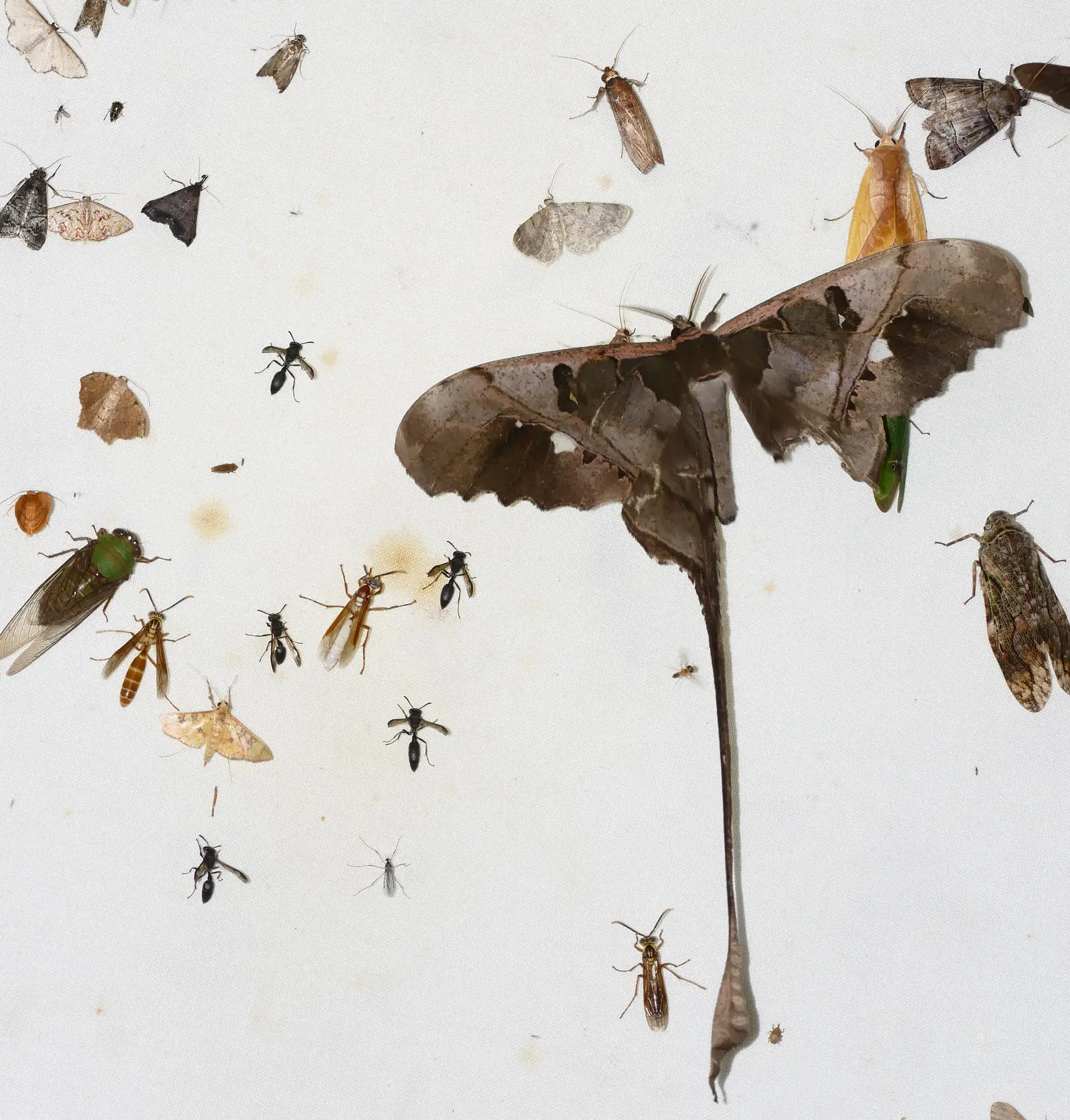
A long-tailed silk moth, Copiopteryx jehovah, among other insects on a white surface, in a photo its author titled "attracted to light." The species follows the source label.
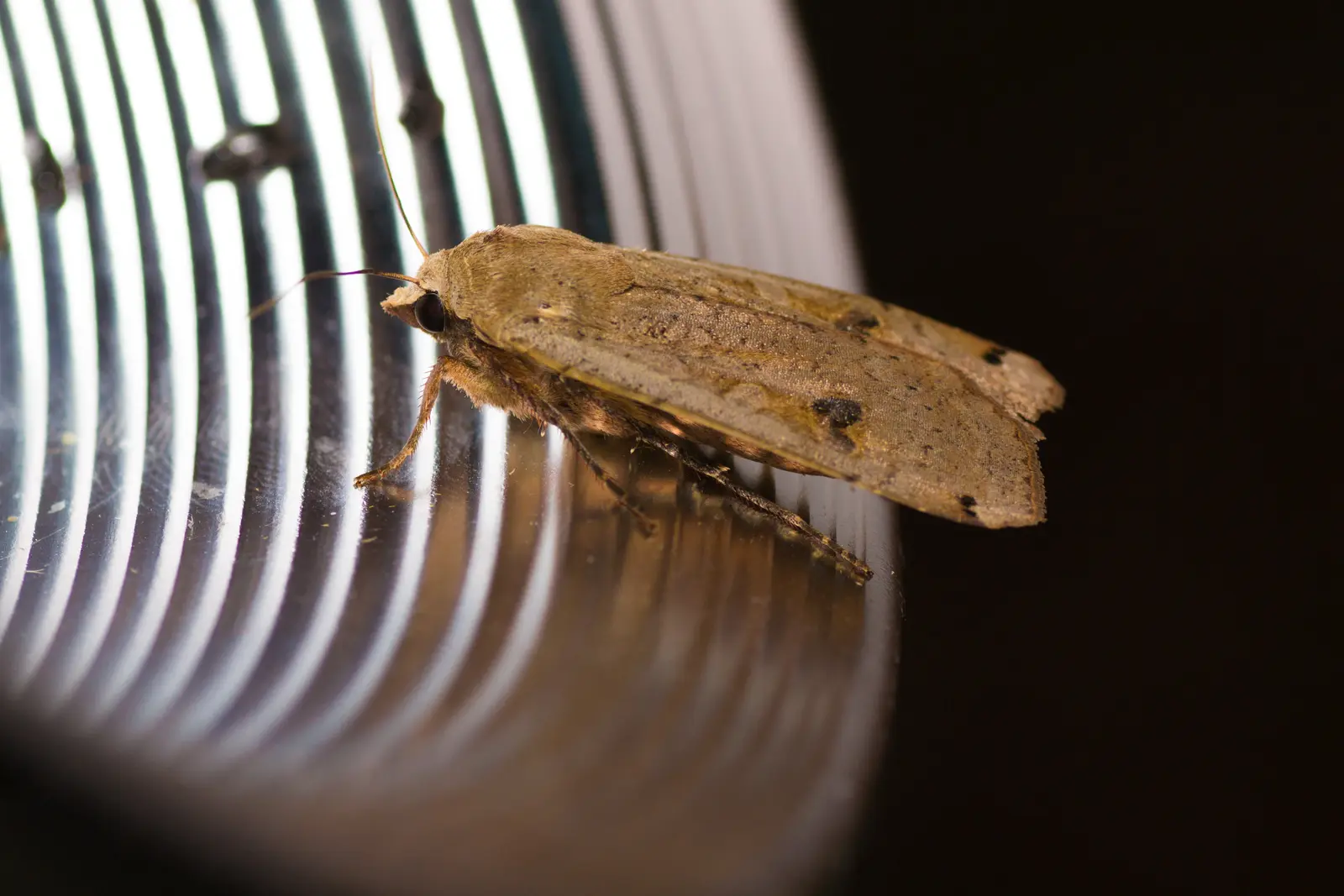
A large yellow underwing on a backyard light in Ohio, per the photo's description. Yellow underwings were among the moths tracked in the 2024 study below.
The short answer
On high-speed video, moths circling a lamp keep their backs tilted toward it, even when that flips them over. That finding comes from a 2024 study that tracked flying insects around lights in three dimensions. Few flew straight at the light. Most traveled sideways to it, banked toward the bulb.
The authors propose a reflex as the cause: the dorsal light response keeps an insect's back toward the brightest part of its view, which under a natural sky is up, so a nearby lamp may steer it around the light. The moon-compass idea fits the recordings poorly, and the authors consider heat ruled out. How far a light can pull moths in from is less settled.
Do moths really fly toward lights?
Not in a straight line, at least up close. The saying "drawn like a moth to a flame" assumes the moth is aiming for the flame. A 2018 review describes insects that spiral, approach directly, orbit the light, or perch on or under it, apparently stunned.
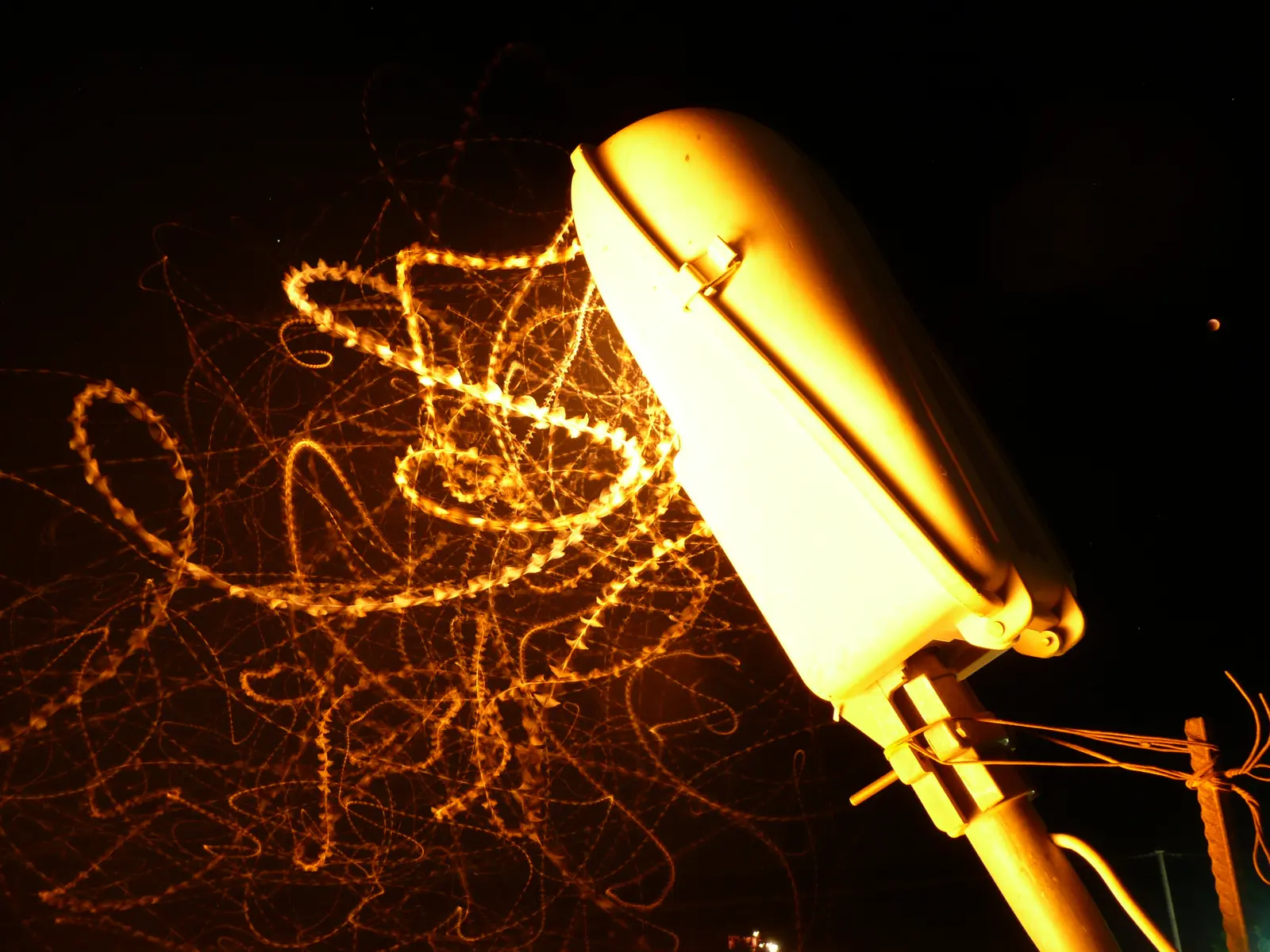
Insects at a streetlight, drawn as looping streaks by a 15-second exposure, per the source label.
In 2022 and 2023, the 2024 team filmed wild insects at ultraviolet lights in Monteverde, Costa Rica, with paired high-speed cameras under infrared light, which the authors assumed the insects could not see. Across 477 recordings, three abnormal moves kept appearing:
- Orbiting: a fairly steady circle around the light, body banked toward it.
- Stalling: a steep climb while facing away from the light, slowing until the insect makes no headway.
- Inverting: rolling or pitching upside down over the light, then diving toward the ground.
Lepidoptera, the order of moths and butterflies, appeared in 387 videos at the lights, far more than any other order. In 41 videos of dark forest with no lamp, 3 showed any of these moves. All of them were stalls.
Which explanations have been proposed?
The 2024 paper lists four popular ones: an escape toward light, as toward a gap in foliage; a moon compass fooled by a lamp; heat; and night-adapted eyes blinded by glare. The 2018 review adds an illusion of open sky and, from a 1973 study, dark "Mach bands" at light–dark borders. Flight data able to test these ideas had been exceedingly rare, the 2024 authors note. Here is how the main ones fared:
| Explanation | What it predicts near a light | What the 2024 recordings showed | Where it stands |
|---|---|---|---|
| Moon compass | Inward spirals, light kept on one side | No inward spirals; in 25 of 37 light-switch videos, the orbiting insect reversed direction | Does not fit close-range trapping; a role farther out is untested |
| Escape toward light | Flights aimed at the light | Few aimed at it; most flew sideways to it | The authors say the recordings refute it |
| Heat | Infrared from the lamp draws insects in | Not tested; the authors note that LED lights, with negligible infrared, still trap vast numbers of insects | Rejected by the authors |
| Dazzle | Erratic, blinded flight | Predictable patterns centered on the light | Argued against as the cause |
| Dorsal light response | Banking toward the lamp; orbits, stalls, flips | Backs tilted toward the light in all four main study groups, but not in oleander hawk-moths | The authors' most plausible model; gaps remain |
The full table, with the Mach band idea, long-range attraction and sources: why-moths-fly-to-lights-hypotheses.csv (CSV · JSON label).
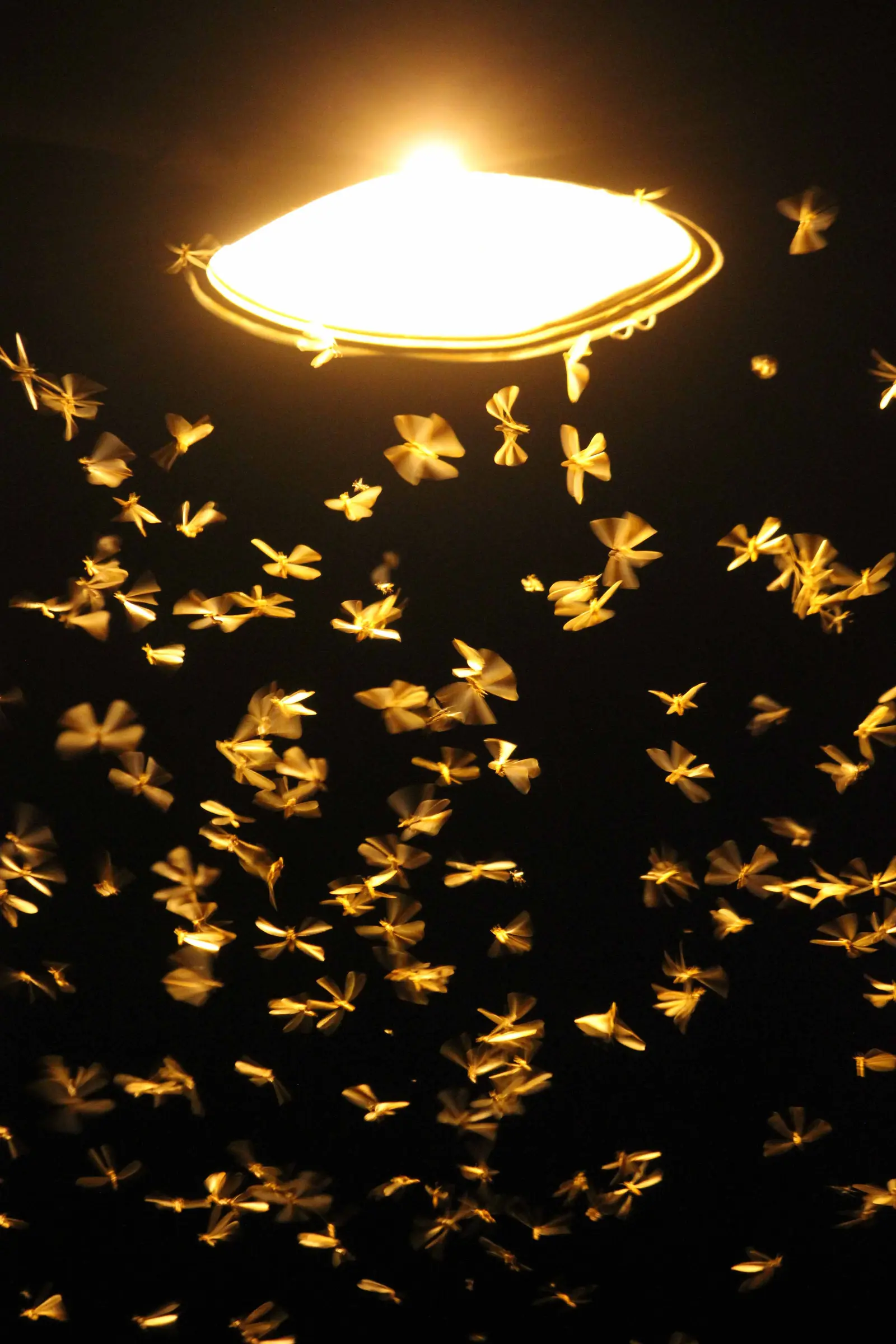
Winged insects crowding the air beneath a lamp in Brazil, per the source label.
Does a moth mistake a lamp for the moon?
The light-compass theory, as a 2018 review summarizes it, holds that an insect keeping a constant angle to light rays, which for most of history came only from the moon or stars, will spiral into an artificial light. The moon's rays arrive nearly parallel, so a fixed angle keeps a course straight. A nearby lamp sends rays out in all directions. The same rule then bends the path into a spiral, as the first figure below shows.
Insects do use sky compasses at night, the 2024 authors note. Among other work, they cite a 1979 study of the large yellow underwing. In a 2024 radar study in Germany, switching on test streetlights made hawk moths' flights more winding when the moon was up.
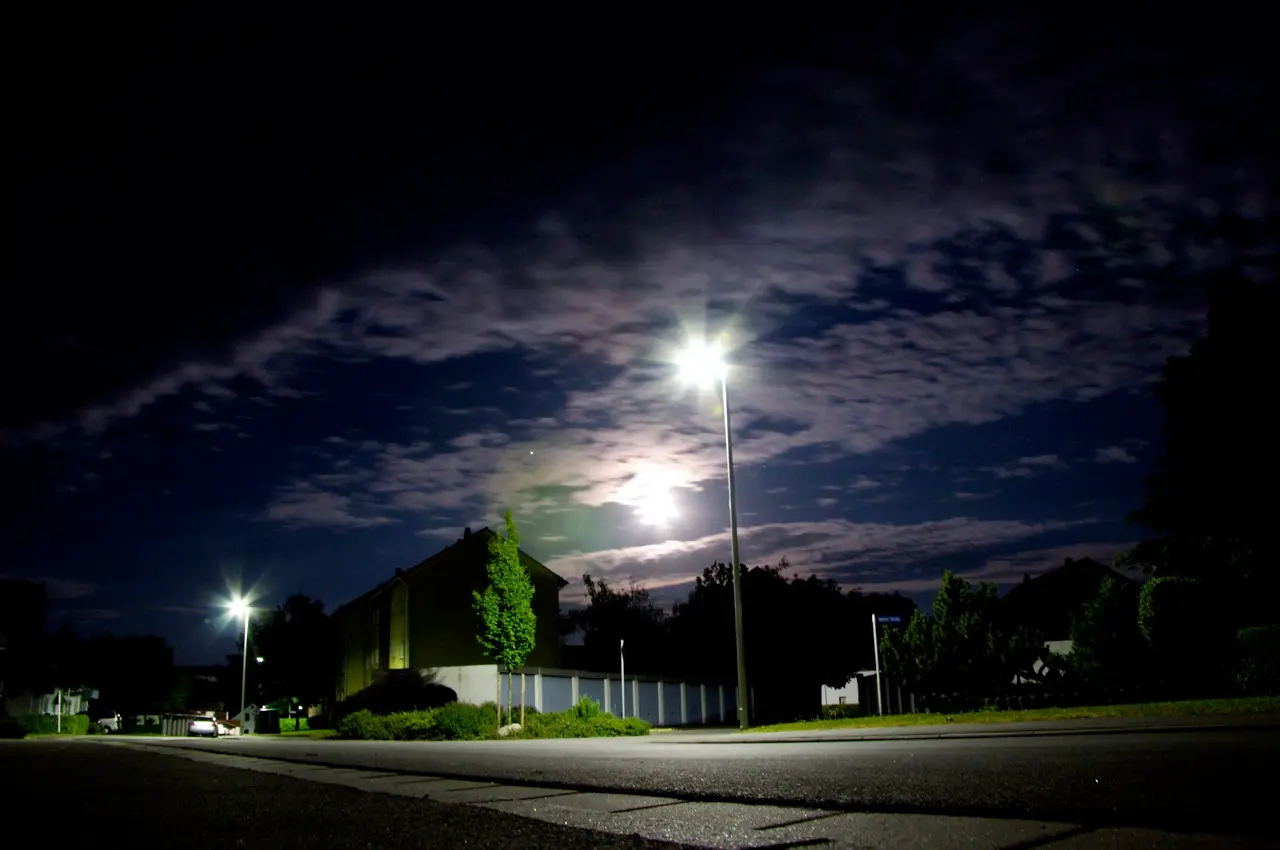
The moon glowing through cloud beside a lit streetlight, in a photo titled "Moon Lamp." Under the compass idea, the distant moon keeps a fixed-angle course straight; a nearby lamp does not.
Up close, though, the recordings did not match the rule. The team saw no inward spirals, which the authors call a key prediction. In Cambridge, England, they hung two ultraviolet lights 2 m up and switched from one to the other while an insect orbited beneath. In 37 of 70 videos the insect began orbiting the second light, and in 25 of those it reversed direction, putting the light on its other side.
An insect steering by a misplaced moon should keep the light on the same side. A confused compass also cannot explain stalling or flipping over a lamp, the authors argue. Butterflies appeared in 23 of the 37 switch videos (whites and sulfurs, Pieridae, and brushfoot butterflies, Nymphalidae), and noctuid moths in 12.
The study did not test what happens farther from a light. There, the authors allow, a lamp could still disrupt heading cues.
What is the dorsal light response?
The dorsal light response is a reflex that keeps the dorsal side, the back, toward the brightest part of the view. Most flying insects show some form of it. Through the long history of insect flight, the 2024 authors write, the brightest part of the view has been the sky, even at night and especially at wavelengths shorter than 450 nanometers.
Tilting matters because of how insects steer. Flying animals typically tilt the whole body to turn. In the team's motion-capture data, the net push from the wings stayed within a narrow range, pointing forward and out through the insect's back.
In the authors' model, a moth that tilts its back toward a lamp beside it tilts that push toward the lamp too, so its path bends around the light. Over the lamp, the back turns down and the push points at the ground.
Motion capture in a tent 2 m across tracked marker frames glued to the thorax. Each frame weighed at most about 5 percent of body weight. The four main study groups were two day-flying dragonflies, the common darter (Sympetrum striolatum) and migrant hawker (Aeshna mixta); yellow underwing moths (Noctua pronuba and N. fimbriata, analyzed together); and Lorquin's atlas moth (Attacus lorquinii), a giant silk moth in the luna moth's family, Saturniidae.
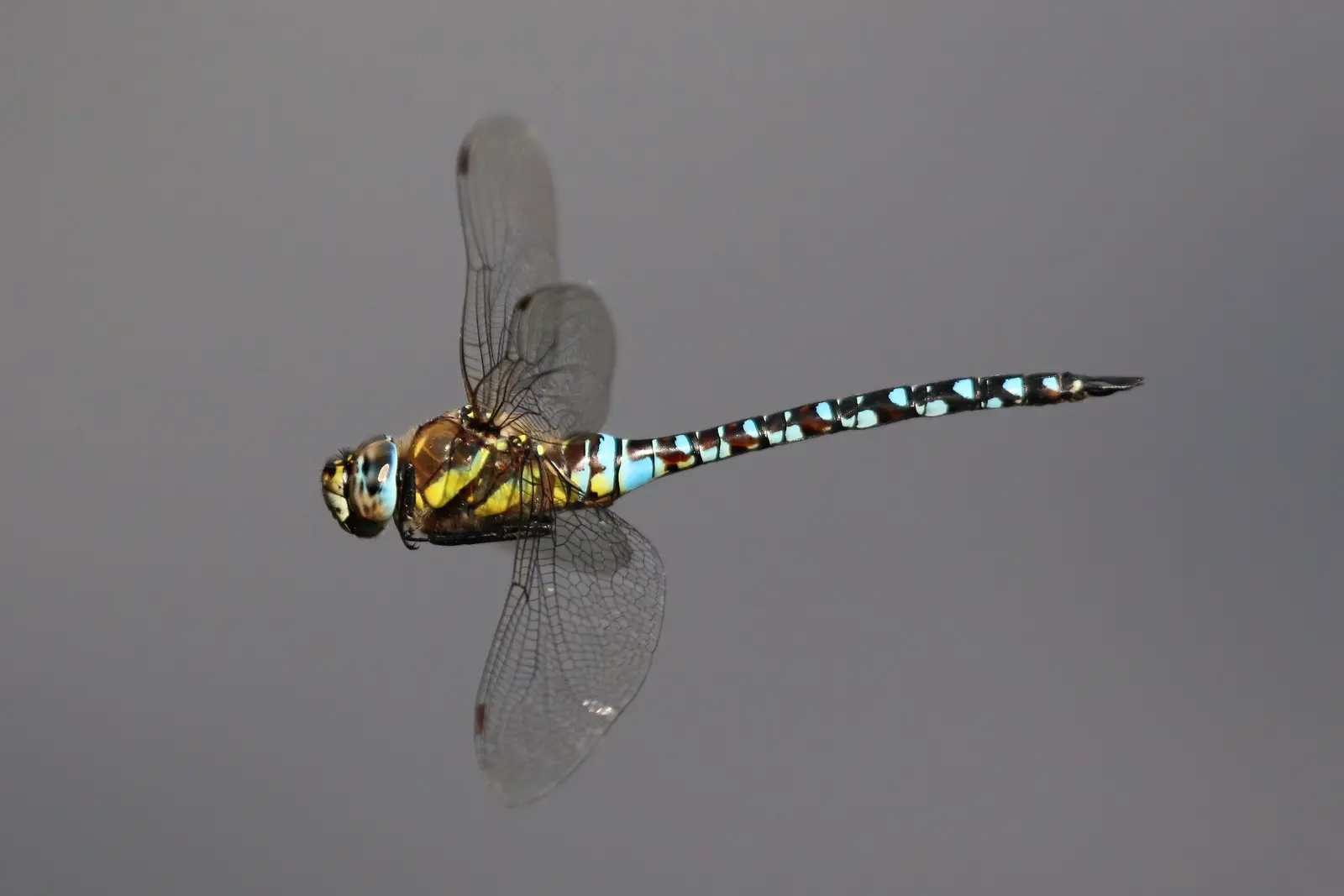
A male migrant hawker in flight in Oxfordshire, England, per the source label. This day-flying dragonfly was one of the four main groups in the 2024 motion-capture tests.
On an index from −1 (back away from the light) to 1 (back toward it), the four groups scored 0.79 to 0.84 near the light, against 0.17 for common darters with the light off. Under a dim, diffuse ultraviolet "ceiling," yellow underwings flew with a median bank of about 14 degrees. Near a single point of light, the median was 48 degrees.
What happens when the light comes from above?
Lighting a white sheet is an established way to trap insects, the authors note, and they did it two ways in the field with the same ultraviolet tube.
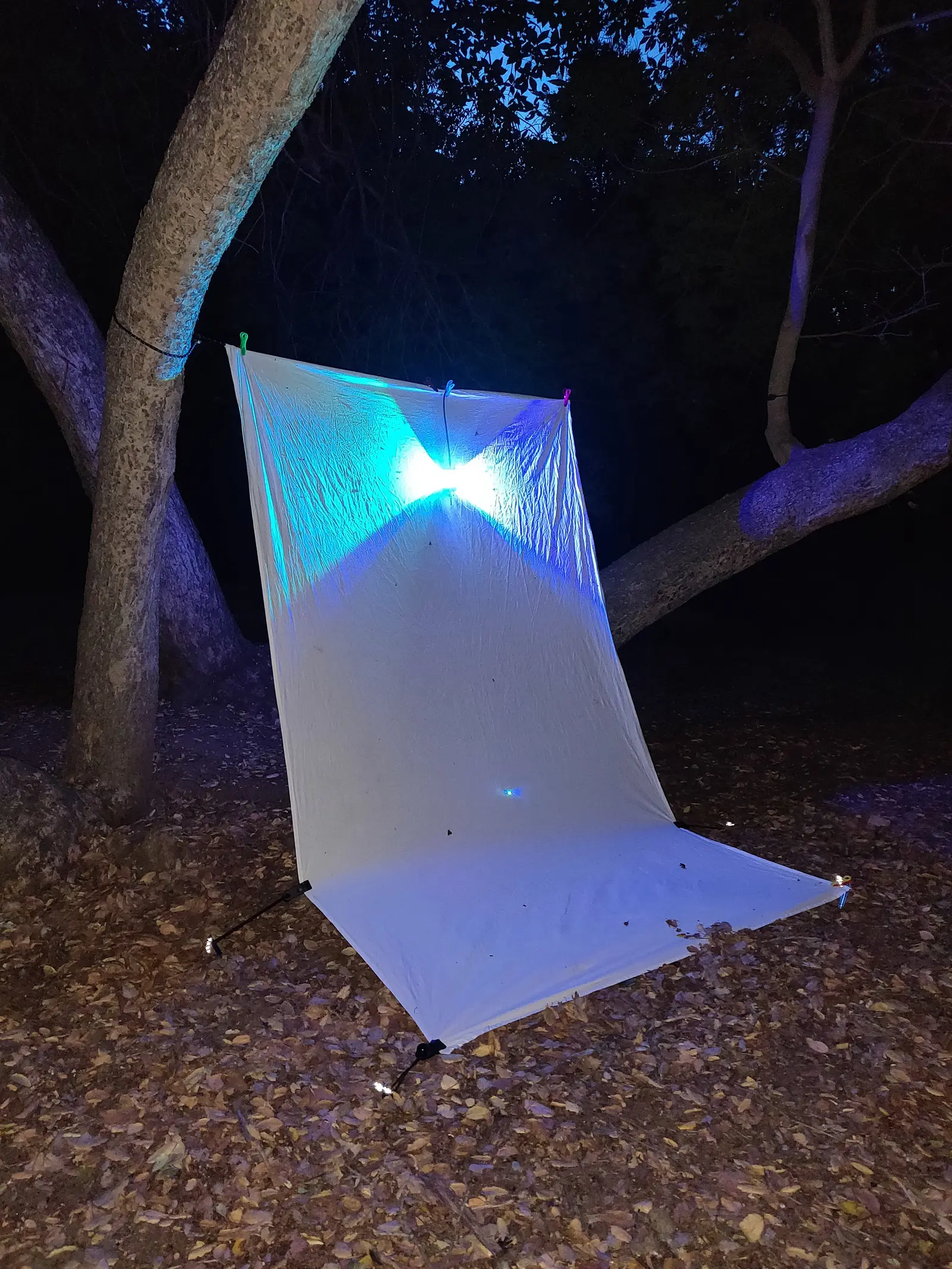
A white sheet lit by an LED lamp in Mount Diablo State Park, California, per the source label. The 2024 team instead lit a sheet on the forest floor or one hung overhead.
With the sheet on the forest floor and the tube about 0.3 m above the ground, facing down, insects rolled over, tumbled and crashed. Inverting showed up in 42 of 46 videos.
In the other setup, with the sheet hung about 2.5 m up and the tube aimed up at it, light came down as a diffuse glow, like a sky. Insects flew various paths underneath without clustering. Of 55 videos, 47 showed none of the three moves.
Small insects did the same in the lab: in a clear box 20 cm on a side, insects up to 2 cm long, from 13 families in 6 orders, flew steadily up toward diffuse ultraviolet light from above. With it from below, every group tested except vinegar flies tilted, flipped soon after takeoff and crashed. Over cool-white LEDs, none of the flies tested crashed, which the authors read as an effect specific to short wavelengths in those flies.
In the team's simulations, an insect whose only response to a lamp was tilting its back toward it reproduced all three moves, and most of 300 randomized runs stayed trapped near the light. That shows the reflex is enough to produce the pattern, not that it is the only possible cause.
Why don't moths circle the moon?
That is still unexplained. Insects also fly when the brightest part of the sky is not overhead, at dawn, at a forest edge or under a low moon, and the 2024 authors write that they do not understand why insects do not tilt toward natural sources of light. Eyes adjusting locally to uneven brightness may be one factor, they suggest.
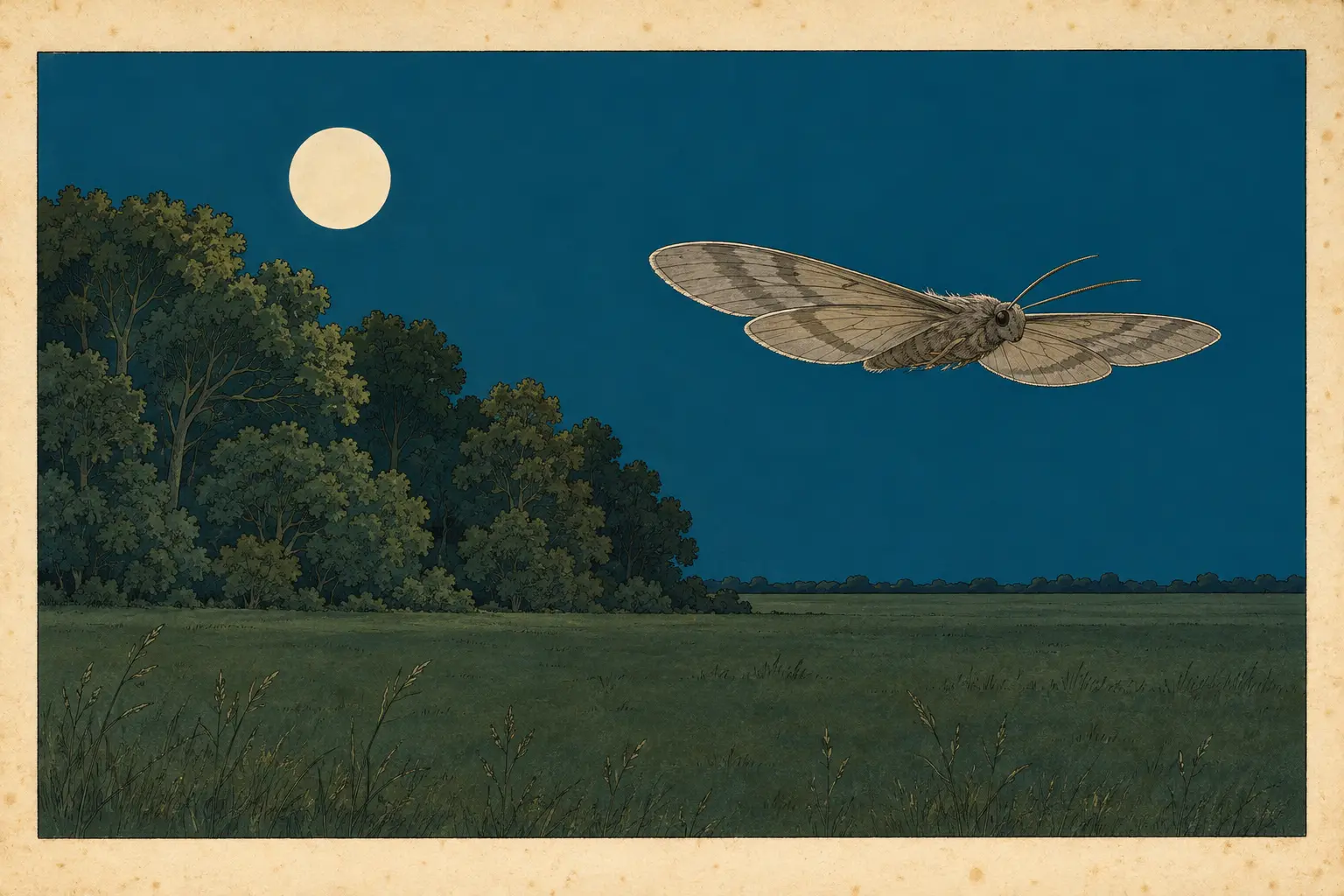
An illustrated scene: a moth flying level at a forest edge, the moon over the trees. The 2024 authors write they do not understand why insects do not tilt toward natural sources of light.
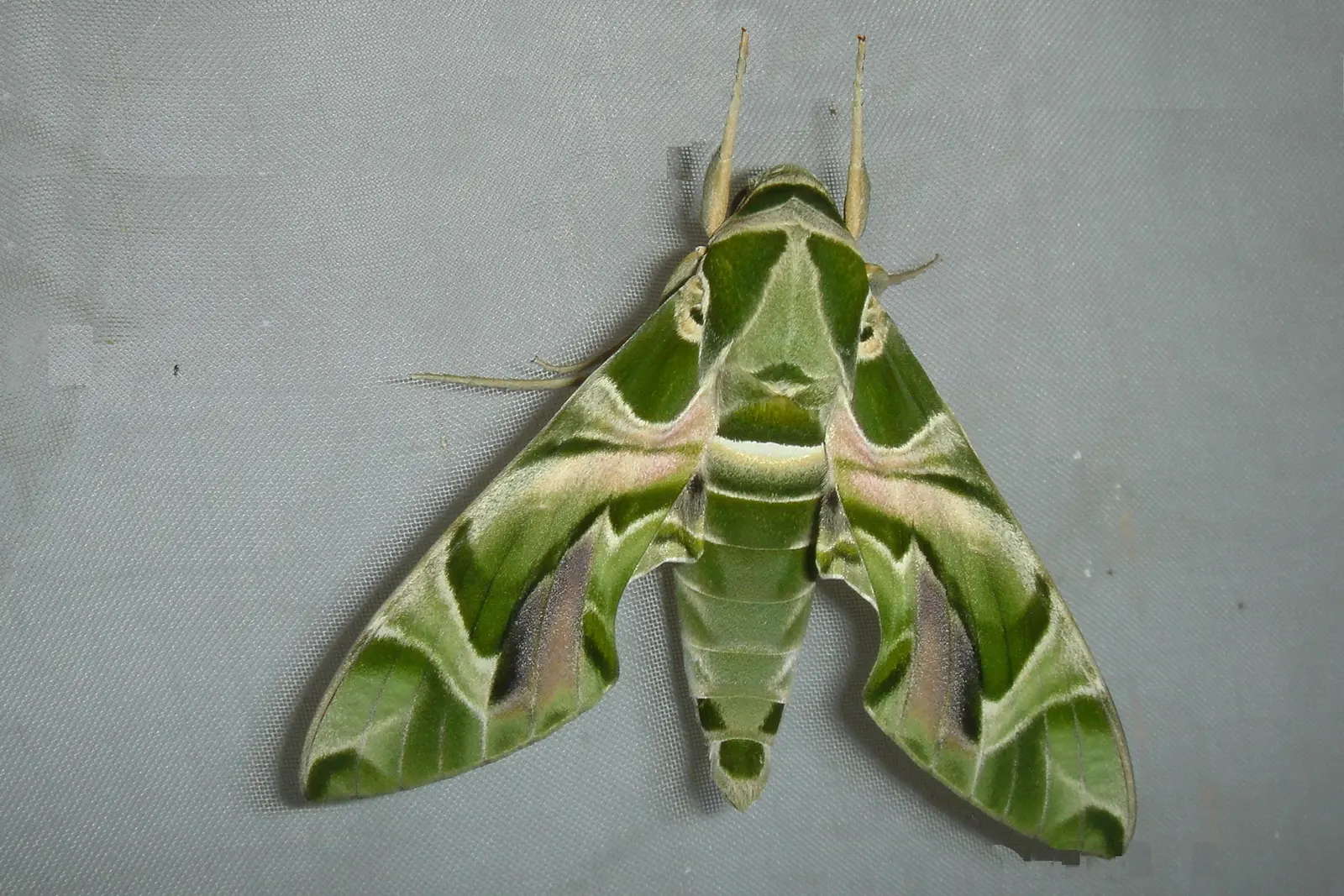
An oleander hawk-moth, photographed in Islamabad, Pakistan, per the source label. In the 2024 lab tests, three of this species flew over lamps without circling them.
Not every insect was thrown off. None of the three oleander hawk-moths (Daphnis nerii) tested in the lab circled or flipped; they flew straight over upward-facing ultraviolet and white LED bulbs, with a back-to-light index of 0.24. Yet lights in the field readily trap oleander and other hawk moths, the authors note, so they suggest the reflex may be suppressed in some states, or tuned to different wavelengths in different species.
The field data have limits the authors spell out. Many insects in the videos could not be identified below order, and the infrared tracking favored larger insects: those tracked averaged an estimated 29 mm, while most insects at the light were under 1 cm long.
How far away can a light pull a moth in?
Perhaps not far, judging by the only long-distance tracking study the 2024 flight team knew of, though its authors call the reach of a light's pull controversial. A 2016 study had used moth catches and a model to estimate an attraction radius of about 23 m around each high-pressure sodium streetlight. In summer 2018, researchers in Germany set six such streetlights in a circle on a pasture, each 85 m from a release point, fitted moths with 10.5 mg radar transponders and released them one at a time.
Of 50 moths released with the lights on, 2, or 4 percent, ended their flights at a streetlight. Twenty-eight came within the estimated 23 m radius, and 24 of them flew out again. All were males caught with the help of light, so the authors had expected far more to end up at the lamps. Up close the lights did work: seven privet hawk-moths (Sphinx ligustri) released 10 m from a streetlight all circled it and crashed to the ground from time to time.
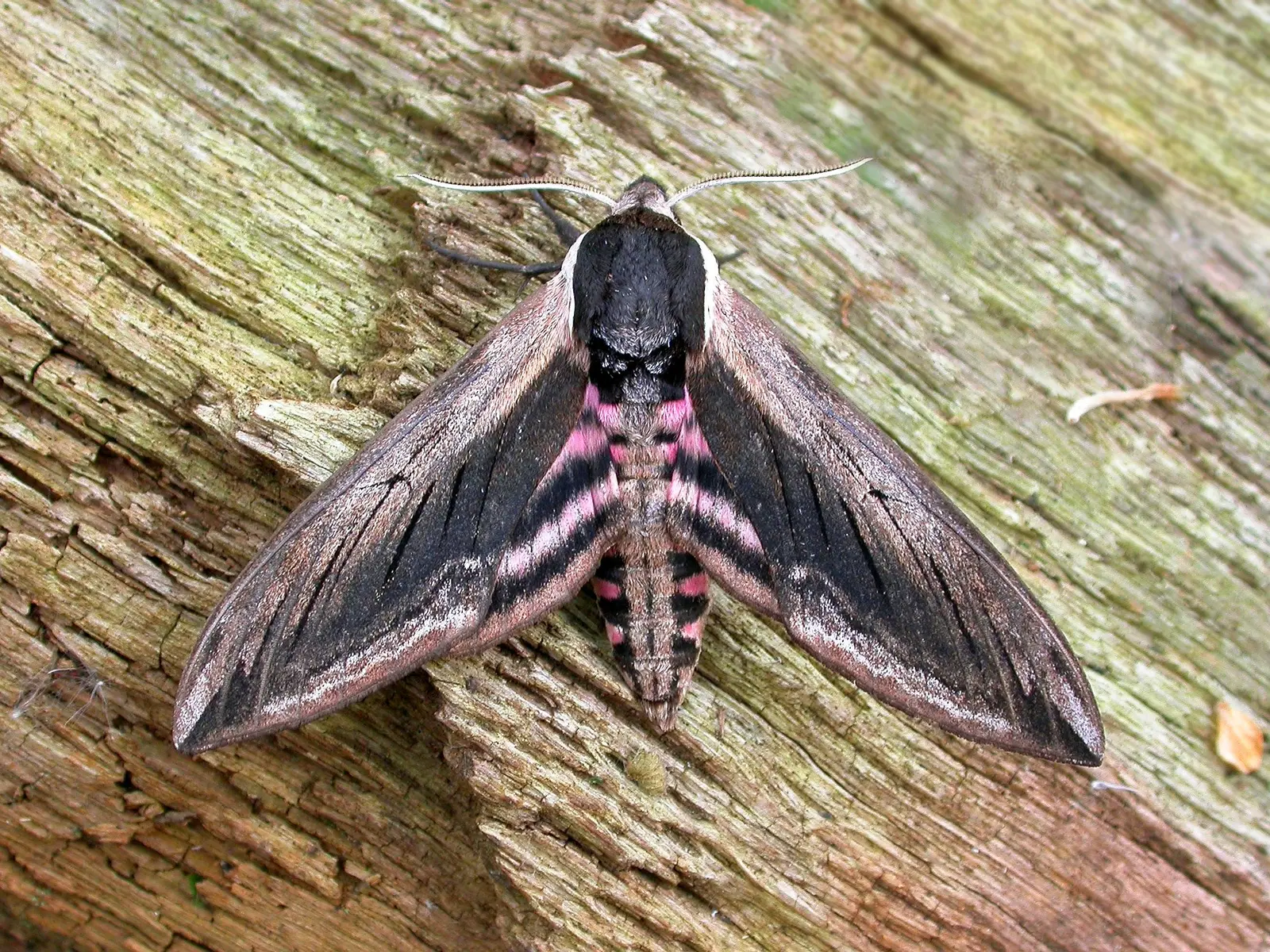
A privet hawk-moth on weathered wood in the New Forest, Hampshire, per the source label. In the 2018 radar experiment, all seven privet hawk-moths released 10 m from a streetlight circled it.
The lights still changed how moths flew. For drinker moths (Euthrix potatoria), a local lappet moth, paths grew more winding and the lit circle acted as a barrier when the moon was below the horizon. The 2024 flight team suggests lights may trap passing insects rather than pull them in from far away. The radar team notes that LEDs still need testing.
Which lights draw the most moths?
Short wavelengths, in the experiments here. In a 2021 indoor study, 6,116 moths of 95 species were released at the center of a 10 by 10 m area with a different lamp at each corner. When the lamps were ultraviolet, blue, green and cool white, 84 percent of lamp counts were at the ultraviolet lamp; with red replacing ultraviolet, 63 percent were at blue.
The 2018 review notes that low-pressure sodium lamps, which glow yellow-orange, rarely attract moths, even though most species can see that light. The 2021 authors recommend lamps with a low share of blue light, and the 2024 flight team suggests cutting unneeded, unshielded and upward-facing lights and reflections off the ground.
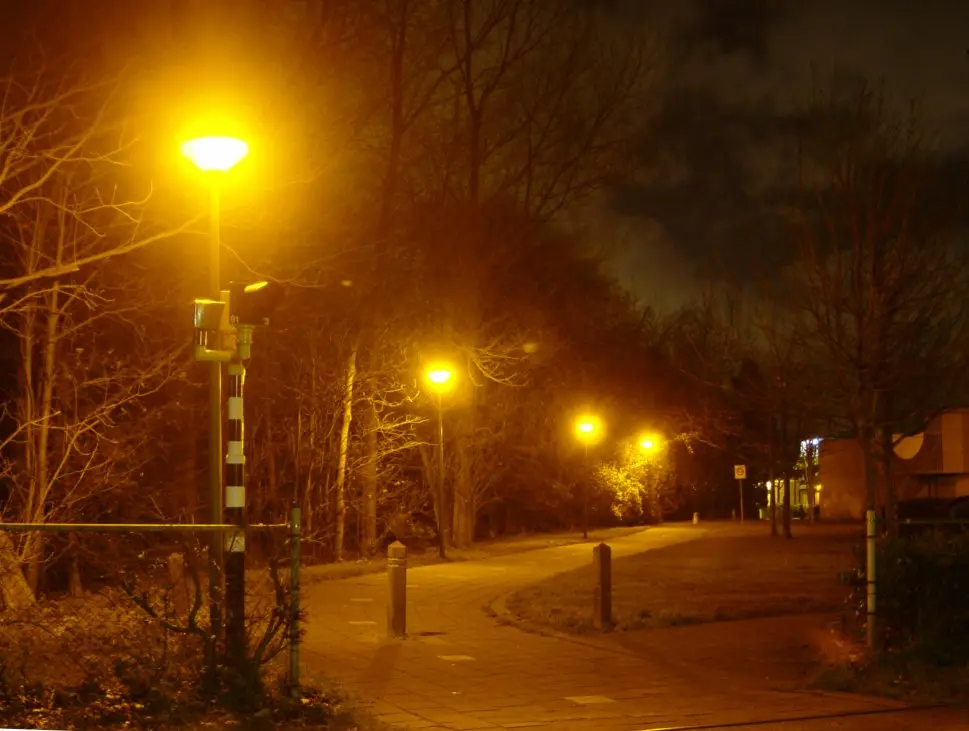
Streetlights fitted with low-pressure sodium lamps light a path in Schiedam, the Netherlands, per the source label.
Luna moths fit the pattern: the University of Florida's species profile says adults are strongly attracted to light, particularly ultraviolet. Their short, non-feeding adult life is covered in Luna Moth: The Adult Can't Eat, So Its Caterpillar Pays for the Week.
What does a night at a lamp cost a moth?
Sometimes its life. Citing a 2006 estimate, the 2018 review says about 30 to 40 percent of insects that approach street lamps die soon afterward, from collisions, overheating, dehydration or predators. Survivors may be stuck in what the review calls a "light sink," unable to feed, find mates or reproduce.
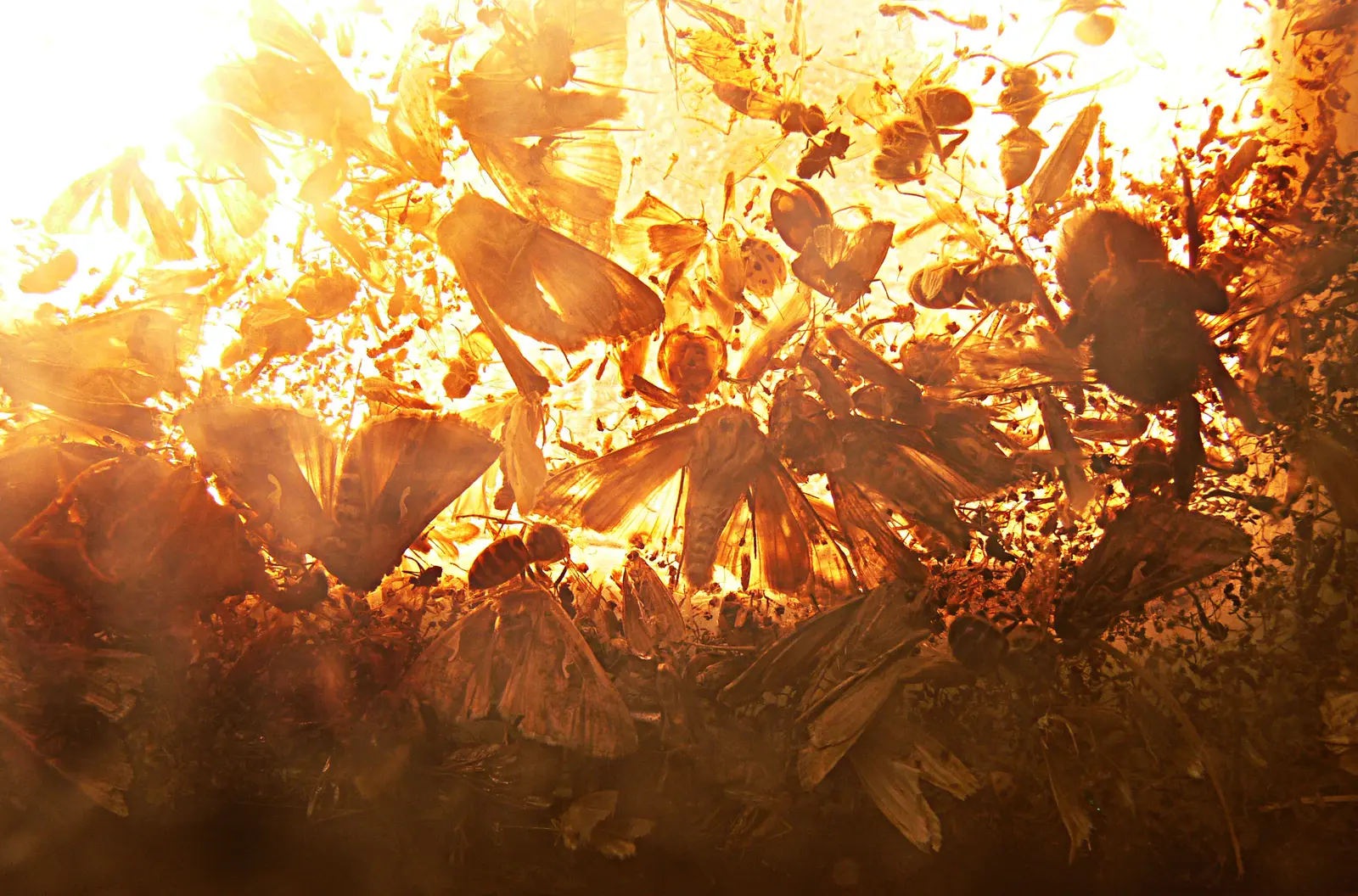
Dead insects, many with broad, moth-like wings, heaped inside a light box set into the ground in Lille, France, per the source label.
Can moths evolve to ignore lights?
Some populations may be changing. A 2016 study reared spindle ermine moths (Yponomeuta cagnagellus, spelled cagnagella in the studies) from young caterpillars under identical conditions. Moths from cities with decades of heavy light pollution flew to a light significantly less than moths from dark-sky sites, a response a 2024 follow-up describes as 30 percent weaker.
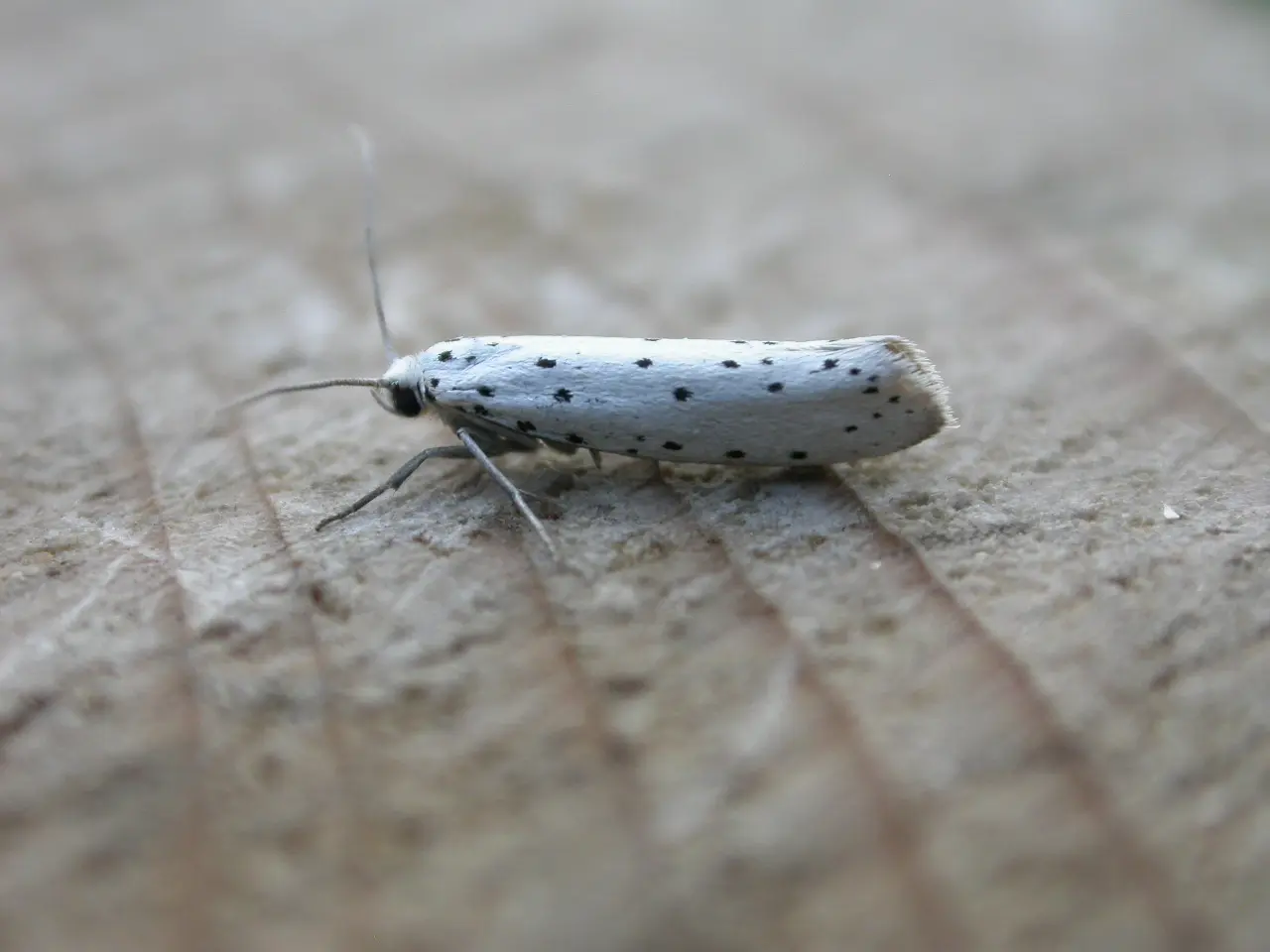
A spindle ermine moth that came to a light in Hellerup, Denmark, per the source label. In the 2016 study, city moths of this species flew to a light less than dark-sky ones.
The follow-up measured the same moths' wings. Urban males' wings were about 4 percent smaller in area. Smaller-winged moths tended to respond less to the light, most clearly in females. The authors read both findings as support for reduced mobility in city moths, though the 2016 study had also raised a change in light perception.
Moths and Lights FAQ
Are moths attracted to the moon?
Not in the studies here. In a 2024 radar study, moths released while the moon was the brightest spot in the sky did not fly directly toward it. Some night insects use sky cues such as the moon to hold a heading. Why insects bank toward a lamp but not the moon is still unexplained.
Do moths fly to lights because of heat?
Not according to the studies here. LED lights give off negligible infrared radiation yet still trap vast numbers of insects, which the authors of a 2024 flight study count as refuting heat as the draw; they also cite a 1972 study that found the heat idea flawed. In a 2021 indoor test, moths favored ultraviolet and blue lamps.
Do yellow lights attract fewer moths?
Lights with little blue or ultraviolet drew fewer moths in the studies here. Low-pressure sodium lamps, which glow yellow-orange, rarely attract moths, a 2018 review notes, and the authors of a 2021 choice test recommend lamps low in blue light.
Next, see where the butterflies that also orbited the test lamps sit on the moth family tree: Moth vs Butterfly: Butterflies Are One Branch of the Moths, and Every Rule Bends.
Figure: Two rules a lamp could disrupt
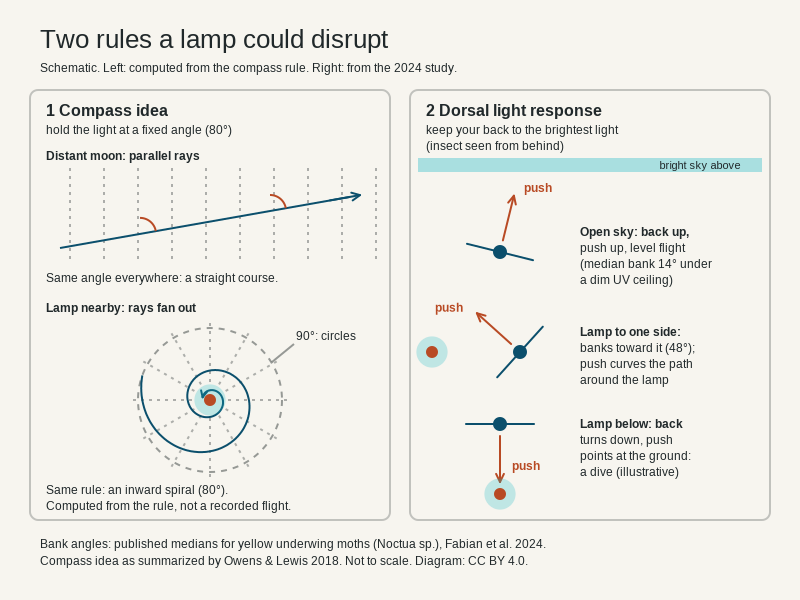
Left: paths computed by this site from the compass rule at a fixed 80° to the line of sight (at 90°, a circle); not recorded flights. Right: schematic rear views from the description in Fabian et al. 2024, with the published median bank angles for yellow underwing moths (14° under diffuse light, 48° near a lamp). The upside-down case is illustrative.
Figure: Where the light comes from changes the flight
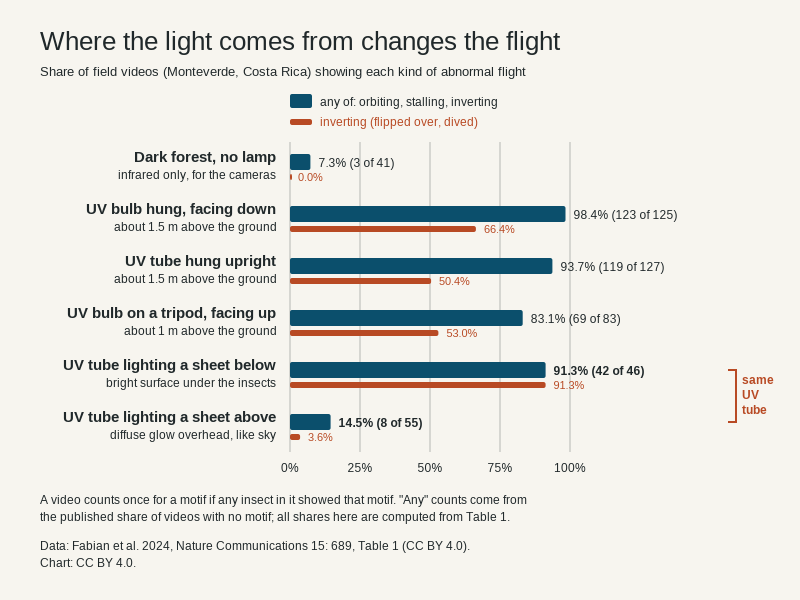
Share of field videos per light setup (477 in all, Monteverde, Costa Rica) showing orbiting, stalling or inverting, drawn by this site from Table 1 of Fabian et al. 2024 (CC BY 4.0). Video counts are computed from the published share with none of the three moves. Data: why-moths-fly-to-lights-motifs.csv (CSV · JSON label).
Source card
- Images: twelve Wikimedia Commons photographs (five CC BY 2.0, one CC BY 3.0, one CC BY-SA 2.0, three CC BY-SA 3.0 and two CC BY-SA 4.0; licenses checked against the Commons records, three on 2026-10-10 and nine on 2026-10-13) and two figures drawn by this site. Species follow each file's source label.
- Classification: every species named here is listed as accepted in the GBIF Backbone Taxonomy.
- Data: most flight results come from one 2024 study, and the radar results from one 2018 experiment with 50 moths released while the streetlights were on. Chart data and the explanation table are available as CSV.
Corrections: none yet.
Sources
- Fabian ST, Sondhi Y, Allen PE, Theobald JC, Lin H-T. "Why flying insects gather at artificial light." Nature Communications 15: 689 (2024) doi.org/10.1038/s41467-024-44785-3full text via Europe PMC (PMC10827719)
- Owens ACS, Lewis SM. "The impact of artificial light at night on nocturnal insects: A review and synthesis." Ecology and Evolution 8(22): 11337–11358 (2018) doi.org/10.1002/ece3.4557full text via Europe PMC (PMC6262936)
- Kawahara AY, Plotkin D, Espeland M, Meusemann K, Toussaint EFA, Donath A, Gimnich F, Frandsen PB, Zwick A, dos Reis M, Barber JR, Peters RS, Liu S, Zhou X, Mayer C, Podsiadlowski L, Storer C, Yack JE, Misof B, Breinholt JW. "Phylogenomics reveals the evolutionary timing and pattern of butterflies and moths." Proceedings of the National Academy of Sciences USA 116(45): 22657–22663 (2019) doi.org/10.1073/pnas.1907847116full text via Europe PMC (PMC6842621)
- Degen J, Storms M, Lee CB, Jechow A, Stöckl AL, Hölker F, Jakhar A, Walter T, Walter S, Mitesser O, Hovestadt T, Degen T. "Shedding light with harmonic radar: Unveiling the hidden impacts of streetlights on moth flight behavior." Proceedings of the National Academy of Sciences USA 121(42): e2401215121 (2024) doi.org/10.1073/pnas.2401215121full text via Europe PMC (PMC11494349)
- Degen T, Mitesser O, Perkin EK, Weiß N-S, Oehlert M, Mattig E, Hölker F. "Street lighting: sex-independent impacts on moth movement." Journal of Animal Ecology 85(5): 1352–1360 (2016) doi.org/10.1111/1365-2656.12540abstract
- Brehm G, Niermann J, Jaimes Nino LM, Enseling D, Jüstel T, Axmacher JC, Warrant E, Fiedler K. "Moths are strongly attracted to ultraviolet and blue radiation." Insect Conservation and Diversity 14(2): 188–198 (2021) doi.org/10.1111/icad.12476abstract
- Hall DW (contact Rhodes EM). Luna Moth, Actias (=Tropaea) luna (Linnaeus). EENY-411/IN737, Featured Creatures, UF/IFAS Extension, University of Florida; original publication June 2007, revised through May 2026 ask.ifas.ufl.edu/publication/IN737full text
- Altermatt F, Ebert D. "Reduced flight-to-light behaviour of moth populations exposed to long-term urban light pollution." Biology Letters 12(4): 20160111 (2016) doi.org/10.1098/rsbl.2016.0111abstract via Europe PMC
- Van de Schoot E, Merckx T, Ebert D, Wesselingh RA, Altermatt F, Van Dyck H. "Evolutionary change in flight-to-light response in urban moths comes with changes in wing morphology." Biology Letters 20(3): 20230486 (2024) doi.org/10.1098/rsbl.2023.0486full text via Europe PMC (PMC10932693)
- GBIF Backbone Taxonomy, species match API (kingdom Animalia): Copiopteryx jehovah Strecker, 1874 (usageKey 1867777, Saturniidae); Attacus lorquinii Felder, 1861 (5124677, Saturniidae); Actias luna Linnaeus, 1758 (1865668, Saturniidae); Noctua pronuba Linnaeus, 1758 (1789695, Noctuidae); Noctua fimbriata Schreber, 1759 (1789745, Noctuidae); Daphnis nerii Linnaeus, 1758 (1862401, Sphingidae); Sphinx ligustri Linnaeus, 1758 (5124143, Sphingidae); Euthrix potatoria (Linnaeus, 1758) (1734453, Lasiocampidae); Sympetrum striolatum (Charpentier, 1840) (1428345, Libellulidae); Aeshna mixta Latreille, 1805 (1425177, Aeshnidae); Yponomeuta cagnagellus (Hübner, 1813) (4525369, Yponomeutidae; Tinea cagnagella Hübner, 1813 listed as homotypic synonym); all ACCEPTED www.gbif.org/species/4525369species match records and synonym list
Cite this page
Plankton to Plumage. “Why Moths Fly to Lights: 3D Video Suggests They Mistake the Bulb for the Sky.” October 12, 2026. https://planktontoplumage.com/insects/why-moths-fly-to-lights/
Add the date you read the page after the address if your style guide asks for it.