Comparison and chart pageNo. 0011
Moth vs Butterfly: Butterflies Are One Branch of the Moths, and Every Rule Bends
Published
Parts of this entry7 parts
Main images
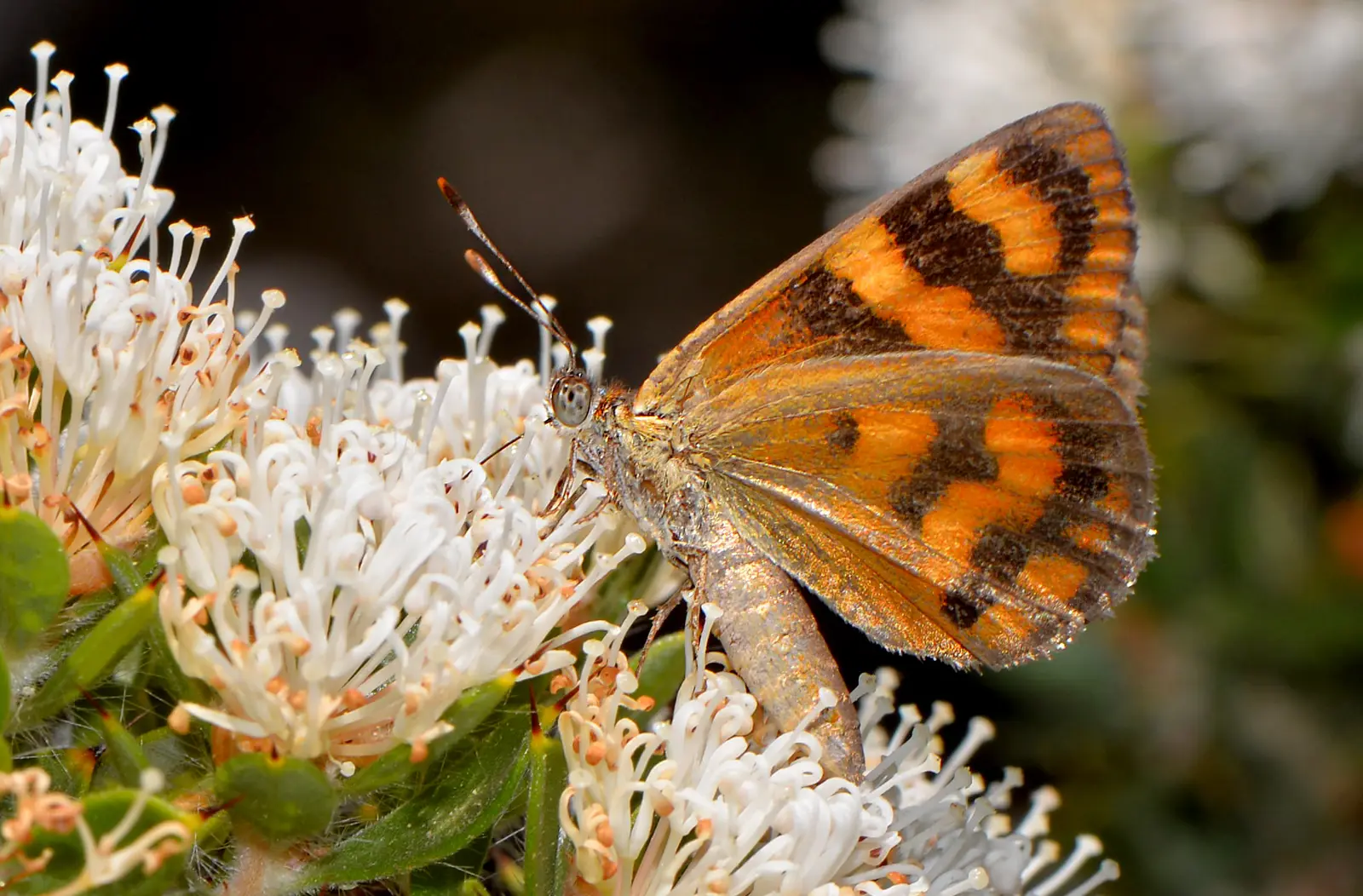
A sun moth on flowering Hakea ruscifolia in the Northern Jarrah forest, Australia, per the file's description.
The short answer
On the Lepidoptera family tree, a luna moth sits closer to a swallowtail butterfly than to a clothes moth. Butterflies are one branch inside the moths. The Australian Museum's guide to telling them apart says there are always exceptions to each "rule."
As a rule of thumb, butterflies have a club or hook at the tip of each antenna, fly by day and rest with their wings held together above the body. Moths tend to have thread-like or feathery antennae, fly at night and rest with their wings flat. The table below lists eight such clues, each with a documented exception. So treat them as a set of hints rather than a test.
Where do butterflies sit among the moths?
A 2011 survey of the order Lepidoptera counted 157,424 described species in 43 superfamilies, groupings ranked between order and family. Butterflies, skippers and hedylids included, make up one superfamily, Papilionoidea, with 18,768 species. That is about 12 percent of the total. The other 42 superfamilies, plus a few unplaced families, hold the moths.
A 2019 study built a family tree from 2,098 genes in 186 species and placed butterflies as the sister group, or closest relative, of the remaining Obtectomera, a branch that includes silk moths, owlet moths and grass moths. The authors concluded that "butterflies are diurnal moths."
The luna moth is a giant silk moth, family Saturniidae, which the 2011 classification puts inside Obtectomera. The webbing clothes moth belongs to Tineidae, in the superfamily Tineoidea, which the same classification places outside Apoditrysia, the larger clade that holds both butterflies and silk moths. The 2019 tree's main figure agrees.
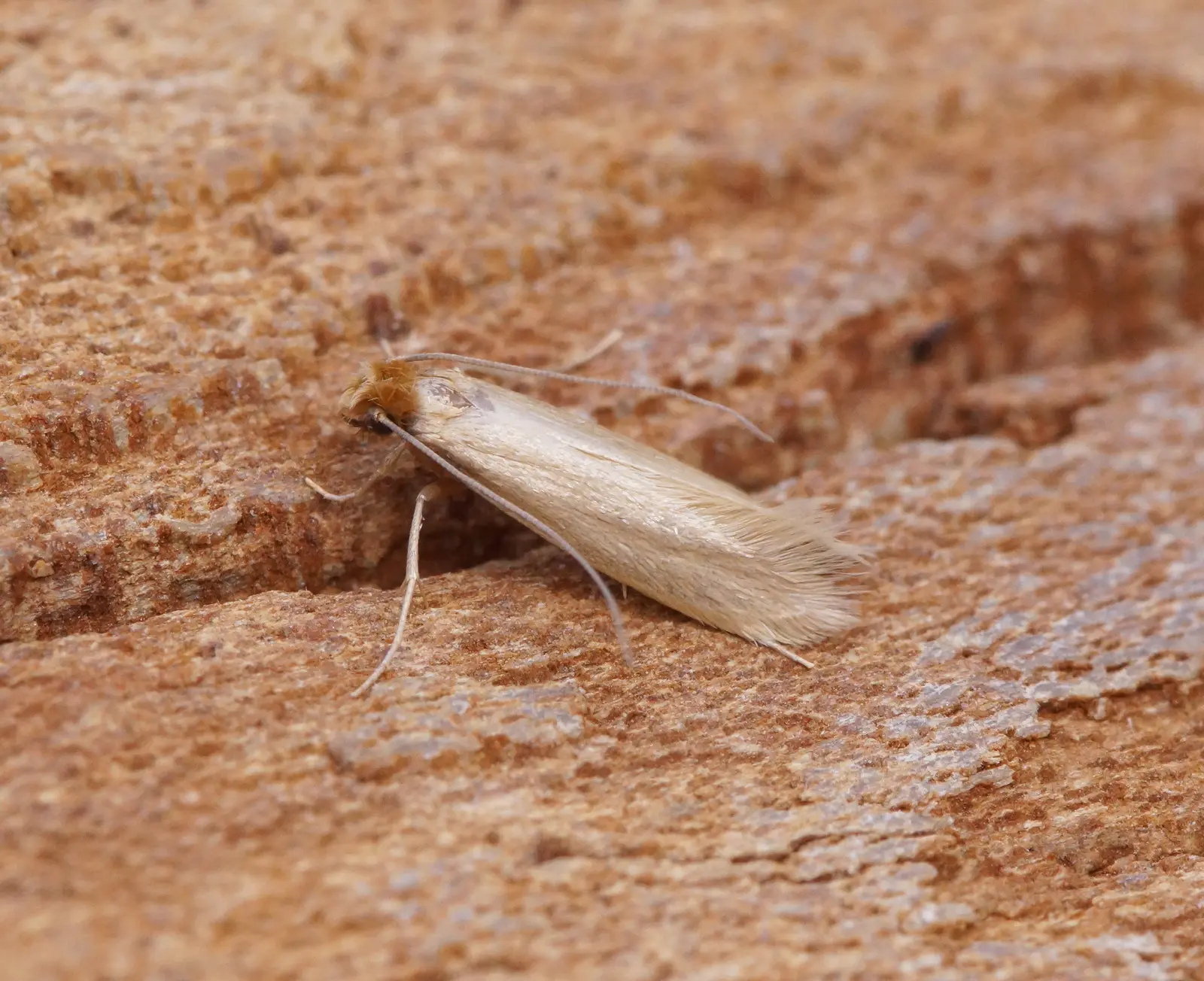
The webbing clothes moth Tineola bisselliella (name per the source label) belongs to Tineoidea, a superfamily outside the clade that holds both butterflies and silk moths.
The 2019 results also indicate that the butterflies' ancestor was likely nocturnal, and that butterflies became day-flying in the Late Cretaceous, around 98 million years ago by the study's dating. Citing earlier work, the study notes that nocturnal moths make up more than 75 percent of Lepidoptera species.
Eight clues, and where each one fails
| Clue | Butterflies, usually | Moths, usually | A documented exception |
|---|---|---|---|
| Antenna tips | Club or hook | Thread-like or feathery, no club | Several moth families have clubbed antennae, most notably sun moths (Castniidae) |
| Wing lock | No frenulum | A bristle, the frenulum, links the wings | The male regent skipper has one; many moths do not |
| Resting posture | Wings together above the body | Wings flat | Many moths, geometrids among them, rest with wings up; metalmarks and Pyrginae skippers rest flat |
| Time of flight | Day | Night | Many moths fly by day; hedylid butterflies are mostly nocturnal |
| Color | Brighter | Duller | Many moths, especially day-flyers, are brilliantly colored; many butterflies are dark brown |
| Pupa | Chrysalis without a cocoon | Pupa in a cocoon | Many moths spin no cocoon; many butterflies and skippers make a silk shelter |
| Forelegs | Reduced, missing end segments | Fully developed | Only some butterflies have reduced forelegs; most skippers have normal ones |
| Eye design | Apposition, in true butterflies (not skippers or hedylids) | Superposition, in most moths | Skippers from seven Australian genera and one hedylid studied have superposition eyes |
Rows one to seven follow the Australian Museum guide. The eye row and hedylid flight times rest on studies from 1972 to 2018. Ledger with sources: moth-vs-butterfly-clue-ledger.csv (CSV · JSON label).
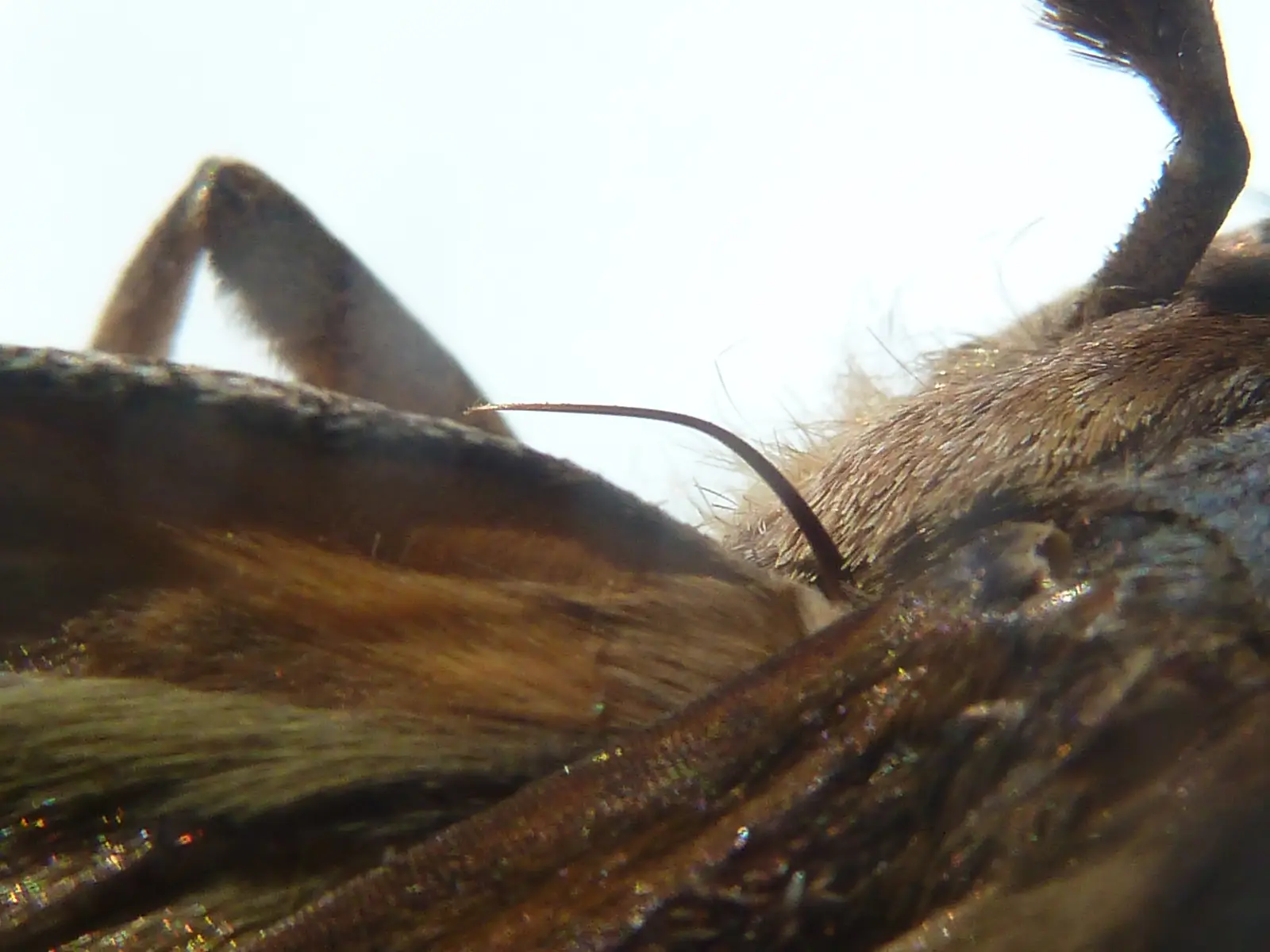
The frenulum of a male hawkmoth, Nephele comma (per the source label), with the forewing pulled back: the single stout bristle that the table's wing-lock row describes.
A moth that passes for a butterfly
Sun moths, family Castniidae, have clubbed antennae, are often brightly colored and fly during the hottest part of the day, according to the Australian Museum. The museum notes that they are often mistaken for butterflies.
At the top of this page, the sun moth Synemon directa shows the clubs clearly. It was also photographed with its wings closed above its back. That is the posture the guide gives for butterflies.
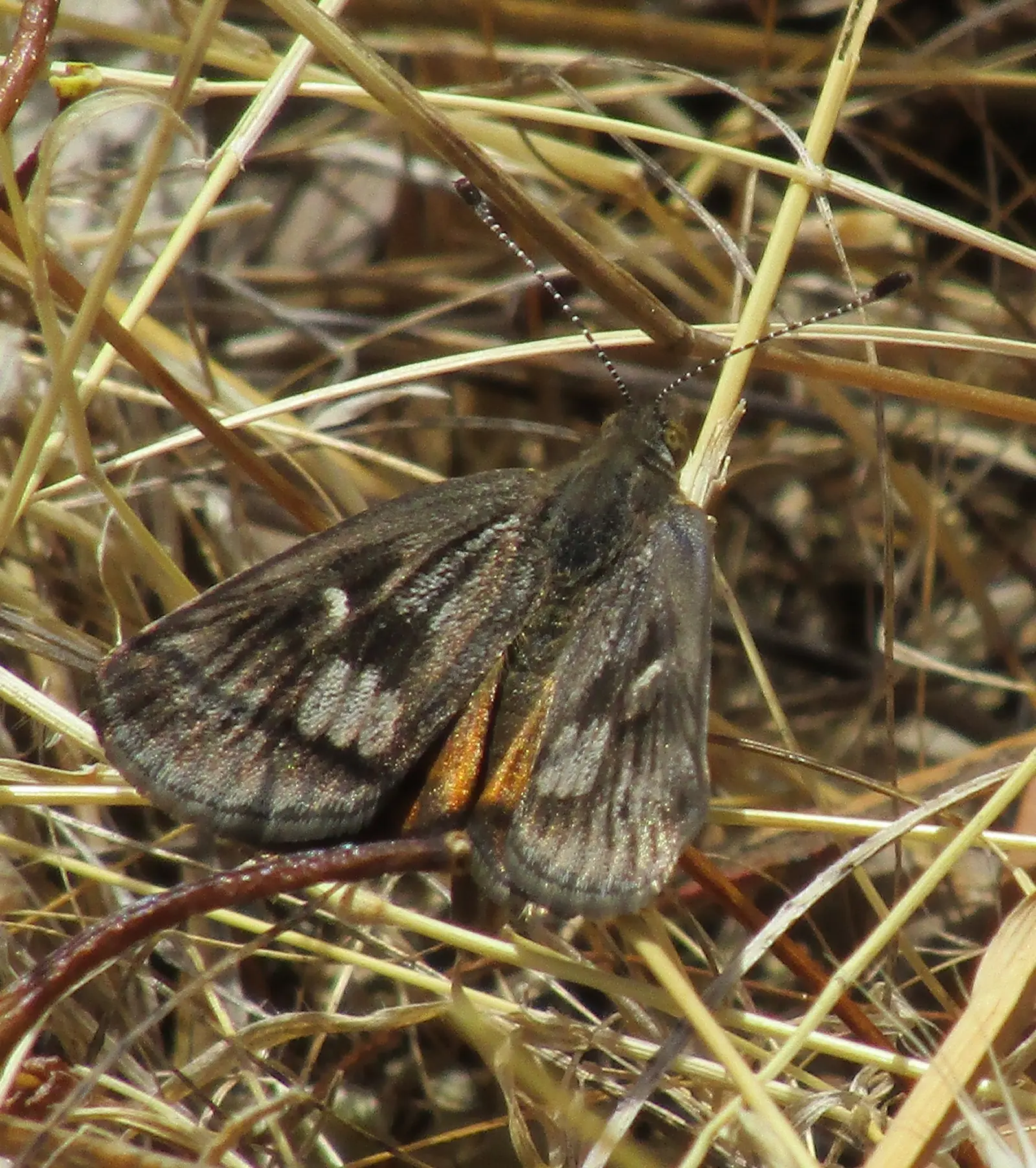
Another sun moth, Synemon theresa (per the source label), also with clubbed antennae. Unlike the one at the top of the page, it was photographed with its wings partly open.
A butterfly that passes for a moth
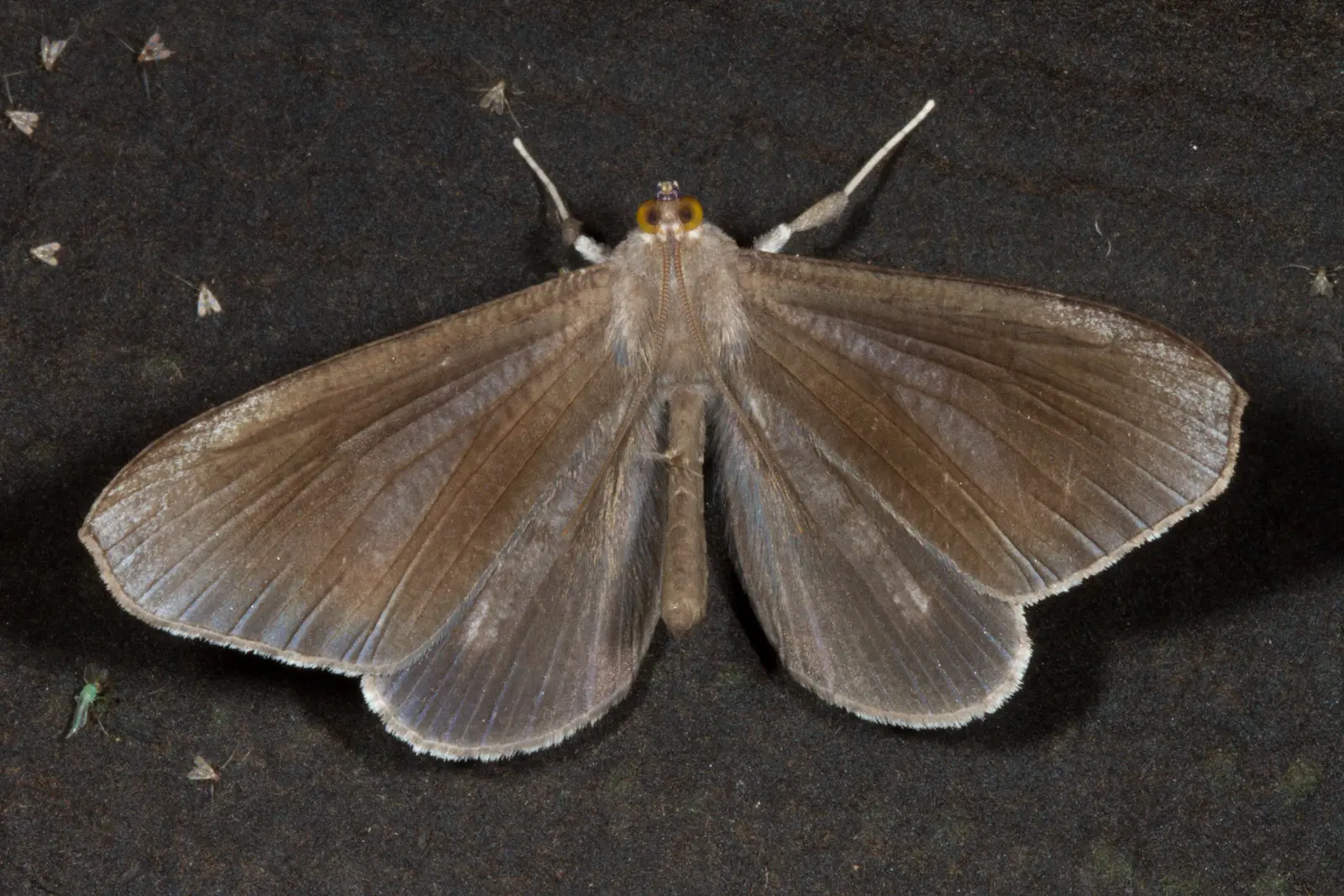
A male Macrosoma lucivittata at Rio Javarí, Amazonas, Brazil, per the source label. Hedylids are butterflies, but this one rests the way the field rules say a moth should.
Hedylids, the Neotropical "moth-like butterflies," break the rules from the other side. A 2018 study calls the family, with 36 described species, perhaps the most unusual butterfly family: it is predominantly nocturnal and has hearing organs that detect bat ultrasound. In a 2007 study of one species, Macrosoma heliconiaria, free-flying adults exposed to ultrasound made sudden, unpredictable changes of direction.
The eyes of that species, examined in a second 2007 study, follow the superposition design that the authors call characteristic of most moths, not the apposition design of true butterflies. Those are two different ways of building a compound eye.
Hedylid night life looks like a return trip. The butterflies' ancestor was likely nocturnal, but a 2018 analysis of 22 hedylid species concluded that the hedylids' own ancestor was likely day-flying, with a shift to nocturnality early in the family's history. The 2019 tree placed hedylids as the closest relatives of skippers.
The one butterfly with a moth's wing lock
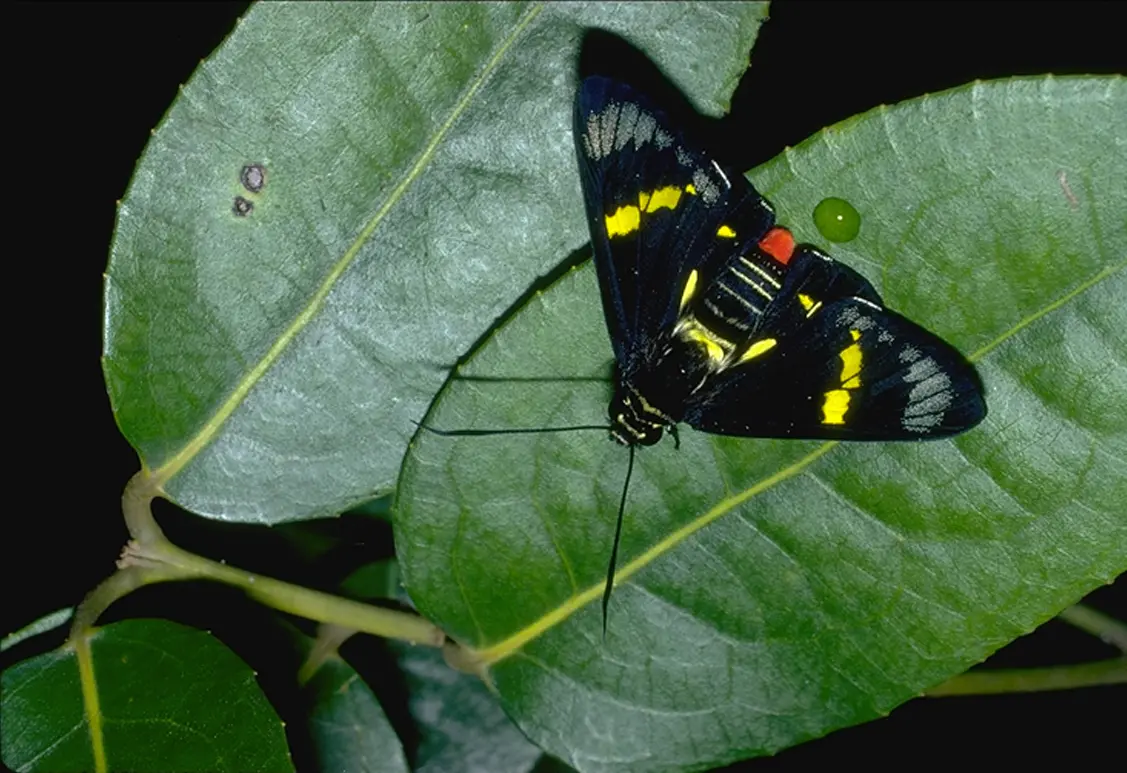
A male regent skipper (sex per the source label).
Many moth families have a frenulum. This bristle-like structure links the forewing and hind wing. The Australian Museum's guide, last updated in 2019, reports that the frenulum is absent in all butterflies and skippers except one: the male regent skipper, Euschemon rafflesia, from Australia. The same guide notes that many moths have no frenulum either, so a missing one does not make an insect a butterfly.
Where does the luna moth fit?
On antennae, the luna moth sits firmly on the moth side. The University of Florida describes its antennae as comb-like on four sides, with the male's larger than the female's. The Australian Museum notes that the feathery antennae of many male moths detect minute amounts of airborne sex pheromone from females, and female luna moths release such a pheromone.
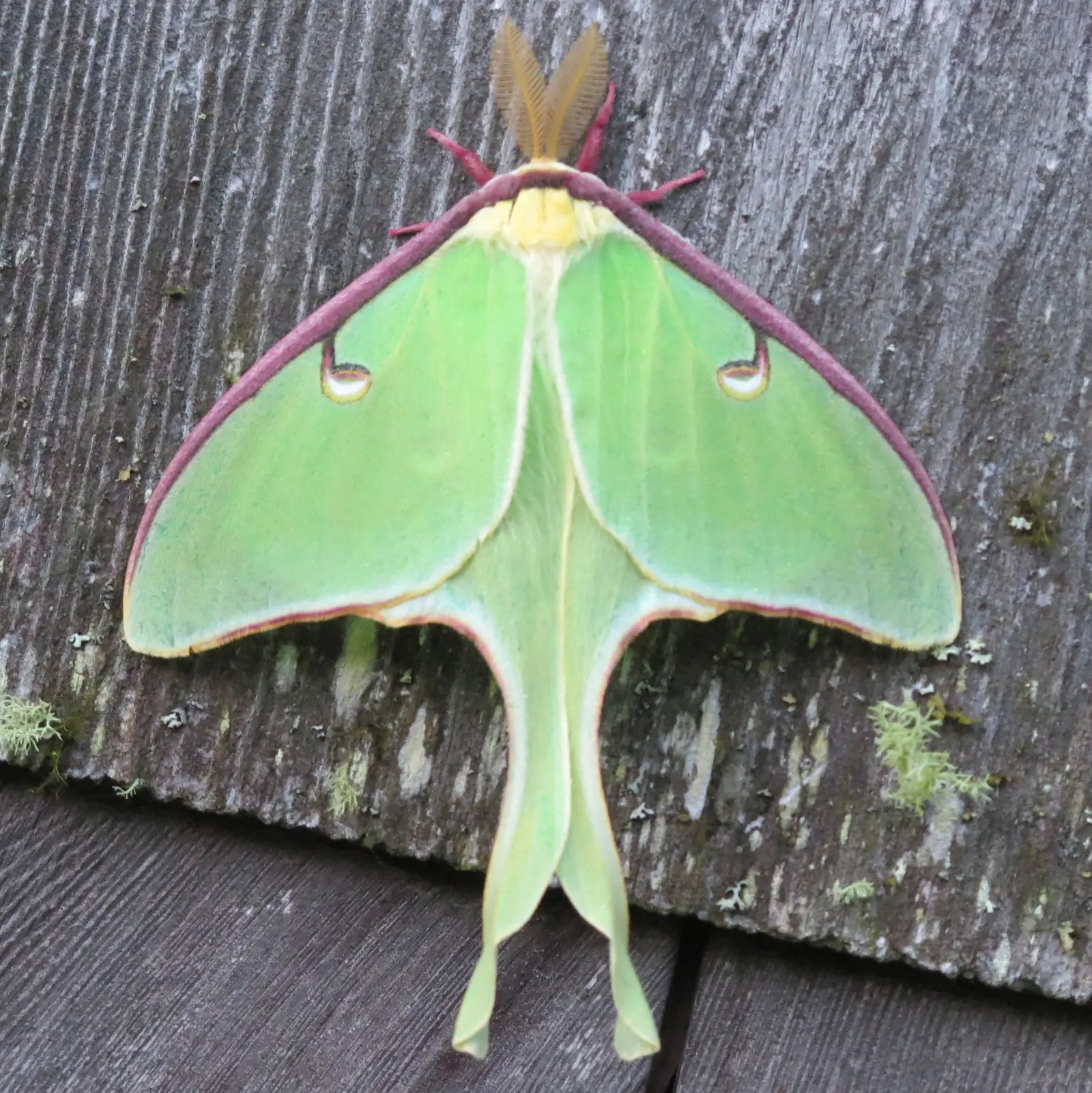
A male luna moth, Actias luna (per the source label), with its broad, feathery antennae raised above its head.
Adult luna moths have vestigial mouthparts and do not feed, an arrangement this site calls paid in advance. Their short adult life is the subject of Luna Moth: The Adult Can't Eat, So Its Caterpillar Pays for the Week.
Next, see what research says about moths and artificial lights: Why Moths Fly to Lights: 3D Video Suggests They Mistake the Bulb for the Sky.
Figure: One butterfly superfamily, 42 of moths
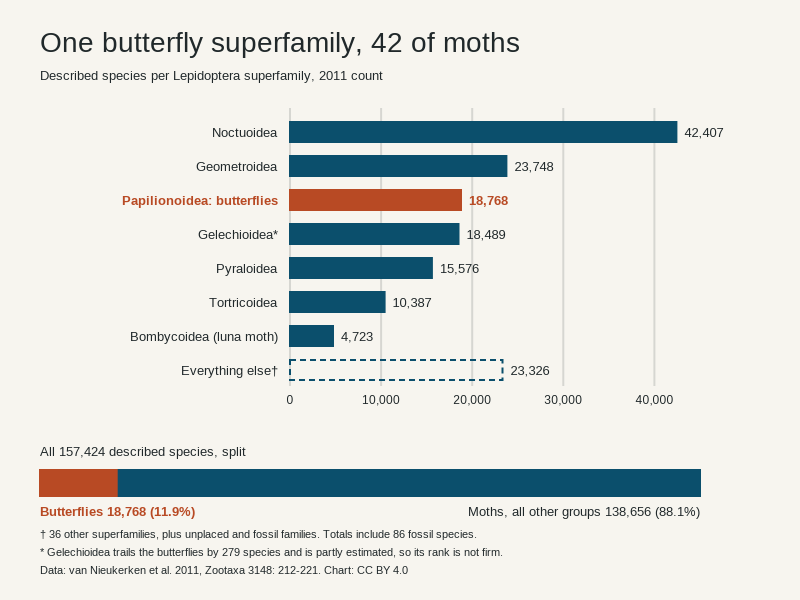
Described species per superfamily, summed by this site from the family counts in van Nieukerken et al. 2011 (Zootaxa 3148: 212–221), including 86 fossil species. Gelechioidea trails the butterflies by only 279 species, and the count for its largest family, Gelechiidae, is partly an estimate, so which of the two ranks third is not settled. Data: moth-vs-butterfly-species-counts.csv (CSV · JSON label).
Source card
- Images: seven photographs, all from Wikimedia Commons (two CC BY 2.0, one CC BY 3.0, one CC BY 4.0, one CC BY-SA 3.0 and two CC BY-SA 4.0), no public-domain plates and one chart drawn by this site, with photo licenses checked against the Commons records on 2026-10-10 for the sun moth under Main images, the hedylid and the regent skipper and on 2026-10-13 for the other four; species and sex follow each file's source label.
- Classification: "butterflies" means Papilionoidea, skippers and hedylids included (van Nieukerken et al. 2011; Kawahara et al. 2019). Every moth and butterfly species named here is accepted in the GBIF Backbone Taxonomy under the family given.
- Data: chart counts and clue ledger, both as CSV.
Corrections: none yet.
Sources
- Britton D. What are the differences between butterflies and moths? Australian Museum, Animal factsheets: Insects; updated 27 March 2019 australian.museum/learn/animals/insects/what-are-the-differences-between-butterflies-and-moths/full text (page and gallery captions)
- Kawahara AY, Plotkin D, Espeland M, Meusemann K, Toussaint EFA, Donath A, Gimnich F, Frandsen PB, Zwick A, dos Reis M, Barber JR, Peters RS, Liu S, Zhou X, Mayer C, Podsiadlowski L, Storer C, Yack JE, Misof B, Breinholt JW. "Phylogenomics reveals the evolutionary timing and pattern of butterflies and moths." Proceedings of the National Academy of Sciences USA 116(45):22657–22663 (2019) doi.org/10.1073/pnas.1907847116full text via Europe PMC (PMC6842621)
- van Nieukerken EJ, Kaila L, Kitching IJ, Kristensen NP, Lees DC, Minet J, Mitter C, Mutanen M, Regier JC, Simonsen TJ, Wahlberg N, Yen S-H, Zahiri R, et al. "Order Lepidoptera Linnaeus, 1758." In: Zhang Z-Q (Ed.) Animal biodiversity: An outline of higher-level classification and survey of taxonomic richness. Zootaxa 3148:212–221 (2011) doi.org/10.11646/zootaxa.3148.1.41full text (publisher PDF, https://www.mapress.com/zt/article/download/zootaxa.3148.1.41/21730)
- Kawahara AY, Breinholt JW, Espeland M, Storer C, Plotkin D, Dexter KM, Toussaint EFA, St Laurent RA, Brehm G, Vargas S, Forero D, Pierce NE, Lohman DJ. "Phylogenetics of moth-like butterflies (Papilionoidea: Hedylidae) based on a new 13-locus target capture probe set." Molecular Phylogenetics and Evolution 127:600–605 (2018) doi.org/10.1016/j.ympev.2018.06.002abstract via Europe PMC (PMID 29902572)
- Yack JE, Johnson SE, Brown SG, Warrant EJ. "The eyes of Macrosoma sp. (Lepidoptera: Hedyloidea): a nocturnal butterfly with superposition optics." Arthropod Structure & Development 36(1):11–22 (2007) doi.org/10.1016/j.asd.2006.07.001abstract via Europe PMC (PMID 18089084)
- Yack JE, Kalko EKV, Surlykke A. "Neuroethology of ultrasonic hearing in nocturnal butterflies (Hedyloidea)." Journal of Comparative Physiology A 193(6):577–590 (2007) doi.org/10.1007/s00359-007-0213-2abstract via Europe PMC (PMID 17431639)
- Hall DW (contact Rhodes EM). Luna Moth, Actias (=Tropaea) luna (Linnaeus). EENY-411/IN737, Featured Creatures, UF/IFAS Extension, University of Florida; original publication June 2007, revised through May 2026 ask.ifas.ufl.edu/publication/IN737full text
- GBIF Backbone Taxonomy, species match API: Synemon directa Westwood, 1877 (usageKey 1941682, Castniidae); Macrosoma lucivittata Walker, 1863 (5150002, Hedylidae); Macrosoma heliconiaria Guenée, 1857 (5150011, Hedylidae); Euschemon rafflesia (5141650, Hesperiidae); Actias luna Linnaeus, 1758 (1865668, Saturniidae); Tineola bisselliella (Hummel, 1823) (1857626, Tineidae; vernacular names include webbing clothes moth, via Catalogue of Life); all ACCEPTED www.gbif.org/species/1857626species match records and vernacular names
- Horridge GA, Giddings C, Stange G. "The superposition eye of skipper butterflies." Proceedings of the Royal Society of London B 182(1069):457–495 (1972) doi.org/10.1098/rspb.1972.0088abstract
- GBIF Backbone Taxonomy, species match API: Nephele comma Hopffer, 1857 (usageKey 5124088, Sphingidae); Synemon theresa Doubleday, 1846 (1941702, Castniidae); both ACCEPTED www.gbif.org/species/1941702species match records
Cite this page
Plankton to Plumage. “Moth vs Butterfly: Butterflies Are One Branch of the Moths, and Every Rule Bends.” October 12, 2026. https://planktontoplumage.com/insects/moth-vs-butterfly/
Add the date you read the page after the address if your style guide asks for it.