Deep explainerNo. 0005
Luna Moth: The Adult Can't Eat, So Its Caterpillar Pays for the Week
Published
Parts of this entry10 parts
Spec card
Size analogy (wingspan)≈ 3–4 U.S. quarters edge to edgeScale: Computed: 75–105 mm wingspan (UF/IFAS EENY-411) ÷ 24.26 mm quarter diameter (U.S. Mint coin specifications) = 3.1–4.3
- Common name
- Luna moth, American moon mothSource: Clemson Cooperative Extension HGIC 2515 (2020)
- Scientific name
- Actias luna Linnaeus, 1758Source: GBIF Backbone Taxonomy, usageKey 1865668 (accepted); UF/IFAS EENY-411 also gives the genus Tropaea
- Group
- Giant silk moths, family Saturniidae (order Lepidoptera)Source: GBIF Backbone Taxonomy; UF/IFAS EENY-411
- Size band
- Wingspan 75–105 mm (UF/IFAS) or 3–4.5 in (Clemson); full-grown caterpillar 55–70 mmSource: UF/IFAS EENY-411 (citing Covell 2005; Godfrey et al. 1987); Clemson HGIC 2515; sources differ slightly
- Distribution / habitat
- Forests of eastern North America: southern Canada from Nova Scotia to Saskatchewan; in the US, Maine to Florida, west to eastern Texas and eastern North DakotaSource: UF/IFAS EENY-411
- Adult life span
- About one week after leaving the cocoon; adults do not feedSource: Clemson HGIC 2515 (about one week); UF/IFAS EENY-411 (vestigial mouthparts, do not feed)
- Three ID features
- Sea-foam green to yellowish wings with a long tail on each hind wing
- an eyespot on each of the four wings
- comb-like antennae with teeth on four sides, larger in males
- The misidentification twin
- Not yet verified
Download this card as CSV luna-moth-spec-card.csv · CC BY 4.0File label (JSON): name, license, publisher
Main images
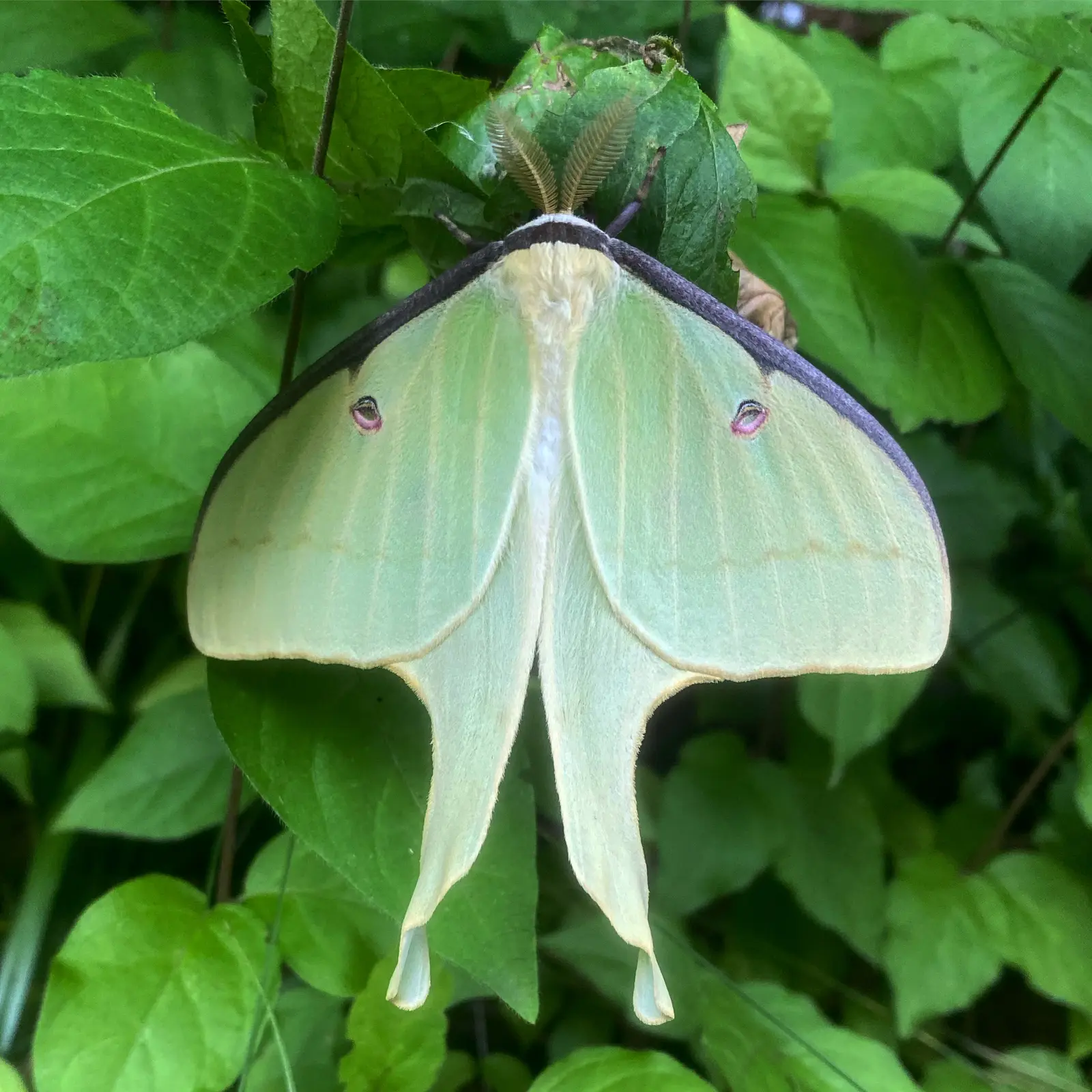
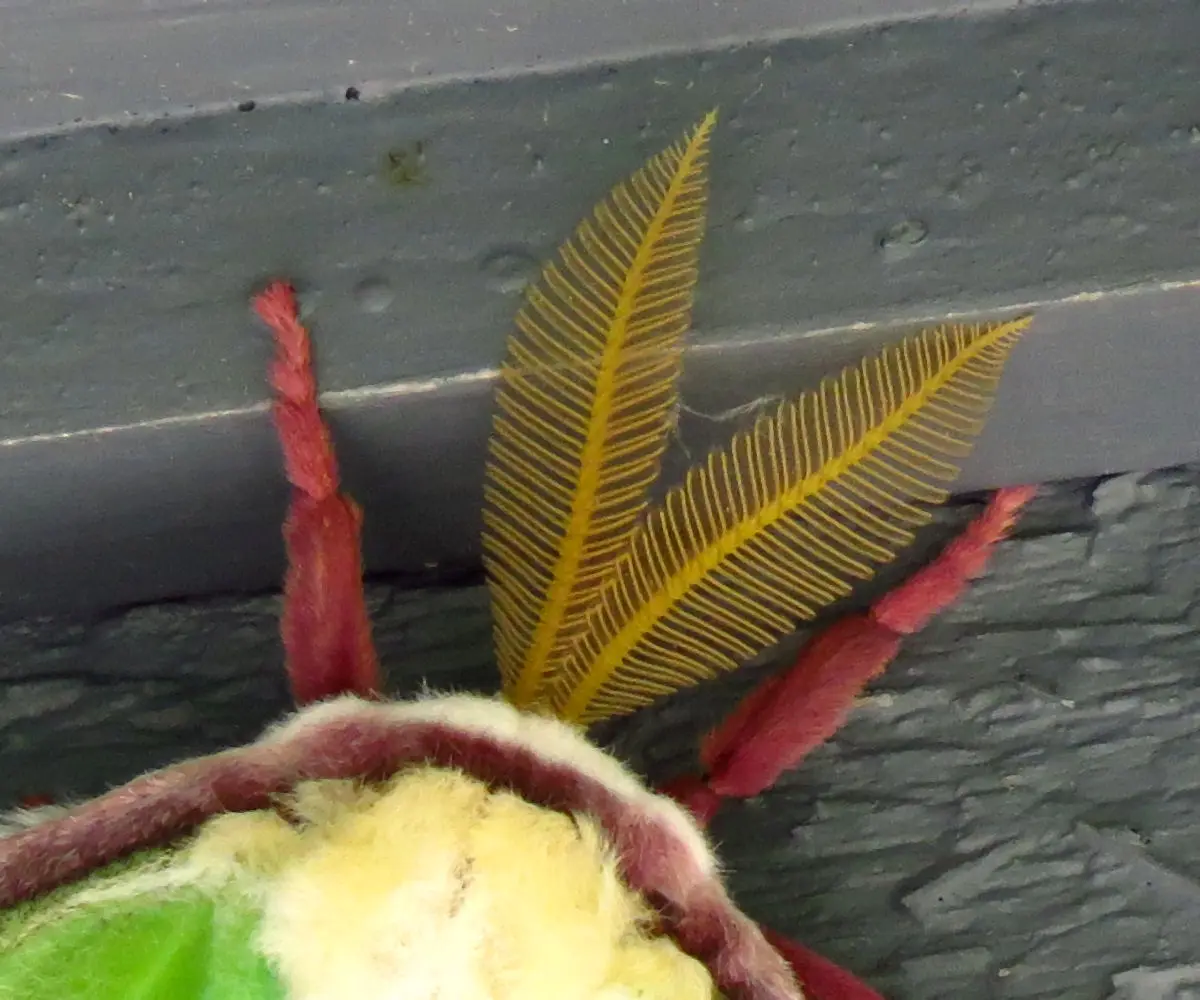
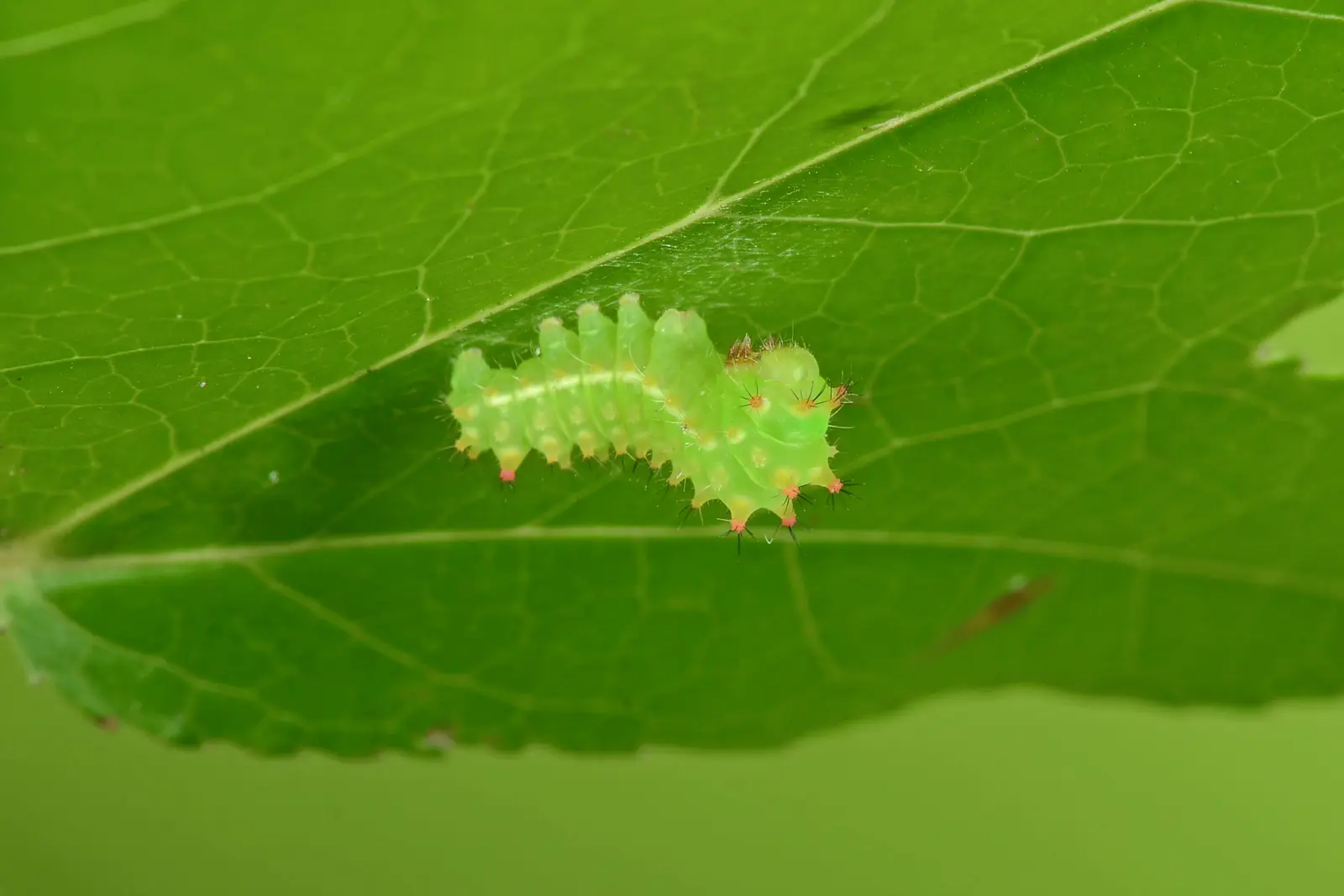
The short answer
A luna moth climbs out of its cocoon with all the fuel its adult life will ever get. Its mouthparts are vestigial, meaning reduced and no longer working. The adult therefore does not feed. For about a week it flies, mates and, if it is a female, lays eggs, all on energy stored while it was a caterpillar eating tree leaves.
The luna moth (Actias luna) is a large green silk moth of the forests of eastern North America. Its wingspan is 75 to 105 mm, about three to four U.S. quarters laid edge to edge, and each hind wing trails a long, twisted tail. In lab tests, those tails pull bat attacks away from the body.
What is a luna moth?
The luna moth belongs to Saturniidae, the family of giant silk moths. This page follows the GBIF Backbone Taxonomy, which lists it as Actias luna Linnaeus, 1758; the University of Florida species profile also gives Tropaea as an alternative genus name.
Petiver described the moth in 1700 as Phalena plumata caudata, a name that pointed to its tails, making it the first North American saturniid in the literature. Linnaeus renamed it luna in 1758. The common name comes from its moon-like wing spots.
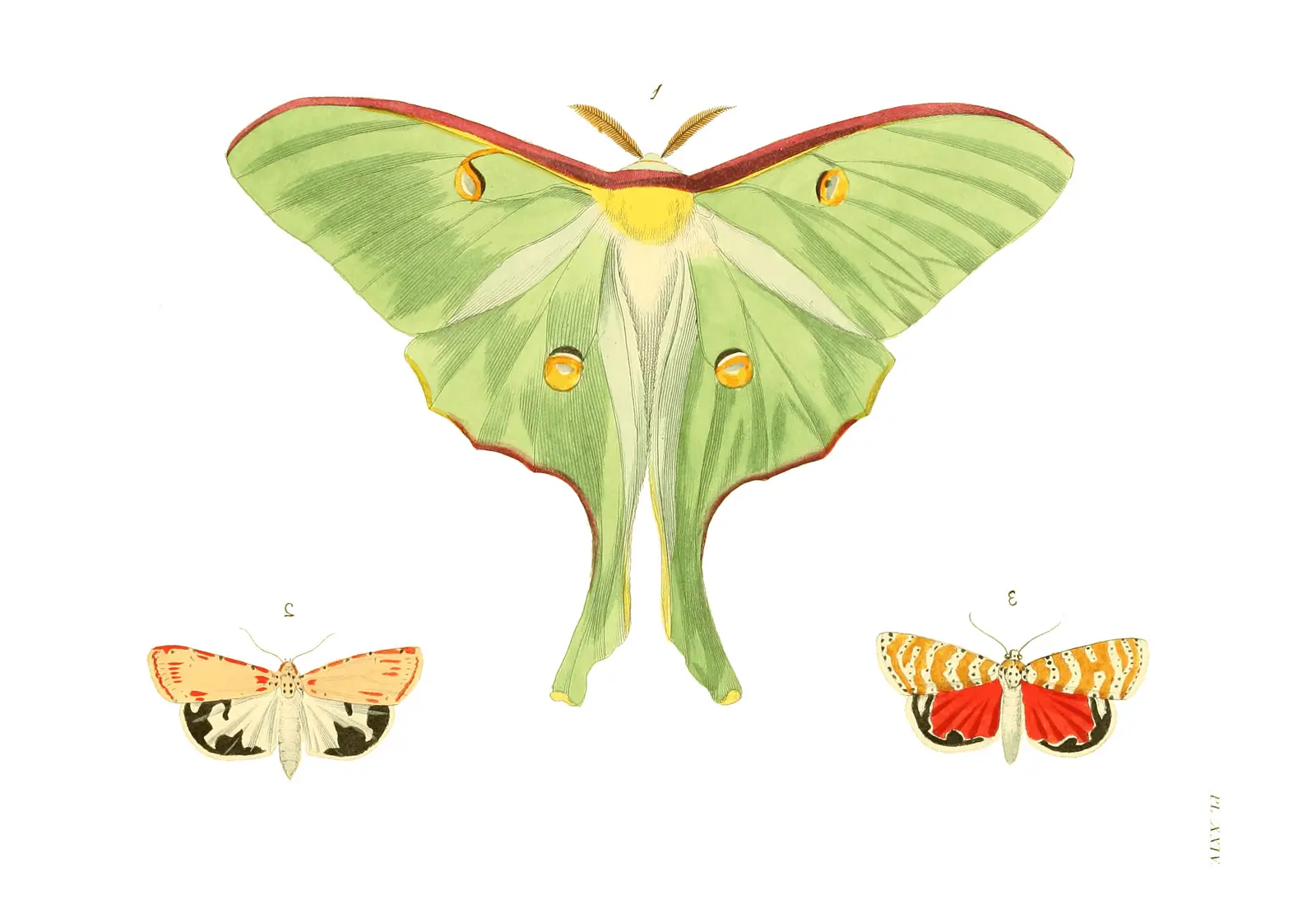
Full credit and license
"Illustrations of Exotic Entomology, Vol. I, Plate XXIV" by Dru Drury — https://commons.wikimedia.org/wiki/File:Illustrations_of_Exotic_Entomology_I_24.jpg — Public domain (plates dated 1770, this edition 1837; Dru Drury died 1804 and J. O. Westwood 1893, so public domain in the U.S. and the EU)The luna moth (figure 1) on a plate dated 1770, twelve years after Linnaeus named the species luna. Figures 2 and 3 show another moth species.
In southern Canada, luna moths occur from Nova Scotia to Saskatchewan. In the United States they live in every eastern state from Maine to Florida, and west to eastern Texas and eastern North Dakota, usually in forest.
The number of generations a year depends on latitude. There is one from Michigan north, two through the Ohio Valley, and three farther south. Where there are several, spring adults tend to be a deeper green with reddish-purple wing edges. Later broods are more yellowish.
Both sexes have comb-like antennae, with teeth on four sides. The male's are larger.
Why can't an adult luna moth eat?
Many moths and butterflies feed through a proboscis, a long, slender mouthpart. Clemson Cooperative Extension describes the luna moth's proboscis as functionless. The University of Florida profile says the adults have vestigial mouthparts and do not feed. As a result, the profile adds, they are short-lived.
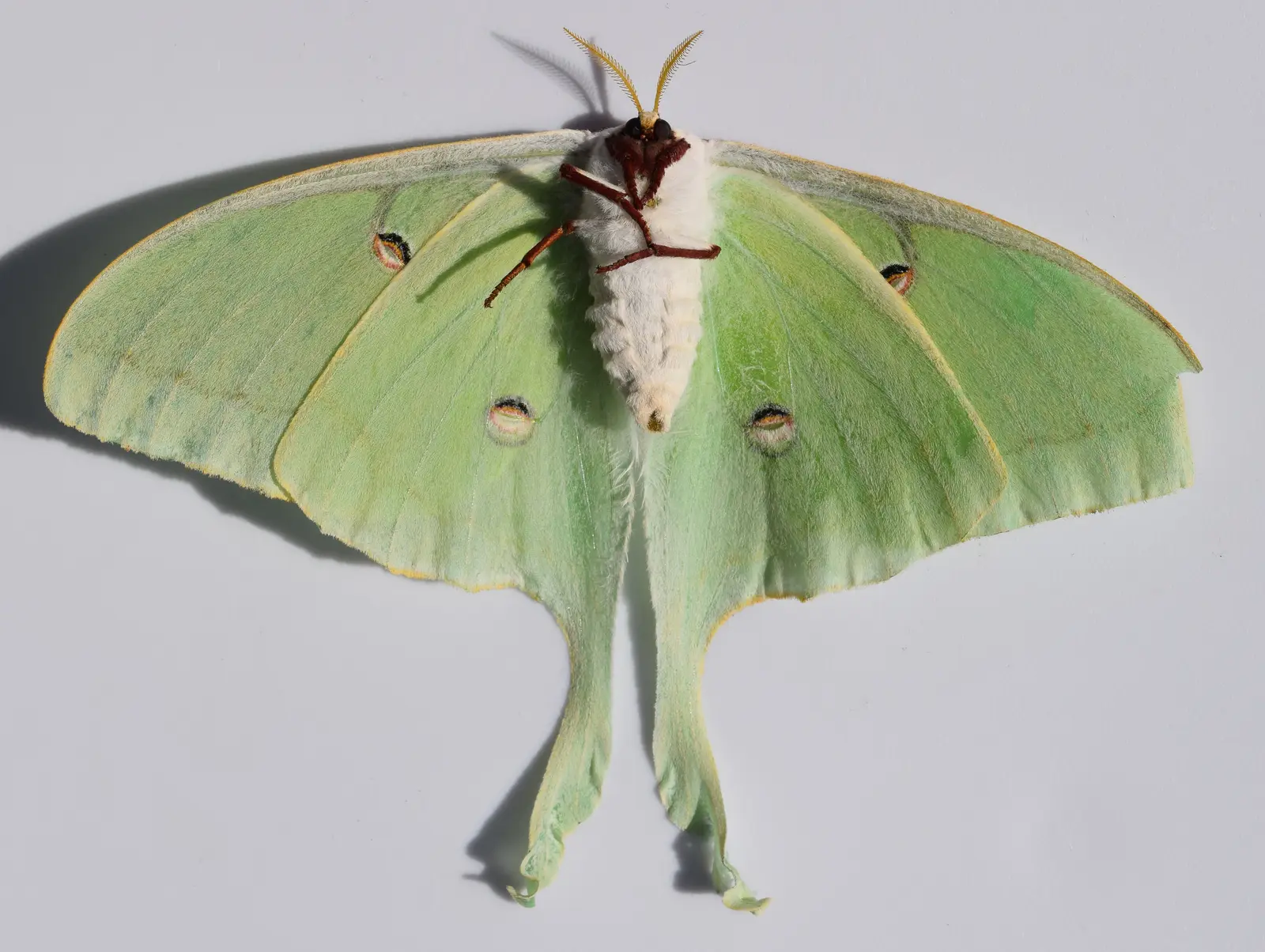
An adult female luna moth seen from below. Its head, with dark eyes and comb-like antennae, carries vestigial mouthparts, so the adult does not feed.
So the adult's energy budget is set before its wings ever open: Clemson's factsheet says the food energy for the adult stage is stored during the caterpillar stage. On this site, that arrangement is called paid in advance. The phrase is an editorial metaphor, not a term from physiology, and it is used only for species with a source saying that the adults do not feed.
The label does not stretch to every relative. Clemson says luna moths share the non-feeding adult stage with "many other silk moths," which is a reason to check each species, not a rule for the family. Adults with a working proboscis, as in many other moths and butterflies, do feed. That contrast is covered in Moth vs Butterfly: Butterflies Are One Branch of the Moths, and Every Rule Bends.
On its first day, the new moth voids a reddish liquid called meconium, waste left from breaking down the old larval tissues.
How long does a luna moth live?
As an adult, about a week. That is Clemson's rough figure: approximately one week after the moth leaves its cocoon. A 2015 bat study, citing earlier work on tropical silk moths, gives female silk moths in general an average adult life of 4 to 8 days.
The whole life takes much longer. A 1967 rearing experiment kept caterpillars indoors at about 20 to 30 °C. They began spinning cocoons an average of 27 days after hatching. The author noted that earlier sources gave 48 to 50 days, and the University of Florida profile says hatching to pupation takes a month or longer, depending on temperature.
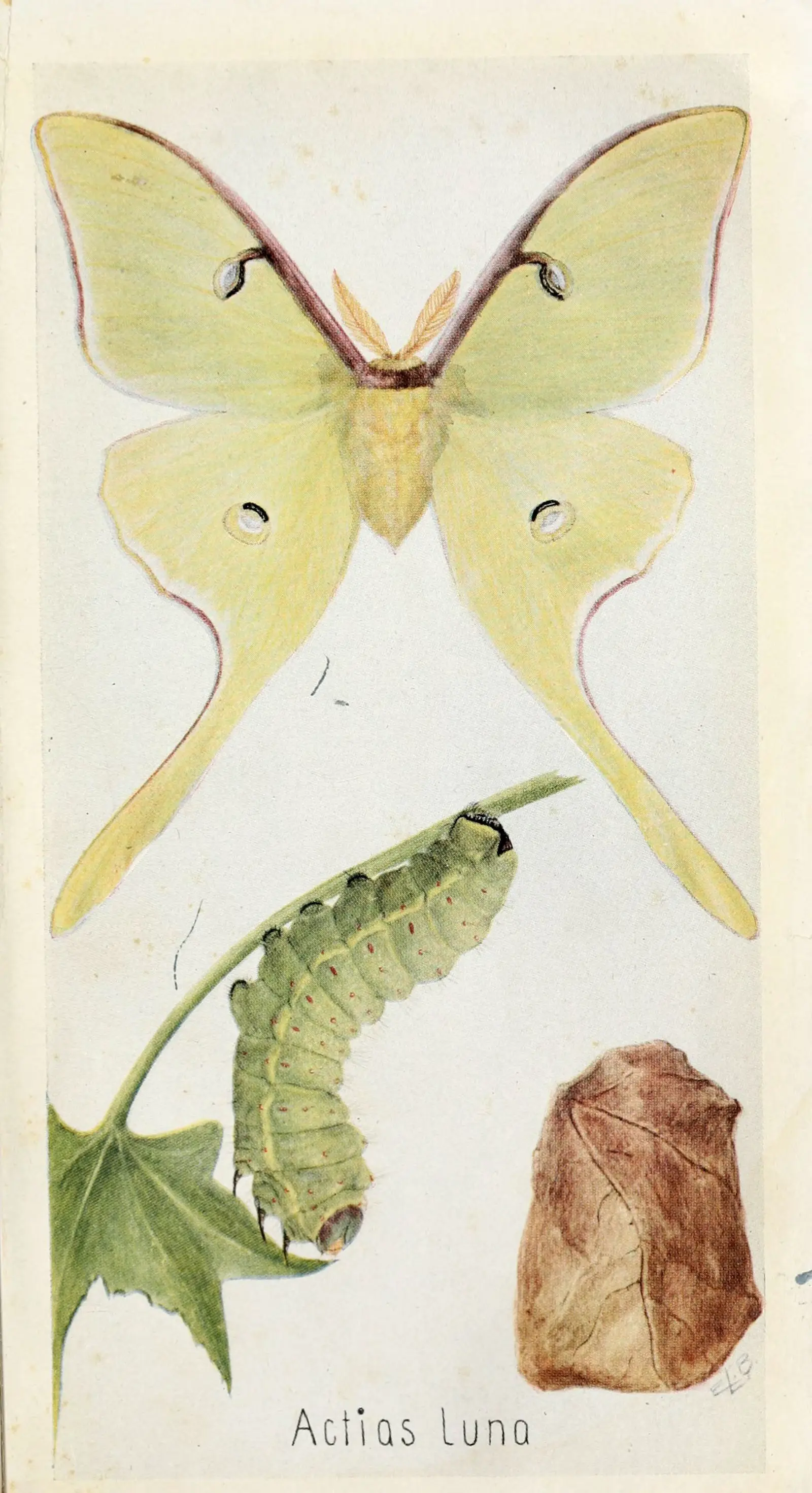
Full credit and license
"Field book of insects, Plate XLIII (Actias luna)" by Edna Libby Beutenmüller, in Frank E. Lutz's Field Book of Insects — https://commons.wikimedia.org/wiki/File:Field_book_of_insects_(6244368714).jpg — Public domain (published in the U.S. in 1918; E. L. Beutenmüller died 1934 and Frank E. Lutz 1943, so public domain in the U.S. and the EU)Luna moth caterpillar, cocoon and adult on one plate from a 1918 insect field guide. In a summer generation, the adult stage is the shortest of the three.
Inside the cocoon, the wait depends on the season. Caterpillars raised under long days, with 16 or 24 hours of light, made pupae that emerged as moths 15 to 25 days after spinning. Under 11-hour days, none of 11 pupae had emerged five months later. They appeared to have entered diapause, a resting state in which development stops, which is how a cocoon waits out winter.
Add up a summer generation: 27 days as a caterpillar, a mean of 18.5 days in the cocoon (computed here from all 19 published times for pupae that skipped diapause), then about a week as a moth. By that rough sum, the adult stage is the shortest of the three, under a fifth of a summer moth's life after hatching. The caterpillar and cocoon figures come from one small lab study of 42 caterpillars, so wild moths will not match them day for day. The first chart below draws the stages to scale.
What tells a cocoon to wait for spring?
Day length, at least in the lab. The 1967 study divided 42 young caterpillars among four light schedules and then checked which pupae entered diapause.
All 11 pupae from the 11-hour group entered diapause. So did 5 of the 7 kept in constant darkness. None of the 17 from the 16-hour and 24-hour groups did. The University of Florida profile summarizes the same pattern: short days lead to diapausing pupae.
The study left two more clues. The University of Florida says caterpillars turn reddish just before pupation. In 1967, though, red caterpillars appeared only in the 11-hour group. Cocoons from the 11-hour and dark groups were brown, and long-day cocoons were light colored.
In the wild, the cocoon is wrapped in leaves of the host tree and is not tied to a twig, so it drops with the leaves in autumn. Clemson describes it lying in the leaf litter through winter, camouflaged and sheltered from the weather.
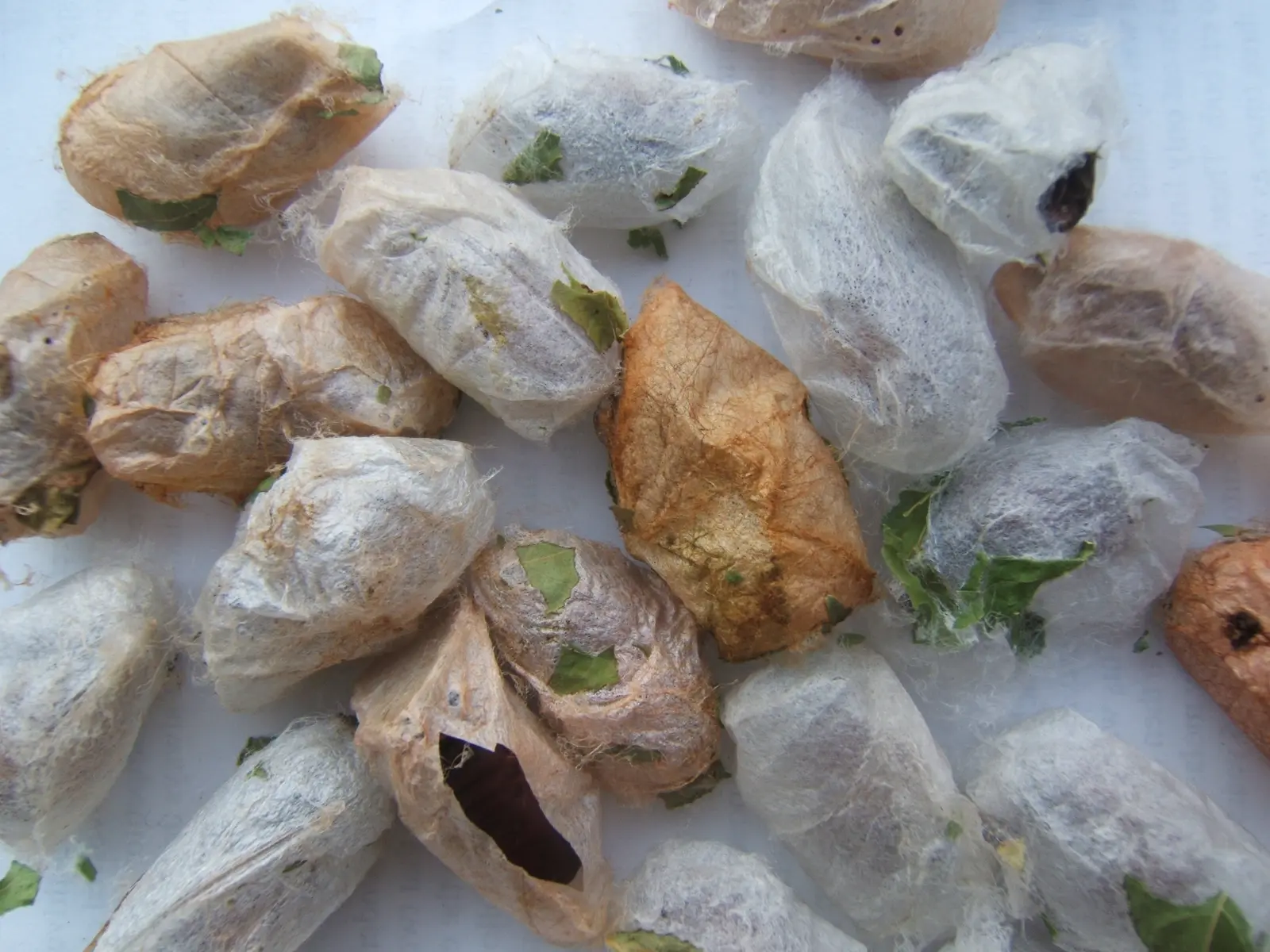
Luna moth cocoons from caterpillars reared on sweetgum, one of the host trees. Some are pale and some brown, with bits of leaf caught in the silk.
How does a luna moth spend its adult week?
Getting out comes first. The adult splits the pupal case at its front end, then cuts through the cocoon with serrated spurs on its thorax near the bases of the front wings.
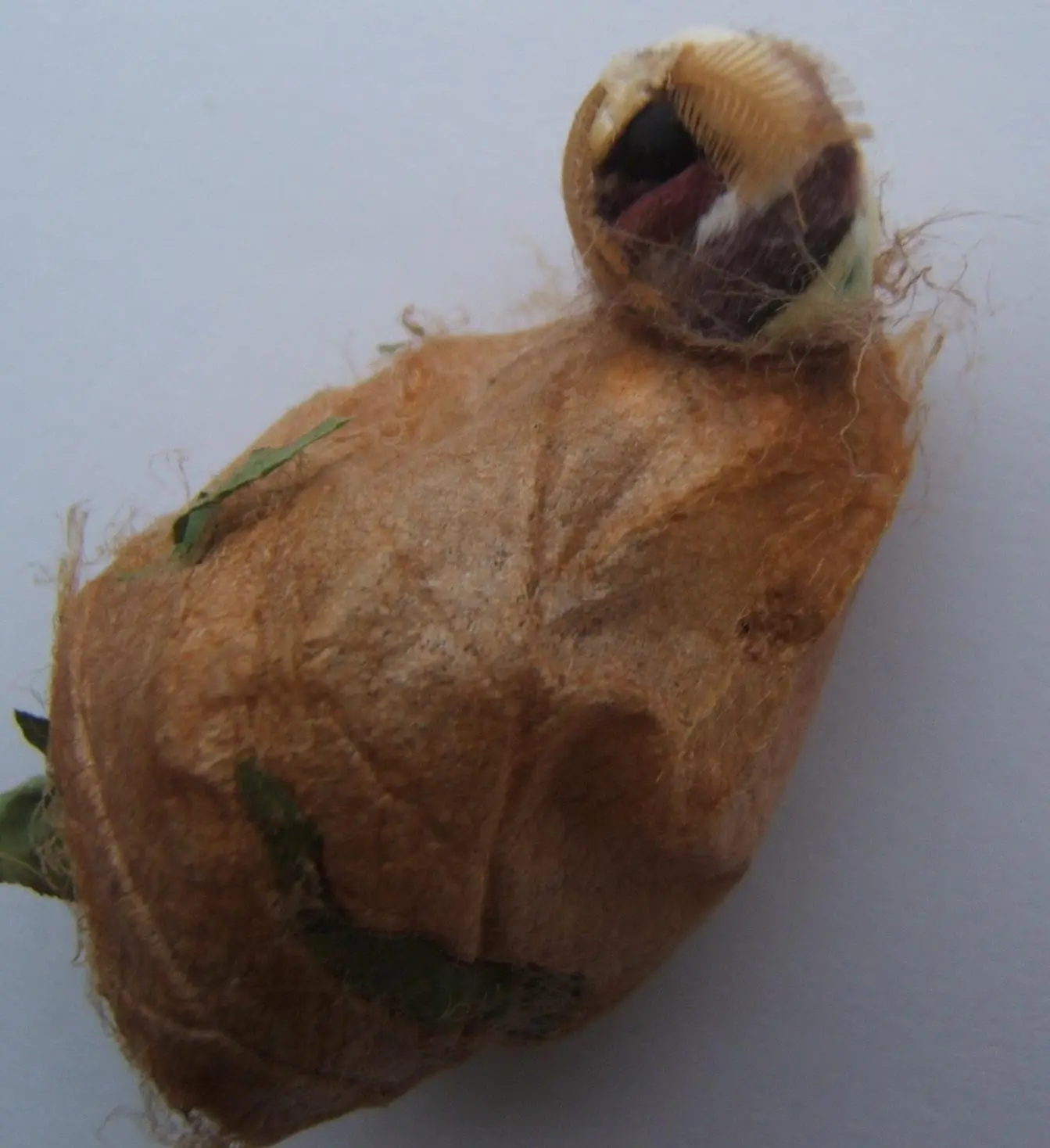
A male luna moth, reared on sweetgum, emerging head first from one end of its cocoon.
Emergence usually happens in the morning. That leaves the day for the wings to expand and dry before the evening flight. Males usually begin emerging several days before females.
Then the female signals with scent. She releases a sex-attractant pheromone that may draw males from a distance. Males are strong fliers.
In 2016, chemists found three compounds in extracts of female pheromone glands that male antennae responded to. In field trials in Ontario and Kentucky, one of them, (6E,11Z)-6,11-octadecadienal, attracted males on its own. Adding (6E)-6-octadecenal appeared to boost the pull. The authors therefore suggest the pheromone is a blend of those two.
Mating usually takes place in the first couple of hours after midnight. Females start laying eggs the following evening and continue for several nights, and Clemson notes that females die once they have laid their eggs. The 2015 bat study describes a general pattern in silk moths: females often do not fly until they have mated, while the males do the searching and face a greater threat from bats.
Adults are strongly attracted to light, particularly ultraviolet. Citing a 1979 light-trap study, the University of Florida profile notes concern that streetlights may keep luna moths and other silk moths from mating in cities. Why moths head for lights at all is its own question: Why Moths Fly to Lights: 3D Video Suggests They Mistake the Bulb for the Sky.
Does a moth that cannot eat fly more cheaply?
Possibly, but the evidence is mixed. A 2021 study filmed five species of hawkmoths, a family in which most species feed as adults, and five silk moth species, including the luna moth. Hawkmoths relied on fast wingbeats to make force, while silk moths relied on wing shape and size for force and on slow, wide wingstrokes to keep power down. Both groups ended up needing similar aerodynamic power.
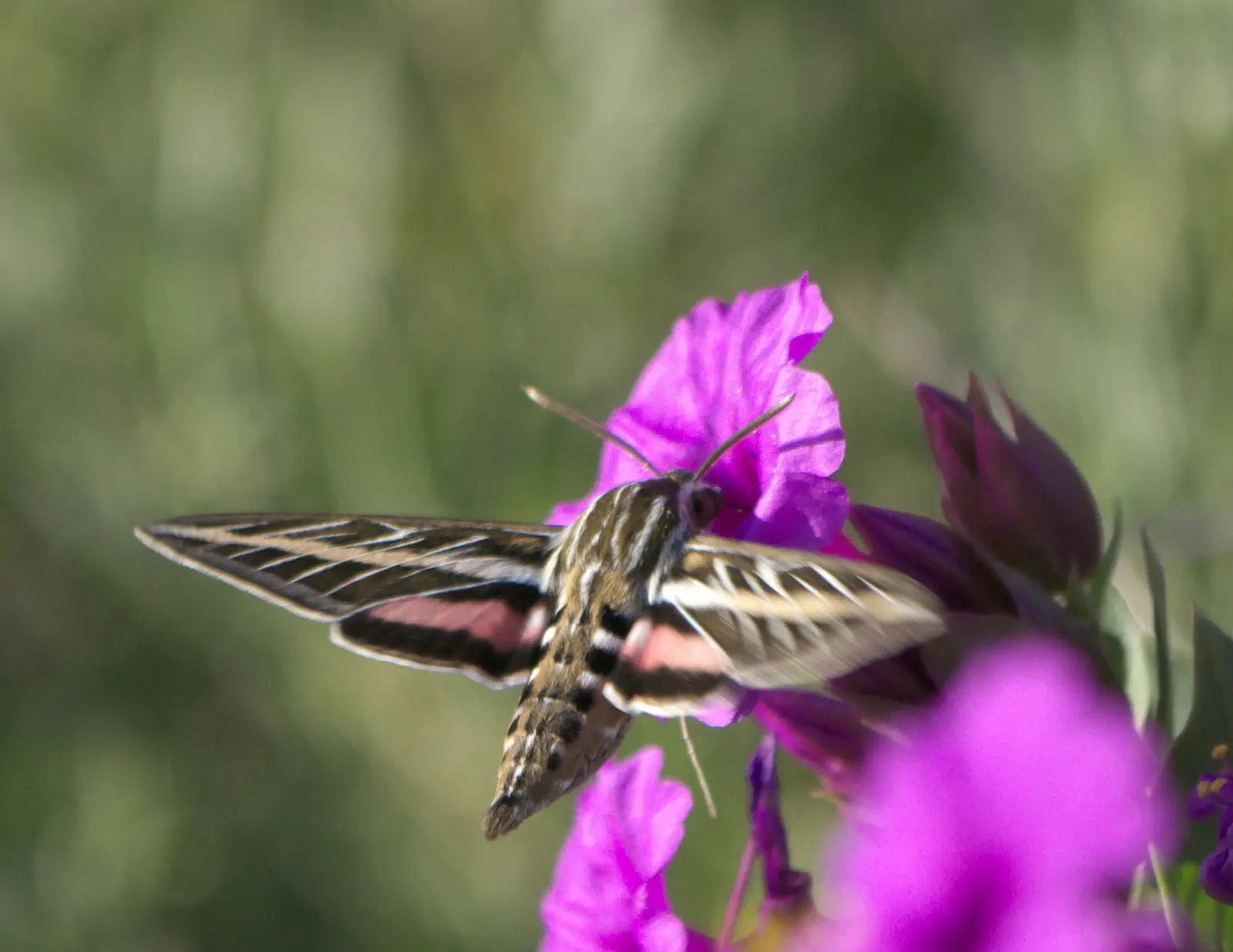
A white-lined sphinx, a hawkmoth, in flight at a four-o'clock flower in Colorado. In the 2021 study, hawkmoths made force with fast wingbeats; silk moths kept power down with slow, wide wingstrokes.
Adult silk moths lack working mouthparts, the authors point out. With that in mind, they suggest, as a hypothesis for future research, that the silk moth thorax, which drives the wings, may have become better at storing and returning elastic energy with each stroke. They also note that silk moths need about as much aerodynamic power as butterflies, which do feed as adults, and read that as a sign that silk moths have no extra power savings.
A 2025 model looked at a different detail. Silk moth bodies pitch up and down in step with each wingbeat. Using flight video of four silk moth species, including the luna moth, the team calculated that this timing tilts the wings so their force points more usefully, lowering drag without losing weight support or forward thrust.
The authors suggest the saving matters because many adult silk moths rely on limited energy reserves. It is a model result, not a measured fuel budget.
What are the luna moth's long tails for?
In lab trials, the luna moth's long tails lure bat attacks away from the body. A 2015 study tethered luna moths on monofilament line in a dark flight room. Eight big brown bats hunted them there.
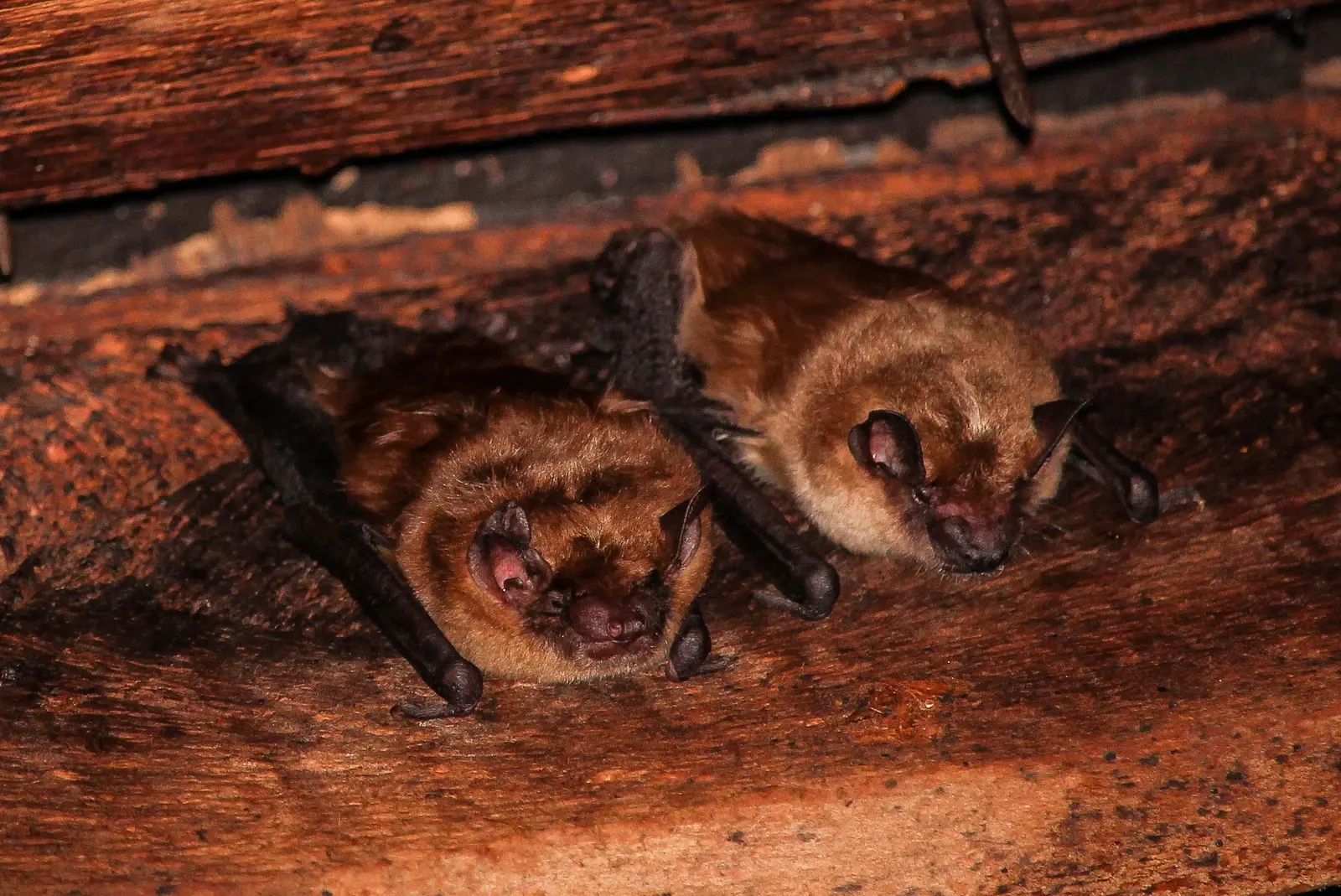
Big brown bats roosting in a Minnesota barn. Eight bats of this species hunted the tethered luna moths in the 2015 flight-room trials.
The bats caught 34.5% of 87 moths with intact tails. Of 75 moths whose tails had been cut off, they caught 81.3%. By the team's statistical model, a moth without tails was 8.7 times more likely to be caught.
Size alone did not explain it. Polyphemus moths, silk moths with no tails but a larger combined wing and body area than intact lunas, were caught 66% of the time, and pyralid moths used as controls 97.5%.
Where the bats aimed explains the gap. In 55.2% of attacks on intact moths, the bats went for the tails, and those attacks caught the moth only 4.2% of the time. Attacks aimed at the body succeeded 71.8% of the time. In about a fifth of encounters, a bat bit off a tail, damaged one, or tore away hindwing near it.
The bats came from Idaho, outside the range of tailed silk moths. Their success did not improve over the nights of testing. Cutting the tails raised the wingbeat rate from about 10 to 11 beats a second, but the team found no other change in normal flight or escape.
How the tails fool a bat is less settled. A 2016 acoustics study found that tail echoes are weak next to echoes from the wings and body, but that the twisted tails return echoes from every angle, which may throw off a bat's aim. If form is frozen physics anywhere on this moth, it is in that twist. The mechanism, though, is still a hypothesis.
By day, the tails do not seem to draw extra attacks from birds: wild-caught Carolina wrens, offered pastry-dough models fitted with real luna moth wings, did not find or attack tailed models more often.
According to the 2015 study, long tails with spoon-shaped tips have evolved independently four times in silk moths. In 10 museum specimens of the luna moth, the tails averaged 37.5 mm. That is about the width of one and a half U.S. quarters.
What does a luna moth caterpillar eat?
Tree leaves. Which trees depends on where it lives.
Northern populations most often use white birch. Farther south, caterpillars use walnuts and hickories, sumacs, sweetgum and persimmon, according to the University of Florida profile. Clemson's longer list adds trees such as alder, beech, red maple, white oak and willows.
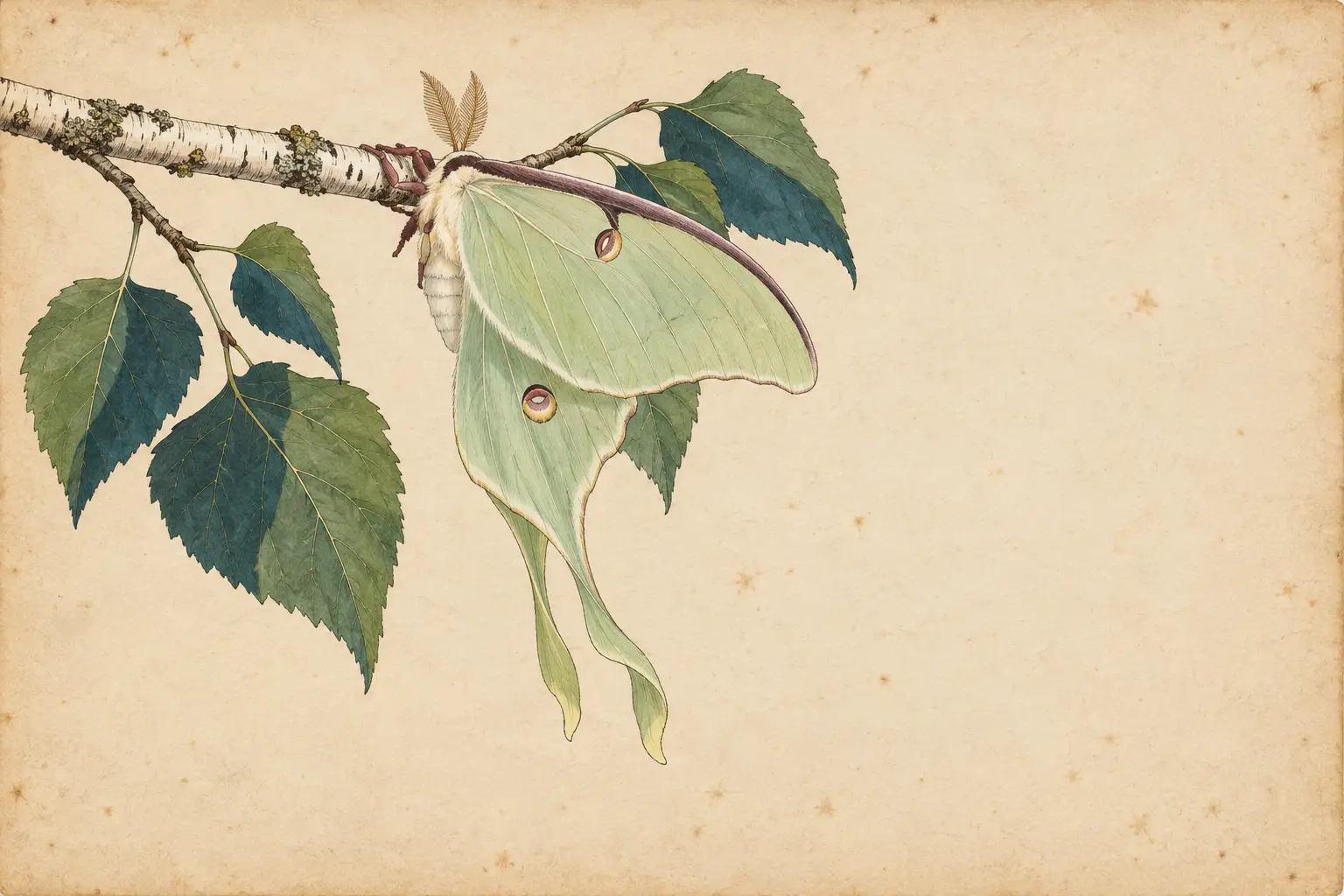
An adult luna moth on a white birch twig, the tree northern caterpillars most often feed on.
A recorded host is not always a good one. In a 1989 feeding test with 11 tree species, newly hatched caterpillars survived extremely poorly on seven. Several of those were recorded hosts. The caterpillars did well on birch, walnut, butternut and hickory.
The author suggested that luna moths specialize more as individuals or populations than as a species, and that gut enzymes may help them handle defensive chemicals in walnut-family leaves.
This is where the adult's budget gets built. The caterpillar grows through five instars, or growth stages. Measurements from 1914, quoted by the University of Florida, run from 6 to 8 mm in the first instar to about 65 mm in the fifth, roughly 8 to 11 times longer.
A caterpillar that eats for a month also has to survive that month. Its green color helps it blend in. When threatened, it often rears up the front of its body in a "sphinx" pose, and if attacked, it clicks its mandibles, its paired jaws, sometimes before or while it regurgitates a distasteful fluid.
A 2007 study found that luna caterpillars click when attacked and that the sounds come before regurgitation; in tests with caterpillars of the related polyphemus moth, the regurgitated fluid deterred ants and mice.
Luna Moth FAQ
Are luna moths rare?
Luna moths are not an endangered species, according to Clemson Extension's 2020 factsheet, though sightings have become less frequent in some areas. Clemson lists habitat degradation and fragmentation, light pollution, and pesticides building up in the environment as issues that may contribute. The University of Florida adds that the caterpillars are never common enough to significantly damage their host trees.
Do luna moths have mouths?
Adult luna moths have mouthparts, but they are vestigial and do not work; Clemson Extension calls the luna moth's proboscis functionless. Adults do not feed and live on energy stored by the caterpillar, which spends about a month eating tree leaves.
When can you see luna moths?
It depends on latitude: Canada and the northern states have one generation a year, flying from May to July, according to Clemson Extension. The Ohio Valley has two generations, and the Deep South can have three, from March to September. In Louisiana and Florida, adults may appear in any month. They fly mainly at night and are attracted to lights.
What eats luna moths?
Clemson Extension lists owls, bats, bald-faced hornets, parasitic wasps and fiery searcher ground beetles among their predators. One study reported the ground under an owl roost littered with silk moth wings, including luna moth wings. Caterpillars also host parasitoid flies and wasps from three insect families, according to the University of Florida. Owl feathers and their quiet flight get their own entry.
Next, look at why so many moths, luna moths among them, end up at lights: Why Moths Fly to Lights: 3D Video Suggests They Mistake the Bulb for the Sky.
Figure: Where a luna moth's life goes
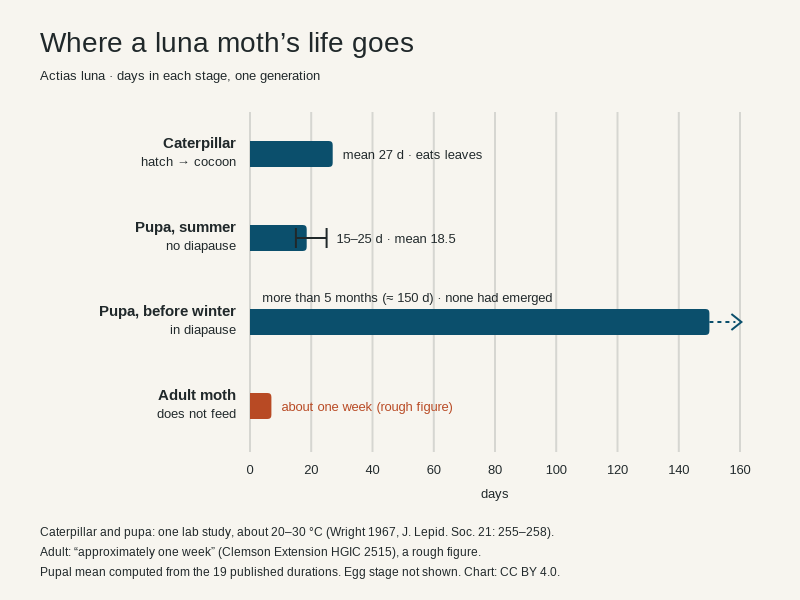
Days in each stage. Caterpillar and pupa bars: one 1967 lab study at about 20 to 30 °C (Wright, J. Lepid. Soc. 21: 255–258), with the 18.5-day pupal mean computed from its 19 non-diapause durations. Adult bar: drawn at one week from Clemson Extension's rough figure. No timed source for the egg stage was found, so it is left out. Data: luna-moth-life-stages.csv (CSV · JSON label).
Figure: Cut the tails, and the bats catch more
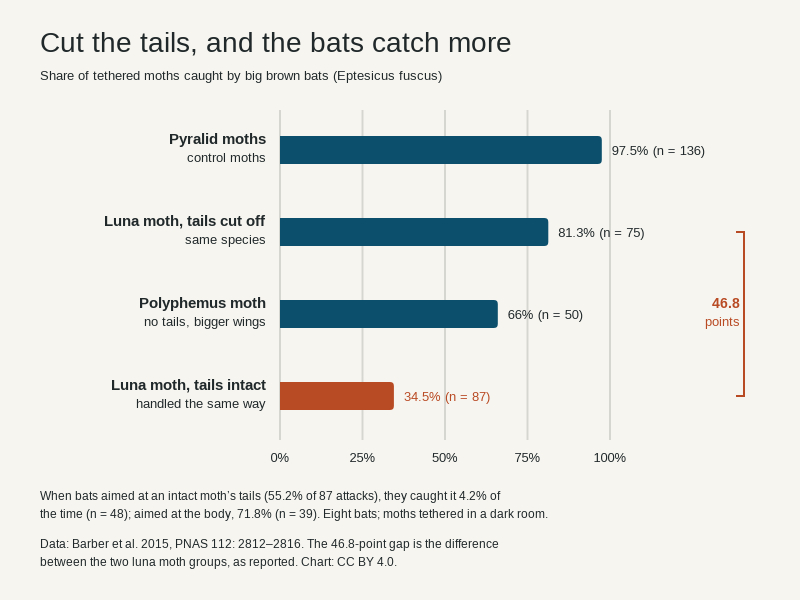
Share of tethered moths caught by eight big brown bats in a dark flight room, drawn by this site from the results reported by Barber et al. 2015 (PNAS 112: 2812–2816). The 46.8-point gap is the difference between the two luna moth groups. Data: luna-moth-bat-trials.csv (CSV · JSON label).
Source card
- Images: eight Wikimedia Commons photographs, one of them first posted on iNaturalist (one CC0, one CC BY 2.0, two CC BY-SA 2.5, one CC BY-SA 3.0 and three CC BY-SA 4.0), two public-domain book plates (1770 and 1918), two charts drawn by this site and one generated schematic illustration; the adult, antennae and caterpillar photographs were checked against the Commons records on 2026-10-10, and the other five photographs and both plates on 2026-10-13. Species and sex follow each file's source label.
- Classification: GBIF Backbone Taxonomy lists Actias luna Linnaeus, 1758 as accepted (usageKey 1865668), family Saturniidae.
- Data: stage lengths come from one 1967 lab study, and wild timing varies with temperature; bat results come from one 2015 lab study with eight bats. The spec card and both chart datasets are available as CSV.
Corrections: none yet.
Sources
- Hall DW (contact Rhodes EM). Luna Moth, Actias (=Tropaea) luna (Linnaeus). EENY-411/IN737, Featured Creatures, UF/IFAS Extension, University of Florida; original publication June 2007, revised June 2012, December 2016, January 2023 and May 2026 ask.ifas.ufl.edu/publication/IN737full text
- Sparks SR, Benson EP, Culin JD; revised by Burgess L. Luna Moth. HGIC 2515, Home & Garden Information Center, Clemson Cooperative Extension; revised August 6, 2020 hgic.clemson.edu/factsheet/luna-moth/full text
- GBIF Backbone Taxonomy. Actias luna Linnaeus, 1758 (usageKey 1865668, status ACCEPTED, family Saturniidae, order Lepidoptera), species match API www.gbif.org/species/1865668species match record
- Wright DA. "The effects of photoperiod on the initiation of pupal diapause in the wild silkworm, Actias luna." Journal of the Lepidopterists' Society 21(4):255–258 (1967) images.peabody.yale.edu/lepsoc/jls/1960s/1967/1967-21%284%29255-Wright.pdffull text (scanned PDF from the Lepidopterists' Society archive)
- Barber JR, Leavell BC, Keener AL, Breinholt JW, Chadwell BA, McClure CJW, Hill GM, Kawahara AY. "Moth tails divert bat attack: Evolution of acoustic deflection." Proceedings of the National Academy of Sciences USA 112(9):2812–2816 (2015) doi.org/10.1073/pnas.1421926112full text via PMC4352808
- Lee W-J, Moss CF. "Can the elongated hindwing tails of fluttering moths serve as false sonar targets to divert bat attacks?" Journal of the Acoustical Society of America 139(5):2579–2588 (2016) doi.org/10.1121/1.4947423abstract via Europe PMC (PMID 27250152)
- Rubin JJ, Martin NW, Sieving KE, Kawahara AY. "Testing bird-driven diurnal trade-offs of the moon moth's anti-bat tail." Biology Letters 19(2):20220428 (2023) doi.org/10.1098/rsbl.2022.0428abstract via Europe PMC (PMID 36722145)
- Millar JG, Haynes KF, Dossey AT, McElfresh JS, Allison JD. "Sex attractant pheromone of the luna moth, Actias luna (Linnaeus)." Journal of Chemical Ecology 42(9):869–876 (2016) doi.org/10.1007/s10886-016-0751-6abstract via Europe PMC (PMID 27544534)
- Aiello BR, Sikandar UB, Minoguchi H, Bhinderwala B, Hamilton CA, Kawahara AY, Sponberg S. "The evolution of two distinct strategies of moth flight." Journal of the Royal Society Interface 18(185):20210632 (2021) doi.org/10.1098/rsif.2021.0632full text via PMC8647679
- Sikandar UB, Aiello BR, Sponberg S. "Body oscillations couple with wing flapping to reduce aerodynamic power in wild silk moth flight." Journal of the Royal Society Interface 22(229):20250061 (2025) doi.org/10.1098/rsif.2025.0061full text via Europe PMC, PMC12381587 (CC BY 4.0)
- Lindroth RL. "Chemical ecology of the luna moth: Effects of host plant on detoxification enzyme activity." Journal of Chemical Ecology 15(7):2019–2029 (1989) doi.org/10.1007/BF01207434abstract via Europe PMC (PMID 24272292)
- Brown SG, Boettner GH, Yack JE. "Clicking caterpillars: acoustic aposematism in Antheraea polyphemus and other Bombycoidea." Journal of Experimental Biology 210(6):993–1005 (2007) doi.org/10.1242/jeb.001990abstract via Europe PMC (PMID 17337712)
- United States Mint. Coin Specifications (quarter dollar diameter 0.955 in., 24.26 mm) www.usmint.gov/learn/coins-and-medals/circulating-coins/coin-specificationstext read from the Internet Archive capture of 2026-09-07 (web.archive.org/web/20260907143753/https://www.usmint.gov/learn/coins-and-medals/circulating-coins/coin-specifications)
- GBIF Backbone Taxonomy. Hyles lineata Fabricius, 1775 (usageKey 1862841, status ACCEPTED, family Sphingidae, order Lepidoptera), species match API www.gbif.org/species/1862841species match record
Cite this page
Plankton to Plumage. “Luna Moth: The Adult Can't Eat, So Its Caterpillar Pays for the Week.” October 12, 2026. https://planktontoplumage.com/insects/luna-moth/
Add the date you read the page after the address if your style guide asks for it.