Deep explainerNo. 0012
Left-Handed Snails: Lefties Like Jeremy Are Mostly Flukes, Study Suggests
Published
Parts of this entry8 parts
Spec card
Size analogy (length)≈ the width of a U.S. half-dollar coinScale: Computed: 28–32 mm shell (UF/IFAS EENY-240) ÷ 30.61 mm half dollar (U.S. Mint coin specifications, Internet Archive 2026-09-07) = 0.91–1.05
- Common name
- Garden snail, brown garden snailSource: Davison & Thomas 2020 (garden snail); UF/IFAS Featured Creatures EENY-240 (brown garden snail)
- Scientific name
- Cornu aspersum (O.F. Müller, 1774); synonym Helix aspersaSource: GBIF Backbone Taxonomy, usageKey 5858758 (accepted, checked 2026-10-10); UF/IFAS EENY-240 (synonyms)
- Group
- Land snails, family Helicidae (order Stylommatophora)Source: GBIF Backbone Taxonomy
- Size band
- Adult shell 28–32 mm across, with four to five whorlsSource: UF/IFAS EENY-240, citing Burch 1960
- Distribution / habitat
- Native to Britain, western Europe and the shores of the Mediterranean and Black Seas; introduced to parts of the Americas, South Africa, Australia and New Zealand; gardens and cropsSource: UF/IFAS EENY-240, citing Burch 1960 and Capinera 2001
- Three ID features
- Fairly thin, globe-shaped shell of four to five whorls, the lip of the opening turned back
- yellow or horn-colored, with chestnut-brown spiral bands broken by yellow flecks or streaks
- coils to the right (dextral); left-coiling shells are rare
- The misidentification twin
- Not yet verified
Download this card as CSV snail-shell-coiling-direction-spec-card.csv · CC BY 4.0File label (JSON): name, license, publisher
Main images
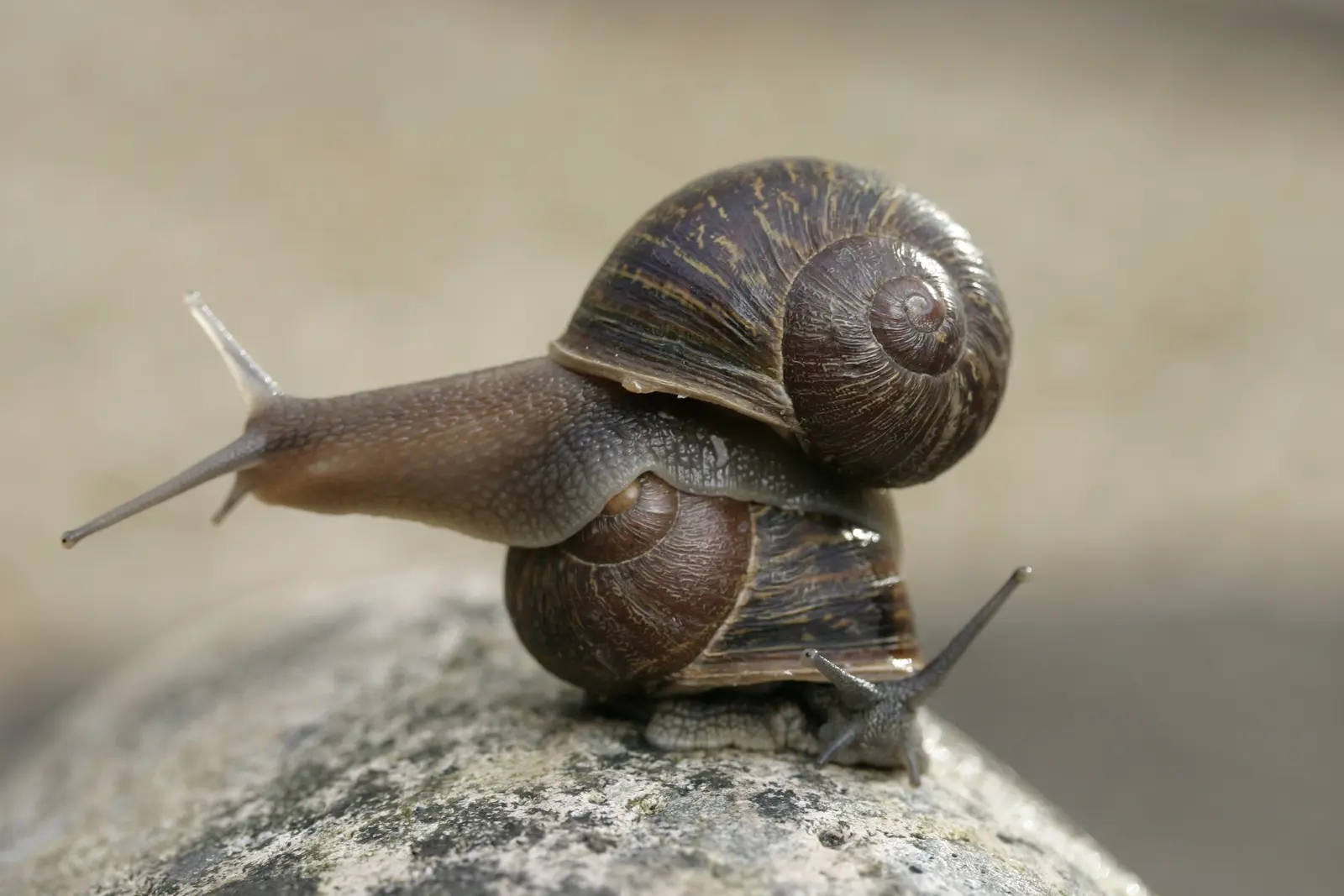
Jeremy, a left-coiling garden snail found in London, on top of a right-coiling snail that a 2020 study names Theresa.
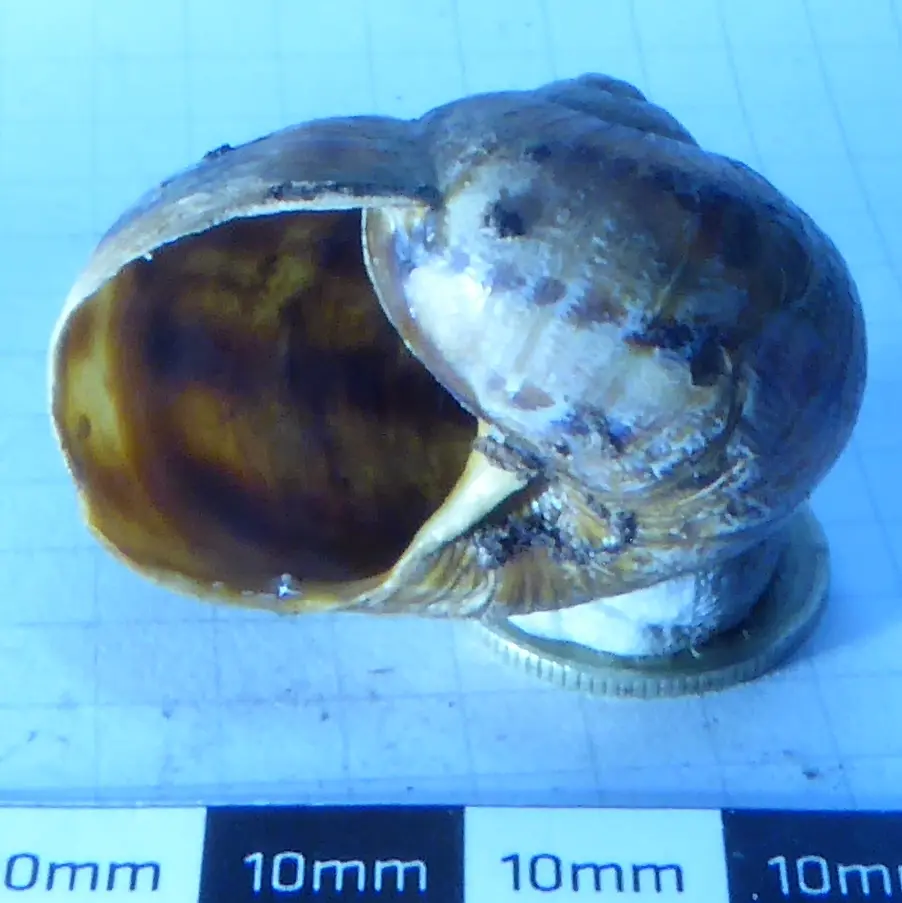
A left-coiling garden snail shell from a different source, with its opening toward the camera.
The short answer
Thirteen left-coiling garden snails had 1,120 young between them, and every one coiled to the right. That result comes from a breeding study set off by a snail named Jeremy. It is a recent chapter in a century of work on what sets snail shell coiling direction.
Most snail shells coil to the right. A 2005 review puts right-handed, or dextral, groups at more than 90% of snail taxa. In the pond snails where the genetics has been worked out, the mother's genes set the coil of her young, not their own genes.
Rare lefties among garden snails look different. Across three generations bred from them, only 17 of 14,596 young coiled left, which points mainly to accidents of early development rather than a single major lefty gene in the mother.
How can you tell which way a snail shell coils?
Hold the shell with its tip up. In a dextral shell, a 2010 paper explains, the opening is then on the right-hand side; in a sinistral, or left-handed, shell it is on the left. Researchers also call the two forms clockwise and counterclockwise coiling.
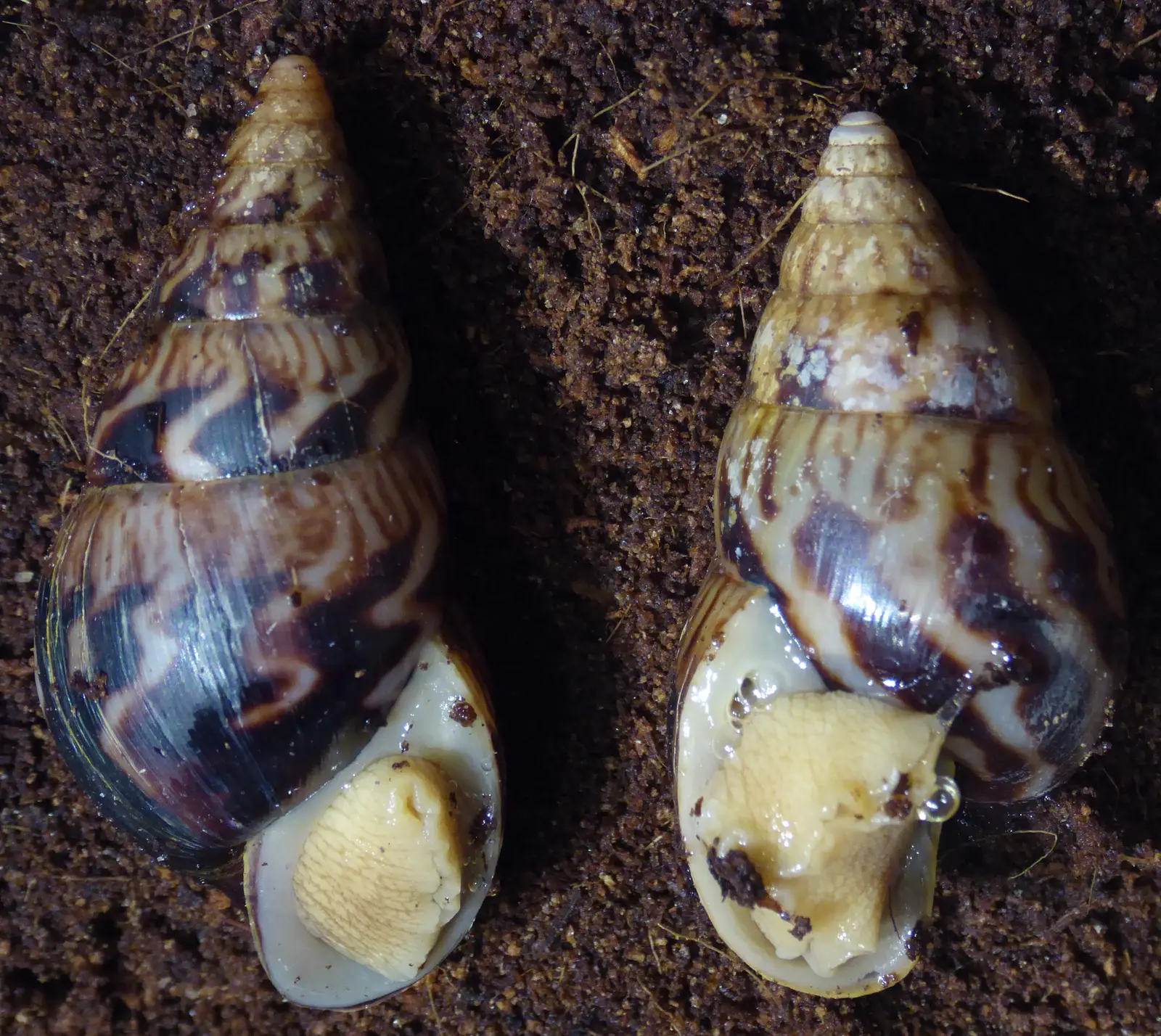
Two snails of one species, Limicolaria martensiana, labeled as a sinistral and dextral pair at the source. Tip up, the left snail opens on the right (dextral) and the right snail opens on the left (sinistral).
The coil runs through the whole animal, not just the shell. A 2020 paper describes clockwise and counterclockwise shells "with mirror-imaged bodies to match." In a left-handed snail, the genitals sit on the opposite side of the head from where a right-handed snail has them.
The drawing below uses the coiling rule from A Seashell Is an Equation: Four Numbers Draw Both a Snail and a Clam with one set of settings. It draws a right-handed shell, then reflects it. The reflection is a left-handed shell. Seen from the tip, the drawing also shows the clockwise turn of the dextral coil and the counterclockwise turn of its mirror image.
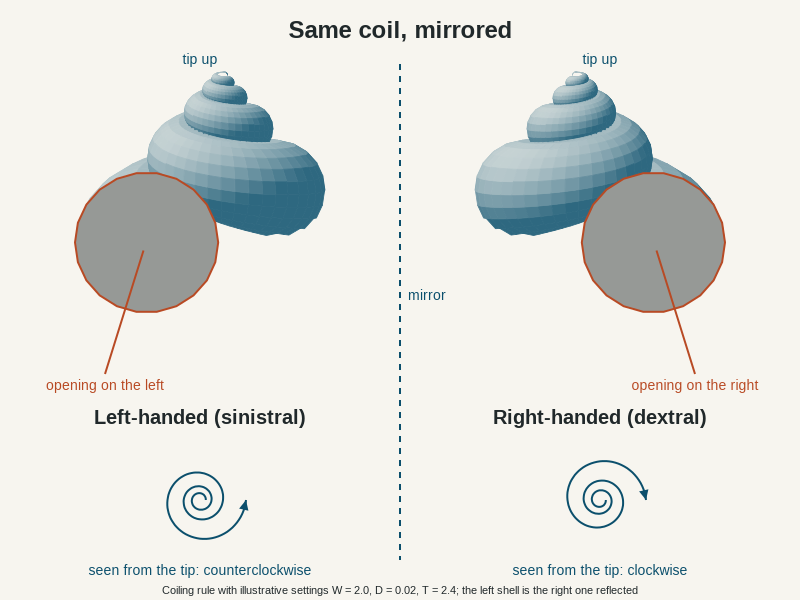
Drawn by this site from the coiling rule with illustrative settings, not a measured species. The left shell is the right one reflected; nothing else changed.
Is a left-handed snail a perfect mirror image?
Not quite, at least in one species. Both coils are normal in Amphidromus inversus, a land snail. In a 2010 study, 18 volunteers measured 50 dextral and 50 sinistral shells with calipers, and four of the volunteers found the sinistral shells significantly stouter. But the authors could not rule out that people handled left-handed shells differently.
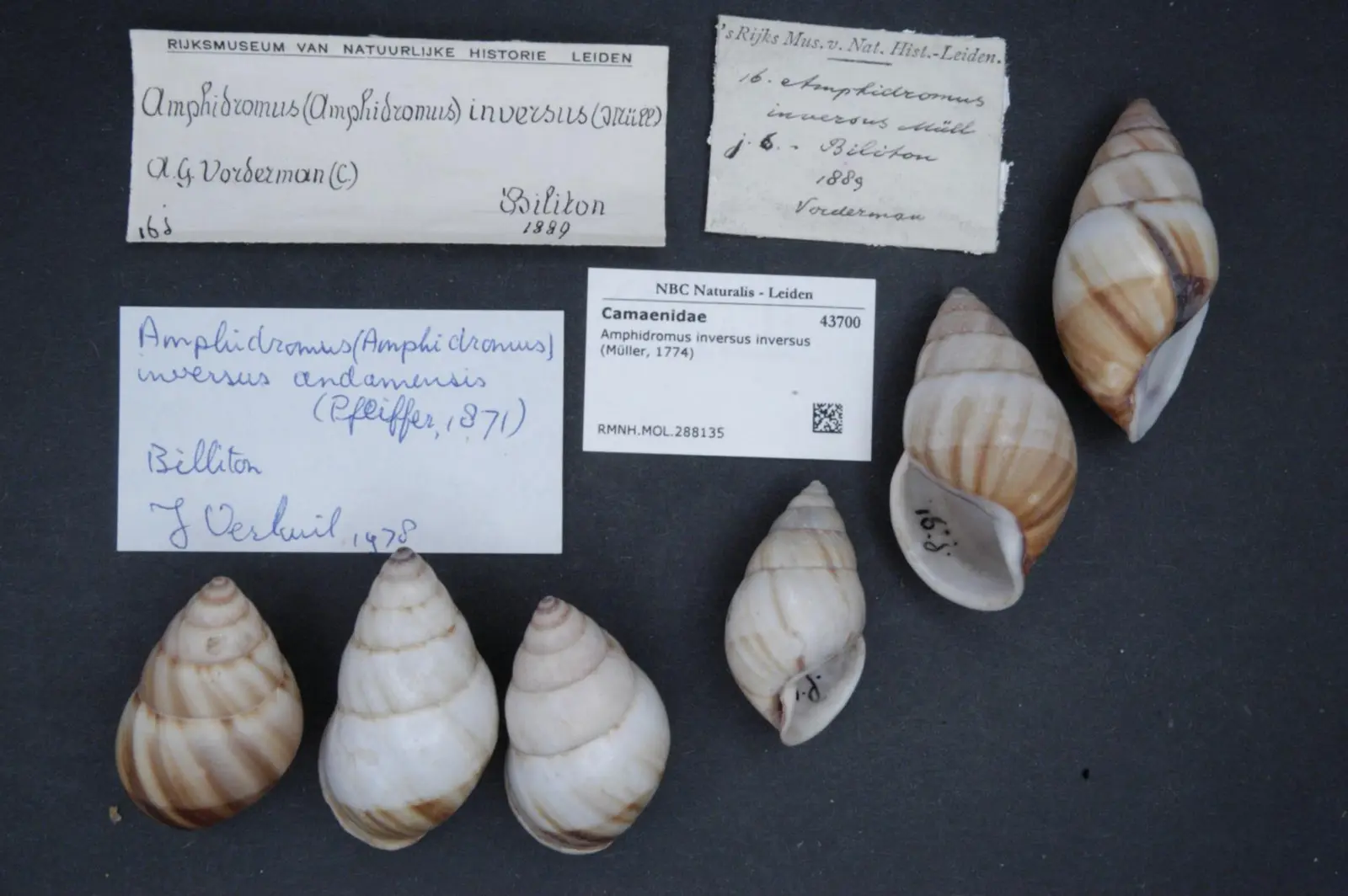
Museum shells labeled at the source as Amphidromus inversus. Tip up, the middle of the three shells at right opens on the left (sinistral); the other two open on the right (dextral).
A landmark-based shape analysis of the same shells did find a difference: a slight but significant widening and twisting of sinistral shells near the opening. The authors concluded that dextrals and sinistrals from the same gene pool are not exact mirror images.
The mirror also stops at the sperm. In pulmonate, or lunged, snails, sperm cells twist into a helix as they mature. A 2011 study of Amphidromus inversus found the sperm always coiled to the right, whichever way the snail itself coiled.
What decides which way a snail coils?
By the time an embryo of the great pond snail, Lymnaea stagnalis, has eight cells, its direction is set. The twist shows at the third cell division. In dextral embryos, four small cells bud off from four large ones and twist clockwise; in sinistral embryos they first emerge without a twist and turn counterclockwise later.
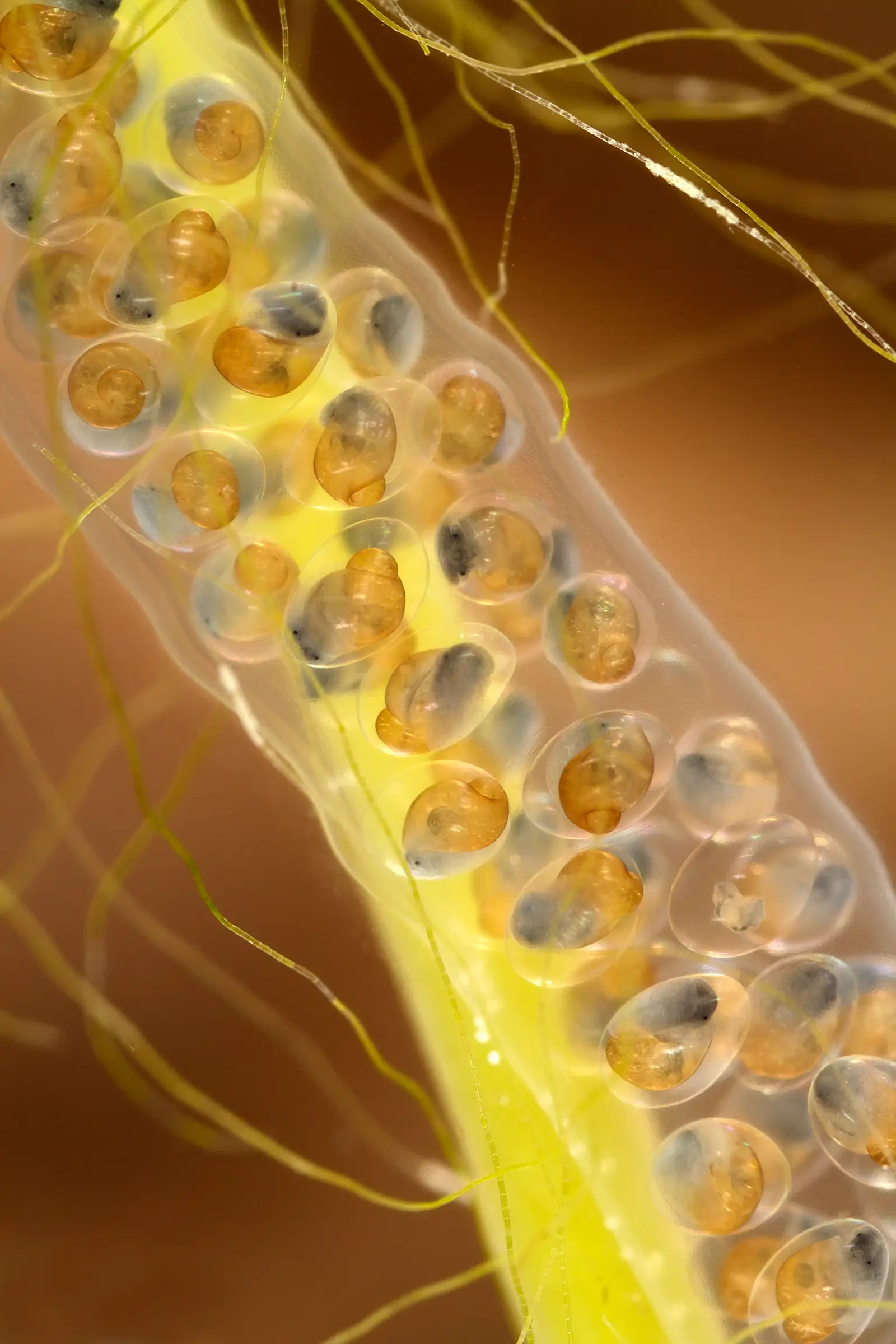
Embryos of the great pond snail in an egg mass, labeled at the source as Lymnaea stagnalis. Many already show a small coiled shell, its direction set by the eight-cell stage.
In 2009, Kuroda and colleagues pushed those cells the other way by micromanipulation, between the four- and eight-cell stages. The embryos grew into healthy, fertile snails with every usual left-right difference reversed. The arrangement of the cells at the eight-cell stage, the team concluded, sets left and right for the rest of development.
Why do the mother's genes decide?
The instructions for that twist come from the mother. In 1923, Boycott and Diver, and separately Sturtevant, showed that coiling in a pond snail then called Limnaea peregra is controlled by a maternal-effect gene. A dominant allele in the mother gives her young a clockwise twist. (GBIF matches that name to Peregriana peregra.)
A maternal-effect gene works through the egg. In Lymnaea stagnalis, the one-cell embryo already holds the message from the coiling gene. The mother made that message.
So a snail's own coiling genes show up only in its young, when it acts as a mother. A 2010 study put it plainly: in species with both forms, there is no predictable link between a snail's own coiling genes and the way it actually coils.
The same broad pattern had been shown in all species studied, notes the 2020 garden snail paper described below, though in some the sinistral allele is the dominant one. A 2005 review adds a limit: the genetics had been studied in only a few pulmonate species, and the authors urged work on more groups, especially from the sea.
What is the pond snail's coiling gene?
In 2016, a team led by Angus Davison found that left-coiling Lymnaea stagnalis carry a one-letter deletion in a formin gene they called Ldia2, a mutation perfectly matched with coiling in their crosses. Formins help build actin filaments, part of the scaffolding inside a cell. One-cell embryos from mothers with two copies of the mutation held about 0.6% as much of the gene's message as embryos from mothers with two normal copies. Embryos from mothers with one working copy held about half, and those mothers' young still coil right.
A drug that blocks formins made some embryos that should have coiled right begin their third division without the twist, as sinistral embryos do. The same study found that interfering with formin in early frog embryos scrambled the left-right placement of organs such as the heart in some tadpoles.
In 2019, Abe and Kuroda reported the first use of CRISPR gene editing in a mollusc, on the same pond snail. When both copies of a formin gene they call Lsdia1 were broken, the snails produced left-coiling young generation after generation, in a line that was otherwise entirely right-coiling. They report that the gene sets the direction at the one-cell stage.
Why are left-handed snails so rare?
The studies used here point mainly to mating. A lefty's genitals are on the opposite side of the head, and courtship is also handed, so lefties do not usually mate with normal snails. Because a new lefty struggles to find a partner, selection is expected to work against whichever form is rare. Development may add a cost too: in the most studied species, a 2020 paper notes, the mutations that make lefties also cause developmental problems.
Shell shape changes the odds. Tall-shelled land snails usually mate with one partner mounted on the other's shell. Globe-shaped to flat ones mate face to face. Mixed matings are physically easier in tall snails, which a 2010 study gives as the probable reason that left-handed genera have evolved more often among tall-shelled pulmonates.
The barrier leaks. In Japan's Euhadra land snails, naturalists' reports added up to five records of matings between dextral and sinistral snails, three in the wild and two in the laboratory. Genome data point to recent or ongoing gene flow between the left-coiling Euhadra quaesita and a right-coiling form that the 2017 study's authors say should probably be treated as the same species. The authors suggest the mating problem is mainly behavioral, and conclude that, at least in Euhadra, more than a single gene is needed before a coil reversal can be said to make a new species.
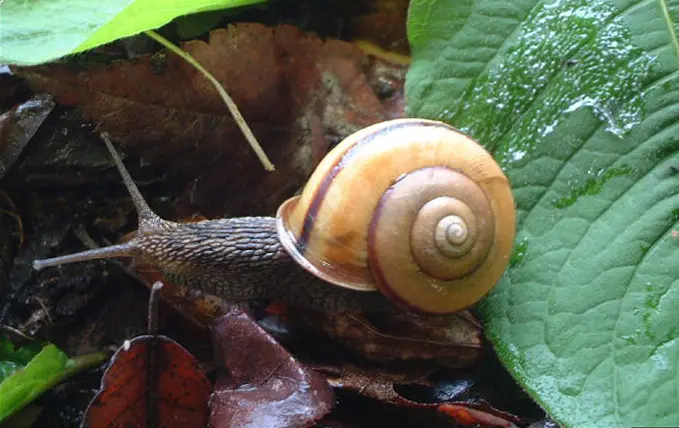
A land snail from Sendai, Japan, labeled at the source as Euhadra quaesita, the left-coiling species in the 2017 gene-flow study.
Where are both coils normal?
The tree snails of the subgenus Amphidromus break the rule outright. In most of its species, dextral and sinistral snails live together in roughly equal numbers. In one population of Amphidromus inversus, a 2007 study found that matings between opposite coils happen more often than chance would predict. Anatomy suggests those mixed pairs probably produce more young, and a computer simulation found that, under those conditions, both forms are expected to persist.
Can being left-handed save a snail's life?
Sometimes. A family of South-East Asian snakes that includes the genus Pareas is regarded as specializing in land snails and slugs. A Japanese species, Pareas iwasakii, strikes a crawling snail from behind at a fixed leftward angle and pulls the body out with its lower jaws. A skull in a 2010 study has about half a dozen more teeth on the right side of the lower jaw than on the left.
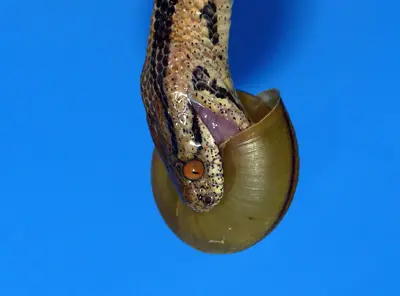
A snake labeled at the source as Pareas iwasakii eating a land snail, its jaws inside the shell's opening.
That "right-handed" attack often fails on a left-coiling shell. In feeding trials with four snakes, none of the right-coiling Satsuma mercatoria survived. Of the left-coiling Satsuma perversa, 87.5% did. The authors note that the two species may also differ in other ways.
The advantage was much larger in these snails, about 27 mm across, than in Bradybaena similaris, about 13 mm across. The snakes' gape is limited, so they can hardly hold a lefty whose opening is large.
The pattern shows up on maps too. Among land snail genera of the group Stylommatophora worldwide, 11.8% of the genera counted within the snakes' range were left-handed, against 5.0% outside it, a link the authors call marginal. They do not conclude that snakes caused every left-handed species in that range. Left-handed genera also exist outside it.
Was Jeremy the snail just a fluke?
Jeremy was a left-coiling garden snail found in South West London. Angus Davison, of the University of Nottingham, used the snail to launch a #snaillove campaign to find Jeremy a mate. The snail was named after the politician Jeremy Corbyn. It appeared in more than 1,000 news and science articles.
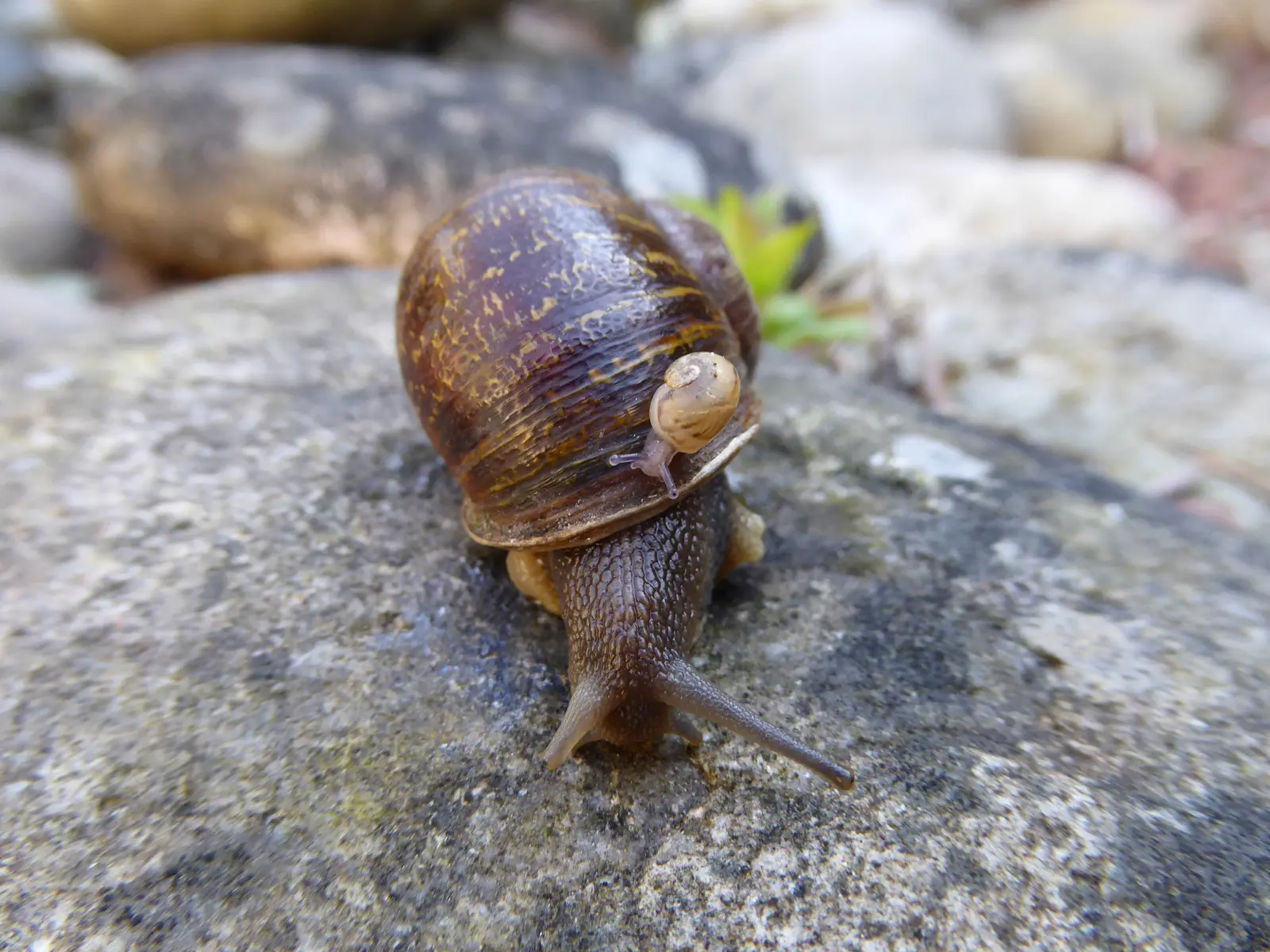
Jeremy, the left-coiling garden snail, with a young garden snail on its shell. The source does not name the young snail's parents.
Two more lefties turned up: Lefty, found in the wild in Ipswich, and Tomeu, from a snail farm on Mallorca. One of them mated with Jeremy and produced young. Lefty's 46 young and Tomeu's 335 all coiled right.
The campaign brought in records of 45 left-coiling garden snails. Snail farms accounted for 34 of them. Records from three snail farms, in Spain, Poland and on Mallorca, gave an estimate of about one lefty in 40,000, which could mean lefties are much more common than the "one in a million" figure put to the public. But the estimate is an upper limit, because it leaves out times when no lefties were found.
Did three generations of young all coil right?
One generation of right-coiling young does not settle the question. If the cause were a recessive maternal-effect allele, up to three generations of breeding could be needed to reveal it. So the team bred the lefties' young, and then their grandchildren.
The 13 original lefties that produced young had 1,120 between them, all right-coiling. Sixty-three young of nine lefty mothers were bred in turn and produced 3,598 more, all right-coiling, and 107 snails of the next generation produced 3,576, all right-coiling. The only lefties turned up among the grandchildren of two farm lefties from France: 17 of 6,302 young, in the broods of 6 of the 32 mothers.
The authors concluded that rare left-coiling garden snails are not usually caused by a major maternal gene. Instead, they wrote, lefties are likely produced mainly by a developmental accident, perhaps a chance or environment-triggered reversal at the third cell division. The French broods fit a recessive allele that tips only some embryos the other way.
That conclusion is about rare lefties as a group. Jeremy never produced a brood as a mother. The young that Tomeu had after mating with both Lefty and Jeremy probably had mixed fathers. So Jeremy's own coiling genes were never tested directly.
Left-handed snail FAQ
Are left-handed snails rare?
In most species, yes. A 2005 review puts right-handed snail taxa at more than 90%, and a 2020 study estimates no more than about one left-coiling garden snail in 40,000 on farms. There are exceptions: some species, genera and even whole families coil left, and in most species of the tree snail subgenus Amphidromus both coils are common in the same population.
Can a left-handed snail mate with a right-handed snail?
Not easily, in most species. The genitals sit on opposite sides of the head and courtship is handed, so mixed pairs usually fail. Tall-shelled snails that mate by climbing onto a partner's shell manage it more easily. Rare mixed matings have been recorded in Japanese Euhadra snails, and in one population of Amphidromus inversus tree snails, mixed pairs mated more often than chance predicts.
Is the direction a snail coils genetic?
In the few species whose genetics had been studied, a single gene acting through the mother sets the coil of her young, so a snail's own genes show up only in its offspring. In the great pond snail, that gene is a formin. Rare left-coiling garden snails such as Jeremy look different: three generations of breeding gave 17 lefties in 14,596 young, which points mainly to accidents of development.
Next, try the tip-up test on other shells: Seashell Identification: A Clam's Two Halves Are Its Left and Right Sides.
Figure: Three generations, 17 lefties
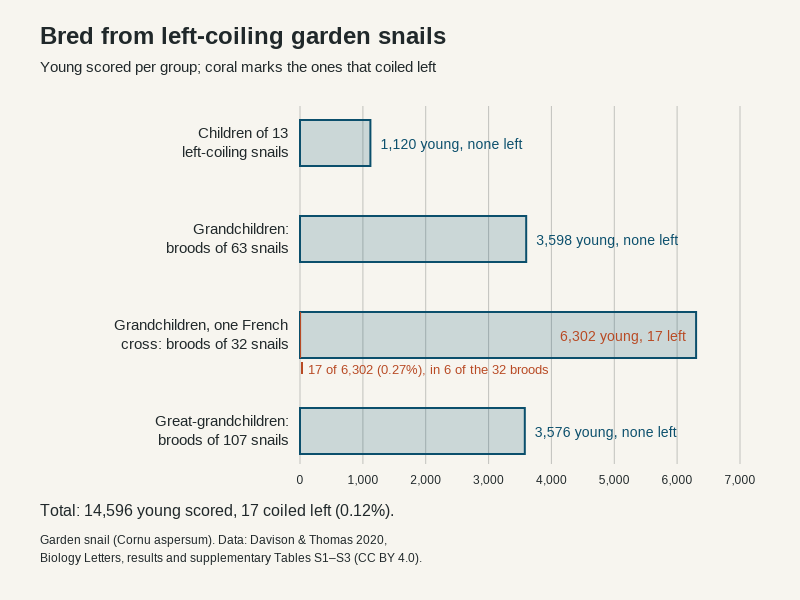
Young scored in each generation bred from rare left-coiling garden snails, from Davison and Thomas 2020 (results text, and supplementary Tables S1 to S3 under CC BY 4.0). The 17 lefties all came from six broods of one French cross. Totals and shares are computed by this site from the published counts.
Download the counts, sources and computed shares: snail-shell-coiling-direction-breeding.csv (CSV · JSON label).
Source card
- Images: eight photographs from Wikimedia Commons (five CC BY-SA 4.0, one CC BY-SA 3.0, one CC BY 2.5, one CC0 1.0) and two figures drawn by this site for this page; photo licenses were checked against the Commons records and file hashes matched to the originals, three on 2026-10-10 and five on 2026-10-13.
- Classification: GBIF Backbone Taxonomy lists Cornu aspersum (O.F. Müller, 1774) as accepted (usageKey 5858758), along with the other species named here, checked 2026-10-10; it lists the 1923 study's Limnaea peregra as a synonym of Peregriana peregra. Species names in the photos follow the source labels.
- Data: the chart counts come from Davison and Thomas 2020; summing the supplementary tables row by row gives the same totals as the paper, and the overall total and the shares are computed by this site. The mirror-shell figure uses illustrative settings.
Corrections: none yet.
Sources
- Davison A, Thomas P, 'Jeremy the snail' citizen scientists. "Internet 'shellebrity' reflects on origin of rare mirror-image snails." Biology Letters 16:20200110 (2020) doi.org/10.1098/rsbl.2020.0110full text read via PubMed Central, PMC7336844
- Davison A, Thomas P. Supplementary Tables from "Internet 'shellebrity' reflects on origin of rare mirror-image snails." The Royal Society, figshare dataset (2020) doi.org/10.6084/m9.figshare.12382865.v1spreadsheet (Tables S1 to S3) downloaded and summed row by row; CC BY 4.0 per the figshare record
- Schilthuizen M, Davison A. "The convoluted evolution of snail chirality." Naturwissenschaften 92:504–515 (2005) doi.org/10.1007/s00114-05-0045-2abstract read via Europe PMC, PMID 16217668
- Schilthuizen M, Haase M. "Disentangling true shape differences and experimenter bias: are dextral and sinistral snail shells exact mirror images?" Journal of Zoology 282:191–200 (2010) doi.org/10.1111/j.1469-7998.2010.00729.xfull text read via Europe PMC, PMC3020325
- Schilthuizen M, van Heuven BJ. "Dextral and sinistral Amphidromus inversus (Gastropoda: Pulmonata: Camaenidae) produce dextral sperm." Zoomorphology 130:283–287 (2011) doi.org/10.1007/s00435-011-0140-1full text read via Europe PMC, PMC3213333
- Davison A, McDowell GS, Holden JM, et al. "Formin is associated with left-right asymmetry in the pond snail and the frog." Current Biology 26:654–660 (2016) doi.org/10.1016/j.cub.2015.12.071full text read via Europe PMC, PMC4791482 (CC BY 4.0)
- Kuroda R, Endo B, Abe M, Shimizu M. "Chiral blastomere arrangement dictates zygotic left-right asymmetry pathway in snails." Nature 462:790–794 (2009) doi.org/10.1038/nature08597abstract read via Europe PMC, PMID 19940849
- Abe M, Kuroda R. "The development of CRISPR for a mollusc establishes the formin Lsdia1 as the long-sought gene for snail dextral/sinistral coiling." Development 146:dev175976 (2019) doi.org/10.1242/dev.175976abstract read via Europe PMC, PMID 31088796
- Richards PM, Morii Y, Kimura K, Hirano T, Chiba S, Davison A. "Single-gene speciation: Mating and gene flow between mirror-image snails." Evolution Letters 1:282–291 (2017) doi.org/10.1002/evl3.31full text read via Europe PMC, PMC6121799 (CC BY 4.0)
- Schilthuizen M, Craze PG, Cabanban AS, Davison A, Stone J, Gittenberger E, Scott BJ. "Sexual selection maintains whole-body chiral dimorphism in snails." Journal of Evolutionary Biology 20:1941–1949 (2007) doi.org/10.1111/j.1420-9101.2007.01370.xabstract, introduction and methods read via Europe PMC, PMC2121153
- Hoso M, Kameda Y, Wu SP, Asami T, Kato M, Hori M. "A speciation gene for left-right reversal in snails results in anti-predator adaptation." Nature Communications 1:133 (2010) doi.org/10.1038/ncomms1133full text read via Europe PMC, PMC3105295 (CC BY-NC-SA 3.0)
- Dekle GW, Fasulo TR. "Brown garden snail, Cornu aspersum (Müller)." Featured Creatures EENY-240, University of Florida / Florida Department of Agriculture and Consumer Services (2001; latest revision March 2021) web.archive.org/web/20231202014818/https://entnemdept.ufl.edu/creatures/misc/gastro/brown_garden_snail.htmfull page read via Internet Archive capture of 2023-12-02
- GBIF Secretariat. GBIF Backbone Taxonomy, species match API: Cornu aspersum (usageKey 5858758), Limicolaria martensiana (9214446), Lymnaea stagnalis (2291253), Amphidromus inversus (9025651), Euhadra quaesita (10457466), Satsuma perversa (9886018), Satsuma mercatoria (10344785), Bradybaena similaris (2297154), Pareas iwasakii (2453024); Limnaea peregra (7884042) matched as a synonym of Peregriana peregra api.gbif.org/v1/species/match?name=Cornu%20aspersumspecies match results for every species named in the article
- United States Mint. "Coin Specifications." (Internet Archive capture of 2026-09-07) web.archive.org/web/20260907143753/https://www.usmint.gov/learn/coins-and-medals/circulating-coins/coin-specificationsarchived page read
Cite this page
Plankton to Plumage. “Left-Handed Snails: Lefties Like Jeremy Are Mostly Flukes, Study Suggests.” October 12, 2026. https://planktontoplumage.com/shells/snail-shell-coiling-direction/
Add the date you read the page after the address if your style guide asks for it.