Deep explainerNo. 0006
A Seashell Is an Equation: Four Numbers Draw Both a Snail and a Clam
Published
Parts of this entry8 parts
Main images
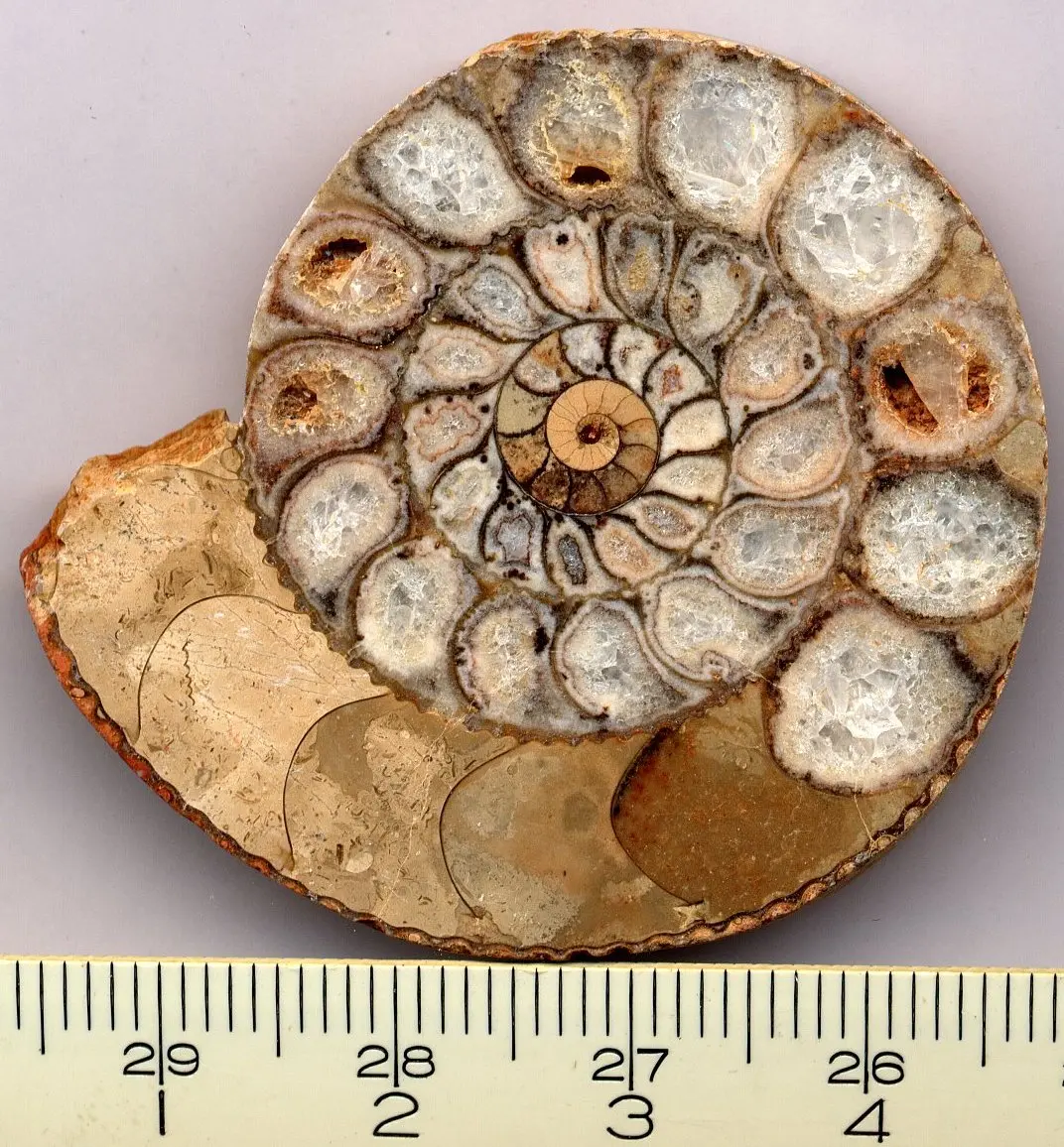
An ammonoid shell cut through its plane of coiling. Each turn of the tube is wider than the turn inside it. The source does not name the species.
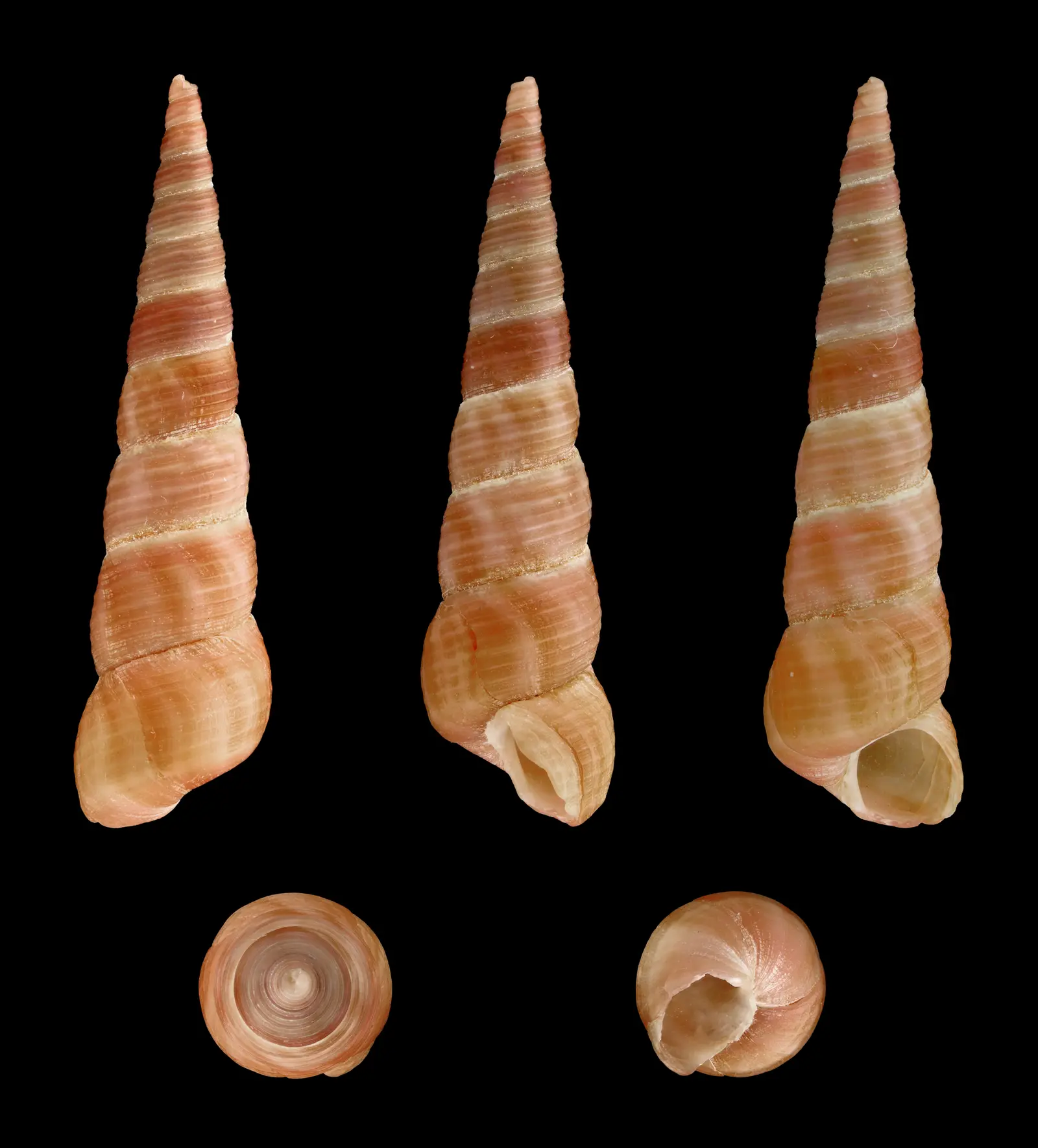
A tall, slowly widening spire: one common screw shell, 3.6 cm long according to the photographer, filed at the source under a name WoRMS no longer accepts, Turritella communis.
The short answer
One rule with four numbers can draw both a clam valve and a tall snail shell. In the early 1960s, David M. Raup showed that a computer could draw coiled shells from four parameters. As his shell coiling model is usually described, they are the shape of the opening, how fast it widens per turn, how far it sits from the coiling axis, and how fast it slides along that axis. Change the numbers and the same rule draws a clam-like valve, a flat ammonoid coil or a tall spire.
The equation describes shells; it does not build them. No snail computes anything: a sheet of soft tissue at the rim adds new shell at the edge, and the coil is the record of where that edge went. Most of the shapes the model can draw have never been found in nature. The reasons are still argued over.
What are Raup's four shell-coiling numbers?
Picture the opening of a shell, the aperture, as a ring. Spin that ring around a fixed line, the coiling axis, and let it grow as it turns. In Raup's scheme, a coiled shell is the tube that ring sweeps out. Four numbers set the sweep:
- S, the shape of the opening: a circle or an oval. The figures on this page use a circle.
- W, the whorl expansion rate: how many times larger the opening gets in one full turn, or whorl. At W = 2, each turn doubles it.
- D, the distance from the axis: the inner edge of the opening divided by its outer edge, both measured from the axis. At D = 0 the tube hugs the axis.
- T, the translation: how far the opening slides along the axis for each step it moves outward. T = 0 gives a flat coil; a large T gives a tall spire.
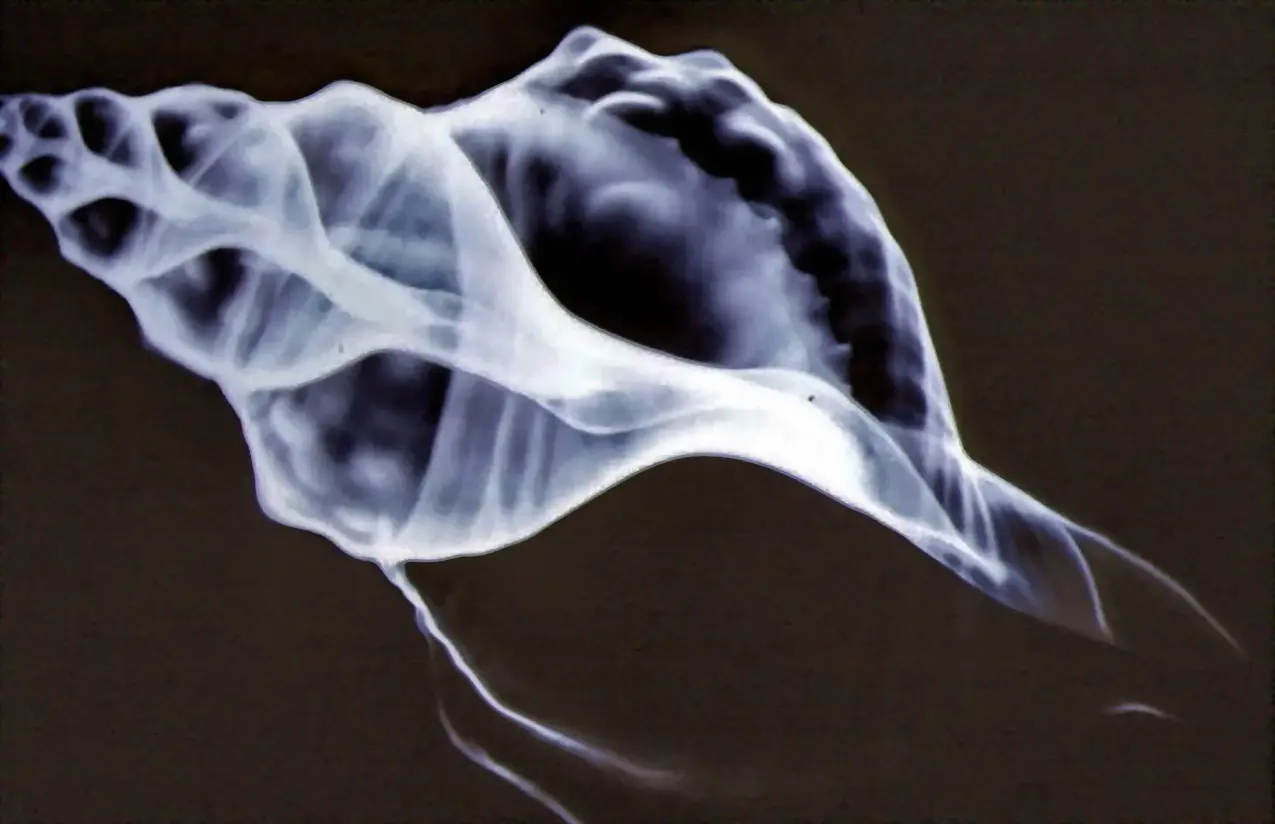
An X-ray of a triton shell shows what the outside hides: one tube winding around a central column, each turn wider than the one before.
Raup reported in 1962 that four parameters can define the basic form of many coiled snail shells, and that a digital computer with automatic plotting equipment could draw a shell from any values of them.
In 1965, he and A. Michelson pushed the idea further. To understand what a coiled shell does, they argued, you need to analyze the forms that do not occur in nature as well as the ones that do, and computers can draw the ones that do not. A 2023 review calls the result a classic theoretical morphospace: a map of all the shell shapes the four parameters allow.
The idea outlived its plotter. A 2016 paper called Raup's model still the most popular theoretical shell model and offered a reason: it is simple enough for biologists with limited math and programming experience to use.
How does a seashell actually grow?
The mantle edge lays down a mollusk shell. This soft, elastic sheet of tissue sits at the rim of the shell. As the animal grows, the mantle reaches slightly past the current opening and adds a new strip of shell to the margin. A 2014 study sums it up: the shell is, in effect, a frozen history of its own opening.
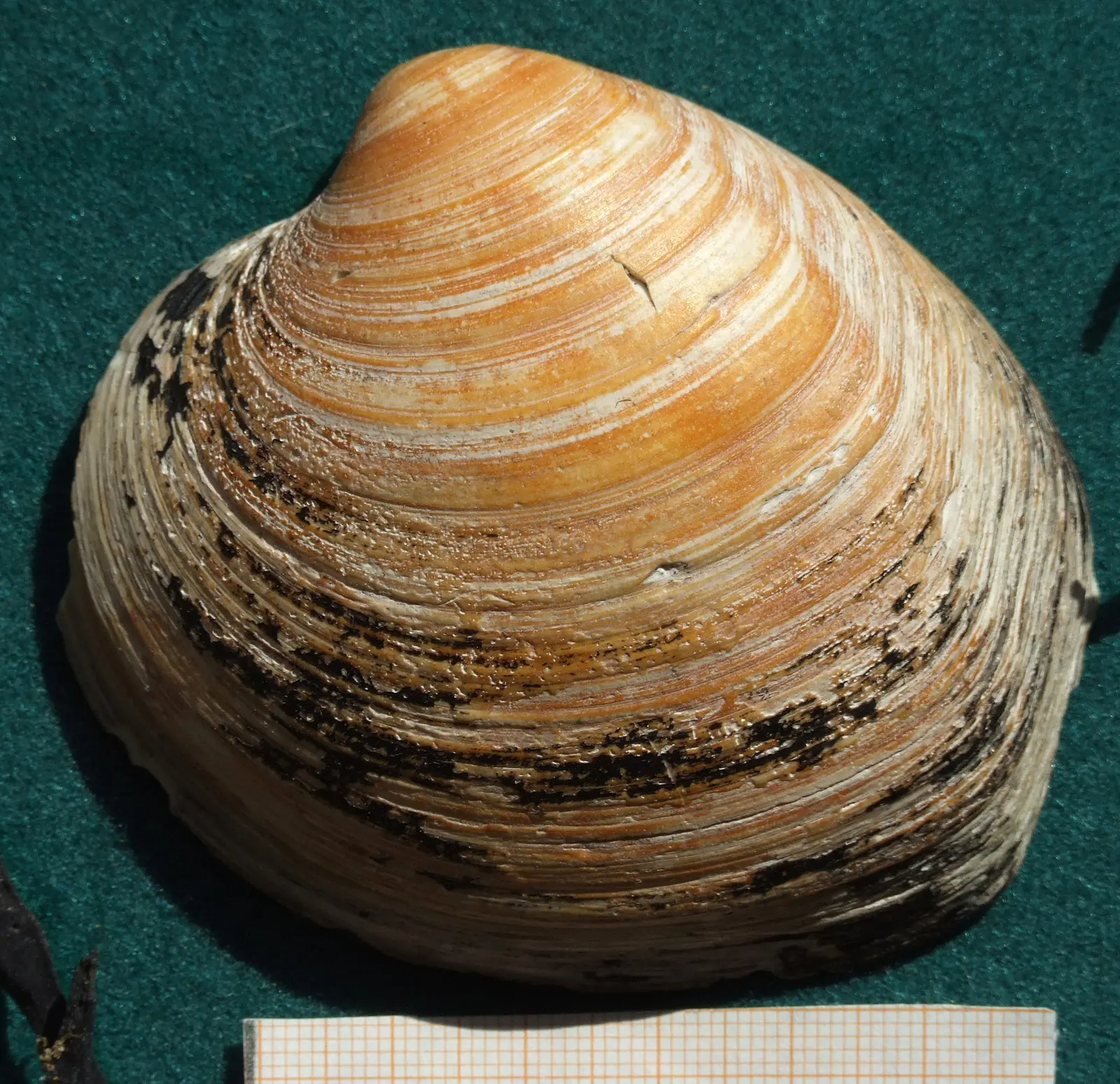
Lines of growth on an ocean quahog shell. In 1917 D'Arcy Thompson described such lines as the successive margins of the shell: each was once its growing edge.
Most of the finished shell is crystal. A 2020 review describes finished mollusk shells as calcite or aragonite, two crystal forms of calcium carbonate, bound with proteins. The proteins are typically less than 5% of the shell's mass. Even so, they play a significant role in setting its microstructure.
The equation, then, is neither a genetic program nor a force. In 2012, three researchers who model shell growth wrote that the basic coiling of mollusk shells can be simulated with few parameters, but that the developmental mechanisms behind it are largely not understood. The 2020 review reached the same point from the biology side: large gaps remain in how mollusks build their shells and how they produce so many forms.
Why does a shell keep its shape as it grows?
A shell grows at one end only. Yet small and large shells of one kind can look like scaled copies of each other. In On Growth and Form (1917), D'Arcy Thompson pointed out that among curves, this trick belongs to the logarithmic spiral alone. Keep adding to its tip, and the whole figure keeps the same shape.
Raup's W is the growth factor of that spiral. In the model, the opening is multiplied by W in every turn. That is what makes the coil logarithmic. At W = 2, four turns make the opening 16 times its starting size, and the shape of the whole coil never changes along the way.
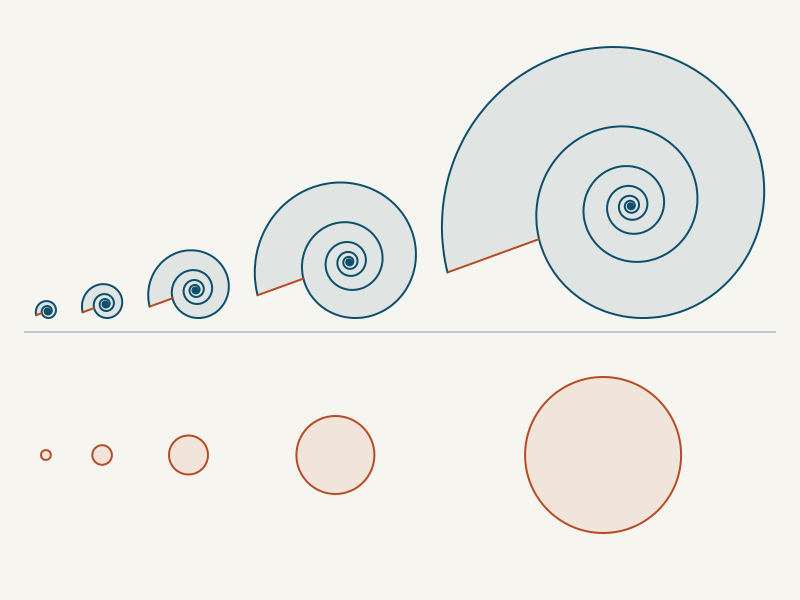
Drawn by this site: one model coil (W = 2) at five stages a turn apart, with each opening drawn as a ring below. The opening doubles every turn, 16-fold in four; the shape never changes.
Thompson also expected small departures. Any slight change in the forces of growth, he wrote, would pull a shell a little off the regular spiral, and such departures "we shall not be surprised to find, more or less frequently, in Nature."
How can one equation draw a clam and a snail?
The figure below draws four shells from one coiling rule. Only W, D and T change.
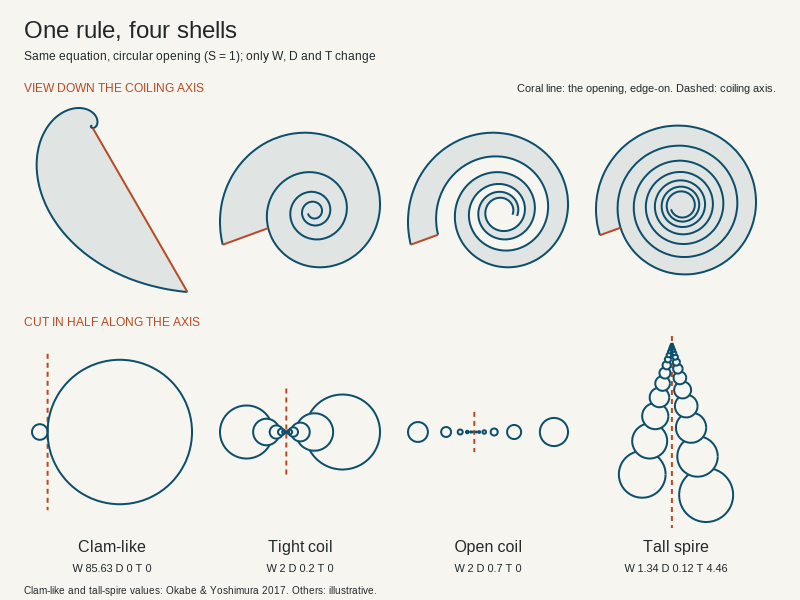
Drawn by this site from the coiling rule. The clam-like and tall-spire settings are optimal shapes reported by Okabe and Yoshimura (2017); the two flat coils use illustrative values. All values are in the CSV linked under the second figure.
Start with the flat coils. With T = 0, the shell coils in a single plane. At W = 2 and D = 0.2, each turn doubles in size and wraps over the turn inside it: by this site's calculation, each new whorl overlaps 75% of the width of the one before. Raise D to 0.7 and the turns pull apart, leaving a gap between them.
Now raise W instead. A 2017 modeling study by Okabe and Yoshimura searched Raup-style shapes for the one that encloses the most space for a fixed amount of shell material. They repeated the search under different assumptions about how shell thickness changes with growth.
One of their optimal shapes had D = 0 and a W of about 86 per turn (e raised to the power 4.45). At that rate, the opening would be 86 times wider after a single turn. Drawn out, the coil barely starts before it opens into a broad valve with a small curled beak, a shape the authors describe as resembling a bivalve shell.
Another optimum, with W near 1.34, D near 0.12 and T near 4.5, is a tall cone with many slowly widening turns. On paper, a clam and a snail are the same rule at different settings.
The rule leaves things out. As the 2014 study notes, a clam's shell is two valves, while in other mollusks the shell is a single structure. The four numbers say nothing about how two valves fit together.
Why are most possible seashell shapes missing?
Raup placed real shells in the space of his parameters. Most of it was empty. In his 1966 analysis, as the 2017 study summarizes it, most species of four groups sat in separate regions that together cover a small part of the space. The groups were brachiopods (lamp shells), bivalves, gastropods (snails) and cephalopods, the group that includes the ammonoids.
By the same account, Raup himself concluded that no single factor explained where ammonoids fell. The shape that would use shell material most economically did not match any real species.
Ammonoids, an extinct group of marine cephalopods, show the pattern in detail. They lived from about 400 million to 65 million years ago.
A 2015 study found ammonoid genera packed into a roughly triangular patch of the W–D plane that tends to stay on one side of the curve W = 1/D. On that curve each new whorl just touches the last; beyond it the whorls separate, a form the authors call gyroconic. Such open coils are considered mechanically weaker and less favorable for moving through water.
The map at the end of this article plots that curve. The 2015 study argues that the curve is unlikely to be an absolute wall. Shells beyond it exist, the authors point out, in lineages probably ancestral to ammonoids and in heteromorph ammonoids, irregularly coiled forms that turn up occasionally in the Mesozoic and more often in the Cretaceous.
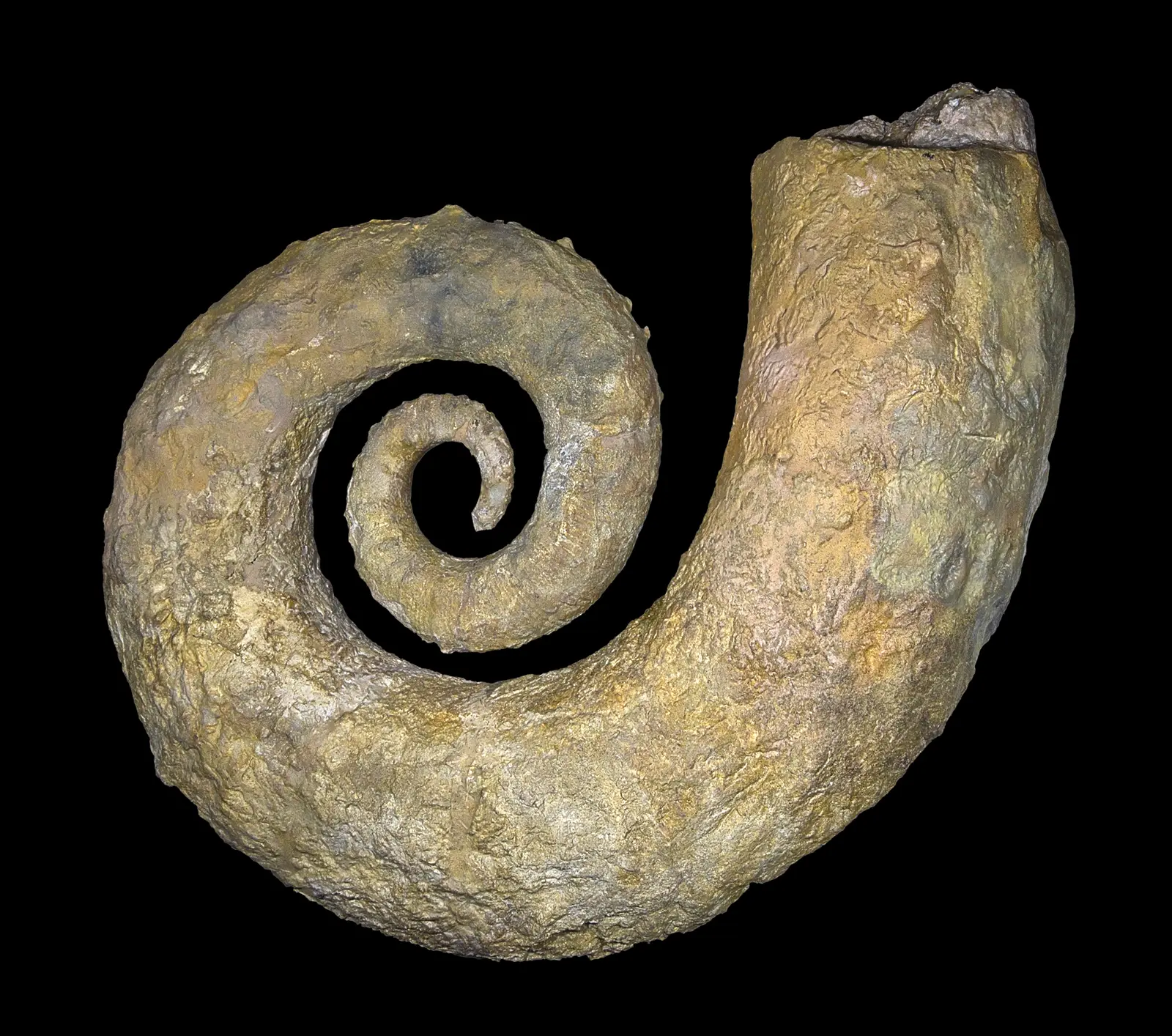
A fossil ammonoid from Gard, France, with whorls that stand apart instead of overlapping. In the model's terms, the shell lies beyond the W = 1/D curve.
The triangle also came back after disasters. After the mass extinctions of 372 and 359 million years ago, the study reports, surviving ammonoid genera refilled much the same region of shape space. Ammonoid genera that survived the Permian–Triassic extinction, 252 million years ago, refilled part of that region.
Four explanations for the empty space
The 2017 study opens by calling the question of whether shell shapes are optimal an open problem, despite earlier attempts. These are the main candidates:
- Drag. Hydrodynamic efficiency, measured in experiments by Chamberlain, peaks close to the most crowded parts of ammonoid shape space, the 2015 study notes.
- Several jobs at once. The 2015 team found that ammonoid shapes fill a pyramid whose corners are each best at one task, such as saving shell material, low drag, fast growth or compactness. In that view, no single best shape is expected. The tasks are inferred from the data, so this is a hypothesis.
- Shell thickness. The 2017 study argues that the missing piece is how thickness scales with size. If thickness grew in exact step with size, the material-saving optimum would be an impossibly tight coil. If it grows more slowly, as ammonoid data suggest, the optima become shapes resembling a clam, a flat coil and a cone.
- Geometry. In tall snail shells, a high T tends to come with a low W, a link the 2017 study cites as a constraint on high-spired forms.
The 2017 authors present their own result as a solution, but they also list other factors that should shape real shells, among them hydrodynamics and stability.
Where do real shells break the equation?
The model holds the four numbers fixed for a shell's whole life. The shells of most snails deviate from this ideal to some extent, a 2014 study notes.
The study's own subject is an extreme case. Plectostoma concinnum is a land snail about 3 mm tall and 3.5 mm wide as an adult, roughly a twelfth the length of the screw shell pictured above. It lives only on limestone in northern Borneo.
Its first five or six whorls form a regular spire that approximates an ideal logarithmic spiral. Then comes a short transitional stretch the researchers call the constriction, and the last half whorl, the tuba, grows in a distorted coil, detached from the spire. Using 3D models of the shells' growth record and observations of living snails, the team traced the switch to rotation of the animal's body and mantle edge relative to the shell it had already built. In model terms, the snail changes its own settings partway through life.
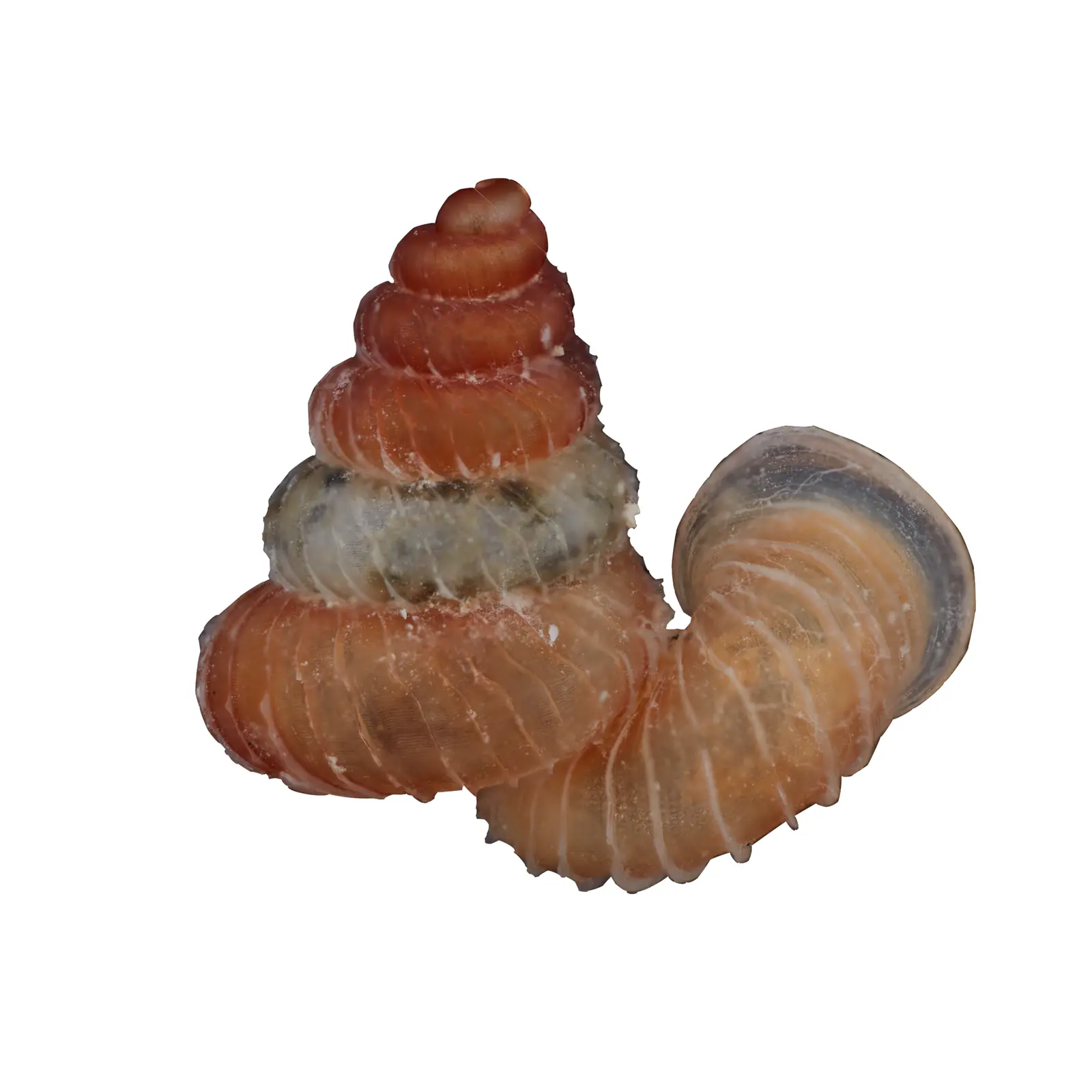
A shell of Plectostoma wallacei kudikense from Sarawak, Borneo, in the same genus as the snail of the 2014 study. Its last stretch, the tuba, stands free of the conical spire.
Ornament, environment and measurement
Ornament is a second break. Ribs, knobs and spines are not in the four numbers at all. Spines on seashells are classically read as defenses that evolved again and again against shell-crushing predators.
A 2013 study asked how spines form, using a model that starts from the mechanical contact between the soft mantle edge and the hardened shell edge it adheres to while laying down new shell. Small changes in the model's control parameters produced a wide range of spine shapes. If any part of a shell fits the idea that form is frozen physics, the spines may be it. That case still rests on a model: the authors list measuring the mantle's mechanical properties and filming a spine as it forms as work still to be done.
The environment moves the numbers too. At the local level, the 2020 review found that temperature, food supply and cues from predators significantly affect shell form.
Even measuring the numbers is harder than it looks. In ammonoids, the coiling axis shifts as the animal grows, so on real fossils it can be difficult to place exactly.
In a 2017 reanalysis, Gerber showed that Raup's space lacks the geometry of an ordinary map: distances and directions inside it do not carry a fixed meaning, so the spread of species and genera across it can mislead. He still called the model a valuable tool for describing ammonoid shells. For comparing shapes, though, he recommended measurements based on fixed landmarks.
Seashell coiling FAQ
Do seashells follow a mathematical formula?
Not in the sense of calculating one. A shell grows as the mantle edge adds new material at the rim. Raup's four parameters describe the basic form of many shells, and the logarithmic spiral explains how a shell can grow at one end and keep its proportions. But most snail shells drift from the ideal to some extent, and some, like Plectostoma concinnum, switch to a new coiling pattern partway through growth.
What is the whorl expansion rate?
The whorl expansion rate, W, is how many times larger a shell's opening becomes in one full turn of the coil. At W = 2, the opening doubles every turn. The five ammonoid archetype shapes in a 2015 study range from about 1.07 to 4.6. One 2017 optimum that resembles a clam valve has a W of about 86, so its coil barely starts before it widens.
Can a shell have gaps between its coils?
Yes: in a flat-coiled shell, the model separates the whorls whenever D is greater than 1/W. Open coils like this exist, for example in heteromorph ammonoids and in lineages probably ancestral to ammonoids. Ammonoid genera, though, tend to sit on the overlapping side of that curve. Open coils are considered mechanically weaker and less favorable for moving through water than tightly coiled ones.
Next, look at which way snail shells coil, to the right or to the left: Left-Handed Snails: Lefties Like Jeremy Are Mostly Flukes, Study Suggests.
Figure: Where whorls stop touching
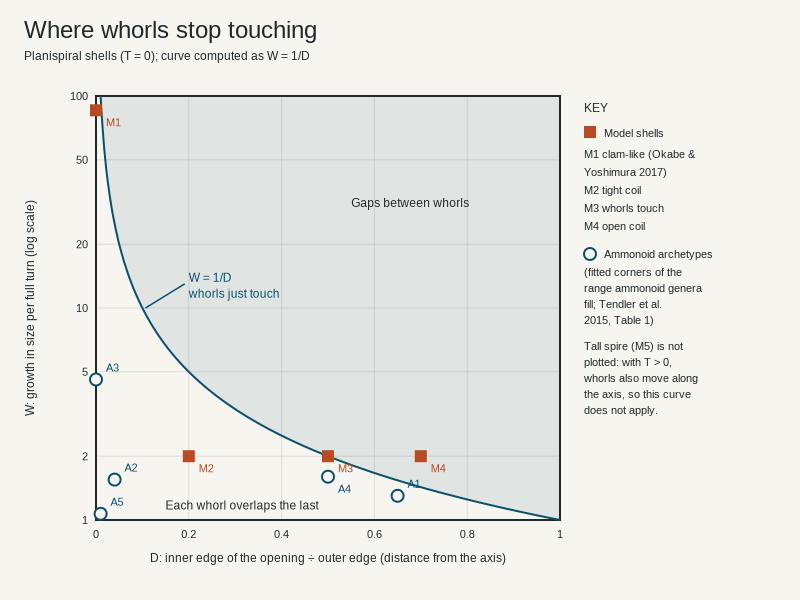
The curve W = 1/D is computed from the model: in a flat coil, the next whorl's inner edge sits at D times the outer radius and the last whorl's outer edge at 1/W of it. The same geometry gives the overlap shares in the CSV as (1 − DW)/(1 − D). Hollow circles: the five ammonoid archetypes of Tendler et al. 2015 (Table 1), fitted corners of the region ammonoid genera fill. Squares: the model settings M1 to M4 in the CSV; the tall spire is left off because its whorls also move along the axis.
Download the parameter values, sources and computed columns: seashell-coiling-model-parameters.csv (CSV · JSON label).
Source card
- Images: six photographs, all from Wikimedia Commons and one of them a figure from Lee et al. 2024 (three CC BY-SA 3.0, one CC BY 2.5, one CC BY-SA 4.0, one CC BY 4.0), no public-domain plates and three figures drawn by this site, with licenses and file hashes checked against the Commons records on 2026-10-10 for the two main images and on 2026-10-13 for the other four, the journal figure also against the article's own license.
- Classification: WoRMS lists Turritella communis Risso, 1826 as unaccepted; the accepted name, used here, is Turritellinella tricarinata (Brocchi, 1814) (AphiaID 1381415, checked 2026-10-10). The ammonoid is unidentified at the source and is named only to group level.
- Model and data: parameter values come from Okabe and Yoshimura 2017 or Tendler et al. 2015, or are marked illustrative; the W = 1/D curve and the overlap shares are computed from the model's definitions. Raup's 1966 and 1967 papers were not read in full; claims about them come from the later studies below.
Corrections: none yet.
Sources
- Raup DM. "Computer as Aid in Describing Form in Gastropod Shells." Science 138:150–152 (1962) doi.org/10.1126/science.138.3537.150abstract read via Europe PMC, PMID 17818401
- Raup DM, Michelson A. "Theoretical Morphology of the Coiled Shell." Science 147:1294–1295 (1965) doi.org/10.1126/science.147.3663.1294abstract read via Europe PMC, PMID 17790826
- Polly PD. "Extinction and morphospace occupation: A critical review." Cambridge Prisms: Extinction 1:e17 (2023) doi.org/10.1017/ext.2023.16full text read via Europe PMC, PMC11895730 (CC BY 4.0)
- Tendler A, Mayo A, Alon U. "Evolutionary tradeoffs, Pareto optimality and the morphology of ammonite shells." BMC Systems Biology 9:12 (2015) doi.org/10.1186/s12918-015-0149-zfull text read via Europe PMC, PMC4404009 (CC BY 4.0)
- Okabe T, Yoshimura J. "Optimal designs of mollusk shells from bivalves to snails." Scientific Reports 7:42445 (2017) doi.org/10.1038/srep42445full text read via Europe PMC, PMC5301254 (CC BY 4.0)
- Liew TS, Schilthuizen M. "A Method for Quantifying, Visualising, and Analysing Gastropod Shell Form." PLoS ONE 11:e0157069 (2016) doi.org/10.1371/journal.pone.0157069full text read via Europe PMC, PMC4900530 (CC BY 4.0)
- Liew TS, Kok ACM, Schilthuizen M, Urdy S. "On growth and form of irregular coiled-shell of a terrestrial snail: Plectostoma concinnum (Fulton, 1901) (Mollusca: Caenogastropoda: Diplommatinidae)." PeerJ 2:e383 (2014) doi.org/10.7717/peerj.383full text read via Europe PMC, PMC4034611 (CC BY 4.0)
- Clark MS, Peck LS, Arivalagan J, et al. "Deciphering mollusc shell production: the roles of genetic mechanisms through to ecology, aquaculture and biomimetics." Biological Reviews 95:1812–1837 (2020) doi.org/10.1111/brv.12640abstract read via Europe PMC, PMID 32737956
- Moulton DE, Goriely A, Chirat R. "Mechanical growth and morphogenesis of seashells." Journal of Theoretical Biology 311:69–79 (2012) doi.org/10.1016/j.jtbi.2012.07.009abstract read via Europe PMC, PMID 22820493
- Thompson DW. On Growth and Form, chapter XI, "The Logarithmic Spiral" (begins p. 493). Cambridge University Press (1917); Project Gutenberg eBook #55264 www.gutenberg.org/ebooks/55264chapter XI passages on the equiangular spiral and shell growth (printed pp. 505–508) and on lines of growth (printed pp. 516 and 562), Project Gutenberg plain-text edition
- Chirat R, Moulton DE, Goriely A. "Mechanical basis of morphogenesis and convergent evolution of spiny seashells." Proceedings of the National Academy of Sciences 110:6015–6020 (2013) doi.org/10.1073/pnas.1220443110full text read via PMC, PMC3625336 (abstract also via Europe PMC, PMID 23530223)
- Gerber S. "The geometry of morphospaces: lessons from the classic Raup shell coiling model." Biological Reviews 92:1142–1155 (2017) doi.org/10.1111/brv.12276abstract read via Europe PMC, PMID 27151556
- WoRMS Editorial Board. World Register of Marine Species: Turritella communis Risso, 1826 (AphiaID 141872, unaccepted), Turritellinella tricarinata (Brocchi, 1814) (AphiaID 1381415, accepted) and Brachiopoda (AphiaID 1803) www.marinespecies.org/aphia.php?p=taxdetails&id=1381415taxon records for AphiaID 141872 and 1381415, and vernacular names for AphiaID 141872 and 1803
- WoRMS Editorial Board. World Register of Marine Species: Arctica islandica (Linnaeus, 1767) (AphiaID 138802) and Charonia Gistel, 1847 (AphiaID 138425) www.marinespecies.org/aphia.php?p=taxdetails&id=138802taxon records for AphiaID 138802 and 138425, and vernacular names for AphiaID 138802 (none listed for 138425)
- Lee JY, Nasir NS, Marzuki ME, Vermeulen JJ, Khalik MZ. "The land snail fauna of Batu Kudik, isolated limestone outcrop near Simunjan, Sarawak, Malaysian Borneo (Mollusca, Gastropoda)." Biodiversity Data Journal 12:e115556 (2024) doi.org/10.3897/BDJ.12.e115556full text read via Europe PMC, PMC10892197 (CC BY 4.0)
Cite this page
Plankton to Plumage. “A Seashell Is an Equation: Four Numbers Draw Both a Snail and a Clam.” October 12, 2026. https://planktontoplumage.com/shells/seashell-coiling-model/
Add the date you read the page after the address if your style guide asks for it.